Low-MOQ Private Label: What to Check Before You Start
Low MOQ private label is less a supplier feature than a state your operation has to reach. What is missing from your evidence decides the next step: an insert or label, a branded packaging pilot, or a deeper private-label commitment.
01–11
How to read this page. Official sources are used only for the boundaries they state; operating detail is method, not proof; the single worked calculation further down is hypothetical. Nothing here settles compliance, origin, certification, platform acceptance or IP clearance.
Answer First: Take the Smallest Reversible Step You Can Prove
Three next steps differ in what you can undo.
- Rung 1 — insert or label on stock you already sell. Commits only printed material and tests whether artwork approval survives real orders.
- Rung 2 — branded packaging pilot on one SKU. Commits one packaging material at its own minimum and tests whether supply, storage and the pack instruction hold.
- Rung 3 — a deeper private-label commitment. Commits product, packaging, artwork and inventory together, and unwinds only by selling through or writing off.
Staying at rung 1 is a valid end state. Six gates follow.
Private Label, White Label and OEM Are Not Fixed Terms
Two suppliers can use the same word for different work.
| Term | Often used to mean | What it does not settle | Ask for instead |
|---|---|---|---|
| Branded dropshipping | Generic stock, your insert or sticker | Whether the product is exclusive | What is added, by whom, when |
| White label | A supplier's product under your brand | How many sellers carry it | Whether it sells elsewhere unbranded |
| Private label | Your brand around product and packaging | How much of the product changes | A written list of what is exclusive |
| OEM / ODM | Made to your spec, or supplier-designed | Tooling, development cost, design ownership | Who owns design, tooling, mold |
A quote is comparable only once restated as work.
What Actually Moves the Minimum
A minimum order quantity is rarely one number — product, packaging, print run and tooling each carry one.
| Driver | Raises the minimum | Can lower it | Ask in writing |
|---|---|---|---|
| Product source | Made to order for you | Ready stock already held | Stock-pulled, or made to order |
| Customization depth | Product change, mold, component | Sticker, label, insert, hang tag | Which change the price assumes |
| Packaging structure | Custom box, custom die line, finish | Stock size carrying printed artwork | Whether a stock size fits |
| Print method | Plate or setup-based printing | Short-run printing where offered | Method assumed; cost of change |
| Variant count | Each color, size or language | One variant, one artwork | Per SKU, or per order |
| Certification or testing | Category or destination rules | Nothing negotiable | Which rule applies, and why |
| Reorder expectation | A one-off test, no repeat signaled | A stated reorder intention | Reorder minimum and lead time |
If a supplier lowers a minimum, confirm what changed.
Gate 1 — Product and Supplier Readiness
Branding makes the specification a reference point; stabilize the product first.
ASQ describes supplier quality as a managed process, not a single inspection.
Close this gate with evidence:
- The specification is written: materials, dimensions, weight, finish, components, packaging.
- Variants are final; adding one after artwork approval restarts gates below.
- The supplier has made this item before, or says plainly it is a first run.
- Product and packaging minimums, sample cost, setup, lead time and reorder terms sit on one dated document.
- Who inspects, against what standard, at which stage — the supplier verification decision behind this one.
- Category risk is named: food contact, cosmetics, children's products, electronics and batteries shift what later gates require.
Gate 2 — Sample and Artwork Approval
Two approvals hide inside “sample”: the physical item, and the artwork that prints.
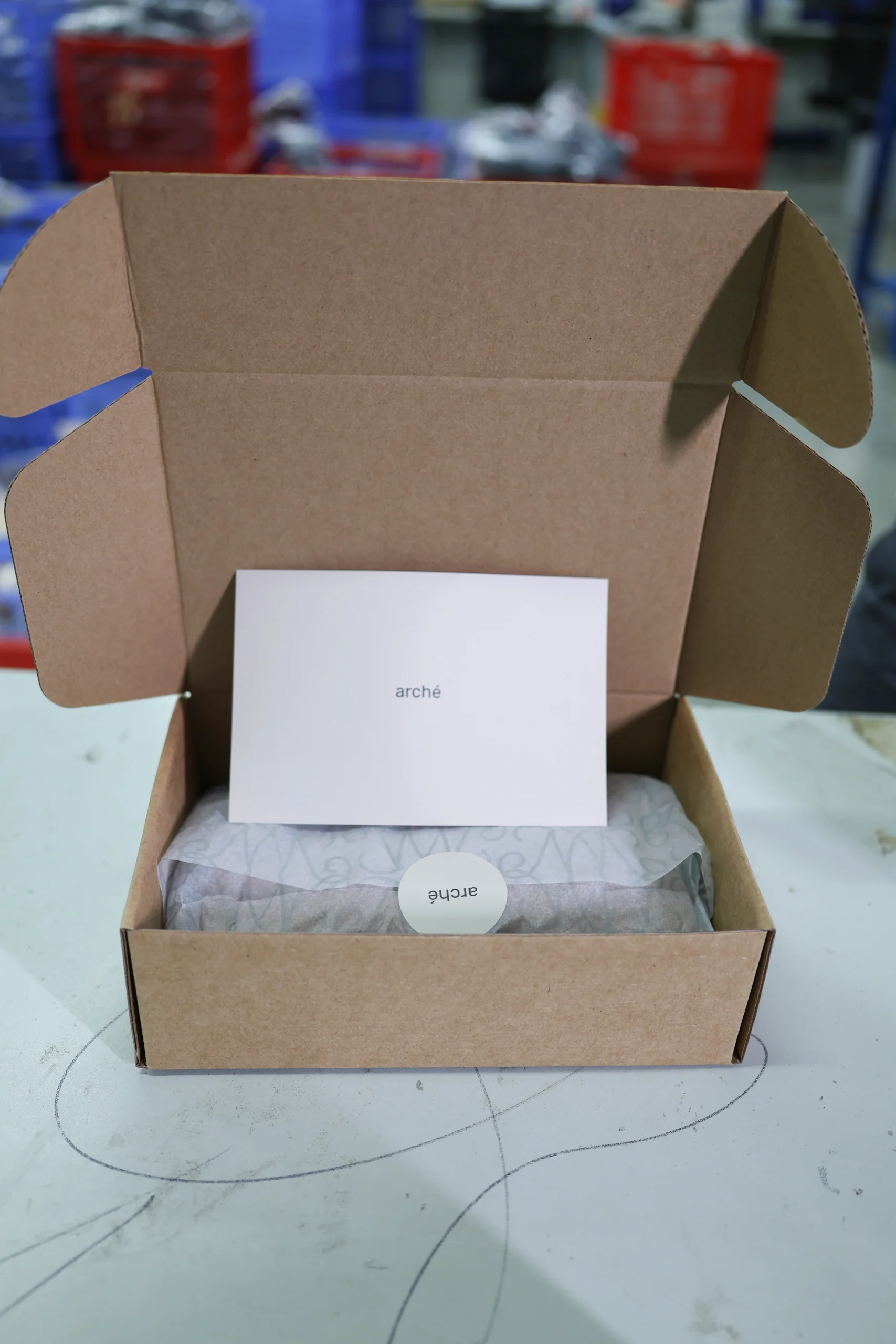
Keep one approval record per version.
| Record field | What it must state |
|---|---|
| Sample reference and date | Which unit was approved, and when |
| Specification | Materials, dimensions, weight, finish, components |
| Artwork version | A version number and file name, not "the latest" |
| Print method and color | How it prints; the color standard matched |
| Label content and owner | Each element; who owns its wording |
| Identifier and scan check | Whether the barcode scanned on real material |
| Packaging structure | Material, size, grade, how it sits |
| Approver and date | A person, not a chat thread |
An approved sample proves what one unit looked like on one day — not batch consistency, not compliance.
Gate 3 — The Cost Stack Behind One Branded Unit
A branded unit costs more than product plus box; most additions are one-time or minimum-bound.
| Cost layer | What sits in it | Ask before committing |
|---|---|---|
| Product at this quantity | Unit price at the run size intended | The price at your quantity |
| Samples and revisions | Samples, revisions, courier both ways | Cost of a second revision |
| Artwork and setup | Prepress, die line, plate, setup | Whether it repeats on reorder |
| Packaging material | Boxes, mailers, bags, tape, void fill | The material's own minimum |
| Labels and inserts | Label rolls, hang tags, cards | Per unit, or per print run |
| Applying the branding | Labeling, inserts, kitting, re-boxing | Per-unit charge; what is a unit |
| Inspection, branded units | Print, placement, variant, packaging | Whether branded checks cost extra |
| Storage | Product and unused packaging | How charged, from which day |
| Order handling | Pick, pack, dispatch on its own rule | Whether a branded SKU costs more |
| Rework and leftovers | Relabeling, repacking, material left | Who pays for leftovers |
Ask about leftovers before comparing prices.
Gate 4 — Packaging and Product Inventory Exposure
Private label packaging is inventory: it arrives on its own minimum and can outlive its artwork.
Illustrative arithmetic only. These figures are invented, not a typical minimum or quote. Ordering boxes at a minimum of 500 while testing only 100 units leaves four-fifths of that spend sitting in unused boxes.
| Situation | What becomes exposed | The reversible move | Cost of unwinding |
|---|---|---|---|
| Packaging minimum exceeds the test | Most of the packaging spend | Neutral packaging, applied label | The label run only |
| Product outsells the packaging | Orders that cannot ship branded | Fallback: ship neutral, say so | Consistency of experience |
| Artwork revised mid-run | Old-version units in stock | Version control, a use-up rule | The remaining old material |
| A variant is added | New artwork, new minimum, space | One variant branded first | An extra artwork setup |
| A SKU is discontinued | Packaging fitting nothing else | Keep packaging non-product-specific | The dedicated material |
Generic packaging reduces artwork-change exposure. Keeping packaging and product stock in step is one of the packaging and material services handled alongside it.
Gate 5 — QC, Labels, Barcodes and Receiving Readiness
On a branded unit, quality control also covers print position, color and variant.

Identifiers before artwork
GS1 material on getting barcodes describes a GTIN as product identification; its barcode standards material covers the symbols carrying that data. This page cannot decide which identifier suits a SKU.
Label ownership and claims
FTC guidance on the Made in USA standard requires substantiation for U.S.-origin claims. NIST material on packaging and labeling notes labels can carry consumer-information requirements. No origin claim is decided here, and no label is declared compliant.
Destination receiving rules
Amazon's custom packaging programme page describes eligibility and testing before certification; Walmart's WFS inbound guidance expects labeled inventory and warns nonconforming shipments may be charged or returned. Check the destination's current page.
Branded-unit QC scope
Agree what is checked on branded units first: a pre-shipment QC process blind to print position can pass a failing batch.
Gate 6 — Fulfillment Execution Readiness
A branded SKU is a different operational object, even with an identical product inside.
- Routing. The branded SKU is a separate item; a shared code routes the unbranded version out.
- The pack instruction. One written instruction naming packaging, insert, placement and variant.
- The out-of-material rule. Hold, ship neutral or substitute — decided in advance.
- Proof. Which orders get a photo, and where it is stored.
- Exception ownership. Who decides when a branded check fails.
- Reorder triggers. Packaging and product reorder points differ.
This sequence is covered in a walkthrough of low-MOQ private label supplier verification, QC and fulfillment.
The Readiness Scorecard: Go, Pilot or Hold
Score completeness, not confidence: a row is evidenced or it is not.
| # | Evidence item | Weight | Evidenced when you can produce |
|---|---|---|---|
| 1 | Supplier terms sheet | Critical | One dated document: product and packaging minimums, costs, lead time, terms |
| 2 | Approved physical sample | Critical | The sample and its approved specification |
| 3 | Approved artwork version | Critical | Version number, file, named approver, date |
| 4 | Label content ownership | Critical | Each element, with its responsible party named |
| 5 | Completed cost stack | Critical | Ten layers filled, or marked unknown with the question |
| 6 | Identifier plan | Supporting | Identifier decided before artwork lock, scanned on material |
| 7 | Packaging-to-product match | Supporting | Both quantities, and the rule for whichever runs out first |
| 8 | Branded QC scope | Supporting | What is checked on a branded unit, agreed beforehand |
| 9 | Destination receiving check | Supporting | Your destination's current requirements, dated |
| 10 | Branded SKU routing | Supporting | Separate SKU and instruction, tested on a real order |
Route on what is missing, not a total:
- HOLDHOLD — any critical row unevidenced. The gap is the work; commit now and a failure becomes undiagnosable.
- PILOTPILOT — all five critical rows evidenced, supporting rows open. Run rung 1 or 2 on one SKU.
- GOGO — all ten rows evidenced. Proceed at the smallest quantity the terms allow, keeping the same records for the reorder.
The scorecard cannot say the product will sell — only whether a failure would be diagnosable.
Frequently Asked Questions
What does low MOQ private label actually mean?
A private-label arrangement whose committed quantities are small enough to test. Product, packaging, print run and tooling each set their own minimum.
When is low MOQ realistic for a first test?
More realistic with a stock product, applied customization, and one variant per artwork. Harder with a mold, custom box or several variants.
Should I start with a label, an insert, a custom package, or a product change?
Start with whichever step you can undo: a label commits only print; a package commits a material at its minimum; a product change commits tooling and is hardest to reverse.
What must be approved before production?
Two things: a physical sample against a written specification, and artwork as a numbered version with a named approver.
How do I reduce packaging and inventory exposure?
Track both stock levels: packaging arrives on its own minimum and usually can't be sold. Use neutral packaging with an applied label while testing.
Can a supplier guarantee the same MOQ for every product and reorder?
No. Minimums are set per product, material and print run — a figure for one item doesn't carry to another. Ask for reorder terms in writing.
Working out which rung your own product is on? Bring your specification, supplier terms, artwork status, destination markets and the quantity you will commit, and discuss private label options.