By Janson Wang, CEO & Founder, ASG Dropshipping · 15 min read · Updated 2026-08-25

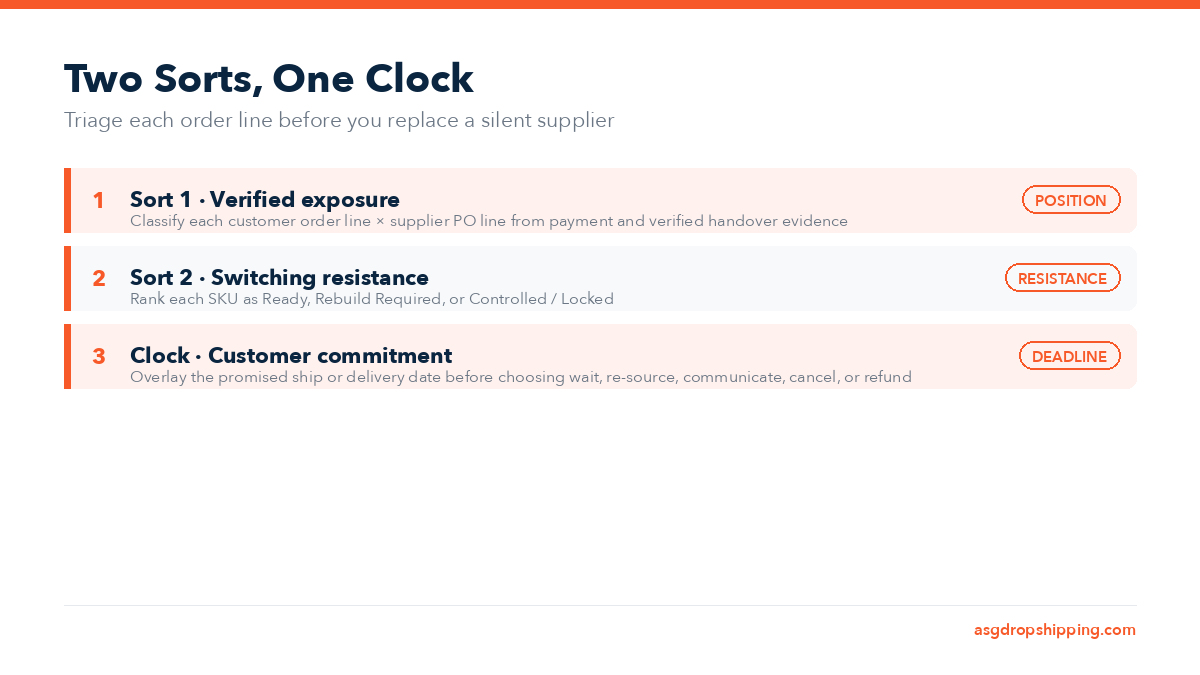
When a dropshipping supplier stops responding, run two separate sorts and one deadline check before you go looking for a replacement. Sort each customer-paid order line by what you can actually verify about supplier payment and shipment. Sort each SKU by how much you would have to rebuild before a second factory could ship it. Then lay the customer promise date over both sorts, and only then decide whether to re-source, wait, communicate, cancel, or refund.
Finding a new supplier is the part that feels urgent. It is rarely the part that is time-critical on day one.
1. Direct Answer: Two Sorts, One Clock
The unit of analysis is one customer order line matched to one supplier PO line — not the whole Shopify order.
A single customer order with three items can hold three different exposures at once: nothing paid to the supplier on item A, a deposit paid on item B, item C already handed to a forwarder. Sorting at order level forces those three into one bucket and hides the two that matter.
So the model has three moving parts:
- Sort 1 — Verified Exposure State. For each order line and its PO line: what can you prove about the money and the goods right now?
- Sort 2 — SKU Switching Resistance. For each SKU: what would have to be rebuilt before a second source could ship it?
- The Clock — Customer Commitment. How long until the date you promised the customer, and has the customer been told anything yet?
The decision is the intersection of all three. Exposure alone does not tell you whether to refund. A SKU that is easy to re-source is still a broken promise if the new lead time lands a week after the date on the confirmation email.
2. The First 30 Minutes
Do these five things before you open a sourcing platform.
- Pause new non-essential purchase commitments with the silent supplier. Not as a punishment — every new PO line adds another row you will have to triage.
- Export your customer order lines, with SKU, quantity, paid date, and the ship or delivery date you promised.
- Export or reconstruct the matching supplier PO lines, with amounts, deposit and balance state, and currency.
- Pull the payment evidence from your bank or payment provider, not from your store admin. What you need is whether the transfer left and cleared, and on what date.
- Pull whatever shipment evidence exists — tracking numbers, forwarder receipts, pickup records, handover documents — and mark every line where you have none.
Then mark the customer promise date on every line. That column is what turns a spreadsheet into a triage queue.
If your product records live in Shopify, the purchase order object is a reasonable place to hold the commercial side of this. Shopify’s documentation describes purchase orders as recording products, prices, quantities, inventory costs, payment terms and supplier information (Shopify Help Center: Creating purchase orders, retrieved 2026-08-25).
One boundary, stated early because merchants get burned by it: the payment terms on a Shopify purchase order are a commercial agreement, not proof that money reached the supplier. Shopify’s own documentation says payments to suppliers are made outside the Shopify admin, and that payment terms and supplier currencies are specific to individual purchase orders (Shopify Help Center: Creating and managing suppliers, retrieved 2026-08-25). Whether a payment actually cleared has to be reconciled against your bank or payment provider.

3. Sort 1: Verified Exposure by Order Line
The honest name for this sort is verified exposure, not “where the goods are.” You are not measuring physical reality. You are measuring what your documents currently let you establish.
Sort each order line into one of five states.
| Verified exposure state | What you must be able to show | What it means operationally | Today’s action |
|---|
| Uncommitted | No supplier payment made and no irrevocable purchase commitment on this line | Your cash has not been exposed to this supplier yet | Re-sourcing is a live option. Check the PO terms before withholding anything scheduled |
| Financially committed | A deposit or full payment left your account and cleared, but no verified handover evidence exists | Money is exposed; control of the goods is unclear | Document the payment and the PO line. Decide per SKU tier and per clock |
| Logistically committed | A forwarder receipt, pickup record, first-leg handover document or verified manifest exists, but no normal transport events | Goods have left the origin control point, with poor visibility | Chase the party that issued the document. Set a named check-back date |
| In transit | Valid carrier acceptance or movement events exist | The problem has become transport monitoring and customer communication | Track and communicate. Do not re-source this line yet |
| Evidence incomplete | Payment, handover or transport evidence cannot be verified | Unknown. Forcing it into another state would manufacture confidence you do not have | Name the missing document and the person who could produce it |
A line sits in one state at a time, and it can move. A line that was Financially committed on Monday can be Logistically committed on Thursday when a forwarder receipt finally arrives.
Evidence incomplete is a real destination, not a failure to classify. These five states are the ones you can separate with documents a merchant normally holds. When the documents do not settle it, the correct answer is that they do not settle it.
4. The Customer Commitment Clock
Exposure tells you what you can still recover. It does not tell you what you owe.
For each order line, record five things:
- Promised ship date and promised delivery date
- Whether the customer has been told anything yet
- Whether the customer has agreed to a delay or chosen an alternative
- Current refund, cancellation, platform or payment-dispute risk
- The realistic date a re-sourced line could ship
The reason this axis cannot be dropped: a line can be Uncommitted, sitting on a SKU that is easy to re-source, and still be undeliverable. If your promise date is tomorrow and a second source needs a week to ship, “the money is still mine” does not make the promise keepable.
That is also why a fixed calendar rule is a poor substitute. There is a widely circulated 2023 blackout timeline from a wholesale-directory publisher that puts a single instruction at ten business days:
“Definitely stop selling those products and refund all of your customers.”
(Worldwide Brands: Dropshipper Stopped Responding?, published 2023) The publisher sells a supplier directory, and the author writes elsewhere on the same page that she has heard of a supplier going dark only once. Read it as one operator’s timeline, not a standard.
A uniform day-ten refund spends money on Uncommitted lines that were still deliverable, and treats Logistically committed lines — where both cash and goods have left — as no more urgent than the rest. Keeping a timeline is sensible. Running one clock per exposure state is more useful. That is our judgment, not a measured result.
5. Sort 2: SKU Switching Resistance
The second sort measures something different, which is why it belongs in a different table. Sort 1 measures a position. Sort 2 measures a resistance.
The test is not whether another factory will quote you. A quote means somebody is willing to price the item. It says nothing about samples, tolerances, capacity, compliance documents, packaging testing, or whether the new factory can execute single-unit fulfillment reliably.
| Tier | What must already be true | What moving it usually requires | This week’s action |
|---|
| Ready | A qualified backup exists, the spec pack is complete, a sample is approved, and a fulfillment or capacity path has been tested | Release a PO and monitor | Move the affected lines here first |
| Rebuild Required | The product itself is reproducible, but packaging, labels, samples, testing or compliance documents must be rebuilt | Artwork, packaging stock, sample approval, retesting, possibly re-registration | Start the rebuild now, and set the customer expectation to match it |
| Controlled or Locked | Switching is constrained by tooling, a proprietary component, firmware or IP, the certification holder, an exclusive material, or assets you cannot retrieve | A negotiation or a redesign, not a purchase order | Do not promise a switch date. Plan around it and communicate early |
Take the highest resistance across the components of a SKU. One locked part constrains the whole item, because you cannot ship most of a product.
A barcode that is not registered to you does not automatically mean Locked. In many cases a GTIN can be re-applied for, labels reprinted and listings rebuilt — expensive and slow, which usually places it in Rebuild Required. It moves toward Locked when a retailer, marketplace or compliance relationship makes the identifier impractical to migrate in the time you have.
The SKU-level framing is not ours. A dual-sourcing guide already asks per-SKU questions about switching friction, production risk and revenue reliance, and argues redundancy belongs on “the 20% of SKUs that drive the majority of margin, not the entire catalog” (Portless: Dual-Sourcing Without the Cash Drag, updated December 2025). Portless sells direct-fulfillment services, so read this as vendor guidance rather than an independent standard. What the table above adds is the observable condition for each tier, so “a backup quoted us” and “a backup can accept this order” stop being the same sentence.
One structural note on representing this inside Shopify. A product record carries a single Vendor field, and Shopify’s transition guidance describes using variant metafields or metaobjects to represent multiple suppliers (Shopify Help Center: Transitioning from Stocky, retrieved 2026-08-25). Platform capabilities change; check before you build a process on it.

6. How to Verify Whether Goods Actually Left
This is where most blackout triage goes wrong, because a tracking number looks like evidence and often is not.
A tracking number with no scan events does not establish carrier acceptance. It may represent label creation, forwarder pre-advice, delayed data handoff, an inactive last-mile number, or incorrect tracking data. Verify the handover document before you classify the line.
Evidence that can support a Logistically committed or In transit classification includes:
- A carrier acceptance scan
- A pickup or collection record
- A first-leg handover document signed at origin
- A forwarder or warehouse receipt
- A verified loading or manifest record
- A house air waybill or master reference you can look up independently
The inverse also holds. The absence of a tracking number is not proof that nothing shipped. A supplier who has stopped answering is, by definition, also not sending you documents. Goods can be sitting with a forwarder under a house waybill you have never seen.
Shopify can hold the movement side of this if you use it. Purchase orders record the commercial agreement, while linked inventory transfers record the actual movement of goods (Shopify Help Center: Creating inventory transfers, retrieved 2026-08-25), and each transfer shipment can carry its own status and tracking details (Shopify Help Center: Creating and managing transfers, retrieved 2026-08-25). What that gives you is a record, not an independent verification. The verification still comes from the carrier or forwarder document.
Based on ASG operating experience, our own order chain runs order intake, procurement, supplier shipment and logistics confirmation, arrival at warehouse, QC, packing, handover to the outbound carrier, then tracking pushed back to the store. Receiving a tracking number is one step in that chain, not proof that the chain completed.

7. What Supplier Silence Might Mean
Silence is one signal with several plausible causes. The table below is written as hypotheses: a supporting signal raises the likelihood of a cause; by itself it does not establish it.
| Cause hypothesis | Supporting signal | Alternative explanation | Next check |
|---|
| Holiday or seasonal shutdown | Unrelated contacts in the same city or industrial park go quiet in the same week | Coincidence, or your own contacts overlap more than you think | Confirm the local holiday calendar and ask an unrelated supplier in the same region for their reopening date |
| Payment or terms standoff | Silence begins right after a payment date, invoice dispute or price renegotiation | Timing overlap without causation; an internal finance handover on their side | Verify with your bank whether the transfer cleared, and to which account name |
| Factory closure or pivot | The storefront is maintained and new enquiries are answered while your messages are not | Separate sales teams, a different export entity, or a maintained account with production already stopped | Ask a production-specific question and request the responder’s role and legal entity |
| Intermediary gone dark | The factory answers a fresh channel and does not recognise your order reference | A legitimate trading-company structure or an internal reference you were never given | Reconcile the company name on your PO and payment receipt against the entity you are now speaking to |
This table does not give recovery times because we do not have data that would support them. Each row is present only because it gives you a cross-check you can run today.
On switchover day, the thing that stops merchants is often not the new factory’s capability. It is an asset that turned out to belong to someone else.
| Question | What it blocks on switchover day | Commercial points to have counsel draft |
|---|
| Who owns the packaging stock, and which artwork version is it? | The new factory ships in an old carton version, or you find stock you cannot retrieve | Ownership of packaging inventory held at a supplier site, quantity and artwork-version reporting, and return on notice |
| Whose account are the GTINs and label artwork registered under? | Listings break because the identifier is registered to the supplier | Registration and ownership of product identifiers and label artwork, and provision of registration records on request |
| Who holds title, risk and documentary control over goods in transit? | Goods you paid for may not be yours at the moment you need to act on them | Separate treatment of title, risk of loss, possession, insurance interest and documentary control, each with a named transfer point and supporting document |
| What must be handed over if the relationship ends? | Tooling, samples and technical specifications stay where they are | Notice period and transition cooperation, including handover of tooling, samples and technical specifications |
These are commercial control questions, not jurisdiction-neutral legal clauses. Have qualified counsel adapt them to the governing law and your payment structure. Title, risk of loss, possession, insurance interest and documentary control can transfer at different points. Nothing in this article is legal advice.
A supplier-risk playbook recommends a 90-day notice period and a transition cooperation clause “including handover of tooling, samples, and technical specs to a new supplier” (eCommerce Circle: The Shopify Supplier Risk Playbook). If your agreement lacks that clause, it is worth an hour with a lawyer this month.
9. A Backup Supplier Is a Tested Path
The sharpest line on this belongs to that same playbook, not to us:
“A supplier you have never placed an order with is not a backup. They are a name on a spreadsheet.”
Its author also suggests placing 5 to 10 percent of normal order volume with the backup every 4 to 6 months. That is editorial advice from the article’s author, not a quote from a seller.
One caveat has to travel with any test-order advice: a test order proves your process is covered, not that the factory has capacity. A successful trial batch in a quiet month shows that POs, artwork, packing and labels flow. Peak capacity is a separate conversation about their line schedule.
Based on ASG operating experience, the practical sequence is to focus on a small number of core SKUs first, validate with samples and a small or parallel test run, and judge a candidate on communication quality, sample consistency, delivery capability, whether the quotation logic holds up, how they respond to exceptions, and whether an alternative supply path exists behind them. Switching an entire catalogue overnight is rarely the safer move.
Where you buy also shapes your tier distribution. A catalogue-driven sourcing and purchasing setup produces more Ready-tier SKUs than a bespoke one does.
10. What ASG Can and Cannot Do
What we cannot do. We cannot recover money you have already wired to a supplier who stopped answering. We cannot determine legal title to goods in transit. We cannot guarantee that a specific order will be rescued, and we do not promise lowest price, no MOQ across all products, fixed worldwide transit times, or a solution to every supply-chain problem.
What we can do. Audit your order lines and PO lines against the five exposure states. Verify shipment evidence with the parties that issued it. Test an alternative supply path with samples and a small run before you commit volume. Rebuild the fulfillment chain — sourcing, supplier verification, QC, packaging, warehousing, dispatch and tracking return — so that one silent factory does not take the whole pipeline with it.
Our starting point is diagnosis, not a quote. If the diagnosis says an alternative path is not viable for a SKU, we say so rather than take the order.
If you want that walked through against your own SKU mix, that is what the dropship agent service is for.
11. The Two Sorts, One Clock Worksheet
Copy this field table into a worksheet, fill one row per customer order line, and the triage queue builds itself.
| Field group | Fields |
|---|
| Customer | Order ID, line item, SKU, customer-paid date, promised ship date, promised delivery date |
| Supplier | Supplier, PO ID, PO line, payment state, amount paid, balance due, currency |
| Shipment | Tracking number, label created date, handover evidence type and reference, first scan, last event |
| SKU | Spec pack status, approved sample, packaging version, tooling ownership, GTIN registration, certification holder |
| Recovery | Switching tier, backup status, next owner, next evidence date |
| Customer clock | Within promise, at risk, missed, customer informed, customer choice recorded |
Request an ASG Supplier Blackout Exposure Audit through contact us or email janson@asgdropshipping.com. You get back an exposure state per order line, a switching resistance tier per SKU, the clock status, a named list of evidence gaps, the lines that need customer communication first, and a second supply path proposal for the SKUs where one is realistic. Items that need a lawyer, your bank or your payment provider are flagged as such rather than absorbed.
For the wider map of what breaks between an order and a doorstep, see common fulfillment issues.
12. Focused FAQ
What should I do first when a dropshipping supplier stops responding?
Pause new non-essential purchase commitments with that supplier, then export customer order lines with promise dates, matching supplier PO lines, and payment evidence from your bank rather than your store admin. Classify each order line by verified exposure, classify each SKU by switching resistance, and only then qualify replacements.
How do I know whether a supplier actually shipped?
Look for a verifiable handover document, not a tracking number. A carrier acceptance scan, pickup record, first-leg handover document, forwarder receipt, verified manifest, or house air waybill you can look up independently can support the classification. If none exists, the line is Evidence incomplete.
Should I refund every customer immediately?
A single refund date applied to every order can refund customers whose lines were still deliverable. Refund decisions sit at the intersection of exposure state, switching resistance and the customer clock. Where the promise date has passed or cannot be met by a re-sourced line, tell the customer and offer a choice.
Can I withhold the next supplier payment?
Withholding a scheduled payment can breach your purchase-order terms and may affect a deposit or tooling position. Read the PO first. Where the amount is material, get advice from qualified counsel rather than a forum.
How do I know whether a SKU can switch suppliers?
Ask what must be rebuilt before another factory could ship it. A qualified backup with a complete spec pack, approved sample and tested fulfillment path is Ready. Packaging, labels, samples, testing or compliance work is Rebuild Required. Tooling, proprietary components, certification-holder constraints, exclusive materials or unrecoverable assets place it in Controlled or Locked.
What documents should I own before changing suppliers?
Keep the spec pack and approved sample records; packaging artwork and stock ownership; identifier and label registration records; tooling ownership and location; certification documents and certificate holder; and shipping documents showing where title, risk and documentary control transfer.
13. Methodology, Sources and Data Note
Model. Two Sorts, One Clock is our operating model: verified exposure by order line and PO line, switching resistance by SKU, and the customer commitment clock over both. Evidence incomplete exists because the documents do not always settle reality.
Competitor scope. Where this article says other coverage exists, that refers to five articles read for this project. That is a small sample and not a statement about the whole field.
Keyword data. DataForSEO US, measured 2026-08-25: dropshipping supplier stopped responding returned 0 searches per month and 29 organic results; supplier not responding returned 0 and 93 organic results. Six related crisis phrases also returned 0. The parent dropshipping supplier returned 9,900 per month at competition 44, and dropshipping suppliers for Shopify returned 1,000 at competition 42. This article was written for the situation, not for the volume.
ASG Data Note. The ASG statements here are based on ASG operating experience and internal SOPs, not a published dataset across sellers. They are not benchmarks. Cancellations before procurement and after procurement are handled differently; the latter requires assessing return and procurement costs and negotiating.
Legal note. Nothing here is legal advice. The commercial control points listed above should be drafted by qualified counsel under the governing law of your agreement.
External sources
14. About the Author
Janson Wang is the founder and CEO of ASG Dropshipping. He works with Shopify and WooCommerce sellers on sourcing, supplier verification, QC, packaging, inventory and fulfillment. Reach Janson at janson@asgdropshipping.com.