J Janson Wang · CEO & Founder, ASG Dropshipping · Last updated: August 24, 2026 · 28 min read
Most teams treat shipping from china to australia as two unrelated emails. One goes to the forwarder and asks for a rate.
One goes to the accountant and asks about GST.
Then the delivery estimate on the checkout page gets written by whoever is closest to the theme editor that afternoon. It has no relationship to either conversation.
That gap is where Australian orders go wrong. The freight decision, the tax decision and the promise decision are one decision seen five times.
Quick Answer
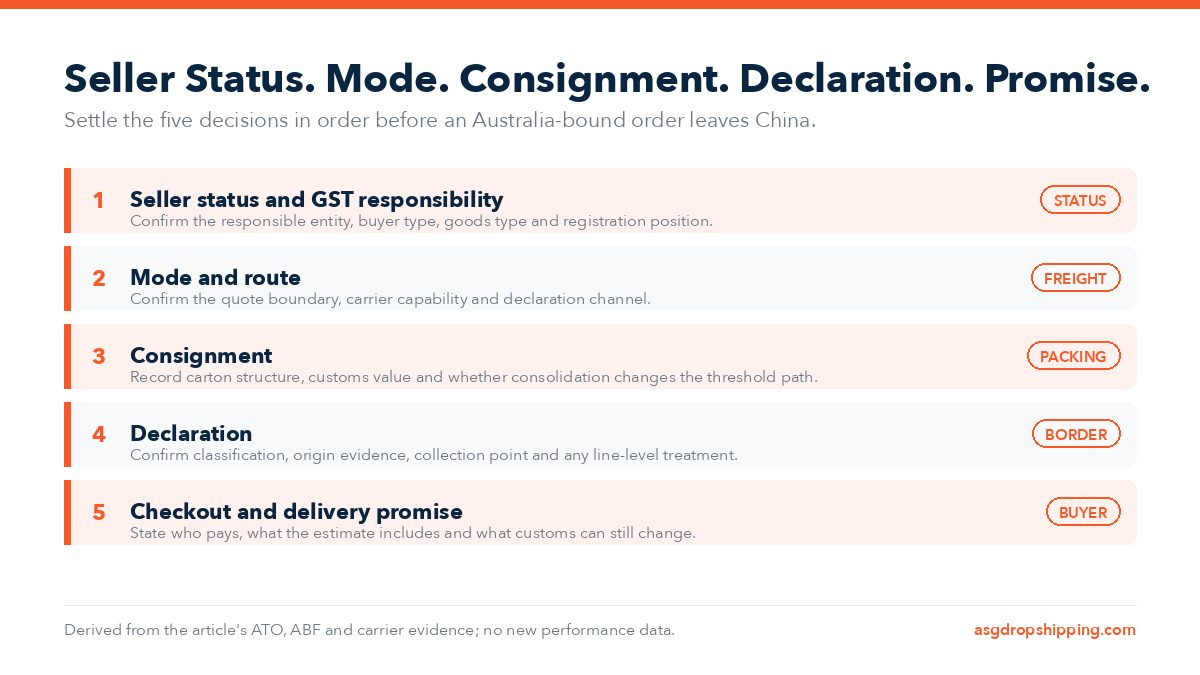
The right way to ship from China to Australia is not the cheapest freight line. It is the chain that survives the border. Work it in one direction, and never backwards:
Seller Status → Mode → Consignment → Declaration → Promise.
- Seller Status. Before any threshold applies to you, settle who the responsible entity is — you, an electronic distribution platform, or a re-deliverer — and whether that entity is registered or required to register for Australian GST. Nothing below this layer means anything until this one is answered.
- Mode. Air, ocean, courier or postal channel, and with it a route and a quote boundary. That choice decides what the shipment costs and which declaration form exists at the far end.
- Consignment. How the goods are packed and consigned decides whether they land above or below the A$1,000 customs boundary, and that boundary moves where GST gets collected.
- Declaration. What is written on the entry — classification, origin evidence, line-level codes — decides what the border assesses and whether your buyer gets charged twice.
- Promise. Only after the first four are settled can you write a delivery date that means anything. Write it first and you are guessing.
Table 1 — Does this article apply to you? Check this before the numbers
| Question |
If yes |
If no or unsure |
| Is the responsible entity you, rather than a marketplace/EDP or a re-deliverer? |
The sales-side rules below are aimed at you |
The platform or re-deliverer may carry the obligation instead — confirm before you build anything |
| Is that entity registered, or required to register, for Australian GST? |
Point-of-sale GST on eligible low-value sales is in scope |
Registration status is generally tested at A$75,000 GST turnover, with voluntary registration possible below it — settle this first |
| Are your buyers Australian consumers rather than GST-registered businesses buying for business use? |
The low-value consumer rules are in scope |
Buyer type changes the treatment |
| Are the goods ordinary taxable goods, not tobacco, alcohol or GST-free items? |
Read on |
Those categories sit outside the general low-value pattern |
| Is your customs value per consignment genuinely under A$1,000? |
The sales-side path is the likely one |
Border collection is the likely path — check the VOTI, declaration and tariff-treatment questions below |
As of 2026-08-24, the ATO sets registration at A$75,000 of current or projected GST turnover, tested over the current month plus the previous 11 or the next 11, with voluntary registration available below it.
It also frames the low-value regime around sales to Australian consumers, and around whether the responsible entity is the merchant, an electronic distribution platform or a re-deliverer.
So there is no universal rule that says every seller of under-A$1,000 goods collects GST. There is a rule that applies to a defined entity, selling to a defined buyer, in defined goods.
And a low average order value does not keep you under the boundary. Bundles, multi-item carts and warehouse consolidation cross the A$1,000 line.
List price does not.
This is practical guidance from an operations perspective, not tax or legal advice. Janson Wang reviewed the operational workflow in this article. It has not been reviewed by an Australian registered tax agent or a licensed customs broker, and it is not a substitute for advice from one on your own facts.
Key Takeaways
- Status comes before thresholds. Who the responsible entity is, and whether it is registered or required to register, decides whether any of the collection rules reach you at all.
- A$1,000 does not switch tax on and off. For a registered or required-to-register vendor or platform selling eligible low-value goods to Australian consumers, it generally changes where GST is collected. Buyer type, product type, platform responsibility and registration status are all live exceptions.
- The parcel you build in China changes the tax outcome. The ATO’s own worked example shows one order shipped as a single consignment being taxed at the border, and the same order shipped as two consignments requiring GST at the point of sale.
- Duty is conditional, GST is not conditional on duty. Classification, tariff treatment and ChAFTA rules of origin decide the duty rate, and it may be zero. GST and processing charges do not disappear because duty is zero.
- A promise you cannot execute is worse than a longer one. Australia Post publishes international delivery estimates that explicitly exclude time in customs.
2. Establish Seller Status and GST Responsibility
This is the layer almost every guide skips, and skipping it is why so much Australian advice reads as confidently wrong.
Start with the entity, not the threshold.
As of 2026-08-24, the ATO’s low-value imported-goods framing turns on sales to Australian consumers, and on which party is responsible: the merchant, an electronic distribution platform, or a re-deliverer.
If your Australian orders arrive through a marketplace, the marketplace may be the responsible entity rather than you.
If a freight-forwarding or mailbox service brings the goods in on the buyer’s behalf, a re-deliverer rule may apply instead.
Then the registration question.
As of 2026-08-24, the ATO sets the GST registration threshold at A$75,000 of current or projected GST turnover, measured across the current month plus the previous 11 months, or the current month plus the next 11 months.
Registration becomes compulsory within 21 days of the requirement arising. Below the threshold, registration is voluntary.
Point-of-sale GST collection generally depends on the responsible entity being registered or required to register.
That single sentence changes the shape of the whole article for a small store.
I am not going to tell you which side of that line you are on.
Nobody writing an article can, and anyone who does is guessing about your turnover, your buyer mix and your platform arrangements.
Take the question to the ATO’s registration page or to an Australian registered tax agent.
Three exception layers stay attached to the claim from here on, and they are not footnotes:
| Exception layer |
What it changes |
| Responsible entity |
An EDP or re-deliverer may carry the obligation instead of the merchant |
| Buyer type |
Sales to a GST-registered business buying for business use are treated differently from consumer sales |
| Goods type |
Tobacco, alcoholic beverages and GST-free goods sit outside the general low-value pattern |
| Registration status |
An entity neither registered nor required to register is in a different position from a registered one |
Settle this layer once, write the answer down, and every section below becomes a mechanical question instead of a legal one.
3. Choose the Shipping Method and Route as One Decision
This is the Mode layer. Everything downstream inherits it.
Pick the mode first, then the route, then check whether the quote boundary matches the other quotes on your desk.
Doing it in the other order is how you end up comparing a port-to-port number against a door-to-door number and calling one of them cheap.
The wrong question is "Which mode is cheapest?" The right question is "Which mode leaves the fewest unpriced boundaries for this shipment?"
International freight forwarding runs across air, ocean, overland and multimodal options.
The solution available to you depends on the route and current market conditions (DHL Global Forwarding, as of 2026-08-24).
That sounds obvious. It stops being obvious the moment a supplier offers you "door to door, all in" and you have no way to check what "all in" contains.
Ocean capacity to Australia is real and named.
MSC’s Asia-to-Oceania 2026 network shows southbound connections from named China gateways into Sydney, Melbourne, Brisbane, Fremantle and Adelaide (as of 2026-08-24).
That tells you the lanes exist and where they land. It does not tell you that one lane is faster or cheaper than another.
Schedules change, so treat any specific transit figure as a snapshot you re-check.
Melbourne is worth a note. In the Port of Melbourne’s CY25 Trade in Review, China was the port’s largest container-import origin.
Read that for what it is: evidence that Melbourne is a relevant entry point for China-origin volume. It is not evidence that Melbourne is the best entry point for your SKU.
Table 2 — Mode against shipment profile: what to settle before you accept a quote
| Mode |
Where it fits |
Quote boundary — ask, do not assume |
The uncertainty you still have to price |
| Express courier |
Small, urgent parcels with high value per kilo |
Does this price run door to door, and which duty setup does it assume? |
Whether the carrier can execute the duty setup you chose |
| Air freight |
Time-sensitive volume too large for a courier |
Where does this quote start and stop — airport, or door? |
Destination handling, brokerage, last mile |
| Sea LCL |
Steady replenishment in mixed cartons |
Port to port, or beyond? What happens at deconsolidation, and who pays for it? |
Consolidation timing and deconsolidation fees |
| Sea FCL |
Full-container replenishment |
Who books the terminal slot and the delivery window? |
Terminal and delivery scheduling |
The third column is the working part of that table. Those are questions to put in writing to the forwarder, not defaults to assume.
One channel detail belongs here rather than in the tax sections: a Self-Assessed Clearance declaration cannot be used for goods arriving through international mail or under a carnet (ABF, as of 2026-08-24).
The postal-versus-cargo choice at origin changes the declaration form that exists on the other end.
For a wider view of where fulfilment breaks before it reaches freight, see Common Fulfillment Issues.
4. Build the Landed Cost Before You Compare Quotes
Build the cost stack first.
A lower freight line can produce a higher final cost, and you cannot see that until every line item is written down against a column that says whether it is included.
The categories are not exotic.
Freight comparisons may need to account for Incoterms, fuel and security surcharges, documentation and service alerts, rather than a single freight figure (DHL Global Forwarding help centre, as of 2026-08-24).
Then the government side stacks on top.
According to the Australian Border Force’s VOTI guidance, GST at the border is 10% of the value of the taxable importation, and that value is built from customs value, duty, transport and insurance, plus wine equalisation tax when applicable.
Above A$1,000 there are also fixed per-entry government charges.
As of 2026-08-24, the ABF schedule lists an electronic import declaration charge of A$0.00 for consignments of A$1,000 or less, A$50.00 for consignments above A$1,000 and under A$10,000, and A$152.00 at A$10,000 and over.
The paper equivalents are A$90.00 and A$192.00. Biosecurity charges are listed at A$48.00 for air and A$71.00 for sea on full import declarations above A$1,000.
That page cites a recent adjustment notice. Treat those figures as current-at-date rather than settled, and verify them against the ABF page before you build them into a model.
Table 3 — Landed-cost worksheet (government charges as of August 2026)
| Line item |
Included in this quote? |
Excluded? |
Unknown — ask before accepting |
| Ocean or air freight |
|
|
|
| Origin handling and export documentation |
|
|
|
| Fuel and security surcharges |
|
|
|
| Destination terminal and handling fees |
|
|
|
| Customs brokerage |
|
|
|
| Customs duty where applicable |
|
|
|
| GST |
|
|
|
| Import declaration / biosecurity charges |
|
|
|
| Domestic last-mile delivery |
|
|
|
The "unknown" column is the useful one. Every blank cell in it is a number your competitor’s quote may have quietly included and yours has not.
There is no market-average freight percentage in this worksheet, and that is deliberate.
A benchmark without a named, dated source is worse than an empty column, because an empty column tells you to go and ask.
5. Chargeable Weight and Packing Move Two Numbers at Once
Chargeable weight is a carrier formula, not a fact about your product.
FedEx Australia publishes its dimensional weight calculation as length × width × height in centimetres divided by 5,000 per package (as of 2026-08-24).
Your carrier may use a different divisor. Check yours rather than assuming this one.
Here is why a weight formula lands in a tax article. Cartonisation decides how many pieces travel and how many handling points they pass.
It also decides — and this is the part people miss — whether the shipment arrives as one consignment or several.
That is the hand-off from Mode to Consignment. It happens at a packing bench, usually decided by someone who has never read an ATO page.
One boundary, stated plainly. Packing and consolidation are operational decisions about handling and cost.
They are not a method for reducing declared value, and nothing here should be read as a way to reduce tax by restructuring what you declare. Declare what the goods are worth.
Then decide how to pack them.
The threshold moves the collection point for the entities it reaches. It does not switch off the tax, and it does not reach everyone.
State it with its boundary attached.
As of 2026-08-24, where the responsible entity is registered or required to register for Australian GST, and it sells eligible low-value goods to an Australian consumer with a customs value of A$1,000 or less, GST is generally collected from the customer at the point of sale rather than at the border.
For consignments imported over A$1,000, GST, customs duty where applicable and clearance charges are charged to the importer at the border.
The exceptions sit right next to that sentence, not in a footnote: buyer type, tobacco and alcohol, GST-free goods, an electronic distribution platform or re-deliverer being the responsible entity, and an entity that is neither registered nor required to register.
Now the border side.
The ABF states that goods with a value of AUD1,000 or less are free of duty and GST, that a Self-Assessed Clearance declaration is required for air or sea cargo at or below that value, and that an Import Declaration is required when a consignment has a combined value over AUD1,000 and is being cleared into home consumption (as of 2026-08-24).
Read either sentence alone and you get a wrong answer.
Read them together and the picture is coherent: the ABF is describing what happens at the border, and the ATO is describing what happens at the point of sale. The two agencies administer the same Australian import tax system, so their agreement is one unified position stated twice — not two independent bodies reaching the same conclusion.
Then there are three different values doing three different jobs, and mixing them is the most common costing error I see.
The number that decides whether you are under A$1,000 is the customs value, which the ATO describes as excluding freight and insurance from the place of export.
The number you charge GST on at the point of sale is the total delivered price, including shipping.
The ATO’s own example is unambiguous: a customer pays A$350 for jeans with a customs value of A$300 plus A$50 for shipping and insurance, and GST is calculated on the A$350 (as of 2026-08-24).
At the border, the figure is the value of the taxable importation, and the complete ABF formula is:
Customs value + customs duty where applicable + international transport and insurance + Wine Equalisation Tax where applicable
ABF’s detailed line formulas can also include countervailing and dumping duty where those apply (as of 2026-08-24). Note what that means in practice: duty is inside the GST base.
A duty change does not only cost you the duty. It moves the GST too.
Table 4 — Which number does which job
| Value name |
What it decides |
What it includes |
Who applies it |
| Customs value |
Whether the consignment is at or under A$1,000 |
Excludes freight and insurance from the place of export |
Seller, at the point of sale |
| Total delivered price |
The GST amount charged to the buyer on an eligible low-value sale |
Goods plus shipping and insurance |
Seller, at checkout |
| Value of the taxable importation |
The GST amount assessed at the border |
Customs value + duty where applicable + international transport and insurance + WET where applicable |
ABF, at the border |
Illustrative worked example A — registered entity, eligible low-value B2C sale. These are sample values, not a real shipment.
An Australian consumer buys an item priced at A$300, pays A$50 for shipping and insurance, and the customs value is A$300.
The responsible entity is the merchant, and it is registered for GST.
GST is calculated on the A$350 delivered price at the point of sale, and the consignment travels as a low-value clearance.
This confusion is not theoretical. On a Shopify Community thread titled Experiencing issues with Australia GST on freight in Shopify?, a merchant posting as Tholomew wrote on 27 July 2022:
"I am having the same issue. GST should be charged on the shipping amount regardless if there are items that are non taxable or taxable or a mix of both. We pay GST on our Australia Post bill, so we need to charge it to the customer."
Tholomew is an Australian domestic merchant, not a cross-border seller shipping out of China. That quote is not a witness to this article’s main scenario.
What it does show, from a named person on a dated post, is that the freight-in-the-base question genuinely trips people up — including people who handle Australian GST every day.
Sources: ATO — GST on low value imported goods · ABF — Import declarations · ABF — Value of Taxable Importation
7. Treat Consignment and the PAID Code at Line Level
This is the Consignment and Declaration layer, and it is where a warehouse decision becomes a tax decision. The ATO wrote the example itself.
An exception applies when a number of low-value goods are shipped to Australia as one consignment with a total customs value over A$1,000. In that case they are taxed at the border.
The ATO then adds the line that should be printed above every packing bench handling Australian orders: if the seller had shipped the items in two consignments, it would have charged the customer GST on the sale, because the exception could not be applied (as of 2026-08-24).
Same order. Same goods.
Two packing outcomes, two completely different tax paths.
The specific dollar figures from that published example are not reproduced here, because they do not reconcile cleanly on their face. The structural rule stands on its own.
Now the code. The GST-paid exemption code — the PAID code — is narrower than the way it gets quoted.
As of 2026-08-24, the ABF describes it as a line-level mechanism for specified low-value goods on which GST was already collected at sale, including the case where such goods are consolidated and sent in one consignment with a total customs value over AUD1,000.
It is not a general code for every shipment or every line over A$1,000. Reading it that way is how merchants end up giving their broker an instruction that does not match the goods.
Illustrative worked example B — consolidated low-value items crossing the line. This scenario uses sample figures rather than an ASG order.
Three eligible low-value items, GST collected at checkout on each, are consolidated in the China warehouse and travel as one consignment with a total customs value of A$1,400.
The consignment now needs a full import declaration.
The already-taxed lines are the ones where the GST-paid treatment is relevant, at line level, so the buyer is not charged a second time on those goods.
Whether it is applied correctly is a question for the declarant.
Here is the failure mode when it is missed.
The ATO states that if a consignment is over A$1,000 and the PAID exemption code has not been included on the import declaration, GST is payable at the border.
It also states that GST will be charged at the border on goods imported with a customs value over A$1,000 even if the supplier incorrectly charged GST on the sale, and that purchasers can seek a refund from their supplier by providing a declaration or evidence that GST was paid at the border (as of 2026-08-24).
Sit with the shape of that. Your customer pays once at checkout.
Then pays again at the door. Then has to send you evidence to get the first payment back.
Three costs land at once: the money, the delay, and the support hours. Your brand absorbs all three, regardless of who typed the declaration.
So separate the layers by what you can actually do with each one.
| Layer |
What it gives you |
Example on an Australian order |
| Evidence you can record |
A fact in your own system, checkable later |
Whether GST was collected at checkout, and the exact wording the buyer saw |
| Instruction you can issue |
A written requirement to a party you pay |
The declaration path and the line-level treatment in your brief to the forwarder |
| Confirmation you can request |
A statement back from that party, in writing |
The broker confirming how the already-taxed lines were treated on the entry |
| Outcome you can only verify |
A result produced by someone else |
What the border actually assessed, read from the entry and the buyer’s experience |
The bottom row is the one people quietly assume they control. They do not.
The most you can hold is the record, the instruction, and the confirmation.
And where the treatment is genuinely ambiguous — two parcels, same date, same carrier, same destination — confirm it with the ATO, your registered tax agent or your licensed customs broker.
Do not guess and hope the border agrees with you.
Related reading on the mechanics of getting orders out the door consistently: How to Dropshipping Fulfillment and Drop Shipping Fulfillment Services.
8. Check HS Classification and ChAFTA Before Assuming Duty
Every sentence in this article says "customs duty where applicable" instead of "duty" for one reason: duty is conditional, and quite often it is zero.
As of 2026-08-24, DFAT’s ChAFTA guide sets out what actually determines the answer: the HS classification of the goods, the applicable tariff schedule, the rules of origin, and the origin documentation supporting the claim.
Only goods that originate in Australia or China are eligible for preferential tariff treatment under the agreement.
Goods that do not satisfy the rules of origin are treated at the general rate rather than the preferential one.
So four things have to be true before a zero duty rate is real: the classification is right, the tariff line carries a preference, the goods meet the origin rules, and you hold the evidence.
Then the part people get wrong in the other direction. A zero duty outcome does not remove GST, and it does not remove import processing or biosecurity charges. Those are separate obligations with separate bases.
A supplier who tells you "no duty, so nothing to pay" has answered one question out of three.
Duty also sits inside the value of the taxable importation.
A preference that takes duty to zero also lowers the GST base slightly; a misclassification that raises duty raises the GST with it.
The two numbers move together, which is why classification is worth getting right rather than guessing at.
Illustrative worked example C — higher-value import with duty as a variable. The amounts below are illustrative, not shipment evidence.
A consignment has a customs value of A$4,000, with A$600 of international transport and insurance.
Under the Australian Border Force’s VOTI formula, if the goods qualify under ChAFTA and duty is nil, the taxable base is A$4,600 and GST is 10% of that.
If the goods do not qualify and duty applies, the duty amount is added to the base before GST is calculated, and the electronic import declaration charge for this value band applies either way.
The duty rate is not something to assume from a supplier’s invoice line — get the classification confirmed.
Who confirms it is not you and not me. It is a licensed customs broker working from the actual goods and the actual tariff schedule.
9. Make DDP/DAP Match the Actual Carrier Setup
This is the Promise layer’s foundation. It can only describe what the earlier layers already decided.
DAP and DDP are not two speeds. They are two answers to one question — who pays the import charges, and does the buyer see them before or after the sale.
Under DAP, goods are delivered to the buyer’s address but the import charges stay with the buyer, typically as a carrier invoice or a parcel held until payment.
Your checkout price looks lower. The buyer’s total is not.
Under DDP, the seller takes on the import costs.
Shopify’s documentation defines delivered duty paid as the seller assuming responsibility for import costs, with payment for those charges collectable during checkout.
For destinations with a low-value goods tax, Shopify recommends DDP so that orders going above the threshold also have duties and import taxes calculated at checkout (as of 2026-08-24).
Those worked examples are EU and UK thresholds, so that is general logic, not an Australian ruling from Shopify.
Be precise about what the choice buys you. DDP changes cost responsibility and price visibility. It does not change clearance speed. Neither incoterm makes an assessment happen faster, and neither removes the possibility of a hold.
Then the constraint that catches people — and its exact scope matters.
As of 2026-08-24, Shopify documents that DDP labels are supported only for specific carriers when you buy labels through Shopify’s carrier accounts — Canada Post for USA destinations only, DHL Express, DHL Express Canada and DHL eCommerce.
Using another carrier through those accounts means you cannot purchase a label for orders where duties were collected: you buy the label externally, or you refund the order.
That list describes what Shopify’s own label-buying flow supports. It does not describe China-to-Australia DDP capacity in general. Plenty of freight forwarders and fulfilment partners run DDP arrangements that never touch a Shopify carrier account.
If you are shipping through an external carrier or a fulfilment partner, four things have to be confirmed directly with that provider, in writing:
| Confirm with the provider |
Why it matters |
| DDP capability on the specific China-to-Australia lane |
Capability on one lane does not imply capability on yours |
| Who is importer of record |
This is a legal role, not a billing preference. ASG does not act as importer of record on your Australian shipments |
| Declaration instructions, including line-level treatment |
This is where already-taxed lines either retain the correct line-level treatment or get lost |
| How the charges are billed back to you |
A DDP quote with an unspecified disbursement fee is not a complete quote |
Carrier lists and provider capabilities change, so re-check both against live sources rather than treating either as permanent.
On the wording itself, there is a useful precedent from a national postal operator.
Australia Post publishes estimated international delivery times for items classified as low value and low risk that are pre-cleared through customs, and states plainly that the estimate "Excludes time in customs if applicable" and may be subject to delay outside its control (as of 2026-08-24).
That page covers outbound Australian shipments, so none of its day counts apply to a China-to-Australia lane and none are borrowed here.
What transfers is the sentence structure: state the estimate, then state what it excludes.
Table 5 — Checkout wording against what actually has to be true
| If your checkout says |
Your carrier setup must |
Border charge expectation |
Safer wording |
| "Duties and taxes included" |
Support a DDP label or an equivalent confirmed arrangement |
Buyer pays nothing at the door |
State it only where the label or arrangement is confirmed |
| "Taxes calculated at checkout" |
Collect on eligible low-value sales; handle threshold crossings |
Depends on consignment value |
Name the threshold behaviour |
| "Delivered in X–Y days" |
Have all five stages measured |
Customs time is unmodelled |
Add what the estimate excludes |
| Nothing about duties |
— |
Buyer may be charged at the door |
Say so before they buy |
Model the timeline in stages rather than as one number: supplier lead time, consolidation, carrier transit, customs clearance, domestic delivery. That is five stages.
You can influence four of them. Customs clearance is the one you cannot, which is exactly why Australia Post writes it out of its estimate.
On promise design more broadly, Goat Order Shipping Time and DHL Delivery Hours both work through the gap between a quoted window and a delivered date.
10. Audit the Last 20 Australian Orders Before Changing the Promise
The strongest argument against doing any of this
Let me put the objection at full strength, because it is a good one and I have heard it from people running real businesses.
"I sell A$40–A$90 items. Almost nothing I ship gets near A$1,000. The consignment exception is an edge case I will hit a handful of times a year. Every hour I spend re-engineering my packing logic and my checkout copy is an hour not spent on product or ads. Just eat the occasional problem order and move on."
For a lot of stores that is the correct commercial call, and I am not going to pretend otherwise.
If your average order value is low, your SKUs are singular, and you almost never consolidate multiple items into one Australian shipment, the boundary rarely binds.
Building elaborate consignment logic for a case that arrives twice a quarter is over-engineering, and over-engineering has a real cost.
Here is where the objection stops holding.
It assumes exposure scales with your average order value. It does not.
It scales with consolidation behaviour.
An A$60 average order does not protect you if your warehouse merges a five-item order, or a customer buys a bundle, or a promotion pushes basket size up for three weeks.
The A$1,000 line is crossed by carts and by packing logic, not by list price.
It also assumes the cost of a problem order is the refund. The double-charge failure path is a customer paying twice, waiting, and then having to send you evidence to get their money back.
That is not a refund line. That is a support ticket, a delay, and a review.
So the honest version sits in between. Do not rebuild your operation.
Do the cheap part: settle your status, know which orders can cross the line, make your checkout wording match what the border will actually do, and confirm the line-level treatment with whoever files the entry.
Pull the records first
Do not redesign anything yet. Pull the last 20 Australian orders and fill in the table, because the blank cells will tell you what to fix and in what order.
| Field |
Why it matters |
| Responsible entity for the sale |
Merchant, platform or re-deliverer — confirm this before applying any threshold |
| Freight mode and route |
Determines the quote boundary and the declaration channel |
| Actual weight and chargeable weight |
Shows whether you are being billed on volume |
| Carton count |
The first input into consignment structure |
| Consignment customs value |
Determines which side of A$1,000 it landed on |
| Declaration path used |
SAC, import declaration, or postal channel |
| Line-level treatment of already-taxed goods |
Whether a double charge was prevented |
| Who paid GST and duty, and when |
Checkout or border |
| Quoted delivery date |
What the customer was told |
| Actual delivery date |
What happened |
| Exception reason, if any |
Where the model broke |
Those fields are observations.
Keep them separate from the decisions you make afterwards — the fix list belongs in a different column, written after the table is full, not while you are filling it.
Blank cells are the finding. If nobody in your business can say which declaration path a given order used, that is not a record-keeping annoyance.
It means your costing model and your delivery promise are both resting on an assumption nobody has checked.
Disagreement is also the finding. If your forwarder’s answer and your own records differ on consignment value, one of them is feeding your checkout the wrong input.
Twenty orders is a diagnostic sample, not a denominator
This sample is chosen to surface failure shapes quickly. It is not chosen to measure how often they happen, and it cannot do that job.
If you ever want a rate, the denominator cannot be twenty. It has to be every Australian order in a defined period that could have crossed the relevant boundary.
Anything narrower quietly excludes the orders that would have made the number honest. No rate is calculated in this article, and I would not calculate one from twenty records either.
Then fix in this order
Fixing these out of order wastes the work, because each step reads from the one above it.
- Seller status and registration position first. Confirmed with the ATO or a registered tax agent, not assumed.
- The packing and consignment record second. Everything downstream reads from it.
- The checkout wording third. Once you know what actually happens, you can describe it accurately.
- Carrier and declaration coordination last. Now you know what to specify and what to ask your broker to confirm.
That is the same chain in reverse order of visibility: Status, Mode and Consignment produce the facts, the Declaration records them, and the Promise is written from all four.
11. Frequently Asked Questions
QUICK ANSWERS ABOUT SHIPPING FROM CHINA TO AUSTRALIA
Does every seller of under-A$1,000 goods have to collect Australian GST?
No.
It depends on the responsible entity — merchant, electronic distribution platform or re-deliverer — and on whether that entity is registered or required to register for GST, generally tested at A$75,000 GST turnover.
Buyer type and goods type are further exceptions (ATO, as of 2026-08-24).
What is the complete formula for the border GST base?
Value of the taxable importation = customs value + customs duty where applicable + international transport and insurance + Wine Equalisation Tax where applicable.
ABF line formulas may also include countervailing and dumping duty where applicable (as of 2026-08-24).
Is the PAID code just for shipments over A$1,000?
No.
It is a line-level mechanism for specified low-value goods on which GST was already collected at sale, including where those goods are consolidated into one consignment over AUD1,000 (ABF, as of 2026-08-24).
Does ChAFTA mean there is no duty on China-origin goods?
Not automatically.
Preferential treatment depends on HS classification, the applicable tariff schedule, rules of origin and origin evidence.
Zero duty does not remove GST or import processing charges (DFAT, as of 2026-08-24).
Does Shopify’s DDP carrier list mean DDP is unavailable on my lane?
No. That list scopes labels bought through Shopify’s carrier accounts.
External carriers and fulfilment partners may offer DDP, but you must confirm capability, importer of record, declaration instructions and billing with them directly (Shopify, as of 2026-08-24).
Do I have to charge GST at checkout when an order ships from China to Australia?
It depends on your status before it depends on the value.
As of 2026-08-24, the ATO frames the low-value regime around the responsible entity — merchant, electronic distribution platform or re-deliverer — selling to Australian consumers, and registration is generally required at A$75,000 of current or projected GST turnover, with voluntary registration available below it.
Where a registered or required-to-register entity sells eligible low-value goods to an Australian consumer, GST is generally collected at the point of sale.
Buyer type, tobacco and alcohol, GST-free goods and platform responsibility are live exceptions.
Your own position is a question for the ATO or an Australian registered tax agent, not for this article.
What exactly goes into the value of the taxable importation?
Customs value, plus customs duty where applicable, plus international transport and insurance, plus Wine Equalisation Tax where applicable.
ABF’s detailed line formulas can also include countervailing and dumping duty where those apply (as of 2026-08-24).
Note the order of operations: duty sits inside the GST base, so a duty change moves the GST as well.
That is separate from the customs value, which excludes freight and insurance from the place of export and is the figure that decides which side of A$1,000 a consignment lands on.
Does customs duty apply to every consignment above A$1,000?
No. Duty is conditional on HS classification, the applicable tariff treatment, and whether the goods satisfy ChAFTA rules of origin with the supporting evidence (DFAT, as of 2026-08-24).
It may be zero.
What does not disappear when duty is zero: GST, the electronic import declaration charge for the relevant value band, and biosecurity charges on full import declarations.
Get the classification confirmed by a licensed customs broker rather than inferring it from a supplier invoice.
How much delivery buffer should I show an Australian customer at checkout?
Model the stages separately — supplier lead time, consolidation, carrier transit, customs clearance, domestic delivery — and state what your estimate excludes rather than burying customs variability inside one number.
Australia Post’s own international estimates exclude time in customs (as of 2026-08-24).
Then check the buffer against your own delivered orders rather than a published average, since the only lane data that describes your lane is yours.
12. Final Thoughts
The chain is short and it runs one way. Seller Status → Mode → Consignment → Declaration → Promise. Settle who is responsible and whether they are registered. Choose the freight boundary.
Record the consignment correctly.
Get the declaration right at line level. Then write the delivery promise — last, from what the first four tell you, not first from what looks good on the page.
Most of the difficulty in shipping from China to Australia is not that the rules are obscure.
The ATO, the ABF and DFAT publish them in plain language, and the ATO went to the trouble of writing out the consignment example itself.
The difficulty is that the rules live in one department and the promise lives in another.
Nothing forces the two to reconcile until a customer is standing at their door, being asked for money they already paid.
A fulfilment partner does not remove customs risk. Nobody removes customs risk, and ASG does not act as importer of record on your Australian shipments.
What a partner can do is make the packing and consignment record accurate enough that your checkout is describing something real.
If you want to test that, run the twenty-order worksheet on your own records first. Then bring the same worksheet to an ASG door-to-door quote and see whether the columns fill in.
A quote that cannot fill in your unknown column is not a cheaper quote. It is an incomplete one.
Further reading on the supply side of this chain: Top 20 Chinese Wholesale Websites and Common Fulfillment Issues.
13. External Sources
All pages retrieved and quoted as of 2026-08-24.
The ATO, the ABF and DFAT administer parts of the same Australian import framework.
Their guidance is cited here as the current unified Australian position on the sales side, the border side and the trade-agreement side respectively, not as independent corroboration of each other.
Third-party summaries of the A$1,000 boundary do not override the official wording.
The Australia Post page covers Australia-origin international services. Only its stated exclusion of customs time is used; none of its day ranges are applied to a China-to-Australia lane.
This article received workflow review from Janson Wang only.
It has not been reviewed by an Australian registered tax agent or a licensed customs broker, and it does not claim professional tax, legal or customs review.
Readers should obtain advice on their own facts from a qualified Australian adviser.
14. ASG Data Note
This article contains no Australia-specific ASG performance figures — no Australian transit times, clearance rates, refusal rates or double-charge rates — because no verified internal records for those measures exist in the ASG knowledge base as of 2026-08-24.
Where such a figure would ordinarily appear, the sentence has been written without it.
General company facts about ASG, where referenced, come from approved internal records and are limited to the company’s warehouse footprint in Shenzhen and Dongguan and its published service scope; any timeframe language uses "typically" because processing and delivery windows vary by product, route and season.
ASG does not act as importer of record for customers’ Australian shipments and does not assume their legal tax obligations.
Contact: hello@asgdropshipping.com