J By Janson Wang, Founder and CEO of ASG Dropshipping | For Shopify and ecommerce sellers holding two or more China quotes
Quick Answer
You have two quotes open in two tabs. One number is lower.
You still cannot tell whether it is cheaper.
The wrong question is which quote is lower. The right question is whether both quotes describe the same job.
Two sourcing quotes are comparable only when seven bases match: approved product specification, quantity basis, QC scope, packaging, delivery boundary, payment timing, and settlement currency and rate date.
This guide hands you a blank worksheet and the method for filling it.
It puts each product sourcing agent quote on one shared basis, so the lines that can be priced sit in one column and the lines that cannot are listed beside them. The numbers stay yours.
Duty rates and exchange rates come from your own verified inputs. This article supplies the structure and the formulas, not the figures.
Key Takeaways
- Ask whether the two quotes share a basis before you ask which one is cheaper.
- A gap that survives normalization is a question to put to both agents. It is not evidence that either one is dishonest.
- One-off charges and repeatable unit cost belong in separate blocks. Restocking sellers only live with the second one.
- Payment timing, lead time, compliance duties and unpriced risk stay on their own lines. Do not price them into a single number.
2. The Seven Bases That Must Match

Two numbers only describe the same job when seven things behind them are the same. Miss one, and the difference you are staring at may be scope, not price.
Here is the whole list, with the failure mode for each.
| Basis |
What it fixes |
What goes wrong if it differs |
| Approved product specification |
Which exact article is being priced: material, dimensions, finish, tolerance, spec version |
You compare two different products and call it a price gap |
| Quantity basis |
The order size the price is quoted against, plus each supplier’s own minimum |
Per-unit numbers built on different volumes look directly comparable, and are not |
| QC scope |
Which inspection work is inside the price and which is billed later |
The lower quote may simply have less inspection inside it |
| Packaging |
Version, materials, inserts, labels, and whether packaging testing is included |
"Custom packaging" is not a specification, so each side prices its own guess |
| Delivery boundary |
The Incoterm plus the named place, which decides which cost items sit inside the number. Per the U.S. International Trade Administration, as of August 2026, the rules also assign who pays export packing and pre-shipment inspection |
One quote stops at the factory gate and the other at your door |
| Payment timing |
When each installment falls due against which event |
A cheaper price with earlier money out is a different deal, not the same deal |
| Settlement currency and rate date |
The currency of record and the date whose rate applies |
Two totals in two currencies converted on two days are two different totals |
Note what the QC row implies. Inspection cost can move between the parties depending on the delivery term you agree, per the U.S. International Trade Administration, as of August 2026.
That is a reason to state who pays for inspection. It is not a reason to conclude that any one Incoterm is the cheaper choice.
Quantity basis needs four cells, not one
Most quote comparisons die here, quietly. Write down four things per quote.
- Your target order quantity. One number, the same for both sides.
- That supplier’s own MOQ. A minimum usually reflects setup and changeover costs that do not shrink with your order.
- What happens when the MOQ sits above your target quantity.
- Overrun and underrun tolerance. If tolerance applies, both sides of your later division use the actual delivered quantity.
For the third cell, two moves keep the comparison honest. Ask that supplier to requote at your target quantity, or mark the whole quote Not comparable at this quantity.
Raising your own target quantity is a third option, but it changes the question you were asking.
Do not prorate. When a supplier’s minimum is above your target quantity, the unit price at your target quantity does not exist yet.
Scaling their number down invents a price nobody offered you.
One practitioner comment on Shopify Community, topic 408297, June 2026, puts the same rule in plainer words:
I usually compare suppliers only after the same spec sheet, the same Incoterm, and the same payment structure are on the table.
That is one person’s working habit, not an industry standard. It is worth quoting because it is the habit most sellers skip.
These seven bases are the floor for whether you can compare at all. They are not the full list for whether you can decide.
Five more items — Ready Date, quote validity, approved sample, importer of record, and responsibility for rework and re-inspection — do not affect comparability, and they will still change your outcome.
The worksheet in the next section gives each one its own line.
3. The Quote Normalization Worksheet
Five steps. Copy the first table once per quote, then compare the two on a single results table.
- Set the money unit. Every figure entering a subtotal is an order-level total, in your settlement currency, at your target quantity.
- Convert before you compare. Goods quoted per piece get multiplied by the target quantity. Fees quoted per order stay as they are. A percentage fee converts only when its base is fixed in writing. Otherwise mark it
Variable.
- Keep the original. The
Quoted basis or unit cell holds the unit and the calculation base as quoted. Never overwrite it.
- Sort each line into one of three blocks. The rule and the three questions are just below.
- Total only what qualifies, then write the coverage receipt.
Which block does a line go in
One rule first, then three questions in order.
The rule: anything that can become a quoted amount belongs in block one or block two. Block three is only for what you cannot price without inventing your own assumptions.
- Will I pay this again on the next restock? Yes, then block one. Even if the amount is not fixed yet, it stays there, marked
Variable.
- Do I pay this once, on the first order only? Yes, then block two. Same rule on unknown amounts.
- Neither of those, so ask the last one. Without adding my own cost of capital or my own price for risk, can this become a quoted amount? No, then block three.
The three blocks are mutually exclusive. Nothing is counted twice, and nothing is quietly averaged across them.
Block one — costs you can normalize
Recurring lines. One copy of this table per quote, so the columns stay narrow enough to read and to paste into a spreadsheet.
| Field |
Quoted basis or unit |
Agent fee or pass-through |
Status |
As quoted |
Adjustment |
Normalized order amount |
| Goods cost |
|
|
|
|
|
|
| Domestic freight in China |
|
|
|
|
|
|
| International freight |
|
|
|
|
|
|
| Insurance |
|
|
|
|
|
|
| Brokerage |
|
|
|
|
|
|
| Customs duty |
|
|
|
|
|
|
| Import VAT or GST |
|
|
|
|
|
|
| QC and inspection fees |
|
|
|
|
|
|
| Packaging |
|
|
|
|
|
|
| Compliance testing and certificates, per batch |
|
|
|
|
|
|
| Agent service fee |
|
|
|
|
|
|
Two of those columns do work people usually skip.
Agent fee or pass-through gets marked on every row. Two quotes can reach the same total while one is mostly service fee and the other mostly goods and freight.
Your results table still has to show that.
Status takes one of four values.
| Status |
What it means |
Enters the subtotal |
Counts as a coverage difference |
Quoted |
A figure you can convert |
Yes |
— |
Variable — not yet priced |
Will be charged, amount unknown |
No |
Yes |
Not quoted |
Not addressed by this quote |
No |
Yes |
Included in another quoted line |
Already counted elsewhere on this quote |
No, value left blank |
No |
That fourth value matters more than it looks. When one agent bundles brokerage into freight and the other bills it separately, neither has left anything out.
Marking it Included in another quoted line keeps you from double-counting the money and from recording a coverage gap that does not exist.
Coverage gatekeeping.
Only Quoted rows, already converted to order-level totals, enter a subtotal. Variable and Not quoted rows are excluded and listed under the results.
When the two quotes exclude different rows, stamp both subtotals Different coverage — not price-comparable. Do not call either subtotal cheaper or more complete until the coverage matches.
Duty and import VAT or GST get separate rows. Do not assume that either belongs in the same subtotal.
Record whether each amount is included in the quoted delivery boundary.
For import VAT or GST, ask three questions before deciding how to treat it: who is registered, who files, and who can recover it.
This worksheet records those answers; it does not state the tax rule for your country.
Block two — one-off costs
Samples, tooling, die cutting, plate making and setup live here. You pay them once.
They never belong inside a repeatable unit cost, because your restock does not pay them again.
| Field |
Quoted basis or unit |
Status |
Normalized order amount |
| Sample and sample shipping |
|
|
|
| Tooling or mold |
|
|
|
| Die cutting |
|
|
|
| Plate making or printing setup |
|
|
|
| Line setup or first-article fee |
|
|
|
| Compliance testing, first certification only |
|
|
|
Normalization policy for hidden amortization. When a one-off cost has been baked into the unit price, pull it back out into block two.
Ask in writing which quantity it was amortized over. If they will not say, mark the item Variable.
Do not reverse-engineer the split yourself.
Compliance work sits in two places on purpose, and the dividing line is frequency. Testing repeated on every batch gets its own row in block one.
A one-time certification belongs in block two.
When one quoted line holds both kinds of money — a first-order inspection setup plus a per-batch re-inspection fee, written as one figure — split it into two rows.
If it cannot be split, keep one linked row in each block. Mark both Variable / allocation unknown and leave both out of every subtotal.
Do not move it to block three. Do not park half of it somewhere to make the arithmetic tidy.
Block three — the lines you do not convert
Four types, one per row. Each answers a different question, so they never share a cell.
| Type |
Rows this type collects |
| Quote metadata |
Quote validity |
| Responsibility |
Importer of record, who is registered for import VAT and who files, rework and re-inspection duty on defective units, after-sales and claims, change management, and whether a payment milestone is tied to a QC result, yes or no |
| Time |
Payment timing, production lead time, Ready Date |
| Unpriced risk |
Anything that cannot become a quoted amount without your own assumptions. Cost lines marked Variable stay in block one or two — they are simply left out of the subtotals |
Three cases people get wrong
These are the hard ones. Each has one correct home.
| Case |
Where it goes |
| "International freight billed at actual, this figure is an estimate" |
Block one, status Variable — not yet priced, value left blank, carried to the Not priced row |
| "Tooling free on the first order, unit price up by a fixed amount per piece" versus "tooling billed separately, lower unit price" |
Restore the tooling to block two and ask for the amortization quantity. No disclosure means the item is marked Variable |
| "Basic packaging free" or "QC free", where the zero comes with conditions |
Block one, value zero, and the condition copied word for word into the note cell. Never shortened to "free" |
Apply that last rule to any quote you receive from us, too. A conditional zero is a condition, and it gets copied out in full or it does not go in the sheet.
The results table — where the two quotes meet
| Result line |
Quote A |
Quote B |
| Unit price as originally quoted |
|
|
| Recurring unit cost, normalized |
|
|
| Agent fee, shown separately |
|
|
| One-off costs, first order |
|
|
| First-order quoted amount, payment timing separate |
|
|
| Payment timing difference, stated separately |
|
|
| Not priced — listed separately |
|
|
| Unpriced risk, stated separately |
|
|
The last three lines do not invent currency values. They carry facts: days, milestones, named parties, open questions and Variable labels.
Coverage receipt, directly under the results. For each quote, list four things: included recurring lines, excluded Variable lines, excluded Not quoted lines, and named exclusions.
Compare recurring unit cost side by side only when both quotes cover the same set of cost lines. Otherwise the next step is a follow-up request, not a verdict on price.
The fields most quotes leave blank
Add a line for each of these, even when the reply is "not stated". A blank you can see beats a blank you cannot.
Quote validity. Lead time and Ready Date.
Sample, tooling, die and plate setup charges. Compliance testing and certificates.
Rework, re-inspection and replacement duty on defective units. Insurance, brokerage and destination charges.
Bank fees, payment platform fees and FX spread. Importer of record.
Packaging version and packaging testing. Change management.
After-sales and claims. Approved sample.
Bank charges, payment platform fees, FX spread and whether anyone is hedging are worksheet fields here, not claims. Write down what each side tells you.
This article does not tell you what those numbers usually are.
One seller on Shopify Community, topic 398871, March 2025, in a thread about tariffs, asked for exactly this list:
Do you have a checklist that we can go through before having that conversation with the suppliers? What I can think of for now is pricing, bulk buy, shipping cost and custom. I do feel like there’s more to consider in preparation to the changing scenarios instead of trials and errors which create very poor experiences with my customers.
He already had four of the right items. The missing part is rarely another cost line.
It is the basis sitting under the lines he already had.
Lead time is three cells, not one
Split it into three fields.
- The trigger event. Does the clock start at deposit received, or at approved sample sign-off?
- Ready Date, meaning ready for pickup.
- Estimated arrival or delivery, listed separately and labelled as an estimate.
Never merge production time and transit time into a single figure. They are controlled by different parties and they fail for different reasons.
QC scope is ten cells
Ask for all ten. This worksheet asks the supplier to write down their sampling plan and its basis.
It does not teach you sampling theory.
- Inspected against which approved sample or spec version
- Inspection stage
- AQL per defect class, one level each for critical, major and minor
- Inspection level
- Lot definition
- Sample size with its Ac and Re values
- Functional test: whether it happens, at which stage, how many units, and who pays for destroyed samples
- Rework and re-inspection duty
- Report deliverables, photos and video
- Who bears re-inspection cost
This article gives no sampling numbers. No standard reference numbers, no Ac or Re values, no recommended levels.
Those belong in a QC article with its own sources. Here, the only requirement is that your supplier writes their plan down and both suppliers write down the same ten things.
One premise before you read any sampling plan. The quantity in your quote is a purchase quantity.
The object of sampling is a lot. Those two are not automatically the same number.
An order split across two production runs or two factories has one purchase quantity and more than one inspection lot.
Any sampling plan also assumes the whole lot is physically available when the inspector arrives, so ask when each lot is complete.
Worked method: Quote A versus Quote B, without invented values
Here is what a real pass looks like, in letters rather than numbers. Tax rates, duty rates and exchange rates are real-world facts, and this article supplies none of them.
Step one, declare the target basis. Write these nine items at the top of your sheet and hold both quotes to them:
[target order quantity] · [approved spec or sample version] · same QC standard · same retail packaging · [target delivery boundary and named place] · [settlement currency] · [shared rate date] · [shared payment milestone] · [assumed number of shipments].
That last one is easy to miss. Per-shipment charges such as brokerage and per-consignment freight are incurred once per shipment, so one order split into two shipments carries them twice.
Fix the assumed shipment count for both quotes, or those lines are not on the same basis.
Step two, walk the calculation path. Add every transport, insurance, brokerage and tax item that your target delivery boundary includes but that quote did not.
Convert every figure into the settlement currency at the rate for your shared date. Lift one-off charges out into block two.
Leave payment timing differences on their own line. Duty and exchange rate inputs come from you: use [your HTS duty rate] and [rate on your chosen date], verified on your own side.
Step three, run the formulas. Field names only, no numbers.
included recurring order total = sum of block one rows with status Quoted,
                                 each already converted to an order-level
                                 total at the target quantity

normalized unit cost           = included recurring order total / settled quantity
                                 (settled quantity = target quantity, or the
                                  actual delivered quantity once an overrun or
                                  underrun tolerance applies — and then the
                                  numerator must be the amount payable for that
                                  same delivered quantity)

included one-off order total   = sum of block two rows with status Quoted

first-order quoted amount      = included recurring order total
                                 + included one-off order total
Three conditions ride with those formulas, and they are not optional.
Variable and Not quoted rows enter no total, anywhere. When the two quotes exclude different rows, the results are not comparable on price, no matter how close the two figures look.
And if either supplier’s MOQ sits above your target quantity and they refuse to requote at it, that quote does not enter the formulas at all.
It gets marked Not comparable at this quantity, with no normalized unit cost printed beside it.
Step four, return to the results table above. Fill it only after both quotes are on the target basis.
Keep payment timing, not-priced items and unpriced risk in words: days, milestones, named parties and open questions.
The moment you convert them into currency, you have added an assumption that came from you and not from either supplier.
Where do two quotes usually diverge?
Across the quotes my own team reviews, it is four cells, in this order: what QC is inside the price, what the delivery boundary covers, whether one-off tooling is hiding in the unit price, and when the money is due.
That is our observation, not a measured industry pattern, and it will shift with product category and order size. Three of those four change the total.
The fourth changes your cash position without changing the total at all.
4. Why Specification, QC and Packaging Change the Price

Three of the seven bases do most of the damage, and they all fail the same way: the words look identical on both quotes while the work behind them is not.
An undefined specification means the two agents priced two different articles. Material grade, wall thickness, finish, tolerance, component brand, spec version.
Leave any of those open and each supplier fills the gap with the cheapest reading that still matches your sentence. Neither of them lied to you.
You asked a question with two correct answers.
One poster on Shopify Community, topic 147028, August 2022, described being unable to reconcile two listed prices for what appeared to be one product:
usually you can see a product on Alibaba for 1$ but that same product in the dropshipping section on alibaba will cost 35-40$ so if you including shipping and profit on this it becomes really expensive
Those figures are that poster’s account of what two listings showed.
They are not verified prices, they say nothing about any agent’s markup, and this article draws no conclusion from their size.
The only thing being borrowed here is the shape of the confusion.
QC scope is a ten-part answer, not a yes or no.
"We inspect everything" tells you nothing about which approved sample was inspected against, at which stage, against which defect classes, on what lot definition, or who pays when the lot fails and needs re-inspection.
Two quotes can both say quality is included and still describe different amounts of work. That is why the ten cells exist: they turn "included" into something both sides have written down.
"Custom packaging" is not a specification either. It is a category.
Version, box grade, insert, print method, label content, and whether packaging testing is included all sit under those two words, and each of them has a price.
This is why my own team does not issue a final quote before four inputs exist: the product, the destination country, the quantity, and the packaging and QC requirements.
That is ASG operating practice, not an industry rule.
The internal standard behind it is blunter than anything I would put in a sales deck: when those inputs are missing, go back to diagnosis rather than quote.
It exists because a fast quote built on an undefined spec is a number that has to be withdrawn later, and withdrawing a number costs more trust than taking a day to ask.
If you want the question list to send both agents before anything else, we keep one here: questions to ask a dropshipping agent.
5. How to Align Incoterms, Payment Timing and Currency
These three are separate axes, and treating them as one is the most expensive shortcut in quote comparison. Fix them in order: boundary, then timing, then currency.
Incoterms standardize the allocation of logistics tasks, costs and risks.
They are one part of quote normalization, not the complete comparison basis. The ICC, as of August 2026, publishes the full cost list for each rule inside that rule’s own A9 and B9 articles.
What the rules do not do, per the U.S. International Trade Administration, as of August 2026, is set your contract price, choose a payment method, fix payment timing, or transfer title.
Those live in your contract, and they have to be normalized separately.
Write the term with its place, every time. FOB needs its port of shipment.
DDP needs its named destination. A term without a place is not a delivery boundary, it is a habit.
One poster on Shopify Community, topic 184143, January 2023, was stuck here before contacting a supplier at all:
Although, I don’t know if the same incoterms apply for air as it applies for sea (EXW, FOB & CIF).
That is the normal starting position. It is also why a quote arriving with a bare three-letter code is doing less work than it appears to.
Who is the importer of record
Any DDP quote has to answer three questions before you accept it. Who is the importer of record.
Who carries the duty and import VAT or GST. Who handles the compliance filing.
Ask them as questions. Log two more alongside: who is registered for import VAT, and who files.
I will not tell you who is eligible to act as importer of record in your country. That depends on rules this article has not sourced.
What the answer does decide is whether duty and import VAT sit inside block one at all, and who can recover anything.
DDP is not a phrase that makes importing somebody else’s problem. It is an allocation, and allocations have names attached.
Payment timing is its own axis. The ITA, as of August 2026, describes five main methods of payment, with open account terms typically running 30, 60 or 90 days.
It also notes that documentary collections are generally less expensive than letters of credit.
Letters of credit are relatively costly and labour-intensive because of bank charges, as of August 2026, and the official advice is to ask your bank how much and who pays before the credit is opened.
At the other end, cash in advance, as of August 2026, means full or substantial payment before shipment, and escrow fees can fall on either party or be split.
Show the cash flow difference in three columns, never one: Normalized cash cost, Payment timing, Working-capital implication.
Turning 60 days into a currency figure needs your cost of capital. That number is in neither quote.
Currency is the last axis, and the easiest to leave blank. CFETS, authorized by the People’s Bank of China, publishes a central parity rate every trading day, as of August 2026.
On the US side, customs regulations set a quarterly certified rate for the renminbi, taken as of the export date.
It switches to a daily rate only when the two differ by five percent or more.
Do not over-read either one. Central parity is an interbank benchmark, not the rate your supplier’s bank gives them.
The customs rate governs duty calculation, not commercial invoicing.
Together they support one conclusion: the which-date question has an official answer somewhere, so it should not be blank in your quote either.
A shared rate date makes two quotes comparable. It does not change what conversion costs either of you.
If one side has hedged and the other has not, the paper match still hides two different outcomes. Whether anyone is hedging goes in block three as a field to fill, not a claim to make.
6. Separating Agent Fees From Pass-Through Costs
There is a legal line between money an intermediary earns and money it advances on your behalf, and it is sharper than most commercial writing on this topic suggests.
A CBP informed compliance publication, October 2006 sets it out. A buying commission is paid to a bona fide buying agent for work done on the buyer’s behalf.
A selling commission is paid to someone working for the seller.
The regulation itself, as of August 2026, defines a selling commission as one paid to an agent related to, controlled by, or working for the manufacturer or seller.
The adjustments provision, as of August 2026, adds selling commissions and packing costs incurred by the buyer into the transaction value.
The deciding factor is narrow: whether the buyer holds the right to control the agent’s conduct. CBP is explicit that being called a buying agent does not make someone one.
The other side of that line matters just as much.
Where an intermediary operates independently, has unrestricted discretion over which supplier to buy from, keeps buyer and seller from ever dealing directly, and takes title to the goods, what it calls a commission is legally its mark-up.
It lands in the price of the goods.
And the burden of proof sits with the importer. That is you, not your agent.
One poster on Shopify Community, topic 415099, May 2025, ran into the practical version of this:
There are some products that you just cant find in US market and when i want to source from China, they always include the VAT in their price (if i shop to EU). I obtained an IOSS number myself hoping to lower the purchase price so i dont double pay VAT. But so far China dropshipping hasnt responded with how to set us up with a non VAT price.
Whatever the right treatment is in that poster’s situation, the reported problem is a worksheet problem: a tax component sat inside someone else’s number and could not be separated out.
This article takes no position on VAT eligibility or recovery in any jurisdiction.
Which items are pass-through depends on the delivery boundary.
They may include goods cost, domestic freight, international freight, insurance, brokerage and duties, depending on the quoted delivery boundary.
Plenty of EXW, FOB and CIF quotes contain no import duty at all. The same is true one platform down: an AliExpress listing price and an agent’s quote are not the same object either.
Never assume "included" covers the same ground twice.
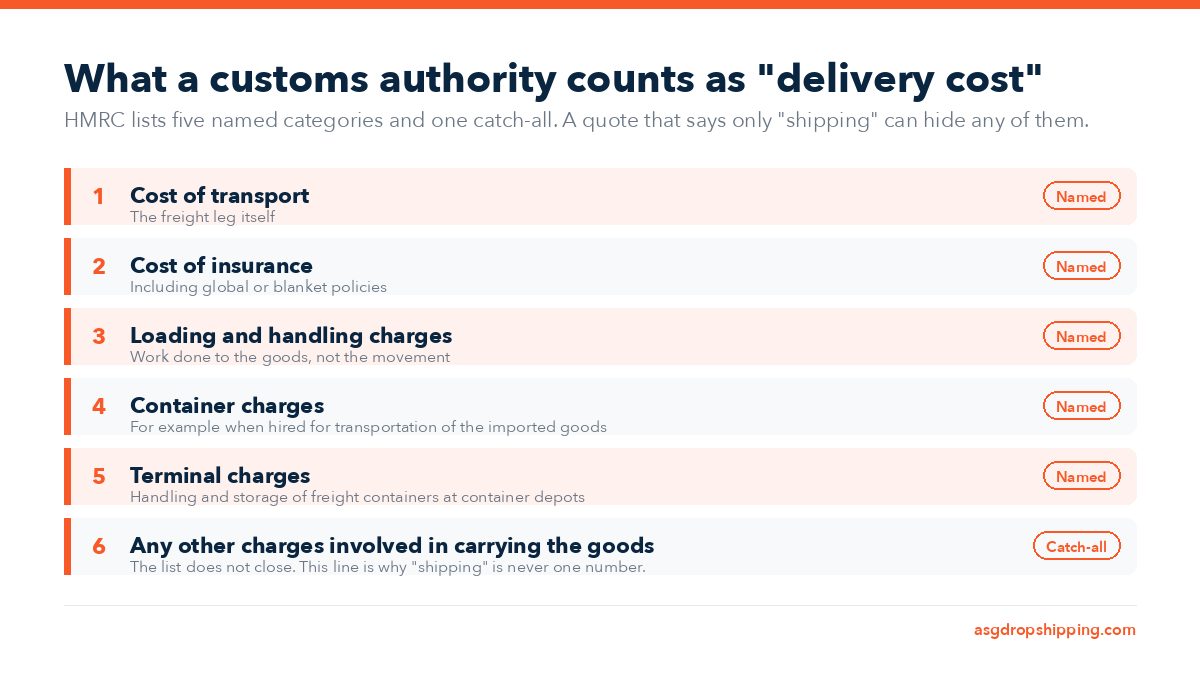
Separate lines exist for a customs reason, not a courtesy reason
To pull a buying commission out of customs value, it has to be shown separately from the price paid or payable. Both CBP and HMRC require it, as of August 2026.
This is not a quirk of one customs authority, and it is also not two independent authorities agreeing.
Both trace back to the same place: Article 8.1(a)(i) of the WTO Valuation Agreement adds commissions and brokerage to customs value, except buying commissions.
What you are looking at is one international rule and two national implementations of it. Treat them as a single source, not as mutual corroboration.
The treaty text does not itself contain the phrase "shown separately" — that specific wording is national.
What the treaty adds is Article 8.3, which requires any addition to rest on objective and quantifiable data.
Here is the scope sentence, and please do not skip it. These documents govern customs valuation and burden of proof.
Separate line items exist so that a buying commission can be excluded from dutiable value.
They are not an industry transparency standard, and none of the three says anything at all about whether itemized quotes are cheaper.
An agent who will not itemize is not thereby dishonest, but is leaving you with a valuation problem that is legally yours.
So what do you actually do with this? Three things, none of them accusatory.
Ask for the service fee on its own line and a separate invoice for it. Ask for the producing factory’s own proforma invoice.
Keep the written agency agreement and the fee invoice where you can find them, because those are the documents the burden of proof runs on.
If a supplier declines, record it as a named exclusion and price the quote as less complete, not as less honest.
| Item |
Whose cost is it |
Where it must appear on the quote |
What to ask for |
| Agent service fee |
The agent’s earnings |
Its own line, separate from the price paid or payable for the goods |
A written agency agreement and a separate fee invoice |
| Goods cost |
The factory’s price |
Its own line, ideally supported by the factory’s own document |
The original proforma invoice from the producing factory |
| Domestic and international freight |
Third-party carriers |
Own lines, with the delivery boundary named |
Carrier documents, and which leg each figure covers |
| Duties, import VAT or GST |
Depends on the delivery boundary and the importer of record |
Its own line, or explicitly named as excluded |
Who is registered, who files, who can recover |
For the deeper version of this audit, including how a markup gets buried inside a unit price, see sourcing agent fees in China: hidden markups versus transparent private agent pricing.
For what it is worth, ASG operating practice is to break a quote into product procurement cost, QC inspection fee, packaging, domestic logistics, international logistics, warehousing and service fee.
That is a structure, not a price list, and no rates or amounts appear in this article.
7. The Fair Case for a Single All-In Quote
The strongest argument against everything above is that itemization is work, and work is a cost too. It deserves a fair hearing, because it is often right.
A single all-in number is easier to budget against.
It gives you one figure for your landed cost model and one figure to put in a spreadsheet, instead of ten lines that each need a definition.
For a small team without a procurement function, that is not laziness — it is a sensible trade of detail for time.
The buyer who has to price freight, brokerage, inspection and packaging separately for every SKU is spending management hours that a growing store may not have.
Some agents also quote all-in because they carry the variance themselves. If freight moves against them mid-order, that is their loss, not a change order in your inbox.
And there is a structural point that itemization advocates tend to dodge. More line items means more places for a number to be argued about, and every argument costs somebody’s afternoon.
Here is the boundary, though. What an all-in quote buys you is convenience, and convenience is real.
It does not buy you a lower price. It transfers uncertainty to the agent, and whoever holds uncertainty prices it — you simply cannot see at what level.
That is a fair deal when you have chosen it knowingly, on a spec that is locked. It is a bad deal when you chose it because nobody offered you the alternative.
None of this makes an itemized quote cheaper. CBP, HMRC and the WTO text say nothing about which structure costs less, and neither will I.
What the itemized version gives you is the ability to answer questions, including the ones a customs officer may eventually ask.
The platform layer sits in the same place.
Alibaba’s own seller documentation, as of August 2026, describes an RFQ Markets mechanism where a buyer posts a requirement and multiple sellers respond, alongside inquiry and instant messaging as the other two contact routes.
That mechanism exists and it saves time. Alibaba is the platform operator here, so read it as evidence that the channel exists, not that it produces better prices.
8. What Quote Normalization Cannot Prove

The worksheet answers one question well and several questions not at all. Knowing which is which keeps you from over-trusting your own arithmetic.
It cannot tell you whether an agent is legitimate. It cannot tell you whether the finished product will pass.
It cannot tell you whether either party is being straight with you. It cannot verify that the factory behind the quote is a factory.
It cannot validate a compliance certificate. And it cannot tell you whether a quote that looks complete corresponds to anything happening in a real building.
A residual gap is the part people read backwards. After both quotes sit on the same basis with the same coverage, a difference may still remain.
That difference is a question to put to both sides in writing. It is not evidence that the pricier one is honest or the cheaper one is hiding something.
In the reviews my own team runs, a wide gap has more than once turned out to be scope that only one side was ever asked for — that is our experience across the quotes we see, not a measured frequency.
So what closes the remaining distance? Four things a spreadsheet cannot do.
Order a sample against the approved spec. Ask for the QC report format before you need it.
Verify the production site. Ask for references you can actually contact.
On the factory question specifically, we have a separate walkthrough on verifying whether an Alibaba supplier is a factory or trading company, and a companion piece on private agent red flags for the behaviours that show up before the paperwork does.
9. Get a Two-Quote Review From ASG
If you would rather not build the sheet alone, we will run it with you. It is called the ASG Two-Quote Normalization Review.
Send the content, not the parties.
Two redacted quotes with supplier names, logos, contact details and bank details removed, plus your RFQ or product specification, target quantity, destination country, intended delivery boundary, and packaging and QC requirements.
Do not send supplier identities or contact information, and do not send your own customer data. We do not need any of it to read a cost structure.
What comes back: whether the two quotes are comparable, which fields are missing, the questions to send back to each side, the normalized recurring unit cost, the one-off costs separated out, the delivery boundary differences, and the risks that stay unpriced.
What this review is not. It is not legal, tax or customs compliance advice.
It does not verify that either supplier is real, solvent or licensed. It does not assess product quality, and it does not make the decision for you.
It reads two documents and tells you what they do and do not say.
The same evidence standard in this article applies to any quote you get from us. Ask us for the fee on its own line.
Ask which cells are Variable. Hold our sheet to the coverage receipt exactly as you would hold theirs.
Our own quoting structure, described as internal practice and nothing more: quotes are broken into product procurement cost, QC inspection fee, packaging, domestic logistics, international logistics, warehousing and service fee.
No final quote is issued before the product, destination country, quantity, and packaging and QC requirements exist. Procurement and fulfilment begin after payment is confirmed.
Those are working rules from our teams in Shenzhen and Dongguan, not published proof. This article carries no ASG figures and no customer cases.
10. Frequently Asked Questions
Quick Answers About Comparing Sourcing Quotes
How do I compare a DDP quote with an FOB quote?
Pick one target delivery boundary and bring both quotes to it. Usually that means adding freight, insurance, brokerage and import charges to the FOB quote.
Per the U.S. International Trade Administration, as of August 2026, the Incoterm decides which items sit inside the number. So those additions are known gaps, not guesswork.
Record the importer of record on both. If a leg cannot be priced yet, mark it Variable and exclude it from both subtotals.
Should a sourcing agent show its fee separately?
There is a legal reason to want it separated, and it is not about trust. To exclude a buying commission from customs value, it must be shown separately from the price paid or payable.
CBP and HMRC both require this, implementing Article 8.1(a)(i) of the WTO Valuation Agreement. The burden of proof sits with the importer.
That is you.
How should sample and tooling fees be treated?
Separately from everything recurring. Watch the reverse case too.
Free tooling paired with a higher per-piece price means the one-off was amortized into your unit cost. Ask over which quantity, in writing, then pull it back out.
No disclosure means the item is marked Variable.
How do payment terms affect quote comparison?
They change your cash position without changing your cost. So they get their own line, not a conversion.
The ITA, as of August 2026, describes five main methods of payment, with open account terms typically running 30, 60 or 90 days.
It also notes documentary collections are generally less expensive than letters of credit. Show timing in three columns and leave the working-capital column in words.
What should I do when an agent refuses to itemize?
Ask once more, in writing: the fee on its own line, plus the factory’s original proforma invoice. A second refusal is information, not an accusation.
Record it as a named exclusion, and stop treating that subtotal as comparable. Then decide whether you will carry the importer’s burden of proof on a quote you cannot break down.
11. Final Thoughts
Look — the reason most quote comparisons go wrong is not arithmetic. It is that one number was allowed to answer a question the other number was never asked.
Normalize what can be priced. List what cannot.
Never mix the two into one number.
Do that once, properly, and choosing a product sourcing agent stops being a judgement about who seems more honest.
It becomes a comparison of two documents on the same footing, with a short written list of everything neither of them settled. That list is worth more than the price gap.
It is what you negotiate with.
Build the sheet on your next two quotes, or send them to us and we will run the review with you.
12. External Sources
- International Chamber of Commerce — Incoterms 2020, as of August 2026
- U.S. International Trade Administration — Know Your Incoterms, as of August 2026
- U.S. International Trade Administration — Methods of Payment, as of August 2026
- U.S. International Trade Administration — Letters of Credit, as of August 2026
- U.S. International Trade Administration — Cash in Advance, as of August 2026
- U.S. Customs and Border Protection — Buying and Selling Commissions, informed compliance publication, October 2006
- Code of Federal Regulations — 19 CFR 152.102, definitions, as of August 2026
- Code of Federal Regulations — 19 CFR 152.103, transaction value, as of August 2026
- Code of Federal Regulations — 19 CFR Part 159 Subpart C, conversion of foreign currency, as of August 2026
- HM Revenue & Customs — Valuing imported goods using Method 1, as of August 2026
- World Trade Organization — Agreement on Implementation of Article VII of GATT 1994
- China Foreign Exchange Trade System — CNY central parity rate, as of August 2026
- Alibaba.com Seller Central — RFQ and buyer contact methods, as of August 2026
- Shopify Community — topic 147028, August 2022
- Shopify Community — topic 184143, January 2023
- Shopify Community — topic 398871, March 2025
- Shopify Community — topic 408297, June 2026
- Shopify Community — topic 415099, May 2025
13. ASG Data Note
This article contains no ASG performance figures, no customer cases and no pricing data of any kind — the only ASG material used describes how our own quoting process is structured and sequenced, drawn from internal working documents rather than published records.