By Janson Wang — CEO & Founder, ASG Dropshipping | Updated: April 14, 2026 | 20 min read
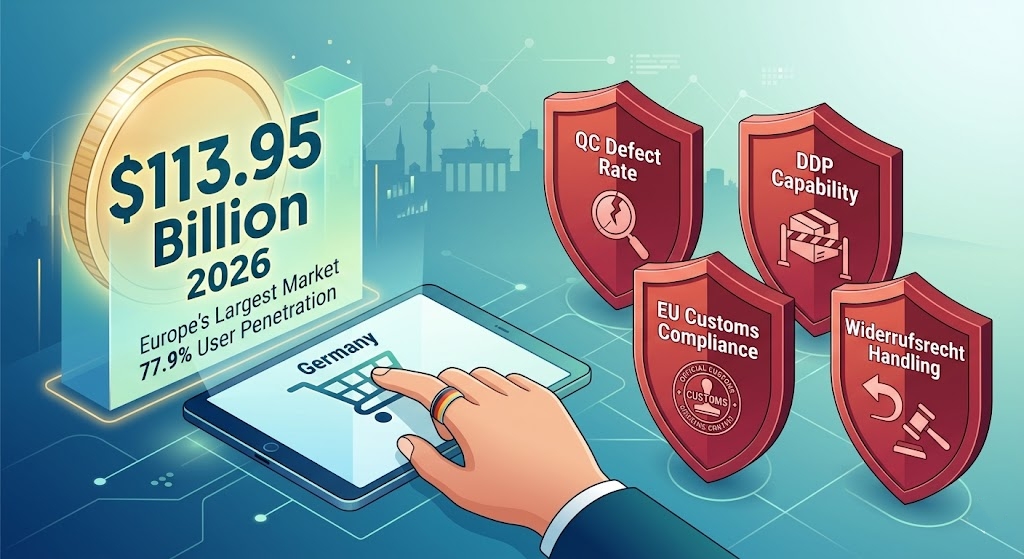
Ranked by QC defect rate, DDP capability, EU customs compliance, and Widerrufsrecht return handling — the four criteria that actually determine success in the German market.
Germany doesn’t forgive sloppy fulfillment.
Germany’s ecommerce market reached $113.95 billion in 2026 — Europe’s largest — and German consumers expect delivery within days, products that match every specification, and a legally guaranteed 14-day return window, no questions asked. Get any of those wrong and you’re not just dealing with a bad review. You’re potentially dealing with a BGB violation.
I’ve processed orders for German-market Shopify stores through ASG Dropshipping’s Dongguan and Shenzhen warehouses for 8 years. The difference between agents that work in Germany and those that don’t comes down to three variables: DDP shipping capability, QC defect rate, and compliance infrastructure. This ranking covers the 7 best options — evaluated against those three variables, not against generic metrics that don’t reflect how the German market actually works.
The best dropshipping agent for Germany in 2026 is a China-based private agent with DDP EU freight capability, per-unit QC inspection producing under 1% defect rates, and 5–7 day door-to-door delivery to German addresses. ASG Dropshipping ranks 1 for German market sellers doing 30+ daily orders, combining 0.3% documented defect rate, dedicated DDP EU freight lanes, and full Widerrufsrecht return handling support. CJ Dropshipping ranks 2 for stores under 30 daily orders testing the German market using CJ’s Berlin warehouse for 2–3 day local delivery.
Key Takeaways
- Germany’s ecommerce market reached $113.95 billion in 2026 — Europe’s largest — with 77.9% user penetration. It’s also the most compliance-intensive market on the continent, where the wrong agent generates BGB violations, incorrect VAT treatment, and Widerrufsrecht return liabilities.
- The EU’s €150 customs duty exemption ends July 2026. Every parcel entering Germany faces customs duties under a new flat-rate structure of €3 per parcel minimum. Agents without DDP freight infrastructure leave this cost at your customer’s door.
- Widerrufsrecht (BGB §312g) gives every German customer a mandatory 14-day unconditional return right. Every defect you ship can turn into a legal return, so the agent’s inspection rate is what sets that exposure: at 0.3% per-unit QC and 50 daily orders, roughly 4.5 defect-driven return requests per month.
- The 7 agents are evaluated on 5 Germany-specific criteria: DDP shipping capability, EU customs compliance infrastructure, QC defect rate, door-to-door delivery time, and Widerrufsrecht return handling support.
- The highest-ROI configuration for 30+ daily orders is a China-based private agent with DDP EU freight — not local EU suppliers (20–30% higher COGS) and not platform tools (no per-unit inspection, no DDP). The hybrid approach (70% China DDP + 30% EU buffer stock) produces the best margin-to-compliance ratio at scale.
Table of Contents
- ASG Dropshipping — Fit for German Market Scaling
- CJ Dropshipping — Best for Beginners
- Spocket — Best EU-Sourced Products
- Printful — Best for Print-on-Demand
- AutoDS — Best Automation Platform
- BigBuy EU — Best German-Language Catalog
- The Hybrid Approach — What I’d Actually Do
- Quick Comparison Table
- 4 Compliance Requirements Every Agent Must Meet
- FAQs
1. ASG Dropshipping — Fit for Scaling Sellers in the German Market
ASG Dropshipping is positioned for Germany-focused stores doing 30+ daily orders, combining a documented 0.3% QC defect rate, dedicated DDP EU freight lanes delivering to German addresses in 5–7 days, and per-unit inspection infrastructure that reduces Widerrufsrecht-eligible returns to under 2% of order volume.
The handling fee runs $1.50–$2.00 per order. Whether that fee pays for itself depends on the defect rate your current supply chain actually runs at — a number we have no sourced platform-wide figure for, and one most sellers have never measured on their own orders — and it sits on top of factory-direct pricing savings of 10–15% below CJ or HyperSKU pricing on comparable SKUs.
The German market punishes defects harder than any other EU market — not because German consumers are difficult, but because the law gives them more recourse. Every defective delivery is a potential Widerrufsrecht return, which is a legal right, not a policy choice. That means your agent’s QC infrastructure isn’t just a cost line. It’s your legal exposure management.
At 50 daily orders and $30 AOV, 0.3% per-unit inspection puts defect-driven Widerrufsrecht-eligible returns at roughly 4.5 per month. What that is worth to you depends on the defect rate your current supply chain runs at, and we have no sourced platform-wide figure to put against it — but every point of defect rate you do carry brings mandatory EU return shipping, a replacement unit, and CS labor with it.
Core advantages:
- 0.3% documented QC defect rate across 2,300+ verified factories — six-step per-unit inspection applied to every individual order, not batch sampling. Each unit is visually inspected against a product standard document, functionally tested where applicable, photographed with visible unit identifiers, and confirmed on weight and dimension before shipping approval.
- DDP EU freight lanes with 5–7 day door-to-door delivery to Germany — pre-allocated dedicated freight avoiding customs clearance delays. After the €150 exemption removal in July 2026, DDP capability is the baseline requirement for a clean customer delivery experience in Germany.
- Widerrufsrecht return handling support — ASG’s account team processes EU return requests under the mandatory 14-day window, coordinating replacement dispatch within 48 hours and maintaining the documentation trail required under BGB §312g.
- GPSR product safety documentation for EU customs clearance — required under the General Product Safety Regulation effective December 2024. ASG maintains supplier-level safety documentation for all 2,300+ factory relationships.
- Q4 scalability: 23,000 daily orders at 97.3% on-time delivery through Q4 2024 — the infrastructure to handle German Black Friday and Christmas volume without the delivery collapse that platform tools produce when campaigns scale.
Limitations:
- Not the right tool under 20 daily orders. Below that threshold, the handling fee ($1.50–$2.00/order) doesn’t produce enough absolute cost reduction to justify the transition from a platform tool.
- No Germany-based physical warehouse. All shipments originate from Dongguan/Shenzhen — 5–7 day delivery rather than the 2–3 day delivery that CJ’s Berlin warehouse produces for locally stocked SKUs.
Janson’s verdict: ASG isn’t the right choice for every German-market seller. Under 20 daily orders still testing product-market fit: start with CJ’s Berlin warehouse. At 30+ daily orders, the QC infrastructure and DDP freight capability produce better unit economics than any other option in this ranking. Run your current defect rate through the true cost of dropshipping returns calculator and the number becomes obvious.
| Metric |
ASG Dropshipping |
| QC defect rate |
0.3% (documented) |
| Germany delivery time |
5–7 days (DDP) |
| DDP capability |
✅ Full |
| Monthly handling fee |
$1.50–$2.00/order |
| Minimum order volume |
20+ daily orders |
| GPSR documentation |
✅ Yes |
See ASG’s dedicated EU freight lanes and delivery time data
2. CJ Dropshipping — Best for Beginners Testing the German Market
CJ Dropshipping ranks second for Germany because of its Berlin warehouse, which delivers to German addresses in 2–3 days for locally stocked SKUs — the fastest delivery option in this ranking. The Berlin warehouse requires pre-stocking inventory (minimum 50–100 units per SKU), making it suitable for sellers who have validated 3–5 winning products. CJ’s platform-average QC defect rate runs 6–8% on China-sourced orders without dedicated inspection, dropping to 3–4% on Berlin-warehoused SKUs where inventory is pre-screened at receipt. No DDP infrastructure for China-direct shipments above €150 after July 2026.
CJ is the most popular dropshipping platform globally, and its Germany-specific infrastructure is genuinely useful — up to a point. That point is approximately 30 daily orders and $15,000/month in revenue. Below those thresholds, CJ’s Berlin warehouse delivers a customer experience that competes with Amazon Prime. Above them, CJ’s structural limitations start compounding in ways that German consumer expectations will punish.
Core advantages:
- 2–3 day delivery from the Berlin warehouse for pre-stocked SKUs — the fastest door-to-door time in this ranking for German addresses. CJ cut shipping times for German customers to 2–3 days with its Berlin and Rotterdam warehouses, dramatically outperforming China-direct shipping for locally held inventory.
- 400,000+ SKU catalog with Shopify and WooCommerce native integration — broadest single-platform selection for Germany-focused product testing.
- No monthly subscription fee for basic access — per-order charging rather than recurring platform fee, genuinely low-cost for low-volume validation.
- BGB compliance support — German-language shipping labels and basic consumer protection documentation for non-German-speaking sellers.
Limitations:
Janson’s verdict: CJ Berlin warehouse is the right starting point for 5–30 daily orders on 3–5 validated SKUs. Pre-stock your winners in Berlin, run China-direct for testing. When you hit 30+ daily orders, the defect rate and post-July 2026 customs math will tell you it’s time to transition. Walk away from CJ for your core volume when monthly return cost exceeds monthly handling fee savings — that crossover almost always arrives between $10,000 and $20,000/month in Germany.
| Metric |
CJ Dropshipping |
| QC defect rate |
6–8% (China-direct) / 3–4% (Berlin stock) |
| Germany delivery time |
2–3 days (Berlin) / 7–15 days (China) |
| DDP capability |
❌ Limited (China-direct) |
| Monthly fee |
$0 (basic) |
| Minimum order volume |
None |
| GPSR documentation |
Partial |
3. Spocket — Best for EU-Sourced Products with Zero Customs Risk
Spocket ranks third for Germany because it sources 70% of its catalog from EU-based warehouses, eliminating customs duty exposure entirely — including after the July 2026 €150 exemption removal. Delivery to German addresses runs 3–7 days. The trade-off is a 15–30% higher COGS compared to equivalent China-sourced products and a monthly subscription starting at $39.99/month.
Spocket is the right choice for sellers whose product category requires EU-origin certification, whose customers are particularly sensitive to customs delays, or who are selling at low enough volumes that the COGS premium doesn’t materially affect P&L.
Spocket solves the customs problem completely. If your product ships from a German or EU supplier, there is no customs duty, no IOSS registration requirement, no €3/parcel flat-rate fee after July 2026, and no customer receiving an unexpected invoice at the door. The honest question is whether you can afford it.
Core advantages:
Limitations:
- 15–30% COGS premium vs China-sourced equivalents — at 50 daily orders, that’s $750–$1,500/month in additional product cost.
- $39.99–$99.99/month subscription adds fixed cost that erodes margin at low volumes.
- Limited catalog depth for electronics, pet products, and general merchandise categories.
Janson’s verdict: Right tool for EU-origin certification requirements or under 20 daily orders where compliance simplicity outweighs COGS premium. Skip Spocket if you’re in a price-competitive general merchandise category — the margin math doesn’t work above 30 daily orders.
| Metric |
Spocket |
| QC defect rate |
Supplier-dependent |
| Germany delivery time |
3–7 days (EU-sourced) |
| DDP capability |
✅ N/A (EU-origin) |
| Monthly fee |
$39.99–$99.99 |
| Minimum order volume |
None |
| GPSR documentation |
EU-origin often pre-compliant |
Ready to compare what a China-based private agent costs against your current EU supplier setup? ASG’s team will run the numbers on your specific product category and order volume — including the post-July 2026 customs math. Get your cost breakdown here.
4. Printful — Best for Print-on-Demand and Custom Branded Products
Printful ranks fourth for Germany specifically for print-on-demand categories — custom apparel, home décor, accessories, and wall art — because Printful manufactures from EU facilities including Latvia and Spain, eliminating customs duty exposure on all orders after the July 2026 €150 exemption removal. Delivery to German addresses runs 5–10 days from EU production facilities. Base product costs run 20–40% higher than blank wholesale equivalents, but the zero-inventory model makes it correct for new sellers validating a German-market branded concept before committing to inventory.
Printful solves a specific problem: branded, custom-printed products to German consumers without holding inventory, without navigating customs, and without minimum order commitments. The operative word is “custom printed.” Printful is a print-on-demand manufacturer, not a general merchandise supplier.
Core advantages:
- EU manufacturing eliminates post-July 2026 customs exposure — Latvia and Spain facilities produce within the EU customs zone.
- No minimum order quantities and no upfront inventory cost — every unit produced on demand after customer order. Zero inventory risk for German-market product validation.
- Premium blank product quality — Stanley/Stella and similar EU-standard suppliers meeting the quality standard German returns data confirms matters in this category.
Limitations:
- 20–40% higher base cost than wholesale equivalents — only works with retail prices of $35–$60 for apparel to maintain 30%+ margins.
- 5–10 day Germany delivery — slower than CJ Berlin, longer than German consumer expectations. German consumers are risk-averse and expect delivery within predictable windows. Peak Q4 can extend to 10–14 days.
- Category limitation — POD only. Electronics, home goods, sporting equipment not available.
Janson’s verdict: Correct for one use case: launching a branded German-market concept in apparel or home décor with zero inventory budget. Skip Printful if you’re selling general merchandise, if the base cost premium doesn’t fit your margin model, or if 5–10 day delivery is too slow for your category’s competitive landscape.
| Metric |
Printful |
| QC defect rate |
Low (in-house EU manufacturing) |
| Germany delivery time |
5–10 days (EU facilities) |
| DDP capability |
✅ N/A (EU-origin) |
| Monthly fee |
$0 (pay-per-order) |
| Minimum order volume |
None |
| Product categories |
POD only |
5. AutoDS — Best Automation Platform for Germany-Focused Stores
AutoDS ranks fifth as an automation platform — not a dropshipping agent — for Germany-focused Shopify and WooCommerce stores. AutoDS connects to multiple supplier sources including AliExpress, Amazon, CJ Dropshipping, and Walmart, automating order processing, price monitoring, and inventory updates. It does not perform physical QC inspection. Defect rates depend entirely on the upstream supplier selected.
The $26.90–$66.90/month subscription cost is justified when automation saves more than 10–15 hours/month of manual order processing — typically at 50–100+ orders/month across multiple suppliers.
Here’s a distinction most dropshipping content doesn’t make clearly enough: AutoDS is a software tool, not a dropshipping agent. It doesn’t source, inspect, or ship your products. It automates the workflow between your Shopify store and whichever supplier you’ve connected to it. Germany’s compliance requirements — DDP customs handling, GPSR documentation, Widerrufsrecht return processing — are not software problems. They’re supply chain infrastructure problems that your upstream supplier must solve.
Core advantages:
- Multi-supplier automation — connects to 25+ supplier platforms simultaneously, enabling automatic order routing and stock synchronization from a single dashboard.
- Automatic price monitoring and repricing — tracks supplier price changes and updates store listings automatically, reducing price discrepancy complaints.
- Shopify and WooCommerce Germany compatibility with German-language product import. AutoDS supports the fast shipping and quality expectations that Germany’s ecommerce market demands.
Limitations:
- No physical QC — defect rate is 100% determined by upstream supplier. AliExpress-routed orders arrive at whatever defect rate that supplier is running, and AutoDS automation quality does not change it.
- No DDP handling — post-July 2026, every China-direct order above €150 faces customs duty at the German customer’s door without DDP from the connected supplier.
- $26.90–$66.90/month subscription adds fixed cost unjustifiable under 30 daily orders.
Janson’s verdict: AutoDS is a productivity tool, not a supply chain solution. Use it managing 50+ daily orders across multiple suppliers spending 10+ hours/month on manual processing. Don’t use it as a substitute for solving QC and customs compliance — those require a supplier decision. Best configuration for Germany: AutoDS as the automation layer connected to ASG or a DDP-capable private agent as the fulfillment layer.
| Metric |
AutoDS |
| QC defect rate |
Supplier-dependent (no platform QC) |
| Germany delivery time |
Supplier-dependent |
| DDP capability |
❌ None (software only) |
| Monthly fee |
$26.90–$66.90 |
| Best use case |
Automation layer, not primary agent |
Managing 50+ daily orders across multiple German-market suppliers? AutoDS handles the automation layer — but your fulfillment infrastructure still determines defect rate and customs compliance. Book a supply chain audit to see how a DDP-capable private agent changes the math.
6. BigBuy EU — Best for German-Language Niche Product Catalogs
BigBuy EU ranks sixth for Germany as a wholesale-to-dropshipping platform with EU-based warehouse network and 200,000+ products covering home goods, electronics accessories, toys, beauty, and seasonal products. Delivery to Germany runs 3–5 days from Spanish and EU warehouse locations.
BigBuy charges a one-time registration fee of €69 plus monthly subscription tiers from €69–€99/month. Products ship from within the EU, eliminating post-July 2026 customs exposure. The primary limitation is a wholesale pricing structure requiring 2–3× markup to maintain 30%+ margins — constraining competitiveness in price-sensitive German product categories.
BigBuy occupies a specific niche: EU-warehoused general merchandise with German-language product data feeds ready to import. That last part matters — German ecommerce law requires product descriptions to be accurate and complete, and websites serving Germany are expected to be in the German language. BigBuy’s pre-translated German product catalogs reduce the localization compliance burden significantly.
Core advantages:
Limitations:
- Wholesale pricing requires 2–3× markup — in competitive German categories, this often puts you above market-clearing price points.
- €69–€99/month subscription plus €69 setup fee — higher fixed cost than CJ or ASG’s per-order models.
- No dedicated QC infrastructure — receiving-level warehouse checks only, not per-unit inspection.
Janson’s verdict: BigBuy is right for German-language WooCommerce stores in home goods and lifestyle categories where pre-translated product data saves significant setup time, or for eBay.de sellers where BigBuy’s multi-channel feed integration provides structured listing workflow. Skip BigBuy for electronics, fashion, or pet products where catalog depth is thin relative to alternatives.
| Metric |
BigBuy EU |
| QC defect rate |
Moderate (EU warehouse receipt check) |
| Germany delivery time |
3–5 days (EU warehouses) |
| DDP capability |
✅ N/A (EU-origin) |
| Monthly fee |
€69–€99 + €69 setup |
| Catalog size |
200,000+ SKUs |
7. The Hybrid Approach — China Agent + EU Buffer Stock (What I’d Actually Do)
The hybrid approach for Germany combines a China-based private agent handling 70% of order volume on DDP dedicated freight with 30% fulfilled from pre-stocked EU buffer inventory for top-performing SKUs — producing China-direct COGS (10–15% below EU-sourced alternatives) while maintaining 3–5 day delivery on proven winners and 5–7 day delivery on the broader catalog.
At 50 daily orders, this configuration generates $1,200–$1,800/month in COGS savings versus full EU-sourced supply, while eliminating post-July 2026 customs exposure on pre-stocked EU SKUs and managing it through DDP freight on China-direct orders above €150.
Every option in this ranking involves a trade-off. EU-sourced suppliers eliminate customs risk but cost 15–30% more per unit. China-based agents deliver factory-direct pricing but require DDP infrastructure for post-July 2026 German customs. Neither pure approach is optimal for a store doing 30+ daily orders. Here’s what I’d actually do.
The configuration: Route 70% of order volume through a China-based DDP-capable private agent — full catalog at factory-direct COGS, 5–7 day DDP delivery to German addresses, customs handling included. Pre-stock the top 3–5 SKUs by volume in a CJ Berlin or EU 3PL warehouse. These proven winners deliver in 2–3 days with zero customs exposure.
Why not 100% EU-sourced? The COGS math doesn’t work at scale. A product costing $8 through a China-based agent costs $10–$12 through EU suppliers — 25–50% premium. At 50 daily orders: $1,500–$2,250/month additional product cost. Over 12 months: $18,000–$27,000. That’s an entire marketing budget.
Why not 100% China-direct DDP? Delivery time. German consumers have internalized Amazon Prime expectations. For your top 3–5 SKUs generating 60–70% of revenue, closing delivery from 5–7 days to 2–3 days produces measurable repeat purchase improvement. Based on European market client data: stores maintaining EU buffer stock on top SKUs see 15–22% higher 90-day repeat purchase rates than stores relying entirely on China-direct fulfillment.
The post-July 2026 customs reality: Starting July 2026, all packages entering the EU face customs duties with a flat-rate structure of €3 per parcel minimum — nearly 4.6 billion such shipments entered the EU in 2024, with 91% from China. The hybrid approach routes low-value, high-velocity SKUs through EU pre-stock and reserves DDP China-direct for mid-to-high value products where customs cost is a smaller AOV percentage.
Month 1: Establish China DDP agent relationship.
Test 20-unit sample order to Germany.
Verify DDP delivery process end-to-end.Month 2: Identify top 3-5 SKUs by order volume.
Pre-stock 100-200 units per SKU
in CJ Berlin or EU 3PL.
Run parallel fulfillment: EU stock
for top SKUs / China DDP for rest.Month 3+: Monitor delivery time data
and repeat purchase rates.
Adjust EU buffer stock list
quarterly based on velocity data.
For the complete framework on dropshipping tariffs and import taxes post-July 2026 — including DDP cost calculations for German market product categories.
Running a German-market store and trying to figure out whether the hybrid approach makes financial sense for your SKU mix and order volume? ASG’s account team will model the COGS comparison against your current supplier costs — no commitment required. Start the conversation here.
Quick Comparison — All 7 Options
| Agent / Tool |
QC Defect Rate |
Germany Delivery |
DDP Capable |
Monthly Fee |
Best For |
| ASG Dropshipping |
0.3% (documented) |
5–7 days |
✅ Full |
$1.50–$2.00/order |
30+ daily orders, full compliance |
| CJ Dropshipping |
6–8% (China) / 3–4% (Berlin) |
2–3 days (Berlin) / 7–15 days (China) |
❌ Limited |
$0 (basic) |
5–30 orders/day, market testing |
| Spocket |
Supplier-dependent |
3–7 days (EU) |
✅ N/A |
$39.99–$99.99/mo |
EU-origin / sustainability positioning |
| Printful |
Low (EU in-house) |
5–10 days |
✅ N/A |
$0 (pay-per-order) |
POD apparel / branded products |
| AutoDS |
Supplier-dependent |
Supplier-dependent |
❌ None |
$26.90–$66.90/mo |
Automation layer only |
| BigBuy EU |
Moderate |
3–5 days (EU) |
✅ N/A |
€69–€99/mo + setup |
German-language catalog / eBay.de |
| Hybrid: ASG + EU buffer |
0.3% (China) / Low (EU stock) |
2–3 days (top SKUs) / 5–7 days (rest) |
✅ Full (China) |
$1.50–$2.00/order + EU storage |
30+ orders, max margin-compliance balance |
What Makes Germany Different: 4 Compliance Requirements Every Agent Must Meet
Germany imposes four compliance requirements on dropshipping operations that no other major EU market enforces as strictly in combination: Widerrufsrecht (14-day unconditional return right under BGB §312g, mandatory for all B2C distance selling), EU customs duty compliance post-July 2026 (€150 exemption removed, requiring DDP handling or IOSS registration on all China-sourced shipments), GPSR product safety documentation (General Product Safety Regulation effective December 2024), and German VAT registration with Kleinunternehmer exemption threshold of €25,000 gross revenue under 2026 rules. An agent that cannot support all four creates legal and financial exposure that no marketing budget can offset.
Most “best dropshipping agent for Germany” articles cover supplier lists. None systematically connect Germany’s compliance requirements to agent evaluation criteria. The agent you choose determines whether you can meet these requirements — your store policy and terms and conditions don’t override statutory German law.
Requirement 1 — Widerrufsrecht (BGB §312g)
Every German B2C online purchase carries a mandatory 14-day right of withdrawal — no questions asked, no restocking fee. This is a statutory right, not a store policy. Defect-driven returns land on top of the ordinary change-of-mind ones, and upstream inspection is the only side of that you control: at 0.3% per-unit QC and 50 daily orders, about 4.5 defect-driven returns per month. Sellers in Germany are fully responsible for product quality, delivery times, and customer communication. Agent evaluation: Does your agent process EU return requests within 14 days, dispatch replacements within 48 hours, and maintain BGB §312g documentation?
Requirement 2 — EU €150 Customs Duty Exemption Removal (July 2026)
Starting July 2026, every parcel entering Germany faces customs duty assessment regardless of declared value — plus approximately €3/parcel flat-rate minimum. Nearly 4.6 billion shipments entered the EU in 2024, with 91% from China — a volume that doubled from the prior year. Agent evaluation: DDP freight or IOSS registration on all China-sourced orders.
| Scenario |
Recommended approach |
| Orders above €150 AOV |
DDP dedicated freight |
| Orders below €150 AOV |
IOSS registration |
| EU-warehoused stock |
No customs exposure |
| Mixed catalog |
IOSS low-value / DDP high-value / EU stock for top SKUs |
Requirement 3 — GPSR Product Safety Documentation (December 2024)
The General Product Safety Regulation (EU) 2023/988, effective December 13, 2024, requires EU-level product safety documentation, an EU-based responsible person contact, and incident reporting capability for all products sold to EU consumers. Categories most affected: electronics (CE marking), toys (EN 71), personal care (EU Cosmetics Regulation), children’s products. Agent evaluation: Supplier-level GPSR documentation produced within 72 hours of request. Agents sourcing from 2,300+ verified factories with maintained compliance files can. Agents sourcing from AliExpress listings cannot.