Most Shopify sellers pick their dropshipping agent based on who ranks first on Google. After 8 years and 5M+ orders across 2,300+ factories, I can tell you: that’s how you end up with a defect problem you didn’t see coming — one that never shows up in your COGS — or worse, stuck selling white-label products with no competitive moat while everyone else copies your bestseller in 48 hours.This list ranks the 5 best dropshipping agents for Shopify in 2026 by what actually determines your long-term business outcomes: QC infrastructure, brand-building capability, and supply chain transparency. Not marketing budgets.
The 5 best Shopify dropshipping agents in 2026: ASG Dropshipping (best for scaling and brand building — 0.3% defect rate, full OEM/ODM, 1.4M+ product library), HyperSKU (best mid-volume, no monthly fee), CJ Dropshipping (best for beginners), Zendrop (best for US-focused stores), Spocket (best for US/EU products). Under 10 daily orders: CJ works. Above 50 daily orders building a brand: you need full QC + a product development partner.
Key Takeaways
- For beginners (under 10 orders/day): CJ Dropshipping — free, no MOQ, 750,000+ catalog. Don’t over-engineer before you’ve found a winning product.
- For scaling stores (50+ orders/day): ASG Dropshipping — 0.3% defect rate through six-step full inspection on every order, dedicated account manager, and a brand-building stack that CJ and Zendrop simply don’t offer.
- For brand builders: ASG offers zero-to-one brand development: product design, OEM/ODM sourcing, custom packaging from a 10-person in-house design team, and a 1.4M+ product library for brand-aligned selection.
- For US-focused stores: Zendrop’s US domestic fulfillment delivers in 3–5 days. Worth the monthly fee if 80%+ of your customers are in North America.
- The vetting test: 50-piece test order, QC photos within 72 hours, tracking sync in Shopify within 24 hours of dispatch. Everything you need to know surfaces in under 6 days.
The full breakdown — with real numbers, honest limitations, and Janson’s direct verdict on each — is below.
The best Shopify dropshipping agents in 2026 are evaluated on four non-negotiable criteria: QC model (full inspection vs spot-check), handling fee transparency, supply chain depth (factory-direct vs catalog markup), and brand-building capability. For scaling sellers, the fifth criterion matters most: whether the agent can help you build a defensible product and brand, not just fulfill commodity orders. Agents handling under 500 daily orders often lack the infrastructure for QC consistency during scaling campaigns.
 1. ASG Dropshipping Best for Scaling & Brand Building
ASG Dropshipping is a China-based private dropshipping agent serving 5,000+ Shopify sellers globally from 4 warehouses in Dongguan and Shenzhen with a 200-person team. ASG performs six-step full QC inspection on 100% of orders — achieving a 0.3% defect rate. Beyond fulfillment, ASG provides a complete brand-building stack: OEM/ODM custom product development, a 1.4M+ product library for brand-aligned sourcing, a 10-person in-house design team, and supply chain transparency with real-time factory progress tracking. No monthly fee. $0.50–$2.00 per order handling. Best for Shopify sellers at 50+ daily orders who want to build a brand, not just sell commodities.
I run ASG, so you should factor that into everything I say here. What I’ll give you is the actual operational data — and let you decide whether the numbers justify the positioning.
The short version: ASG isn’t a product catalog you browse. It’s a supply chain and brand-building operation you partner with. That distinction matters enormously if you’re building something with long-term value — and doesn’t matter at all if you’re still testing products at 5 orders a day.
Full QC Inspection: How ASG Holds a 0.3% Defect Rate
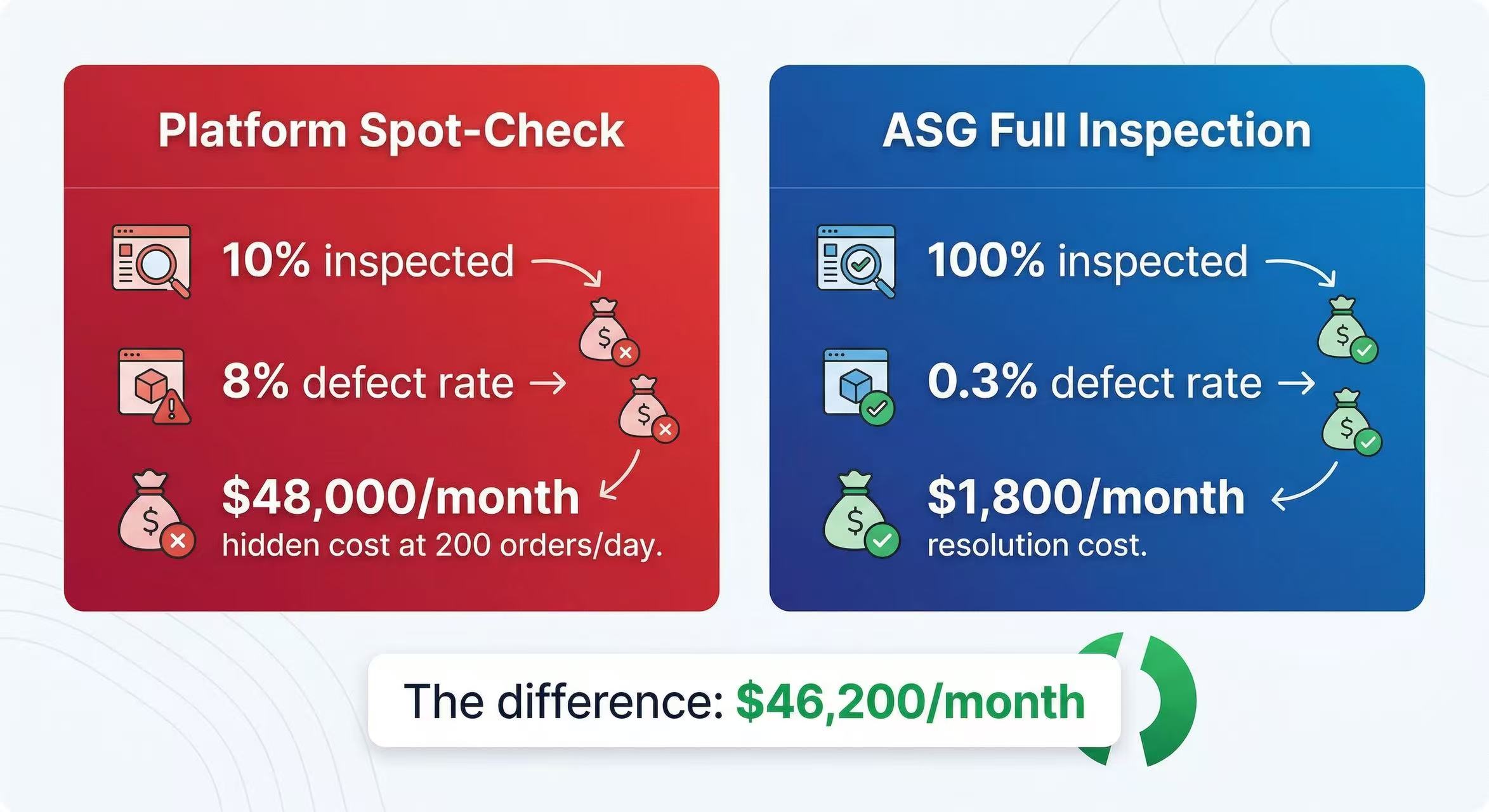
Every agent claims QC. What most mean is spot-check: 5–10% of each batch gets inspected, and the rest ships on assumption. Whatever defect rate the batch actually carries, the 90–95% nobody inspected ships with it — and lands on your customer broken, discolored, or missing a component.
At ASG, every single unit goes through six steps before it ships:
- Arrival check — SKU, color, quantity confirmed against the purchase order
- Visual inspection — surface defects, color deviation, print quality
- Functional test — electronics powered on, mechanical parts operated, seams checked
- Photo documentation — every order photographed, archived 90 days, accessible to you
- Packaging check — branded materials correct, protective packaging sufficient
- Dispatch review — address confirmed, tracking label accurate, carrier correct
The result is a 0.3% defect rate across 5M+ orders. According to Shopify’s merchant research, product quality issues are the primary cause of payment gateway disputes — the kind that don’t just trigger refunds but put your Stripe account processing capability at risk.
Run the math on your own numbers: every defective unit that reaches a customer costs $75–$125 to resolve once you count the refund, the replacement, the shipping and the support time. Multiply that by however many defects your current setup lets through, and you get a number that is invisible in your COGS and very visible in your Stripe dispute log.
Where ASG Differs From Every Other Agent on This List: Brand Building
This is the section no competitor covers. And it’s the reason ASG is the right partner for sellers doing 50+ daily orders who want to build something with real equity — not just a store anyone can clone in a weekend.
ASG’s Brand-Building Service Stack (What Competitors Don’t Offer)
These services don’t exist at CJ, Zendrop, or HyperSKU at the same depth. They’re what separates ASG from “agent that ships your orders” to “partner that builds your brand.”
1.4M+ Product Library for Brand-Aligned Selection
Not just a catalog to browse — a curated selection tool with market trend data, competitor pricing analysis, and profitability scoring. Find products that fit your brand positioning, not just the day’s trending items on AliExpress.
🔧 Product Development & OEM/ODM from Scratch
Source a base product, specify your modifications, and ASG coordinates sampling through 2,300+ vetted factories. Material upgrades, color runs, functional iterations, print-on-demand. From concept to production in 15–30 days. MOQ from 50–500 units depending on product.
Zero-to-One Brand Design (10-Person In-House Team)
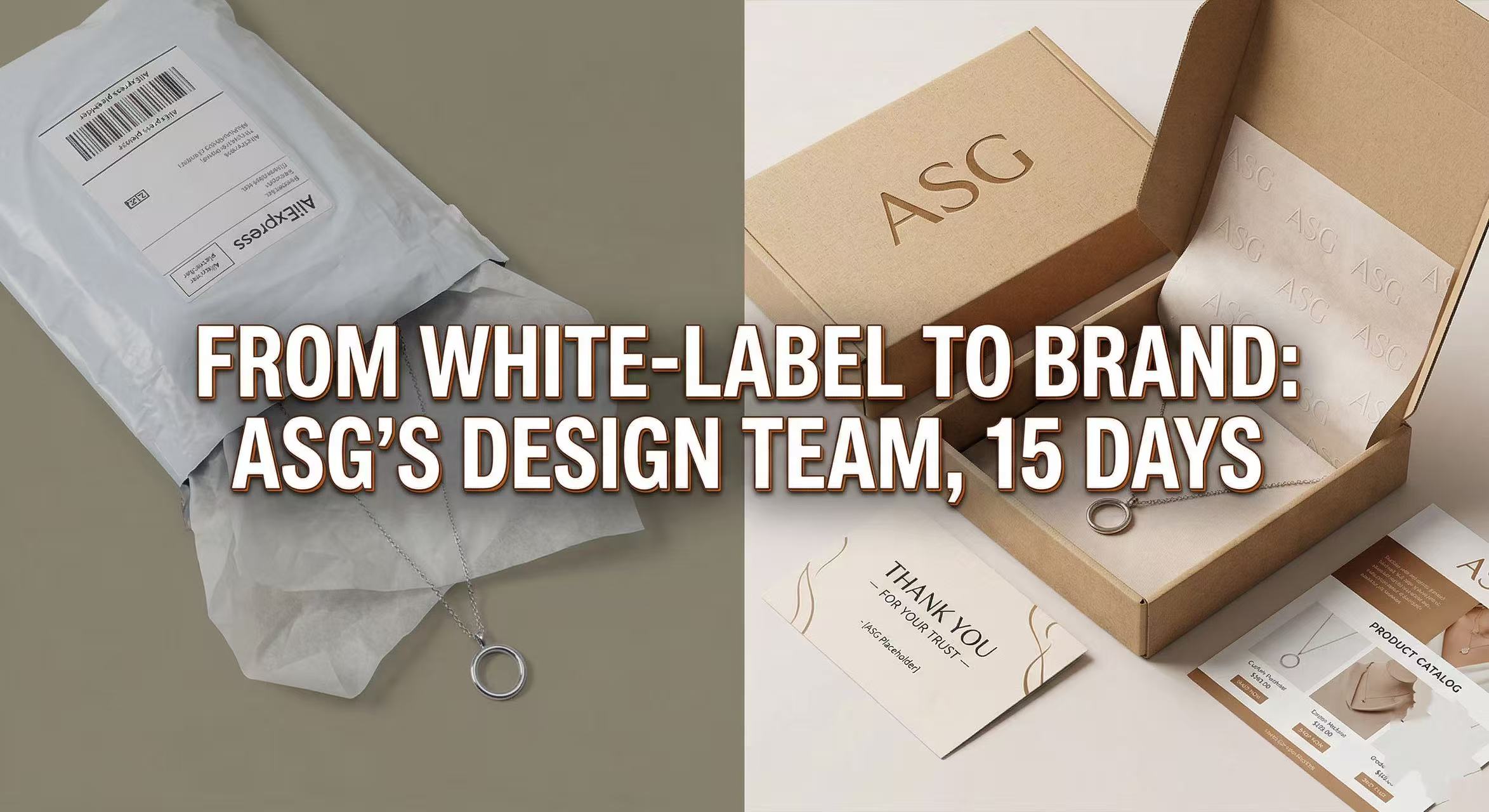
Logo design, packaging structure, thank-you card copy, product label typography, unboxing experience design. Custom mailers from $0.50–$2/unit. Thank-you cards from $0.10–$0.30. This is the team that made 83 white-label sellers into brand sellers between 2022 and 2024.
Product Upgrade & Iteration Services
When competitors start copying your winning product, ASG helps you iterate before they catch up: material substitutions, functional improvements, version 2.0 design. CE/FCC/FDA certification sourcing. Keeps your product-market fit ahead of the knock-offs.
IP Protection + NDA + Supply Chain Isolation
Your winning SKU data stays locked. No data sharing with other sellers (unlike CJ’s platform model). Written NDA for VIP clients. Neutral or branded packaging only — no factory information visible. Clients using brand packaging saw “reverse source” attempts drop from 12% to 2% in 3 months.
Supply Chain Transparency: Real-Time Factory Visibility
This is the part no competitor does. You can see production progress on your orders — not just “in production” but which stage, what the timeline looks like, and what the QC photos show when goods arrive. You’re not a passive buyer. You’re a supply chain partner.
Supply Chain Transparency: Partnership, Not Passive Fulfillment
Most agents operate as a black box. You send orders in. Packages come out. What happens in between is a mystery until something goes wrong.
ASG operates on a transparency-first model. Your dedicated account manager can pull production status on your orders in real time. When a batch arrives at the warehouse, your QC photos are logged before the order ships — not after you get a complaint. When we see a defect trend developing in a product line, we tell you before it hits your review score, not after.
What ASG’s Transparency Model Looks Like in Practice
1
Order placed → Factory sourcing update within 24 hours
You know which factory fulfilled the order, confirmed sourcing cost, and estimated warehouse arrival. Not a generic “in progress.”
2
Goods arrive → QC photos in 48–72 hours
Six-step inspection photos archived for 90 days. You can review them. If a defect batch is caught here, you know before it ships — not when a customer disputes.
3
Dispatch → Tracking synced to Shopify within 24 hours
No manual tracking uploads. No “tracking available in 3–5 days.” Real-time carrier data from origin scan to doorstep.
4
Monthly data review with your account manager
Order volume trend, QC pass rate by SKU, shipping time performance, supplier quality scores. Data you can use to make sourcing decisions — not just a fulfillment report.
This is what “supply chain partner” means operationally. You’re working with the supply chain, not handing it off and hoping.
The Business Case: Real Results From Real Clients
Here’s what the transition data looks like in practice — not a cherry-picked testimonial, but aggregate numbers from documented migrations.
Case Study 1: Texas Home Goods Seller — QC Transformation
Situation (February 2024): 200 daily orders, complaint rate 8.5%, monthly hidden defect cost ~$48,000. Ad scaling stalled — every new dollar in spend generated proportionally more quality complaints.
What changed: Switched to ASG’s full six-step per-order QC. Used the 4-week migration protocol — 30% of orders in Week 2, 70% in Week 3, full cutover in Week 4.
Results at 60 days:
- Complaint rate: 8.5% → 1.8%
- Daily order volume: 200 → 560 orders (same ad budget)
- Estimated monthly defect cost eliminated: ~$44,000/month
The freed-up revenue that was previously absorbing defect costs reinvested directly into paid acquisition. The compound effect did the rest.
Case Study 2: California Fashion Accessories Seller — White Label to Brand
Situation (March 2024): Selling jewelry (necklaces, earrings, bracelets) as white-label. Average order value $28, repeat purchase rate 31%. Customers were finding the source supplier through basic reverse searches — 12% of buyers were sourcing direct within 6 months.
What changed: Engaged ASG’s brand design team. Month 1: brand positioning and visual identity. Month 2: custom packaging boxes ($1.20/unit), thank-you cards ($0.20), product labels ($0.10). Month 3: full brand launch with product photography.
Results at 6 months:
- Average order value: $28 → $36 (+28.6%)
- Repeat purchase rate: 31% → 45%
- Customers finding source supplier: 12% → 2%
- Monthly order volume: 2,500 → 3,200 units (+28%)
- Social sharing rate: 3% → 9% (+200%)
Initial brand investment: ~$1,800. Time to recover investment through higher AOV: under 3 months.
Case Study 3: Australia Outdoor Sports Seller — Long-Term Brand Partnership
Situation (November 2022): 3 years in dropshipping, 800 daily orders, revenue plateaued. Existing agent had inconsistent QC and 12-day average shipping to Australia. Growth had stalled — couldn’t scale ads without complaint rate rising.
What changed: Switched to ASG. Combined supply chain optimization (factory-direct on top 5 SKUs) with staged brand packaging rollout and product iteration (upgraded material on hero product based on return data analysis).
Results at 12 months:
- Monthly orders: 800 → 1,500/day (+87.5%)
- Sourcing cost reduction: −15% (factory-direct vs. platform markup)
- Average order value: +32% (brand packaging + product upgrade)
- Repeat purchase rate: 28% → 42%
- Shipping time (AU): 12 days → 7 days
Source: ASG internal client data, 2022–2023. This seller is now in the top tier of ASG’s annual order volume cohort.
The Aggregate Picture: 386 Transitions, 83 Brand Transformations
In 2024, 386 sellers completed transitions to ASG from other agents. Average defect rate across that cohort dropped from 7.8% to 1.5% within 60 days of switching to full per-order QC.
Separately, from 2022–2024, ASG helped 83 clients complete the white-label to branded product transition. Aggregate results across that cohort: average order value up 35%, repeat purchase rate up 28%, customers finding source suppliers down from 25% to under 3%.
These aren’t exceptional cases. They’re the median of documented outcomes. According to ZIK Analytics, 84% of dropshippers say finding reliable suppliers is their single biggest challenge. The data above is what solving that challenge looks like in real numbers over real time.
And here’s the long-term picture. ASG clients who’ve been with us for 3+ years show this trajectory: Year 1 average monthly orders — 350. Year 2 — 820 (+134%). Year 3 — 1,560 (+345%). That’s not growth ASG caused. That’s growth ASG’s infrastructure made possible.
For more on how a private dropshipping agent differs structurally from platform alternatives, including the full defect cost formula and 4-week migration protocol, that guide covers the complete mechanism.
✓ Core Advantages
- 0.3% defect rate — full six-step inspection every unit
- Dedicated account manager, 20-min response SLA (WhatsApp)
- 1.4M+ product library with brand selection guidance
- OEM/ODM product development from scratch
- 10-person in-house brand design team
- Supply chain transparency — real-time factory visibility
- IP protection + written NDA for VIP clients
- Pre-stocking at no storage cost (50+ daily orders per SKU)
- No monthly fee, flexible MOQ review, $0.50-$2.00/order handling
- Native Shopify app + Google Sheets integration
- 4-week zero-disruption migration protocol
✗ Limitations
- Not the right fit under 10 daily orders — setup overhead isn’t justified yet
- No pre-built catalog to browse (sourcing is on-demand per your products)
- Brand services require upfront investment ($500–$1,800 typically)
- Onboarding requires a test order — not instant like CJ
| Metric |
ASG Dropshipping |
Industry Average |
| QC defect rate |
0.3% |
Not established — we have no sourced industry-wide defect rate |
| QC model |
Full inspection, every unit, 6-step |
Spot-check 5–10% |
| Response time |
Under 20 minutes |
24+ hours |
| Shipping (US/EU) |
4–6 days |
10–20 days |
| Daily order capacity |
10,000–20,000 |
1,000–5,000 |
| Product library |
1,400,000+ SKUs |
Varies |
| Brand services |
Full stack (design + OEM/ODM) |
None or basic |
| Monthly fee |
$0 |
$0–$79 |
The QC defect rate on the industry side is left unfilled because we have no sourced industry-wide figure — not because other agents don’t have one.
🎯 Janson’s Verdict: “This is our operation, so weight that accordingly. Here’s what I’ll say honestly: the 386 sellers who switched to ASG in 2024 didn’t do it on a sales call. They did it after the test order showed them what full inspection actually looks like vs what they’d been getting. And the 83 sellers who built their brand with us didn’t do it because we pitched them — they did it because the QC consistency freed up enough margin to invest in something that lasts. If you’re at 50+ daily orders and you’re still selling white-label commodities, run the test order. That’s all.”
 2. HyperSKU Best Mid-Volume
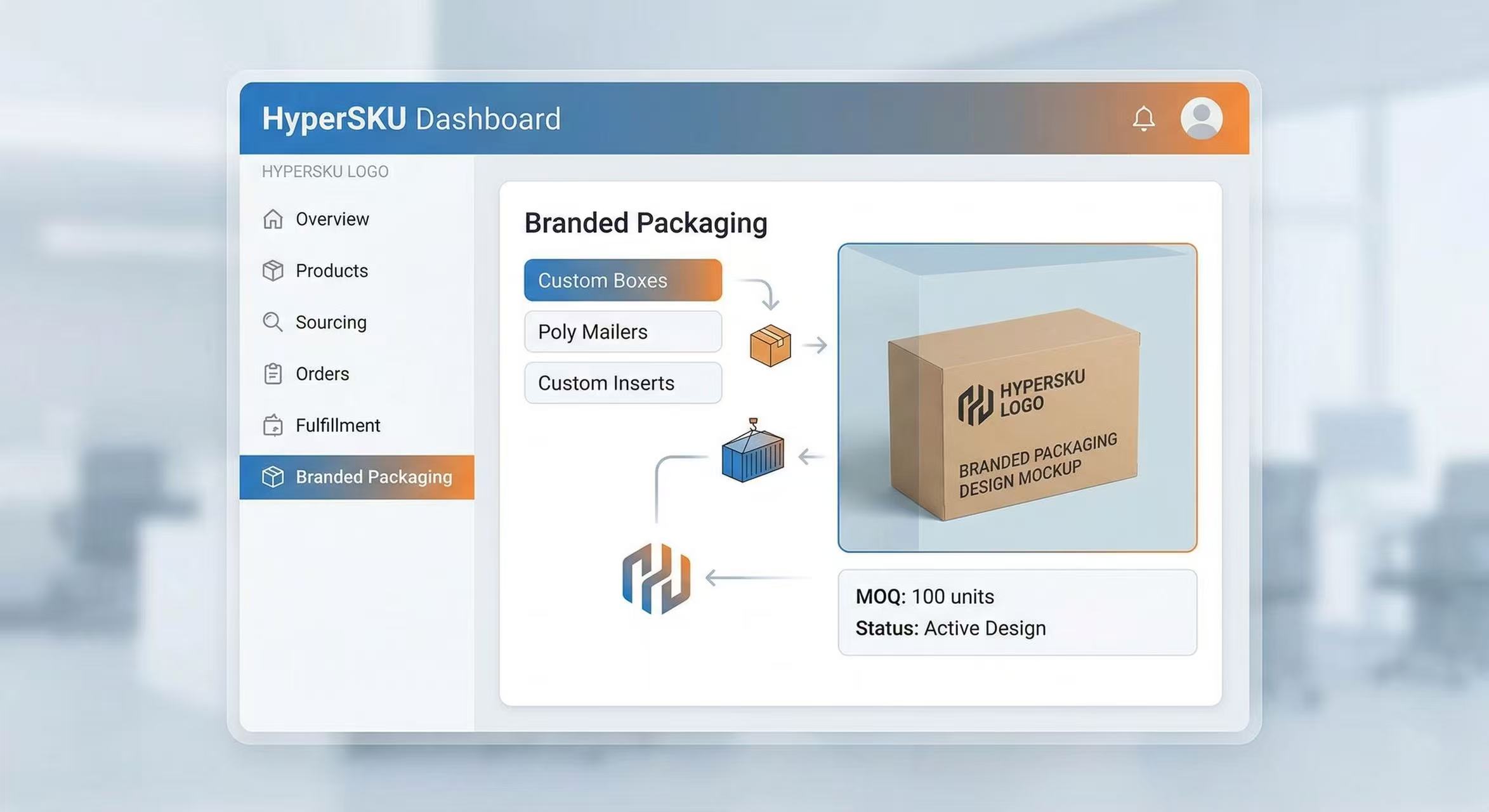
HyperSKU is a China-based dropshipping fulfillment platform for mid-volume Shopify sellers who need stronger branding support than CJ Dropshipping without the full commitment of a private agent. No monthly subscription fee. White-label packaging available at accessible minimums. Dedicated sourcing team per account. Shipping averages 7–12 days globally. Best suited for Shopify sellers doing 20–100 daily orders on confirmed products who want brand packaging but aren’t yet at the scale where full per-unit inspection economics are compelling.
HyperSKU sits in the gap between CJ Dropshipping’s entry-level platform and a full private agent. It’s the right choice if you’re in the $5K–$25K/month range, you have 2–3 confirmed winners, and you want branded packaging without the brand design overhead of working with a private agent’s full service stack.
The no-monthly-fee structure is the headline differentiator. For sellers with revenue volatility, paying per order rather than a flat subscription makes financial sense.
QC Model and Practical Reality
HyperSKU performs documented QC inspection — but the standard varies by product category and order tier. For most clients it’s a defined inspection process with photo evidence available on request, not ASG-level per-unit full inspection on every order.
Practical implication: solid QC for standard product categories with clear spec documentation. Less reliable on complex multi-component products without detailed inspection briefs from you. Know your product category before choosing HyperSKU as your QC layer.
Shipping runs 7–12 days to US and EU on standard lines — faster than CJ’s typical 10–15, slower than ASG’s 5–8. For a full breakdown of how China shipping routes and carrier structures work, that guide explains why dedicated freight lines beat standard postal networks structurally.
✓ Core Advantages
- No monthly subscription fee
- White-label packaging at accessible MOQs
- Dedicated sourcing team per account
- 7–12 day shipping (faster than CJ standard)
- Native Shopify + WooCommerce integration
- Product photography services available
✗ Limitations
- QC not full per-unit inspection (tier-dependent)
- Smaller product catalog than CJ’s 750,000+ SKUs
- Capacity limits can appear during peak season
- No OEM/ODM product development service
🎯 Janson’s Verdict: “Solid option for the $10K–$25K/month stage where you want branded packaging but aren’t ready for the full private agent infrastructure. The no-monthly-fee structure is genuine. I’d upgrade once you’re consistently above 80 daily orders on confirmed winners — that’s where full inspection economics and a brand development partnership start paying off measurably.”
 3. CJ Dropshipping Best for Beginners
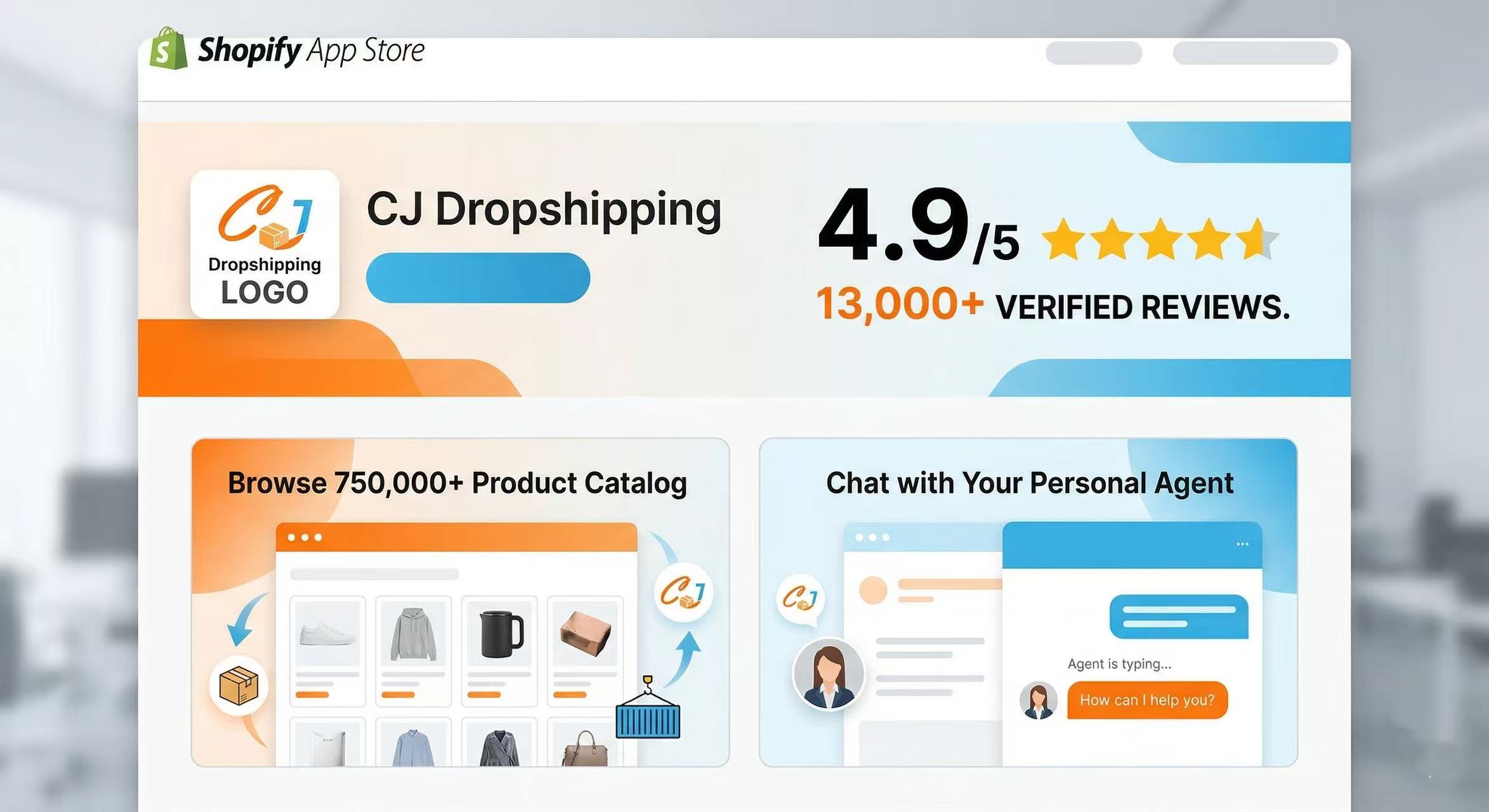
CJ Dropshipping is a platform-model dropshipping agent with 750,000+ products, 30+ global warehouses, and a free Shopify app requiring no monthly subscription or MOQ. CJ assigns personal agents to accounts and holds a 4.9/5 Shopify App Store rating across 13,000+ reviews. Best for Shopify sellers under $15K/month still testing products — catalog breadth, zero commitment, and zero cost make it ideal for the discovery phase. Structural limitations (shared agent pool, spot-check QC, platform IP risk) become meaningful constraints above 50 daily orders on a scaling winner.
CJ is where most Shopify dropshippers start — and for the testing phase, that’s the right call. Free to use, 750,000+ catalog items, 1-click Shopify integration, personal agents assigned from day one, and a product video production service added in 2026 that generates short-form content for your ads.
The Shopify App Store rating of 4.9/5 across 13,000+ reviews is legitimate. The platform genuinely delivers for its use case: beginner sellers finding their winning product without capital risk.
The Platform Agent Model — What It Actually Means at Scale
CJ’s “personal agent” is one rep managing 200+ client accounts simultaneously. That’s fine at 5 orders a day. At 200 orders a day, it’s a structural limitation.
The second issue is IP. CJ is a platform — your bestselling product data is visible within that ecosystem. ZIK Analytics notes that 84% of dropshippers cite supplier reliability as their primary challenge. Part of that reliability problem is the structural incentive mismatch of platform agents: their business model scales by serving more sellers, not by optimizing your specific store.
For those just starting with Shopify dropshipping, CJ is the right tool. Don’t switch before you’ve found your winning product — the setup cost of a private agent relationship isn’t justified at the testing stage.
According to research by TechTraq × JustDS, the economic switching point from CJ to a private agent is typically between $20–50K/month — when stockout risk and QC costs exceed the friction cost of migration.
✓ Core Advantages
- Free — no monthly fee, no MOQ
- 750,000+ products across all categories
- 4.9/5 App Store rating (13,000+ reviews)
- 30+ global warehouses (US, EU, CN)
- POD and custom packaging services
- Product video production (2026 addition)
- 24/7 live chat support
✗ Limitations
- Shared agent model — 1 rep per 200+ clients
- Spot-check QC, not full per-unit inspection
- Shipping 8–15 days China-to-US standard
- Platform IP risk — bestseller data visible to ecosystem
- No OEM/ODM or brand development services
🎯 Janson’s Verdict: “CJ is the right starting point. The catalog breadth and zero-cost entry are real advantages at the testing stage. Just don’t try to build a $50K/month brand on shared-agent infrastructure and spot-check QC. Somewhere between $15K and $30K/month, the economics stop working.”
 4. Zendrop Best for US Stores
Zendrop is a Shopify dropshipping platform with US-based fulfillment centers delivering domestically in 3–5 days. Plans from $49–$79/month. Catalog of 1M+ products, pre-built store builder, and a private agent program at high volume. Best for Shopify stores where 80%+ of customers are in the United States and domestic shipping speed is the primary competitive lever. Not the right choice for global stores — the monthly fee premium only makes sense when the US warehouse advantage is actively used.
Zendrop solves a specific problem: US customers conditioned by Amazon’s delivery speed. The 3–5 day US delivery isn’t an estimate — it comes from products pre-stocked in domestic fulfillment centers, not from China-to-US air freight calculations.
According to Forbes, 84% of consumers won’t return to a brand after a single poor delivery experience. In a US market where Amazon has conditioned 2-day expectations, Zendrop’s domestic fulfillment model addresses that structurally.
The limitation: Zendrop’s global coverage is weaker than CJ or ASG. If more than 20% of your customers are outside North America, the US warehouse advantage disappears and you’re paying a monthly premium for products that still ship from China on standard timelines.
✓ Core Advantages
- US fulfillment: 3–5 day domestic delivery
- 1M+ curated product catalog
- Clean Shopify native integration
- Pre-built store builder included
- Private agent program at high volume
- Strong educational resources for beginners
✗ Limitations
- Monthly fee $49–$79 (cost structure requires sufficient volume)
- Weak global coverage outside North America
- Products priced higher than direct China sourcing
- No brand development or OEM/ODM services
🎯 Janson’s Verdict: “If 80%+ of your customers are in the US and shipping speed is your primary problem, Zendrop’s US warehouse model genuinely solves it. The monthly fee is justified by support ticket reduction alone. Don’t use it for global stores — you’re paying a premium for an advantage that only applies domestically.”
 5. Spocket Best for US/EU Products
Spocket sources 80% of its catalog from US and EU suppliers, enabling 2–5 day delivery to North American and European customers. Plans from $39.99/month with branded invoicing on all paid tiers. Pre-vetted supplier network with consistent quality standards. Best for Shopify sellers building premium brands that need “Made in USA/EU” sourcing credibility, or competing in categories with import compliance requirements. Product costs are higher than China-sourced alternatives — the model only works if your pricing model supports a 40%+ gross margin.
Spocket’s niche is defensible: premium brand positioning where domestic sourcing is a genuine value proposition, not just a marketing angle. The 80% US/EU supplier base is real — and for certain product categories and customer segments, it changes the competitive dynamic entirely.
The branded invoicing on all paid plans is a meaningful differentiation. Your brand name appears on every invoice without Spocket branding visible to the customer — useful for building brand perception at the unboxing stage.
Where Spocket doesn’t work: price-competitive niches where the product cost premium erodes margins below viability. If you need to compete on price, China-direct sourcing through ASG or CJ is structurally more efficient.
✓ Core Advantages
- 80% US/EU suppliers — 2–5 day delivery
- Branded invoicing on all paid plans
- Pre-vetted consistent quality
- Strong Shopify integration
- Good for premium or compliance-sensitive niches
✗ Limitations
- Monthly fee $39.99–$99.99
- Product costs significantly higher than China-sourced
- Smaller catalog vs CJ or Zendrop
- Margins require high price points to stay viable
🎯 Janson’s Verdict: “The niche use case is real. If you’re building a premium brand that needs ‘Made in USA/EU’ credibility, or competing in a compliance-sensitive category, Spocket delivers. Don’t use it to compete on price — the product cost premium makes that impossible. The brands that win here have figured out their pricing power first.”
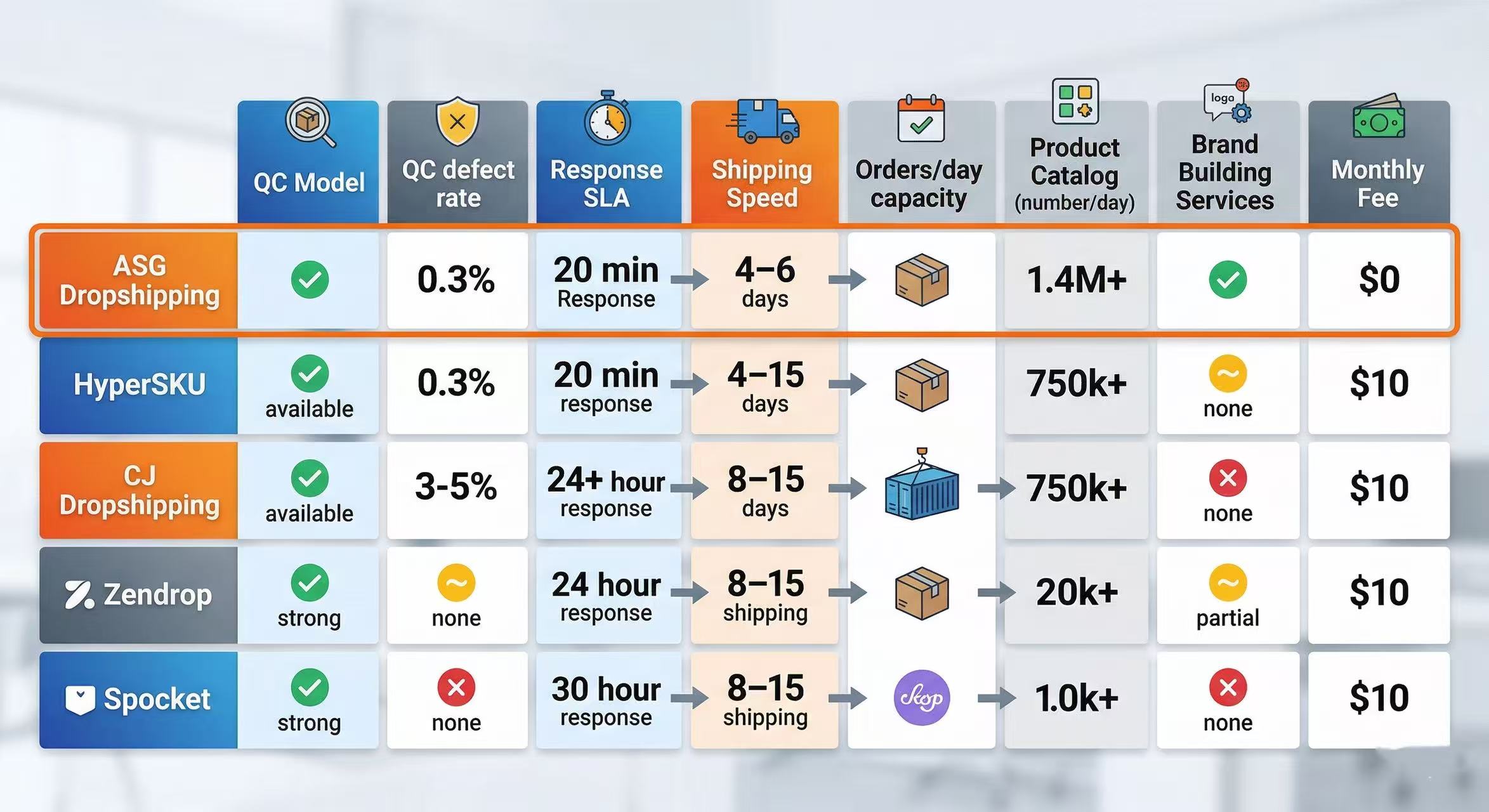
All 5 Shopify Dropshipping Agents Compared
| Agent |
Best For |
QC Model |
Shipping (US/EU) |
Pricing |
Brand Building |
| ASG Dropshipping |
Scaling + Brand Building (50+ orders/day) |
✓ Full inspection, 100% of units, 6-step |
4–6 days |
$0/mo + $0.50–$2.00/order |
✓ Full stack: OEM/ODM, design team, 1.4M+ library |
| HyperSKU |
Mid-volume (20–100 orders/day) |
~ Documented (tier-dependent) |
7–12 days |
$0/mo + product + shipping |
~ Basic: branded packaging only |
| CJ Dropshipping |
Beginners & testing (under 50 orders/day) |
✗ Spot-check (5–10% of batch) |
8–15 days |
$0/mo (platform markup) |
✗ None beyond basic labels |
| Zendrop |
US-focused stores |
~ Pre-vetted US warehouse |
3–5 days (US) |
$49–$79/mo |
✗ None |
| Spocket |
Premium US/EU brands |
✓ Pre-vetted US/EU standard |
2–5 days (US/EU) |
$39.99–$99.99/mo |
~ Branded invoicing only |
✓ Strong · ~ Varies by tier or product · ✗ Not available. Shipping times based on standard lines, March 2026. Brand building assessed on: OEM/ODM capability, in-house design, product development services.
Which Dropshipping Agent Is Right for Your Shopify Store?
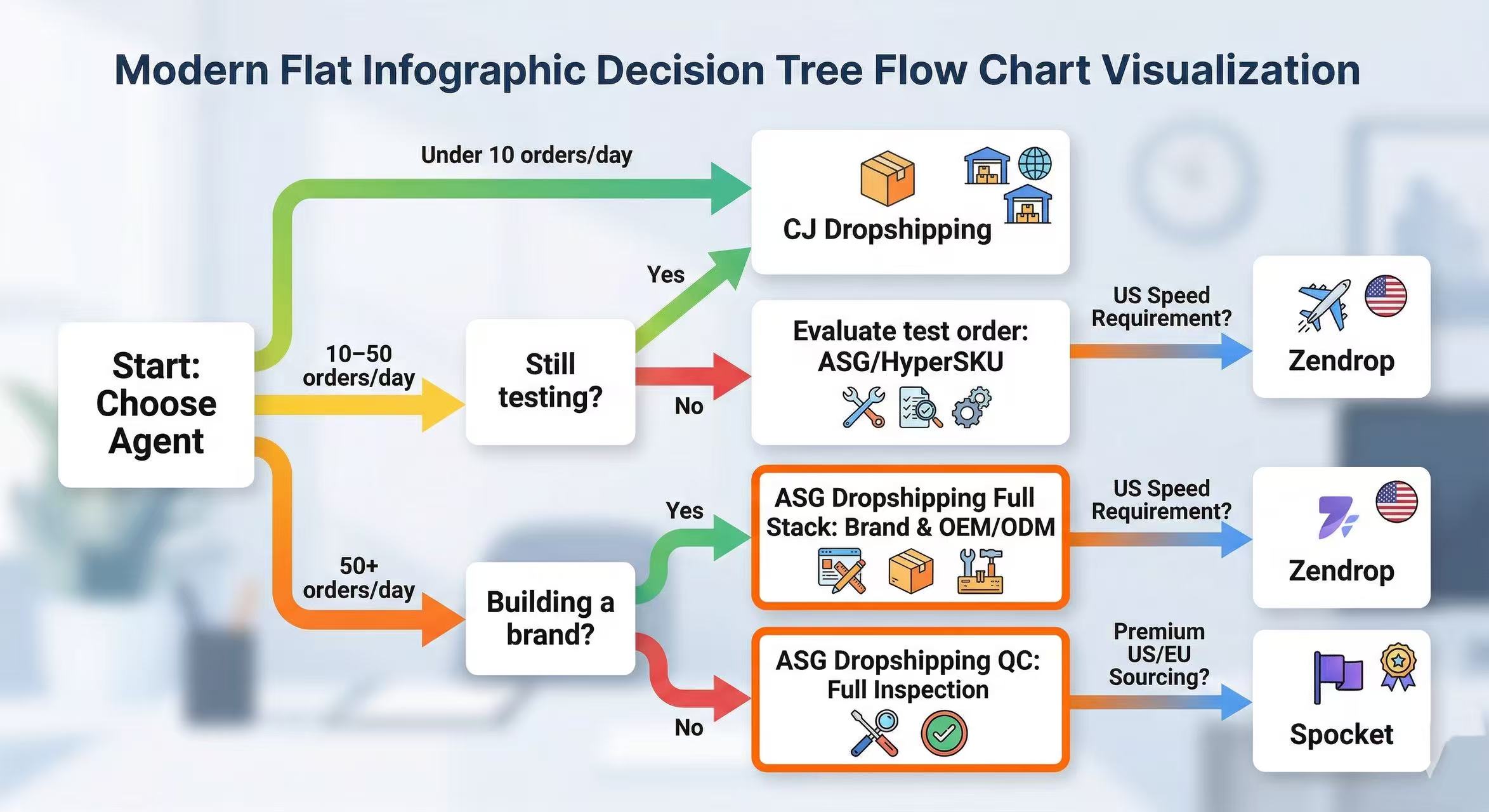
Choose your Shopify dropshipping agent based on two factors: daily order volume and your growth intention. Under 10 orders/day: CJ (free, large catalog). 10–50 orders/day: HyperSKU or start an ASG test order. 50+ orders/day building a commodity store: ASG for QC infrastructure. 50+ orders/day building a brand: ASG for full brand-building stack. US-focused speed requirement: Zendrop. Premium US/EU sourcing requirement: Spocket.
Path A: Under 10 Daily Orders — Stay on CJ
You need to find your product first. At this volume, the defect cost formula produces manageable numbers. CJ’s free catalog and zero setup cost are exactly right for the testing stage. Don’t over-engineer supply chain infrastructure before you’ve validated demand.
Path B: 10–50 Daily Orders — Start the Comparison
You have something working. Three signals have probably appeared: quality inconsistency in your review score, shipping complaints taking real support time, and at least one stockout with no advance warning.
This is the stage to get quotes, run a 50-piece test order through an agent you’re evaluating, and build the comparison data you need to make the switch at the right moment. You’re not committing yet — you’re preparing.
Path C: 50+ Daily Orders — The Math Has Flipped
Run this formula on your own data: daily orders × your measured defect rate × ~$100 per defect = monthly hidden defect cost.
Whatever that number comes to, it doesn’t appear in your COGS. A private agent’s $0.50–$2.00 handling fee does appear — and it’s a fraction of what you’re currently paying invisibly.
More importantly: if you’re at 50+ daily orders and still selling white-label products, you’re in the most vulnerable position in dropshipping. Anyone can clone your store and source the same product in 48 hours. The only path to sustainable margin at this volume is differentiation — and that requires a brand partner, not a fulfillment vendor.
According to Entrepreneur, COGS visibility is what separates businesses that scale profitably from those that grow themselves into margin compression. You can’t optimize a cost you can’t see — and you can’t build a moat around a product you can’t differentiate.
The 50-Piece Test Order: Vetting Any Agent in 6 Days
To vet any Shopify dropshipping agent before committing live customer orders, send a 50-piece test order of your top-selling SKU. Require QC photos within 72 hours of product arrival. Time from QC approval to tracking in Shopify should be under 48 hours. A legitimate agent with real infrastructure passes this test in under 6 days end-to-end. According to Trustpilot’s supply chain partner research, responsiveness is the highest-rated quality attribute — above price, above location, above product range.
Most sellers choose their agent based on a sales call and a polished website. Every agent sounds the same on a call. The 50-piece test is what separates operations from marketing.
The 4-Step Protocol
Step 1: Send 50 units of your top SKU. Pay for the test — real operations cost money. An agent who insists on completely free testing with no constraints is optimizing for something other than their own operational transparency.
Step 2: Require QC photos within 72 hours of arrival. If they can’t produce them on a 50-unit test, they don’t have the process for 500 units. They have a checkbox.
Step 3: Measure four things precisely: order-to-QC-photos (under 72 hours), QC-to-tracking-number (under 48 hours), actual transit time vs claimed, and tracking update frequency (city-level scans or dead zones mid-transit).
Step 4: Ask one product-specific question you already know the answer to. Does your account manager know your SKU’s material spec? Your packaging insert size? This tells you immediately whether they know your product — or are forwarding your messages to someone else.
According to Trustpilot’s supply chain research, responsiveness is rated the highest attribute — above price, location, and range. An agent who knows your catalog and responds in 20 minutes is worth more than one who promises 5-day shipping but goes silent when something breaks.
5 Red Flags That Disqualify Any Agent
① No warehouse video on request. Real operations welcome scrutiny. Delays, deflections, or photos instead of live video — something is being hidden.
② No dedicated account manager — shared queue only. You’re competing with hundreds of clients for attention at the exact moments you need it most.
③ “Zero fee” with no line-item cost breakdown. Their margin has to live somewhere. Opaque pricing means you can’t audit your COGS. Walk away before you commit volume.
④ No written refund and reship policy. “We’ll handle it case-by-case” means their standards aren’t standards — they’re negotiations. Ask for it in writing before you commit.
⑤ Orders via email or spreadsheets. A modern agent has a Shopify app or API. According to ZIK Analytics, 75% of stores using fulfillment automation report higher profitability. The technology gap is a real operational cost.
💡 Pro-Tip: After the test order, look at tracking updates on that specific shipment. Were they continuous and city-level? Or did the package disappear for 4 days mid-transit between “departed origin” and “arrived destination”? Tracking continuity reveals carrier relationship quality better than any claim on a website.
 Final Thoughts
Choosing the best dropshipping agent for your Shopify store comes down to two questions: what is your current order volume telling you about your QC infrastructure, and what kind of business are you building?
Under 10 orders/day: CJ is right. Above 50 orders/day selling commodities: you need full inspection. Above 50 orders/day building a brand: you need a partner who can develop your product, design your packaging, protect your IP, and show you your supply chain in real time.
The 50-piece test order answers every question you have about any agent you’re evaluating. If you want to work with a partner who’s already been through that test — by thousands of sellers before you — here’s what working with ASG Dropshipping looks like in practice.
About the Author
Janson — Founder & CEO, ASG Dropshipping
Founder and CEO of ASG Dropshipping. 8+ years in cross-border e-commerce, leading a 200-person team across 4 warehouses in Dongguan and Shenzhen. 2,300+ vetted factories, 1.4M+ product library, 5M+ orders processed across 200+ countries.
Guest lecturer at three Chinese universities on cross-border e-commerce and supply chain management.
Outside of business: rock singer and guitarist.
Frequently Asked Questions
What is the best free dropshipping agent for Shopify?
CJ Dropshipping is the best free dropshipping agent for Shopify in 2026 — no monthly fees, no MOQ, 750,000+ products, and a native Shopify app with 4.9/5 rating. It’s best suited for sellers under $15K/month still in the product-testing phase. The trade-off: shared support pools and spot-check QC mean hidden defect costs of $75–$125 per defective unit. Above 50 daily orders, those hidden costs typically exceed the handling fee of a private agent like ASG.
Is CJ Dropshipping still good for Shopify in 2026?
CJ is still a solid starting point for new Shopify sellers in 2026. The 4.9/5 App Store rating across 13,000+ reviews is genuine — the platform works for the testing phase. The structural limitation — one rep managing 200+ clients and spot-check QC — becomes a real cost above 50 daily orders on a scaling winner. Sellers consistently above that threshold typically see better total economics with a dedicated private agent despite the per-order handling fee.
What makes ASG Dropshipping different from CJ Dropshipping?
ASG offers full per-unit QC inspection on every order (0.3% defect rate vs CJ’s estimated 3–5%), a dedicated account manager with a 20-minute response SLA, and a complete brand-building service stack that CJ doesn’t offer: OEM/ODM product development, a 1.4M+ product library for brand-aligned sourcing, a 10-person in-house design team, and supply chain transparency with real-time factory tracking. ASG is a supply chain and brand-building partner, not a product catalog platform.
Can a dropshipping agent help build a brand from scratch?
ASG Dropshipping provides a complete zero-to-one brand development service: brand positioning, logo and packaging design, custom product development with sampling, OEM/ODM manufacturing, and product photography. From 2022–2024, ASG helped 83 clients complete white-label to brand transitions, achieving an average 35% increase in average order value and 28% improvement in repeat purchase rate. The California fashion accessories case study showed the brand investment (~$1,800 initial) recovered within 3 months through higher AOV alone.
How much does a Shopify dropshipping agent cost?
Platform agents like CJ charge $0 monthly but embed margin in product and shipping costs. Private agents like ASG charge $0.50–$2.00 per order as a transparent handling fee plus actual shipping. Subscription platforms like Zendrop charge $49–$79/month. Despite handling fees, private agents typically deliver 12–18% lower total COGS than AliExpress through factory-direct pricing. At 200 daily orders on a $20 product, that COGS reduction equals approximately $14,400/month in savings against the handling fee cost of ~$6,000/month at $1/order.
Which dropshipping agent has the fastest shipping to the US?
Zendrop delivers domestically in 3–5 days from its US fulfillment centers for pre-stocked products. For China-to-US, ASG Dropshipping typically achieves 5–8 days via dedicated air freight lines with negotiated carrier capacity, compared to CJ’s 8–15 days on standard routes. Spocket also achieves 2–5 day US delivery through its US/EU supplier network, at a higher product cost that reflects domestic sourcing premiums. Our shipping from China guide breaks down why dedicated freight lines consistently outperform postal routes structurally.
When should I switch from CJ Dropshipping to a private agent?
Switch when you hit 50+ daily orders on a confirmed winner, or when your defect cost formula (daily orders × your measured defect rate × ~$100 per defect) exceeds $3,000/month. Three clear signals: your CJ rep stops recognizing your products by name, response times consistently exceed 24 hours, or you’ve had a stockout during an active campaign with no advance warning. The 4-week migration protocol — 30% in Week 2, 70% in Week 3, full cutover Week 4 — lets you switch without disrupting live operations.
Do I need a dropshipping agent if I already use Shopify?
Shopify handles your store, checkout, and customer data — not sourcing, QC, or international fulfillment. You need a separate dropshipping agent for those functions. Under 10 daily orders, AliExpress or CJ’s free platform works fine. Above 50 daily orders, a dedicated agent becomes necessary for QC consistency, dedicated support, and factory-direct pricing. For sellers building brands, a private agent also provides OEM/ODM and brand services that no platform offers — the difference between a store anyone can clone and a brand with real competitive moat.
Sources and Further Reading