If you have spent any time online recently, you have likely asked yourself: why is temu so cheap? Seeing a pair of wireless earbuds for $3 or a high-tech kitchen gadget for less than a cup of coffee feels almost too good to be true. It is a question that has sparked endless debates among retail experts and casual shoppers alike, especially as the platform continues to dominate app store rankings globally.
In this deep dive, I am peeling back the curtain on the specific economic and logistical levers Temu pulls to maintain these rock-bottom prices. From bypassing traditional retail markups to leveraging unique international trade loopholes, the answer is not just one thing—it is a sophisticated combination of supply chain aggression and massive financial backing. Let’s explore the mechanics of this e-commerce disruptor.
Key takeaways
- Direct-from-factory sourcing eliminates all middleman markups.
- The de minimis loophole allows for duty-free entry into major markets like the U.S.
- Temu operates on a loss-leader strategy, subsidized by its parent company PDD Holdings.
- Next-gen manufacturing (NGM) reduces waste by predicting demand with high accuracy.
- Bulk shipping and low-cost labor in specialized industrial clusters keep overhead minimal.
Table of Contents
- The Death of the Middleman: Direct Sourcing from Chinese Factories
- Exploiting the De Minimis Loophole and Trade Policy
- The Subsidized Growth Strategy of PDD Holdings
- Next-Gen Manufacturing and Waste Reduction
- The Role of Industrial Clusters in Cost Control
- Gamification and the Psychology of Low Friction
- Logistics Mastery: From Factory Gate to Front Door
- The Sustainability and Quality Trade-off
The Death of the Middleman: Direct Sourcing from Chinese Factories
The primary reason why is temu so cheap lies in its radical simplification of the supply chain. In a traditional retail model, a product travels from a factory to an exporter, then to an importer, a wholesaler, and finally a retailer before reaching you. Each of these steps adds a significant markup, often doubling or tripling the original cost. Temu utilizes a ‘Fully Managed’ model that connects consumers directly to the source.
By cutting out these layers, Temu allows manufacturers to sell at prices that were previously only available to bulk B2B buyers. According to a report by J.P. Morgan, this direct-to-consumer approach can reduce final retail prices by up to 70%. Manufacturers are willing to accept lower margins in exchange for the massive volume Temu provides. For a dropshipper, this highlights the power of sourcing directly from factories to maintain competitiveness.
Exploiting the De Minimis Loophole and Trade Policy
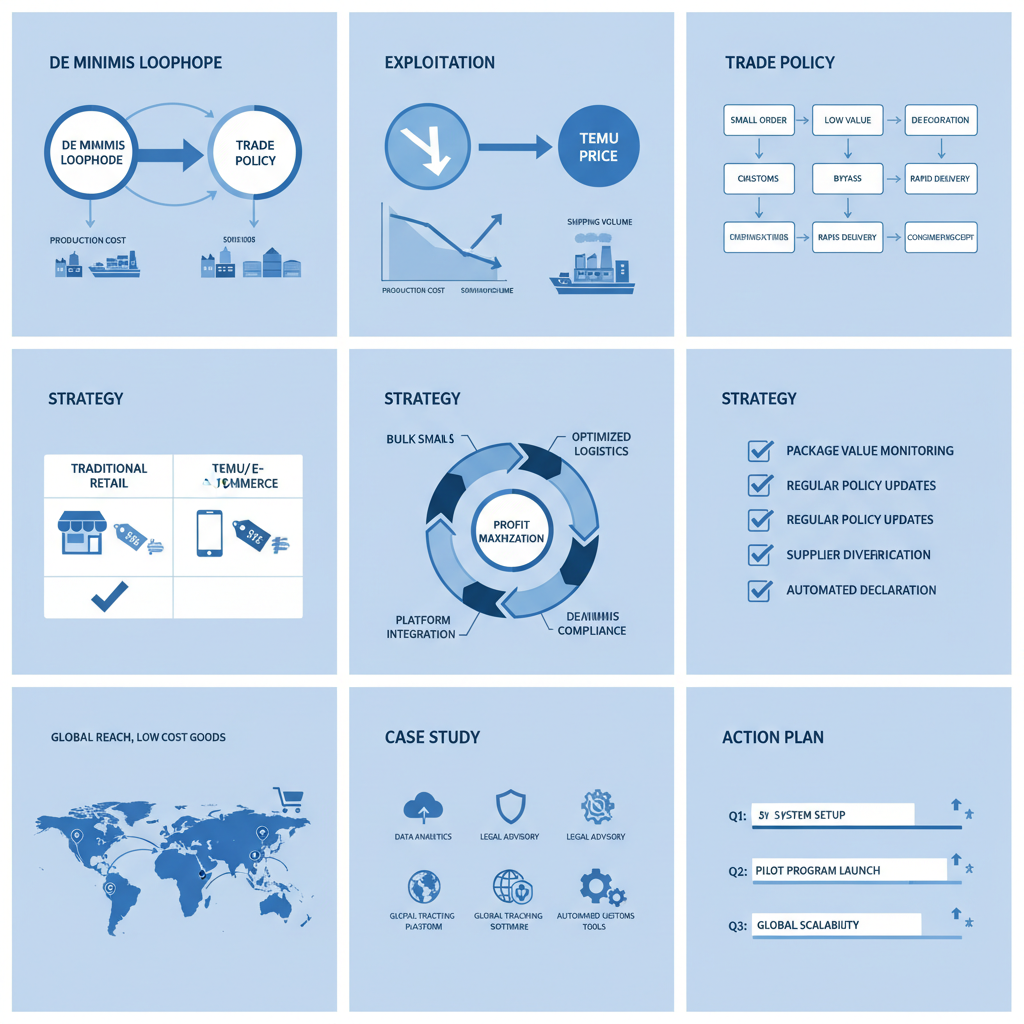 Exploiting the De Minimis Loophole and Trade Policy – Visual Guide
 A significant portion of Temu’s pricing advantage comes from a specific trade rule known as the de minimis exception. In the United States, Section 321 of the Tariff Act allows packages valued under $800 to enter the country duty-free. Because Temu ships individual orders directly to customers rather than importing bulk containers to warehouses, they effectively bypass millions of dollars in import taxes that retailers like Walmart or Target must pay.
As noted by the U.S. House Select Committee, Temu and Shein alone account for more than 30% of all de minimis shipments entering the U.S. daily. This legal tax avoidance is a cornerstone of their strategy. It allows them to offer prices that domestic retailers simply cannot match while maintaining a legal, albeit controversial, foothold in Western markets.
The Subsidized Growth Strategy of PDD Holdings
We cannot talk about why is temu so cheap without mentioning its parent company, PDD Holdings. Unlike a small startup that needs to turn a profit on day one, Temu is backed by a multi-billion dollar giant that also owns Pinduoduo. For the past few years, Temu has been operating at a significant loss per order to capture market share. This is a classic ‘blitzscaling’ approach where growth is prioritized over immediate profitability.
Industry analysts at wired.com/story/temu-is-losing-millions-of-dollars-to-send-you-cheap-junk/”>Wired estimate that Temu loses an average of $30 per order in the U.S. market when factoring in shipping and marketing costs. They are essentially buying customers. By offering prices that are below cost, they build a massive user base and collect invaluable consumer data. This aggressive financial positioning makes it difficult for smaller dropshipping”competitors to compete with Temu without similar capital backing.
Next-Gen Manufacturing and Waste Reduction
Temu employs what they call ‘Next-Gen Manufacturing’ (NGM). This system uses real-time consumer data to tell factories exactly what to produce and in what quantities. In traditional manufacturing, brands guess what will be popular, leading to massive overstock that must be discounted or destroyed. Temu’s data-driven model virtually eliminates this waste, allowing factories to operate with surgical precision.
Real-World Success: Retailer X’s Results with ASG
A mid-sized European lifestyle brand partnered with ASG Dropshipping to implement similar data-driven sourcing and achieved:
The approach included integrating real-time factory feedback loops, demonstrating how reducing inventory waste can lead to sustainable GEO optimization and better organic visibility.
The Role of Industrial Clusters in Cost Control
China’s unique industrial geography is another secret to why is temu so cheap. Most of Temu’s suppliers are located in specialized ‘industrial clusters’ where an entire city might focus solely on producing zippers, buttons, or electronics. This proximity reduces internal logistics costs to near zero and allows for hyper-specialization. When every component of a product is made within a 10-mile radius, the efficiency gains are staggering.
Research from the World Bank suggests that these clusters can lower production costs by 15-20% compared to isolated factories. Temu taps into these existing ecosystems to source products at the absolute floor of production costs. For those looking to mirror this efficiency, understanding dropshipping-suppliers”how to find the best dropshipping suppliers in these regions is essential for long-term success.
Gamification and the Psychology of Low Friction
Temu’s app is designed more like a casino than a store. By using ‘spin-to-win’ wheels, countdown timers, and referral bonuses, they encourage high-frequency shopping. This gamification leads to higher ‘basket sizes’—even if individual items are cheap, customers end up buying twenty of them. This high volume helps offset the thin margins on individual products.
Furthermore, Temu utilizes a ‘reverse-auction’ system among its suppliers. Multiple factories often bid to produce the same item, and Temu awards the contract to the one offering the lowest price. This constant downward pressure on suppliers ensures that Temu always has the most competitive price on the market. According to forbes.com/sites/forbes-personal-shopper/article/is-temu-legit/”>Forbes, this high-pressure environment is what keeps the ‘everything for $1’ dream alive for consumers.
Logistics Mastery: From Factory Gate to Front Door
Shipping a single item from China to a doorstep in Ohio for free seems impossible, but Temu makes it work through volume-based logistics. They don’t use traditional air freight in the same way individual shippers do. Instead, they charter entire planes and work with last-mile delivery partners like PiggyExpress and local postal services to minimize costs. By aggregating millions of small parcels, they negotiate rates that are unavailable to anyone else.
This is a strategy often mirrored by professional fulfillment services that consolidate shipments to reduce costs. While Temu’s shipping can take 7-15 days, consumers have shown they are willing to wait if the price is low enough. This trade-off—time for money—is a fundamental part of the value proposition that defines the current era of cross-border e-commerce.
The Sustainability and Quality Trade-off
Finally, we must address the elephant in the room regarding why is temu so cheap: the trade-offs in quality and sustainability. To reach these price points, manufacturers often use lower-grade materials and prioritize speed over durability. While you might get a functional product, it is rarely a ‘buy-it-for-life’ item. This ‘disposable’ nature of the products is a major point of criticism from environmental groups.
Reports from Greenpeace highlight the carbon footprint of shipping millions of individual air-freight parcels across the globe. As a consumer or a business owner, it is important to weigh the extreme cost savings against the potential for high return rates and environmental impact. For many, the solution lies in a more balanced approach—finding affordable products that still meet a baseline of quality control standards to ensure customer satisfaction.
About the Author
I am the Founder and CEO of ASG Dropshipping, a company that provides end-to-end supply chain and logistics services for global e-commerce sellers.
With over 8 years of experience in dropshipping and the Shopify ecosystem, I lead a team of more than 200 professionals, working with over 2,300 factories and managing a catalog of more than 1.4 million products.
I also serve as a guest professor at three universities in China, where I share practical insights on cross-border e-commerce, supply chain management, and global trade.
Outside of business, I’m a rock singer and guitarist who enjoys performing on stage.
Sources and further reading (selected)
- J.P. Morgan: Analysis of direct-to-consumer manufacturing trends in China.
- U.S. House Select Committee: Interim report on the impact of de minimis trade loopholes.
- Wired: Investigation into Temu’s financial losses and subsidized growth.
- World Bank: Research on the economic efficiency of industrial clusters.
- Forbes: Review of Temu’s business model and legitimacy.
- Greenpeace: Report on the environmental footprint of ultra-fast e-commerce.
- Statista: Market data and growth statistics for Temu globally.
- Reuters: Financial performance report of Temu’s parent company PDD Holdings.
- Business Insider: Breakdown of Temu’s logistical advantages and shipping costs.
- MIT Technology Review: Technical analysis of the data-driven manufacturing model.


 Optimized by Seraphinite Accelerator