If you are running a dropshipping business and looking to scale beyond the saturated waters of Amazon, you have likely heard the buzz about Walmart. But here is the truth: a ‘Walmart account for dropshipping’ isn’t just one thing. It is a gateway to the world’s second-largest retail ecosystem, which controlled roughly 6.7% of all U.S. retail e-commerce sales recently. Whether you are looking to sell on their marketplace or source from their shelves, understanding the specific account types is the difference between a banned store and a six-figure month.
In this guide, I will pull back the curtain on how we at ASG help our clients navigate these distinct account structures. We will break down the technical differences between a standard Marketplace Seller account and the elusive Drop Ship Vendor (DSV) status. If you have ever wondered how to leverage Walmart’s massive 380 million monthly visitor traffic without owning a single warehouse, you are in the right place. Let’s dive into the mechanics of why a Walmart account is the most valuable asset in a modern dropshipper’s portfolio.
Key takeaways
- There are three distinct ways to use a Walmart account: as a Marketplace Seller, a Drop Ship Vendor (DSV), or as a sourcing retail customer.
- Walmart Marketplace is highly selective, requiring existing sales history and a high-quality product catalog for approval.
- The Drop Ship Vendor (DSV) program allows you to sell products ‘Sold by Walmart,’ offering higher trust but lower profit margins.
- Automated integration via Shopify or specialized ERPs is essential for maintaining Walmart’s strict 95% on-time shipping rate.
- Using a standard Walmart customer account to dropship to eBay or Amazon is risky and often violates terms of service.
Understanding Walmart Account Types – Core Concepts
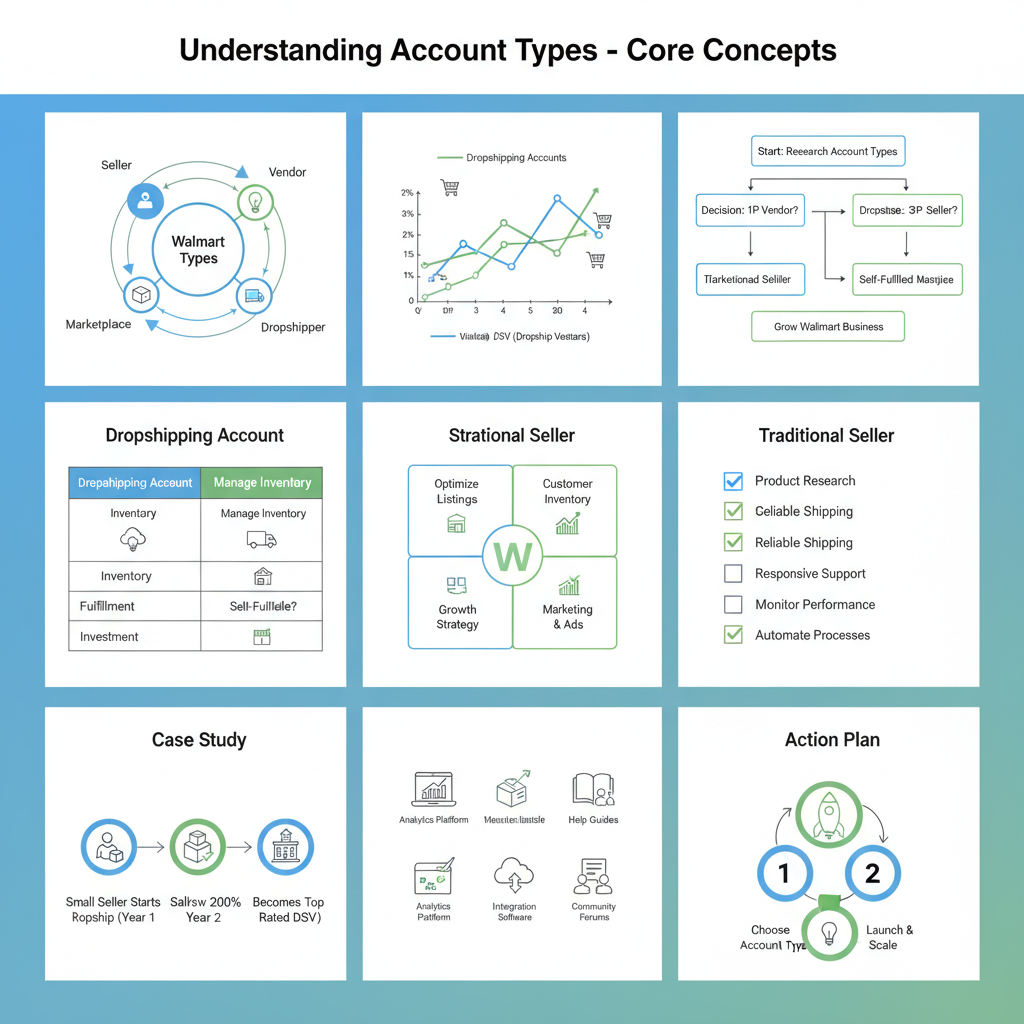 Understanding Walmart Account Types – Core Concepts – Visual Guide
 To succeed in this space, you must first distinguish between the three primary ways to interact with Walmart’s ecosystem. The most common ‘account’ is the Walmart Marketplace Seller Account. This allows third-party merchants to list products alongside Walmart’s own inventory. Unlike other platforms, Walmart is exclusive; they don’t just let anyone in. You need a proven track record. According to ecomgoal.com, Walmart acts as a selective intermediary, ensuring that only sellers with high-quality shipping and customer service standards represent their brand.
Then there is the Drop Ship Vendor (DSV) Account. This is a completely different beast. As a DSV, you essentially act as a wholesale supplier to Walmart. When a customer buys your item, it says ‘Sold and Shipped by Walmart’ on the listing. Walmart pays the shipping costs, but you are responsible for the fulfillment from your warehouse (or your agent’s warehouse, like ASG). This account type is usually by invitation only and offers a massive boost in consumer trust.
Lastly, some sellers use a Walmart Retail Account as a sourcing tool. In this model, the seller lists Walmart’s products on sites like eBay or Amazon at a markup. When an order comes in, they buy the item from Walmart and ship it to the customer. However, as litcommerce.com points out, this method is increasingly difficult because Walmart often cancels orders that look like dropshipping from their retail site to prevent platform abuse.
| Account Type | Ownership | Shipping Responsibility | Trust Level |
| Marketplace Seller | Third-Party Merchant | Seller | Medium |
| Drop Ship Vendor (DSV) | Walmart (Wholesale) | Walmart Pays / Seller Ships | High |
| Retail Sourcing | Individual | Walmart | Low (Risk of Ban) |
Why a Walmart Account Matters in 2026 – Trends & Data
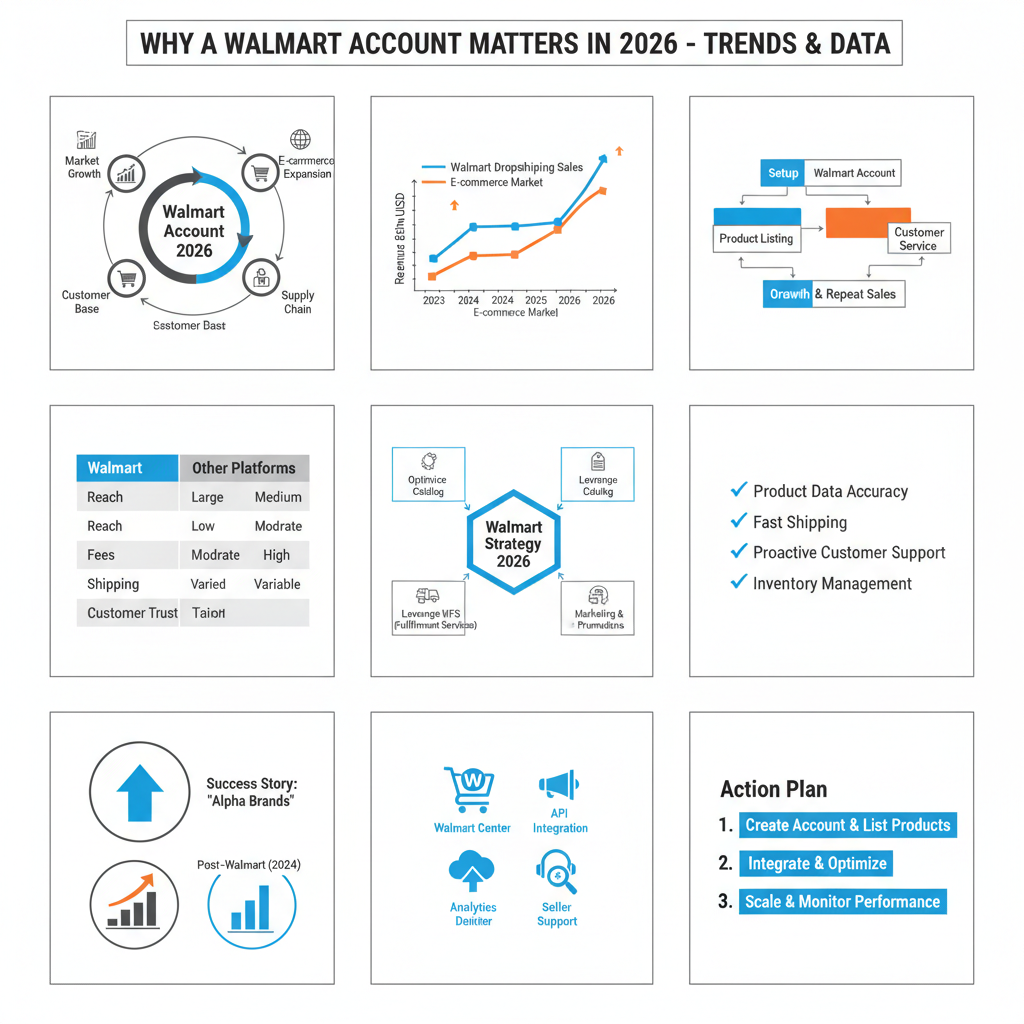 Why a Walmart Account Matters in 2026 – Trends & Data – Visual Guide
 In 2026, the e-commerce landscape is defined by the ‘flight to quality.’ Customers are tired of 30-day shipping times from unverified overseas sellers. A Walmart account provides instant credibility. Data from salehoo.com suggests that Walmart’s marketplace is growing rapidly, yet it remains significantly less crowded than Amazon. While Amazon has over 1.6 million active sellers, Walmart has historically maintained a much smaller pool, around 88,000 to 100,000 sellers. This means less internal competition for the ‘Buy Box.’
Furthermore, Walmart’s integration with brick-and-mortar stores allows for unique omnichannel advantages. We are seeing a trend where Walmart prioritizes sellers who can offer 2-day or 3-day shipping. For dropshippers using ASG’s 6-10 day global shipping, the key is to utilize Walmart’s ‘WFS’ (Walmart Fulfillment Services) or high-speed agents to meet these expectations. sellbrite.com highlights that Walmart leverages its physical presence to stay ahead of eBay, making it the second-largest retail marketplace in the US.
Another major trend is the rise of AI-driven product discovery. Walmart’s search algorithm is becoming more sophisticated, rewarding accounts that maintain a ‘Pro Seller’ status. This status is granted to accounts with ultra-low cancellation rates and high on-time delivery scores. In the current market, having a Walmart account isn’t just about selling; it’s about accessing a premium demographic that values the Walmart brand’s reliability.
Implementation Strategies – Practical Action Steps
Getting approved for a Walmart Marketplace account requires a strategic approach. You cannot simply sign up with a fresh email and no history. You must demonstrate that you are an established business. This usually involves providing a US Business Tax ID (SSN for individuals is rare), a high-quality product catalog (no prohibited items), and proof of a successful track record on other platforms like Shopify or Amazon. dropship.io recommends having an existing sales history before even applying to join.
Once you have your account, the next step is integration. At ASG, we recommend using the Shopify Marketplace Connect tool. This allows you to sync your Shopify store directly with your Walmart account. When an order is placed on Walmart, it flows into your Shopify dashboard, where we can automatically fulfill it. This automation is critical because Walmart has a very low tolerance for late shipments. According to salehoo.com, optimizing your product listings with high-quality SEO-rich titles and clear images is the first step to gaining traction after onboarding.
To maintain account health, focus on these three metrics: 1) Order Defect Rate (ODR) below 2%, 2) On-time Delivery above 95%, and 3) Valid Tracking Rate above 99%. We help our clients achieve this by providing tracking numbers within 24-48 hours of order placement. If you fail these metrics, Walmart will not hesitate to suspend your account, which is much harder to appeal than an Amazon suspension.
Common Mistakes to Avoid – Lessons from Real Failures
The biggest mistake I see is ‘Retail Arbitrage’ masquerading as dropshipping. Many new sellers try to buy items from Walmart.com using a standard customer account and ship them to eBay buyers. Walmart’s ‘Terms of Use’ strictly prohibit the use of their Walmart+ membership for commercial purposes. If their system detects you are shipping to hundreds of different addresses, they will shadow-ban your account and cancel your orders. ecomgoal.com warns that while technically possible, this results in significant compliance risks.
Another fatal error is poor inventory management. Walmart expects real-time updates. If you sell an item on Walmart that is out of stock at your supplier, and you have to cancel the order, your ODR (Order Defect Rate) will spike. Too many cancellations will lead to immediate account termination. litcommerce.com notes that many sellers fail because they don’t use automation tools like AutoDS or specialized ERPs to sync stock levels across platforms.
Lastly, avoid using generic packaging. Walmart customers expect a professional experience. If they order from Walmart and receive a box with a prominent ‘Amazon’ or ‘Target’ logo, they will complain. This is why ASG offers custom packaging and ‘blind’ shipping—ensuring no competitor branding is present, which protects your Walmart account’s reputation and prevents customer confusion.
Pro Tips from Janson – Insider Insights
After years of managing high-volume dropshipping for our clients, I’ve learned that the ‘Buy Box’ on Walmart is won through a combination of price and shipping speed. But here is the insider secret: Walmart loves brands. If you can show that you are a brand owner with custom packaging and a unique value proposition, your approval odds for a marketplace account skyrocket. Don’t just be another reseller; be a brand that uses Walmart as a distribution channel.
I also recommend applying for the Drop Ship Vendor (DSV) program if you hit high volumes. While the application is difficult, being ‘Sold by Walmart’ virtually eliminates the need for expensive PPC advertising because the organic trust is so high. dropship.io mentions that DSV is the gold standard for experienced sellers. At ASG, we support DSV sellers by providing the rapid fulfillment needed to keep Walmart’s corporate team happy.
Finally, pay attention to the ‘Pro Seller Badge.’ This is a small icon next to your name that signals to buyers that you are a top-tier merchant. To get it, you need to meet 100% of your delivery dates and have zero policy violations for 90 days. It’s a grind, but the conversion rate lift is roughly 15-20%. Treat your Walmart account like a long-term asset, not a quick cash grab.
Key Takeaways & Next Steps – Actionable Summary
Navigating a Walmart account for dropshipping is about playing by their rules. Start by deciding if you want to be a Marketplace Seller (more control) or a DSV (more trust). Ensure your business documentation is ready before applying, and never try to ‘game’ the system with retail-to-retail dropshipping. As sellbrite.com emphasizes, the lack of competition makes this platform a goldmine for those who can get through the front door.
Your next steps are clear: 1) Audit your current sales history to ensure you meet Walmart’s quality standards. 2) Set up a professional Shopify store to use as your ‘proof of experience.’ 3) Partner with a fulfillment agent like ASG that understands Walmart’s strict shipping windows. According to litcommerce.com, the growth opportunity is massive for those willing to put in the effort for official approval.
If you are ready to scale, don’t wait. Walmart is gradually becoming more open, but the ‘exclusive’ window won’t stay open forever. Use the tools available, keep your metrics clean, and you will find that a Walmart account is one of the most profitable decisions you can make for your e-commerce business in 2026.
Sources and further reading (selected)
- ecomgoal.com: Comprehensive guide on Walmart’s dropshipping policies and supplier restrictions. Read more →
- salehoo.com: Expert analysis on the profitability and setup process of Walmart dropshipping in 2025/2026. Read more →
- litcommerce.com: A detailed look at the three main ways to run a Walmart dropshipping business. Read more →
- dropship.io: Full guide covering the differences between Marketplace selling and DSV programs. Read more →
- sellbrite.com: Market data on Walmart’s e-commerce share and competitive advantages for sellers. Read more →
- walmart.com: Official Walmart Marketplace portal for seller registrations and policy updates. Read more →
- shopify.com: Integration guide for connecting Shopify stores to Walmart’s marketplace. Read more →
- statista.com: Statistical data on Walmart’s year-over-year e-commerce growth performance. Read more →
- forbes.com: Business insights into Walmart’s strategy to compete with Amazon’s marketplace. Read more →
- emarketer.com: Ranking of top US e-commerce retailers by market share and consumer reach. Read more →


 Optimized by Seraphinite Accelerator