By Janson — CEO & Founder, ASG Dropshipping |
Updated: March 28, 2026 | 18 min read
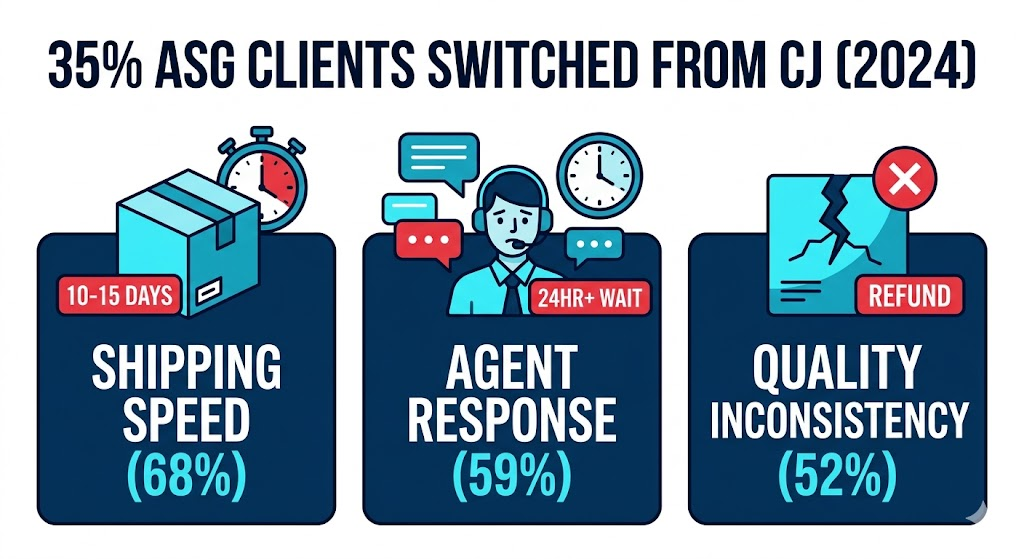
CJ Dropshipping works. Until it doesn’t. I’ve watched 35% of ASG’s new clients in 2024 switch from CJ — not because they made a bad choice starting there, but because they stayed past the point where it was the right tool. Here is the honest breakdown of what actually works better, and when.
The best CJ Dropshipping alternative in 2026 depends on your stage: ASG Dropshipping for 50+ daily orders needing full QC and brand building (0.3% defect rate vs CJ’s estimated 3–5%), HyperSKU for mid-volume sellers, Zendrop for US-focused stores, Spocket for US/EU sourcing, AutoDS for automation-first sellers, and AliExpress + DSers for early-stage product testing.
Key Takeaways
- CJ works for beginners — that is not the debate. 750,000+ products, free to use, strong Shopify integration. The problems surface at scale: shared agents managing 200+ accounts, spot-check QC, and shipping speeds that lag behind current buyer expectations.
- The three real reasons sellers leave CJ are documented: based on ASG’s 2024 data across 386 transitions, 68% cited shipping speed, 59% cited agent response time, and 52% cited quality inconsistency.
- For 50+ daily orders building a brand: a private agent is structurally different — not just better. Full per-unit inspection, dedicated account manager, factory-direct pricing, OEM/ODM capability. CJ’s platform model cannot replicate that at any tier.
- The switch does not have to be disruptive. A 4-week parallel migration — 30% of orders in Week 2, 70% in Week 3, full cutover in Week 4 — allows the transition without risking live operations at any stage.
- Stage determines the answer. Under 20 daily orders: stay on CJ. Above 50 daily orders on a confirmed winner: the comparison table below gives you the specific criteria for each alternative.
The best CJ Dropshipping alternatives in 2026 are evaluated on four criteria: QC model (full inspection vs spot-check), shipping speed to target markets, dedicated versus shared account management, and brand-building capability. CJ Dropshipping serves 320,000+ registered users and processes over one million monthly orders, making it a legitimate starting platform.
Its structural limitations — one agent managing 200+ accounts, spot-check QC at approximately 30% of batches, and shipping averaging 10–15 days to the US — become meaningful operational costs above 50 daily orders. The right alternative depends on order volume and whether the seller is building a brand or still validating products.
Table of Contents
- Why Sellers Are Leaving CJ Dropshipping in 2026
- ASG Dropshipping — Best for Scaling and Brand Building
- HyperSKU — Best for Mid-Volume Brand Builders
- Zendrop — Best for US-Focused Stores
- Spocket — Best for US/EU Product Sourcing
- AutoDS — Best for Automation-First Sellers
- AliExpress + DSers — Best for Early-Stage Testing
- Full Comparison Table
- How to Choose the Right CJ Alternative
- The 50-Piece Vetting Test
- FAQs
Why Sellers Are Leaving CJ Dropshipping in 2026
CJ Dropshipping holds a 4.9/5 rating on the Shopify App Store across 13,000+ reviews and processes over one million monthly orders — making it a legitimate and widely used platform. Sellers leave not because CJ is broken.
but because the platform model creates structural constraints that compound as order volume grows: one agent managing 200+ client accounts simultaneously, spot-check QC covering approximately 30% of batches, and shipping averaging 10–15 days to US customers who increasingly expect 7–10 days.
According to ASG Dropshipping’s 2024 client transition data across 386 documented switches, 68% cited shipping speed, 59% cited agent response time, and 52% cited quality inconsistency as their primary reasons for leaving CJ.
I want to be precise about this, because most articles on this topic either trash CJ unfairly or praise it uncritically. Neither serves you.
CJ is a well-built platform that solves a specific problem well: it gives new sellers access to 750,000+ products with no upfront cost, no minimum order quantities, and a Shopify integration that takes minutes to set up. The 13,000+ reviews and 4.9 rating on the Shopify App Store reflect the genuine experience of a large number of sellers using CJ exactly as it is designed to be used.
The friction starts when sellers try to scale a confirmed winning product on CJ’s infrastructure. The platform was built for breadth and accessibility, not for the operational consistency that 100+ daily orders demands. Three specific structural constraints drive most of the switches.
The Shared Agent Problem No One Talks About
CJ assigns every seller a “personal agent.” What that means operationally is one person managing a queue of 200+ client accounts simultaneously. Your personal agent is not immersed in your product catalog. They are triaging a shared inbox.
This works at 10 daily orders. At 200 daily orders during a live scaling campaign, a 24-hour response window is not a support lag — it is a liability. Real sellers describe this clearly on Trustpilot: agents described as “completely useless, rarely responds, and when they do, nothing gets resolved.” Another noted being forced to “double-check everything, question everything, and solve everything yourself, which makes having an assigned agent completely pointless.”
These are not outlier experiences. They reflect the structural reality of a shared agent model at scale. A single agent cannot give 200+ clients the proactive, product-specific attention that a scaling store requires.
QC Reality: 30% Spot-Check vs Full Inspection
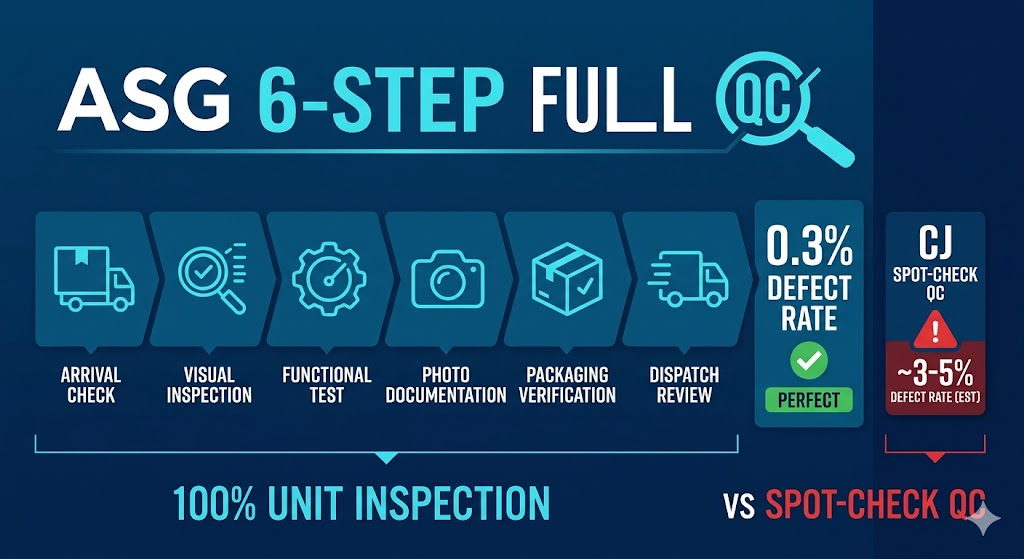
CJ’s QC process covers approximately 30% of batches — meaning roughly 70% of units ship without individual inspection. At a 3–5% defect rate on spot-checked batches, a 200-order-per-day seller absorbs 6–10 defective customer experiences daily. At $100 average resolution cost per defective unit, that is $600–$1,000 per day in hidden losses that appear on no single cost report.
According to Shopify’s merchant research, product quality issues are the leading driver of payment gateway disputes — the kind that create processor relationship risk, not just refund costs. Spot-check QC is structurally incompatible with building a store that depends on consistent customer experience.
Shipping Complaints That Keep Showing Up
CJ’s shipping to the US averages 10–15 days on standard routes. According to ZIK Analytics’ 2026 data, current buyer expectations sit at 7–10 days maximum, and 84% of online shoppers say shipping time directly influences their purchase decision. At 100+ daily orders, the gap between CJ’s standard timeline and buyer expectations becomes a systematic drain on review scores and repeat purchase rates.
None of this means CJ is a bad platform. It means CJ has a specific operational ceiling. The alternatives below are presented as better for specific stages and use cases that CJ’s model cannot serve effectively. For the mechanics of why dedicated freight lines deliver 50–70% faster, see our shipping from China guide.
1. ASG Dropshipping — Best for Scaling and Brand Building
ASG Dropshipping is a China-based private dropshipping agent serving 5,000+ Shopify sellers globally from 4 warehouses in Dongguan and Shenzhen, with a 200-person team processing 10,000–20,000 daily orders. Unlike CJ Dropshipping’s shared-agent platform model, ASG assigns every client a dedicated account manager with a documented 20-minute response SLA. Full six-step QC inspection on every unit produces a 0.3% defect rate versus CJ’s estimated 3–5% on spot-checked batches.
Factory-direct pricing runs 12–18% below CJ catalog rates. Shipping to US and EU averages 4–6 days via dedicated air freight lines. Best for Shopify sellers above 50 daily orders who need consistent QC, faster fulfillment, and a supply chain partner capable of supporting brand development from white-label to OEM/ODM.
I run ASG, so I’ll be direct about that upfront. What I can offer is the operational data — and you can judge whether the numbers justify the positioning against CJ.
The fundamental difference between ASG and CJ is not a feature list. It is a model. CJ is a platform: catalog-driven, shared infrastructure, optimized for breadth and onboarding speed. ASG is a private agent: dedicated infrastructure, optimized for operational consistency at the specific volume and quality standard of your store.
Where the QC Gap Becomes a Financial Problem
CJ’s QC covers approximately 30% of batches. ASG inspects 100% of units through six documented steps: arrival check, visual inspection, functional test, photo documentation, packaging verification, and dispatch review. Every unit. Every order.
Based on our 2024 data across 386 client transitions from CJ and other platform agents to ASG, the average incoming defect rate was 7.8%. After switching to full per-unit inspection, the average defect rate dropped to 1.5% within 60 days. The average time to positive ROI on the transition — monthly handling fee cost divided by monthly defect cost reduction — was 11 days.
The Brand-Building Dimension CJ Cannot Match
ASG provides a complete zero-to-one brand development stack that operates alongside the fulfillment function. A 10-person in-house design team handles logo and packaging design, thank-you card production, and product label creation. OEM/ODM product development from scratch is available through 2,300+ vetted factories — not after hitting a minimum threshold, but from the first conversation.
From 2022 to 2024, ASG helped 83 sellers complete the transition from white-label dropshipping to branded product businesses. The aggregate outcome: average order value up 35%, repeat purchase rate up 28%, and customers successfully reverse-sourcing the winning product down from 25% to under 3%. On CJ, your bestselling product data exists on a shared platform. With ASG, a written NDA covers supply chain isolation for VIP clients.
The Case From Our Own Client Data
In August 2023, a UK-based home goods seller switched from CJ Dropshipping to ASG after processing 200 daily orders with a complaint rate stalled at 8.5% for three months. The switch used the four-week parallel migration protocol.
Results at six months post-cutover: shipping time from 12 days to 6 days, quality complaint rate from 8.5% to 1.8%, monthly order volume from 200 to 480 daily orders on the same advertising budget. The mechanism was not better ads. Consistent QC freed up the margin that defect costs had been absorbing and redirected it into paid acquisition.
Pro tip: The 50-piece test order is the fastest way to verify whether any private agent’s operational claims match their actual process. QC photos within 72 hours of product arrival, tracking sync in Shopify within 48 hours of dispatch, and account manager answering a product-specific question without forwarding it — all four benchmarks in under 6 days.
Core Advantages
- 0.3% defect rate — full six-step inspection every unit
- Dedicated account manager, 20-minute response SLA
- 4–6 day US/EU shipping via dedicated freight
- Factory-direct pricing, 12–18% below CJ catalog
- 1.4M+ product library for brand-aligned sourcing
- OEM/ODM product development from scratch
- 10-person in-house brand design team
- Written NDA and supply chain isolation for VIP clients
- No monthly fee, no MOQ, $0.50–$2.00/order handling
Limitations
- Not the right fit under 10 daily orders
- No browsable catalog — sourcing is on-demand
- Brand services require upfront investment ($500–$1,800)
- Onboarding requires a test order — not instant like CJ
Janson’s Verdict: “This is our operation, so apply the appropriate skepticism. The 386 sellers who switched from CJ to ASG in 2024 did not do it on a sales call. They did it after the test order showed them the difference between 30% spot-check QC and full per-unit inspection in real volume conditions.
If you are above 50 daily orders and your defect rate or shipping complaints are not improving, the 50-piece test costs almost nothing and answers the question faster than any comparison article.”
2. HyperSKU — Best for Mid-Volume Brand Builders
HyperSKU is a China-based dropshipping fulfillment platform positioned between CJ Dropshipping’s entry-level catalog model and a full private agent relationship. No monthly subscription fee. White-label packaging available at accessible minimum quantities. Dedicated sourcing team assigned per account.
Shipping averages 7–12 days to US and EU markets. QC documentation is available on request but varies by product tier — not the same as full per-unit inspection. Best for Shopify sellers doing 20–100 daily orders who have confirmed products and want branded packaging without the full infrastructure commitment of a private agent.
HyperSKU solves a real problem that CJ does not address well: mid-volume sellers who have found a winning product and want to start building brand identity, but are not yet at the volume where private agent overhead is fully justified.
The no-monthly-fee structure is the headline differentiator. You pay for products and shipping, not a subscription. For a seller at $8,000–$25,000 per month with some revenue volatility, a fixed monthly fee during a slow month is a real cost. A per-order fee during a slow month is proportionally small.
QC and What It Means in Practice
HyperSKU performs documented QC inspection on orders — but the standard is tier-dependent and varies by product category. For most standard product types with clear specification documentation, their process is reliable and produces photo evidence on request. For complex multi-component products without detailed inspection briefs, the consistency drops. HyperSKU’s QC sits meaningfully above CJ’s 30% spot-check coverage and below ASG’s full per-unit six-step process.
Branding Services: The Genuine Differentiator Against CJ
Where HyperSKU pulls clearly ahead of CJ for mid-volume sellers is accessible branded packaging. Custom mailers, product inserts, and branded boxes are available at lower minimum order quantities than factory direct minimums — which typically require 500–1,000 units per design. Shipping at 7–12 days runs faster than CJ’s standard 10–15 days. For more on how China-based fulfillment speed compares across sourcing models, that comparison covers the carrier infrastructure behind each tier.
Core Advantages
- No monthly subscription fee
- White-label packaging at accessible MOQs
- Dedicated sourcing team per account
- 7–12 day US/EU shipping — faster than CJ standard
- Native Shopify and WooCommerce integration
- Documented QC with photo evidence on request
Limitations
- QC not full per-unit inspection — tier and category dependent
- Smaller catalog than CJ’s 750,000+ SKUs
- No OEM/ODM product development capability
- Capacity constraints possible during Q4 peak seasons
Janson’s Verdict: “HyperSKU is the right bridge between CJ and a full private agent. If you are in the $10K–$25K/month range, have two or three confirmed products, and want branded packaging without committing to full private agent onboarding, HyperSKU makes operational sense.
I would move to a private agent once you are consistently above 80 daily orders on confirmed winners — that is where full per-unit inspection economics start compounding meaningfully in your favor.”
3. Zendrop — Best for US-Focused Stores
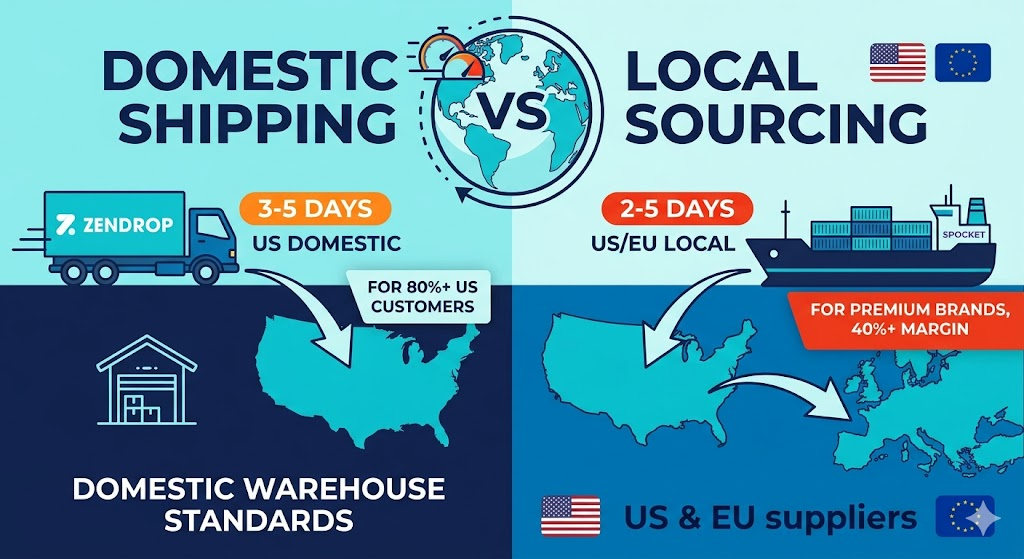
Zendrop is a US-headquartered dropshipping platform with domestic fulfillment centers delivering to US customers in 3–5 days — the fastest domestic delivery among the alternatives on this list. Plans run $49–$79 per month with a 1M+ product catalog, pre-built Shopify store builder, and a private agent program for high-volume sellers.
QC is handled through pre-vetted US warehouse standards rather than per-unit inspection. Best for Shopify sellers where 80% or more of customers are in North America and domestic shipping speed is the primary competitive variable. Not the right choice for global stores — the monthly subscription premium only makes economic sense when the US warehouse advantage applies to the majority of orders.
Zendrop solves one specific problem better than any other option on this list: US customers who expect Amazon-speed delivery and leave negative reviews when they do not get it. The 3–5 day domestic delivery is not an estimate — it is the result of products pre-stocked in US-based fulfillment centers before an order is placed.
According to Forbes, 84% of consumers say they will not return to a brand after a single poor delivery experience. In a US market conditioned by Amazon Prime, Zendrop’s domestic warehouse model addresses that expectation structurally rather than partially.
Where the Monthly Fee Makes Sense
A store doing 150 daily orders in the US with a 15-day average delivery generates a predictable volume of “where is my order” support tickets. At $5–$10 per ticket and a conservative 8% of customers contacting support, that is $600–$1,200 per month in support cost alone — before counting review damage and lost repeat purchases. The $49–$79 monthly fee, offset against that support cost reduction at 3–5 day delivery, typically produces a net positive at 50+ daily orders for US-focused stores.
The Global Coverage Limitation
The trap most sellers walk into with Zendrop: they sign up for the US warehouse advantage and discover that 25–30% of customers are in Canada, Australia, or Europe. For those orders, Zendrop ships from China on standard timelines — 8–14 days — at a cost structure that still includes the monthly subscription.
If your customer geography is genuinely 80%+ US-based, Zendrop is the strongest option here for your situation. If you have meaningful international volume, the monthly fee buys an advantage that applies to a fraction of your orders.
Core Advantages
- 3–5 day US domestic delivery from pre-stocked warehouses
- 1M+ curated product catalog
- Clean native Shopify integration
- Pre-built Shopify store builder included
- Private agent program at high volume
- Auto-fulfillment on all paid plans
Limitations
- $49–$79/month regardless of order volume
- Weak global coverage outside North America
- Product costs higher than China-direct sourcing
- No OEM/ODM or brand development services
Janson’s Verdict: “If 80% or more of your customers are in the US and delivery speed is the primary reason your reviews are where they should not be, Zendrop solves that structurally. The monthly fee pays for itself in support ticket reduction at 50+ daily orders.
Do not use it if you have significant international volume — you are paying a premium for an advantage that applies to a fraction of your orders.”
4. Spocket — Best for US/EU Product Sourcing
Spocket is a dropshipping platform sourcing 80% of its catalog from US and EU suppliers, enabling 2–5 day delivery to North American and European customers without relying on China-based fulfillment. Plans start at $39.99 per month with branded invoicing on all paid tiers and a pre-vetted supplier network enforcing consistent quality standards at the platform level.
Best for Shopify sellers building premium brands that need genuine domestic sourcing credibility, compliance with import regulations that favor local suppliers, or a delivery speed proposition that competes with Amazon. Product costs run 30–60% higher than China-sourced alternatives — the model only works if your pricing supports 40% or higher gross margins.
Spocket occupies a specific niche that no other option on this list fills: sellers who need the words “ships from US” or “ships from EU” to be genuinely true. Compliance-sensitive product categories — cosmetics, supplements, children’s products — carry import restrictions that favor domestic sourcing. Premium brand positioning in artisan home goods or boutique apparel often depends on provenance credibility that China-origin products cannot provide regardless of how good the packaging is.
The Gross Margin Requirement Is Non-Negotiable
Domestic US and EU sourcing carries a product cost premium of 30–60% over equivalent China-sourced items. That is not a criticism — it is the structural reality of domestic manufacturing costs. Spocket only works if your average selling price supports a gross margin of 40% or higher after accounting for the higher product cost and the monthly subscription fee.
The brands that win with Spocket have figured out their pricing power first. They are selling a $65 candle that costs $28 to source domestically, not a $15 product with a $9 domestic cost.
Branded Invoicing as a Genuine Differentiator
Spocket offers branded invoicing on all paid plans — every invoice shows your brand name, not Spocket’s. For sellers building a premium brand where the post-purchase experience is part of the value proposition, this removes one of the most common credibility gaps in dropshipping: the moment a customer receives a packing slip that reveals the actual fulfillment source.
Core Advantages
- 80% US/EU suppliers — genuine domestic sourcing
- 2–5 day delivery to US and EU customers
- Branded invoicing on all paid plans
- Pre-vetted supplier network with platform-level QC standards
- Compliance-ready for import-sensitive categories
Limitations
- Product costs 30–60% higher than China-sourced alternatives
- Plans from $39.99–$99.99/month
- Smaller catalog versus CJ or Zendrop
- Not viable for price-competitive or low-margin niches
Janson’s Verdict: “Spocket’s niche is real. If you are building a premium brand that genuinely needs US or EU sourcing credibility, Spocket delivers that and Zendrop does not. The product cost premium is unavoidable. Verify your gross margin supports it before evaluating the subscription.
5. AutoDS — Best for Automation-First Sellers
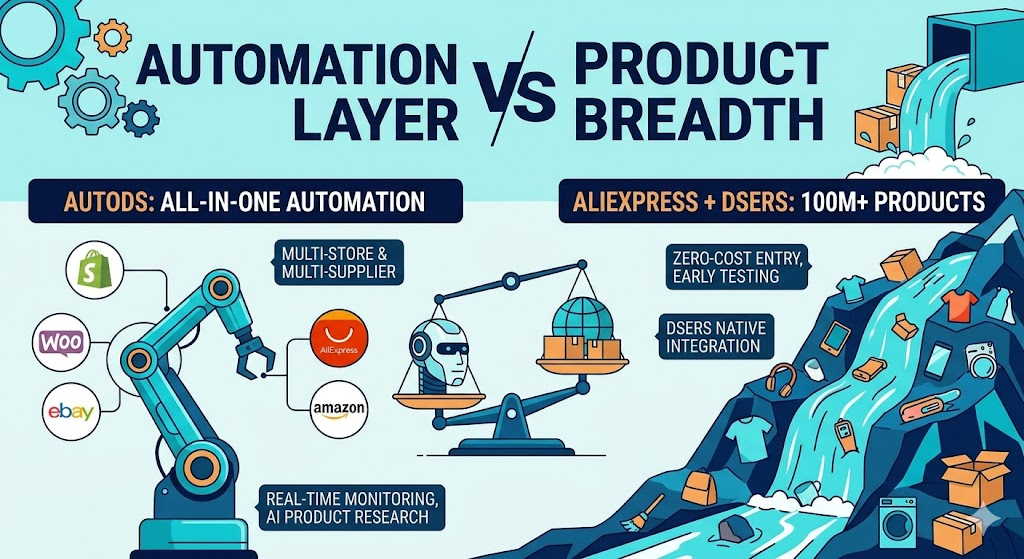
AutoDS is an all-in-one dropshipping automation platform that connects to multiple suppliers simultaneously — AliExpress, Amazon, Walmart, CJ Dropshipping itself, and dozens of others — rather than acting as a supplier directly. Price and stock monitoring run in real time. Order fulfillment executes automatically once configured. AI-powered product research tools identify trending items across supplier networks.
AutoDS integrates with Shopify, WooCommerce, Amazon, eBay, TikTok Shop, and Facebook Marketplace from one dashboard. Plans start at approximately $26.90 per month. Best for sellers managing multiple stores across multiple niches who need automation infrastructure, not a single sourcing partner.
AutoDS solves a different problem from every other option on this list. It is not a supplier. It is not a fulfillment agent. It is a software layer that automates the operational tasks consuming time across a multi-supplier, multi-store dropshipping operation. Understanding that distinction is essential before evaluating it as a CJ alternative.
If your primary frustration with CJ is quality inconsistency, slow shipping, or unresponsive support — AutoDS does not fix any of those. It automates the workflow around whatever supplier you are already using. If you move from CJ to AutoDS but keep CJ as your underlying supplier, your defect rate, shipping speed, and support experience stay exactly the same.
What the Automation Actually Does
Real-time price and stock monitoring across connected suppliers, so you never accidentally sell an out-of-stock item or absorb an unnoticed price increase. Automatic order fulfillment once a sale occurs — no manual processing. Bulk product imports with AI-assisted listing optimization. According to ZIK Analytics, 75% of stores using fulfillment automation across multiple tasks report higher profitability. The gain is from labor cost reduction, not from better suppliers.
The Critical Limitation Most Reviews Miss
AutoDS does not control the quality, speed, or reliability of the suppliers it connects to. This creates a specific failure mode: sellers switch from CJ to AutoDS expecting the fulfillment experience to improve, then discover three months later that all the same complaints still exist — because AutoDS was never the source of those problems. The source was always the underlying supplier.
The right way to use AutoDS is as an automation layer on top of a supplier relationship that is already working. Fix the supplier first. Then automate the workflow around it. In that order.
Core Advantages
- Multi-supplier connectivity from one dashboard
- Real-time price and stock monitoring across all sources
- Automatic order fulfillment — no manual processing
- AI-powered product research and listing optimization
- Multi-store management from single account
- From approximately $26.90/month
Limitations
- Not a supplier — does not control QC, shipping, or support
- Fulfillment quality entirely depends on underlying supplier
- Monthly fee adds cost without solving fulfillment problems
- Can create false confidence that switching to AutoDS fixes CJ issues
Janson’s Verdict: “AutoDS is a legitimate tool for multi-store, multi-supplier operations where manual overhead is consuming real hours. It is not a CJ alternative in the sense that it replaces CJ’s fulfillment function — it sits above it. If your problem with CJ is QC, shipping, or support, AutoDS does not solve that.
Fix the supplier first, then automate the workflow around it. In that order, not the other way around.”
6. AliExpress + DSers — Best for Early-Stage Product Testing
AliExpress combined with DSers is the zero-cost product testing infrastructure that most Shopify dropshippers start on before moving to CJ Dropshipping. It offers 100M+ products, no monthly fee, no minimum order quantities, and DSers’ native Shopify integration automating order routing and bulk fulfillment. Shipping averages 10–20 days to the US on standard routes, with 7–12 days available from US or EU warehouse-stocked sellers.
QC is entirely supplier-dependent with no platform-level inspection standard. Best as a CJ alternative for sellers who need maximum product breadth at zero infrastructure cost during a niche validation phase, or for the product testing side of a hybrid operating model.
Recommending AliExpress plus DSers as a CJ alternative requires explanation, because on paper it looks like a step backward. CJ was built partly to improve on AliExpress’s limitations. Why would you go back?
The answer is product breadth. CJ’s catalog runs to approximately 750,000 products. AliExpress has over 100 million. For a seller who has exhausted the product discovery potential of CJ’s catalog, or who is testing in a niche where CJ’s supplier network is thin, that scale difference is a genuine operational advantage that no other option on this list can match.
What Has Actually Changed About AliExpress in 2026
The conventional criticism of AliExpress — 30 to 45 day shipping times — overstates the current reality. AliExpress has invested significantly in regional warehouse infrastructure over three years. Sellers with US-based warehouse inventory now deliver in 7–12 days to American customers.
According to Dropified’s 2026 analysis, AliExpress sellers have meaningfully closed the delivery gap for sellers who filter for warehouse location at the sourcing stage. The structural problems that have not improved: QC inconsistency, US tariff exposure at 30% or higher, and EU VAT at delivery.
The Right Context for This Option
AliExpress plus DSers makes sense as a CJ alternative in three specific situations: active niche discovery needing the full 100M+ catalog; the testing side of a parallel hybrid model where AliExpress handles new SKU validation and a private agent handles confirmed winners; and early-stage sellers under 20 daily orders where the zero-cost entry is a genuine constraint.
For the full comparison of how AliExpress performs against private agents across shipping, QC, and total landed cost, see our detailed breakdown of dropshipping agent vs AliExpress.
Core Advantages
- 100M+ products — unmatched catalog for testing
- Zero cost — no monthly fee, no MOQ
- DSers native Shopify integration with bulk processing
- US and EU warehouse options for 7–12 day delivery
- Fastest path to first order for new stores
Limitations
- No platform-level QC standard — entirely supplier-dependent
- Economy shipping still 25–45 days without warehouse filtering
- US tariffs of 30%+ on China-origin goods
- EU VAT at delivery — customers receive unexpected charges
- No brand customization on individual orders
Janson’s Verdict: “AliExpress plus DSers is a legitimate choice in this list for one reason: 100 million products versus CJ’s 750,000 is a real difference when you are in active product discovery. If you have hit the catalog ceiling on CJ and need broader testing infrastructure, this is the right move for that specific phase.
It is not a scaling solution — the same QC and shipping structural problems that eventually push sellers past CJ apply here too. Use it to find what sells. Then move the winner to a private agent.”
Full Comparison: All 6 CJ Dropshipping Alternatives
| Alternative |
Best For |
QC Model |
US/EU Shipping |
Monthly Fee |
Brand Services |
| ASG Dropshipping |
50+ orders/day, brand building |
Full inspection, every unit, 6-step |
4–6 days |
$0 + $0.50–$2.00/order |
Full: OEM/ODM, design team, NDA |
| HyperSKU |
20–100 orders/day, mid-volume |
Documented, tier-dependent |
7–12 days |
$0 + product/shipping |
Branded packaging, low MOQ |
| Zendrop |
80%+ US customers, speed-focused |
Pre-vetted US warehouse standard |
3–5 days (US domestic) |
$49–$79/month |
None |
| Spocket |
Premium US/EU brands, 40%+ margin |
Pre-vetted domestic supplier standard |
2–5 days (US/EU) |
$39.99–$99.99/month |
Branded invoicing only |
| AutoDS |
Multi-store, automation-first |
Depends on underlying supplier |
Depends on supplier |
From $26.90/month |
None (tool layer only) |
| AliExpress + DSers |
Early-stage testing, catalog breadth |
None — supplier-dependent |
7–12 days (with US/EU warehouse filter) |
$0 |
None |
| CJ Dropshipping (baseline) |
Beginners, under 50 orders/day |
Spot-check ~30% of batches |
10–15 days standard |
$0 (embedded in pricing) |
Basic POD and packaging |
QC model and shipping times based on documented platform standards and March 2026 operational data. CJ Dropshipping included as baseline reference for comparison.
How to Choose the Right CJ Alternative for Your Store
The right CJ Dropshipping alternative in 2026 depends on three variables: daily order volume, target customer geography, and whether the business is in product discovery or brand-building mode. Under 20 daily orders in discovery mode: remain on CJ or move to AliExpress plus DSers for catalog breadth.
Between 20 and 50 daily orders with confirmed products: HyperSKU for branded packaging without private agent overhead.
Above 50 daily orders building a brand: ASG Dropshipping for full per-unit QC, dedicated account management, and OEM/ODM capability. US-focused stores where speed is the primary variable: Zendrop. Premium brands needing genuine domestic sourcing: Spocket. Multi-store automation requirements: AutoDS layered on top of whichever supplier fits the volume stage.
Most sellers look at this question as a single decision. It is not. It is a staged decision that changes as your store develops — and using the wrong infrastructure for your current stage costs money in ways that do not appear on a single report.
Under 20 Daily Orders: Optimize for Discovery, Not Infrastructure
At this volume, the per-order cost of a private agent relationship is not justified before you have confirmed a winning product. Your goal is product-market fit, not operational consistency. Stay on CJ or move to AliExpress plus DSers depending on whether you need more catalog breadth.
Run the defect cost formula — daily orders times 8% times $100 — and check what it produces. At 20 daily orders the result is $480 per month. That does not justify switching infrastructure. Find your product first.
20–50 Daily Orders: The Transition Window
At 40 daily orders with an 8% defect rate: $9,600 per month in hidden losses. That number is significant enough to justify the comparison conversation. Three actions worth taking before committing to a switch: run a 50-piece test order with one private agent to get real comparative data;
calculate your actual customer geography breakdown to determine whether Zendrop’s US warehouse advantage applies; and assess your gross margin honestly to determine whether Spocket’s domestic sourcing premium is viable. Do not switch infrastructure reactively after a bad batch. Switch based on the formula and the test order data.
50+ Daily Orders: The Math Has Answered It
Above 50 daily orders on a confirmed winning product, the defect cost formula consistently produces a number that exceeds a private agent’s handling fee. At 100 daily orders at 8% defect rate: $24,000 per month in hidden losses against approximately $3,000 per month in private agent handling fees at $1.00 per order.
There is a second question at this volume that most sellers defer too long: are you building a commodity business or a brand? At 50+ daily orders selling white-label products, any competitor can source the same SKU from the same CJ supplier listing in 48 hours.
The only protection is a product they cannot clone — which requires OEM/ODM capability, custom packaging, and IP protection. None of those exist at the platform level at the depth a private agent provides. For the complete breakdown, see our full guide to the best dropshipping agents for Shopify in 2026.
The 50-Piece Test: How to Vet Any Alternative Before Committing Live Volume
Before routing any live customer orders to a new dropshipping agent or platform, place a 50-piece test order of your top-selling SKU. A legitimate operation passes four benchmarks in under 6 days: QC photos delivered within 72 hours of product arrival, tracking number synced to your store within 48 hours of dispatch, actual transit time matching the stated delivery window within one business day, and the account manager answering a product-specific question without forwarding it.
This test applies to every option on this list. Agents and platforms that fail on 50 units will fail proportionally on 500.
Every platform on this list sounds credible in a comparison article. The 50-piece test surfaces the difference between operational claims and operational reality in under a week. Place the test order before committing any live volume. Not alongside it. Before.
Time from order placement to QC photos: benchmark is under 72 hours. Anything beyond that means the test order is being deprioritized or the inspection process is not standardized.
Time from QC approval to tracking number in your store: benchmark is under 48 hours. If tracking takes four days after the QC step, that gap will appear on every live order.
Actual transit time versus stated delivery window: acceptable variance is one business day. An agent quoting 5–7 days who delivers in 9–10 days on a test order is telling you their stated window is marketing, not a commitment.
Account manager product knowledge: ask one question about your SKU’s specific characteristics that requires knowing your product. The response quality tells you whether you have a dedicated account manager or a shared support queue with your name on it.
Five red flags that end the evaluation: no warehouse video available on request; pricing without separate line items for product cost, shipping, and handling fee; order management through email or spreadsheets; no written policy on defective units and reships; and response time over 24 hours during the test period.
The Verdict
There is no single best CJ Dropshipping alternative in 2026. There is a best option for your specific stage, order volume, geography, and business model.
Under 20 daily orders still testing products: stay on CJ or move to AliExpress plus DSers for catalog breadth. Between 20 and 50 daily orders with confirmed products: HyperSKU is the right bridge. Above 50 daily orders building a brand: a private agent is structurally different from everything else on this list — run the 50-piece test with ASG or another private agent and let the data decide. US-focused store where shipping speed is the primary variable: Zendrop.
Premium brand needing genuine domestic sourcing: Spocket. Multi-store automation requirement: AutoDS, on top of a supplier relationship that is already working.
The formula that answers the core question regardless of which alternative you are evaluating: daily orders times 8% times $100. When that number exceeds your chosen alternative’s monthly cost, you have your answer. If you want to see what the transition from CJ to a private agent looks like in practice, here is the full breakdown of the best dropshipping agents for Shopify in 2026, including the 4-week migration protocol and QC model comparisons.
About the Author
Janson — Founder and CEO, ASG Dropshipping
8 years in cross-border dropshipping. 200-person team, 4 warehouses in Dongguan and Shenzhen. 2,300+ vetted factories, 1.4M+ SKU library, 5M+ orders processed across 200+ countries. Guest lecturer at three Chinese universities on cross-border supply chain management.
Outside the warehouse: rock singer and guitarist.
Frequently Asked Questions
What is the best CJ Dropshipping alternative in 2026?
The best CJ Dropshipping alternative depends on your order volume and business stage. For sellers above 50 daily orders building a brand, ASG Dropshipping offers full per-unit QC inspection (0.3% defect rate versus CJ’s estimated 3–5%), dedicated account management with a 20-minute response SLA, factory-direct pricing 12–18% below CJ catalog rates, and OEM/ODM brand development services.
For mid-volume sellers at 20–100 daily orders, HyperSKU provides branded packaging without a monthly fee. For US-focused stores where domestic shipping speed is the primary variable, Zendrop delivers in 3–5 days domestically.
Why are sellers leaving CJ Dropshipping in 2026?
According to ASG Dropshipping’s 2024 client transition data across 386 documented switches, the three primary reasons were: shipping speed (68% of switchers), agent response time (59%), and quality inconsistency (52%). CJ’s shared agent model — one account manager per 200+ clients — and spot-check QC covering approximately 30% of batches create structural constraints that compound as daily order volume grows above 50 orders. These are platform model limitations, not individual performance failures.
Is HyperSKU better than CJ Dropshipping?
HyperSKU is better than CJ Dropshipping for mid-volume sellers because it offers branded packaging at accessible minimum quantities, a dedicated sourcing team per account, and 7–12 day shipping faster than CJ’s standard 10–15 days — all without a monthly fee. HyperSKU is not better for early-stage product testing where CJ’s 750,000+ catalog breadth is a genuine advantage. The right choice depends on whether you have confirmed products and want brand packaging, or are still in the discovery phase.
Is Zendrop a good CJ Dropshipping alternative?
Zendrop is a good CJ Dropshipping alternative specifically for Shopify stores where 80% or more of customers are in the United States. Its US-based fulfillment centers deliver in 3–5 days domestically — structurally faster than any China-based option including CJ.
The $49–$79 monthly fee is offset by support ticket cost reduction at 50+ daily orders. Zendrop is not a good CJ alternative for stores with significant international order volume, where the monthly premium applies to orders that still ship from China on standard timelines.
Can I use a private agent and CJ Dropshipping at the same time?
Yes — running them in parallel is the recommended migration approach. Route confirmed winning products above 50 daily orders through a private agent for full QC and faster shipping. Keep CJ or AliExpress for new product testing at low volume.
The 4-week parallel migration protocol — 30% through the new agent in Week 2, 70% in Week 3, full cutover in Week 4 — allows the transition without disrupting live operations. Most sellers complete the migration to a private agent within 4–8 weeks of hitting the 50-daily-order threshold.
What is the cheapest CJ Dropshipping alternative?
AliExpress plus DSers is the cheapest CJ Dropshipping alternative at zero monthly cost with no per-order handling fee. HyperSKU is also free monthly with per-order costs only. ASG Dropshipping charges $0 monthly with $0.50–$2.00 per order handling, but factory-direct pricing typically runs 12–18% below CJ catalog rates, meaning total COGS is often lower than CJ despite the visible handling fee. The cheapest option on paper is frequently not the cheapest in practice once defect costs and platform markup are included in the calculation.
How long does switching from CJ Dropshipping take?
Switching from CJ Dropshipping to a private agent using the parallel migration protocol takes 4 weeks from test order placement to full cutover. Week 1: place a 50-piece test order and confirm QC and tracking benchmarks. Week 2: route 30% of live orders to the new agent. Week 3: increase to 70%. Week 4: full cutover. No customer-facing disruption at any stage. The break-even on transition cost averaged 11 days across ASG’s 386 documented 2024 client transitions.
Does switching from CJ Dropshipping affect my Shopify store?
Switching from CJ Dropshipping to a private agent does not affect your Shopify store’s customer-facing experience when done using the parallel migration protocol. Your product listings, pricing, and storefront remain unchanged. Most private agents provide a native Shopify app or API integration that replicates CJ’s order sync functionality. The 4-week parallel migration ensures CJ remains available as a fallback until full cutover is confirmed stable.
Article written and assembled: March 28, 2026 |
Workflow: ASG SEO Writer 21-Step Process |
Phases completed: 1–17 (full workflow)