Choosing between 1688 and Taobao feels like standing at a crossroads in the middle of Guangzhou’s busiest wholesale district. One path leads to factory-direct rock-bottom prices but demands heavy lifting in logistics; the other offers a polished, user-friendly retail experience but eats into your margins. After eight years of managing supply chains for over 5,000 clients at ASG, I’ve seen too many sellers burn their budget on Taobao when they should have been on 1688, or conversely, get stuck with 500 unsellable units from a factory because they skipped the retail testing phase.
This isn’t just a battle of apps; it’s a strategic choice about your business model. Whether you are a solo dropshipper or a scaling brand, understanding the DNA of these Alibaba-owned giants is the difference between a 10% and a 40% profit margin. Let’s strip away the marketing fluff and look at the raw data on pricing, shipping, and supplier reliability to find your perfect match.
Key takeaways
- 1688 is a B2B platform designed for domestic wholesale, offering the lowest possible factory prices.
- Taobao is a C2C/B2C marketplace focused on retail, variety, and ease of use for individual buyers.
- MOQ (Minimum Order Quantity) is usually 2+ units on 1688, while Taobao allows single-item purchases.
- International buyers typically need a sourcing agent for 1688 due to payment and language barriers.
- Taobao supports international credit cards and consolidated shipping, whereas 1688 is strictly for the Chinese mainland market.
Understanding 1688 and Taobao: The Core Concepts
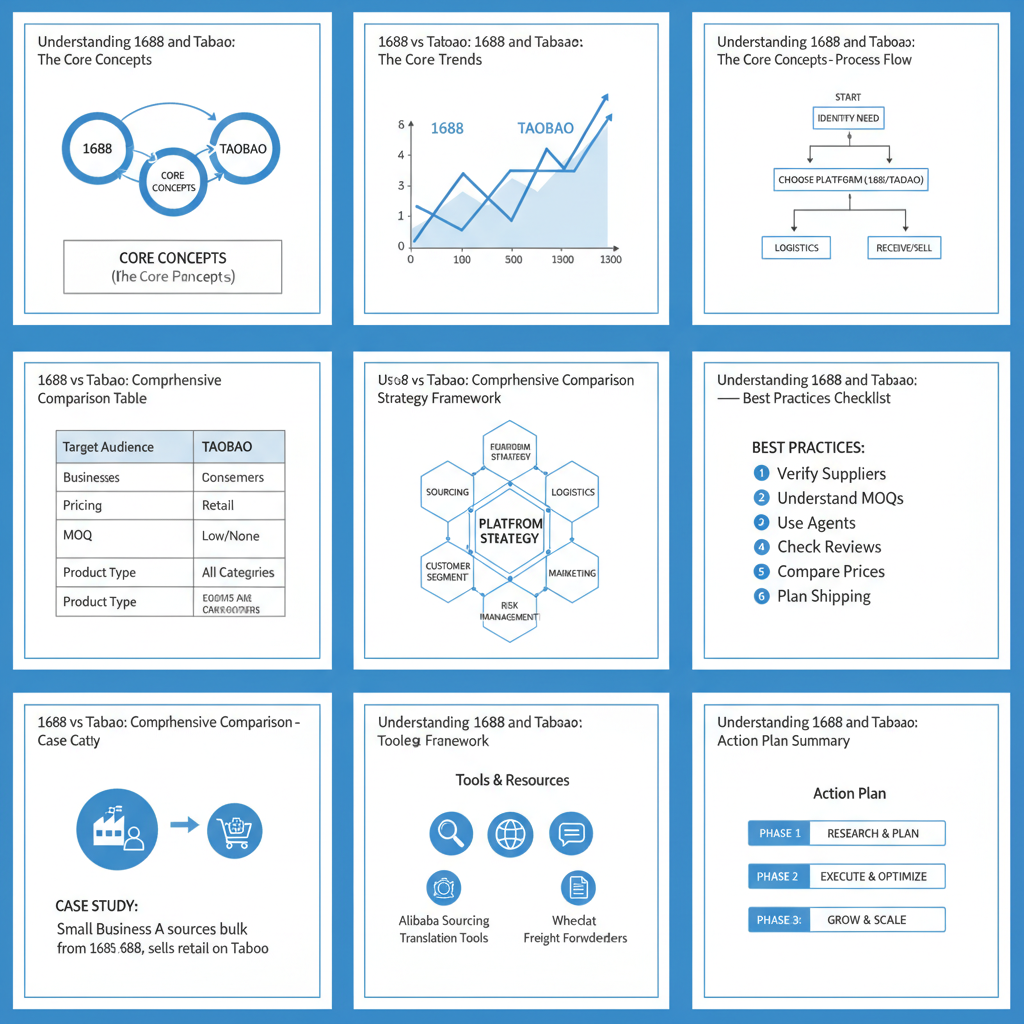 Understanding 1688 and Taobao: The Core Concepts – Visual Guide
 To navigate the Chinese e-commerce ecosystem, you must first recognize that both platforms are siblings under the Alibaba Group umbrella, yet they serve entirely different masters. 1688.com is essentially the ‘factory floor’ of China. It is a Business-to-Business (B2B) powerhouse where manufacturers and large-scale distributors list products at wholesale rates. As noted by sourcingwise.com, 1688 is the domestic version of Alibaba.com, meant for Chinese companies to trade with each other. This means the interface is 100% Mandarin, and the pricing is tiered based on volume.
Taobao, by contrast, is the world’s largest Consumer-to-Consumer (C2C) and Business-to-Consumer (B2C) marketplace. Think of it as a hybrid between eBay and Amazon, but on steroids. It’s where individual creators, small boutiques, and major brands sell directly to end-users. While 1688 focuses on the ‘product,’ Taobao focuses on the ‘experience.’ You get high-quality photography, detailed reviews, and robust buyer protection. According to nichesources.com, Taobao targets the retail segment, making it the go-to for trend-seekers who don’t want to deal with bulk inventory. For a global seller, Taobao is your ‘testing ground,’ while 1688 is your ‘scaling engine.’
Comparison Table: 1688 vs. Taobao at a Glance
| Feature | 1688.com | Taobao.com | Actionable Insight |
| Model | B2B Wholesale | C2C / B2C Retail | Use 1688 for bulk, Taobao for samples. |
| Target Audience | Chinese Businesses | Individual Consumers | Taobao is easier for beginners. |
| Pricing | Factory Direct (Tiered) | Retail (Higher) | 1688 is 20-40% cheaper on average. |
| MOQ | Usually 2-3 units | 1 unit | 1688 requires inventory commitment. |
| Payment | Alipay / Chinese Bank | Credit Card / Alipay | 1688 usually requires an agent. |
| Language | Mandarin Only | Mandarin (Global version available) | Use Chrome Translate for both. |
| Shipping | Domestic Only | International Available | 1688 needs a forwarding warehouse. |
In the current economic climate, margin compression is the biggest threat to e-commerce longevity. Data from Statista suggests that global dropshipping market values are expected to hit $301 billion by 2025, but the ‘low-hanging fruit’ of easy profits is gone. Sellers now have to move closer to the source to survive. This is why 1688 has seen a massive surge in interest from international sellers who previously relied on AliExpress. By cutting out the middleman, you aren’t just saving pennies; you’re often cutting your COGS (Cost of Goods Sold) by half.
However, Taobao remains relevant because of ‘micro-trends.’ Because Taobao is a consumer-facing platform, it reacts to trends faster than factories do. If a specific style of ‘Y2K fashion’ goes viral on TikTok, you will see it on Taobao within 48 hours, whereas it might take a week or two to hit the wholesale listings on 1688. blog.sugargoo.com highlights that Taobao’s visual search and recommendation engine are superior for discovering high-demand, low-competition items. For my clients at ASG, we often recommend a ‘Hybrid Strategy’: identify trends on Taobao, buy 5 units to test, and once the product proves its worth, move the entire supply chain to 1688 for bulk fulfillment.
Implementation Strategies: How to Sourcing Like a Pro
Sourcing from 1688 requires a different set of ‘muscles’ than Taobao. If you’re going the 1688 route, your first step is finding a reliable sourcing agent or a fulfillment partner like ASG. Since 1688 suppliers often don’t speak English and don’t ship internationally, you need someone on the ground in China to handle the ‘last mile’ of the supply chain. oneclickonlineservice.com emphasizes that using an intermediary is essential for quality control. You don’t want to find out your 500 units are defective after they’ve cleared customs in London.
For Taobao, the implementation is more straightforward. You can use ‘Taobao Global’ and pay with a standard Visa or Mastercard. The platform even offers a consolidation service (Cainiao) that groups your orders from different sellers into one box to save on shipping. However, be warned: Taobao sellers are optimized for domestic speed, not international durability. I’ve seen many sellers try to dropship directly from Taobao only to have the fragile ‘retail’ packaging arrive crushed. If you use Taobao, always ask the seller for ‘extra reinforcement’ or have your agent re-pack the items in export-grade cartons. As we say in the warehouse, ‘rhythm comes from training, but protection comes from the right box.’
Common Mistakes: Lessons from Real Failures
I want to share a failure lesson from October 2023. A client of ours, let’s call him Mark, decided to source a high-end kitchen gadget directly from 1688 without a sample. He saw a price that was 60% lower than Taobao and jumped. When the 200 units arrived at our Dongguan warehouse, the ‘stainless steel’ was actually painted plastic. Mark fell for the ‘Tier 3’ pricing trap—where the cheapest listing on 1688 is often a lower-quality replica of the actual factory item. This is a classic industry observation: on 1688, the lowest price is rarely the best value.
Another common blunder is ignoring the ‘Seller Power’ icons. On Taobao, you look for ‘Gold Medals’ and ‘Hearts/Diamonds/Crowns’ to gauge trust. On 1688, you must look for the ‘Bull’ icon (Powerful Merchant) and the number of years they’ve been active. diffreight.com points out that Taobao sellers are more terrified of bad reviews because it kills their search ranking instantly, whereas 1688 sellers care more about long-term repeat business. If you treat a 1688 supplier like a retail clerk, you’ll get nowhere. You need to build a ‘Guanxi’ (relationship) or have an agent do it for you to ensure consistent quality.
Pro Tips from Janson: My Insider Insights
Here is a secret that most sourcing gurus won’t tell you: many Taobao sellers are actually just ‘dropshipping’ from 1688 themselves. I’ve walked through factories in Shenzhen where the owner has one 1688 account for bulk and his daughter runs three Taobao shops for retail. If you find a product on Taobao you love, use the 1688 ‘Image Search’ tool. 90% of the time, you will find the exact same product at a 30% discount. This is how the pros scale.
Also, pay close attention to the shipping labels. Taobao sellers often include ‘thank you’ notes or marketing flyers in Chinese, which can confuse your international customers if you are dropshipping. At ASG, we provide a ‘Blind Shipping’ service where we strip all Chinese branding and replace it with your custom logo and English inserts. This turns a generic 1688 product into a premium brand. Remember, your customer isn’t just buying a product; they’re buying the ‘feeling’ of your brand. Don’t let a stray 1688 invoice ruin that illusion.
Key Takeaways & Next Steps: Your Action Plan
The choice between 1688 and Taobao boils down to your current business stage. If you are in the ‘Discovery Phase,’ use Taobao. Its high-resolution videos and consumer feedback are gold for market research. If you are in the ‘Growth Phase’ and doing more than 10 orders a day, it is time to migrate to 1688. The cost savings alone will fund your entire advertising budget. SourcingWise correctly identifies that for bulk buying, 1688 is the undisputed champion.
Your next step? Start by downloading both apps. Use a translation plugin and spend an hour searching for your main product on both. Compare the ‘Real Shot’ photos on 1688 with the ‘Model Shots’ on Taobao. If the price gap is significant, contact a fulfillment partner to get a landed cost estimate. Don’t let the language barrier stop you—China’s supply chain is the most powerful engine in the world, and 1688 is the key to the ignition. Let’s make global entrepreneurship simple and joyful by picking the right tool for the job.
Sources and further reading (selected)
- SourcingWise: A detailed comparison of B2B vs B2C features in the Chinese market. Read more →
- NicheSources: Strategic guide on choosing platforms based on business volume. Read more →
- Sugargoo Blog: Insights into the user experience and buying process for foreigners. Read more →
- OneClick Online Service: Expert advice on fulfillment and the role of sourcing agents. Read more →
- DiFFreight: Logistics-focused comparison highlighting shipping challenges. Read more →
- Alibaba Group Investor Relations: Official corporate structure and platform definitions. Read more →
- Statista E-commerce Reports: Global e-commerce and dropshipping market growth statistics. Read more →
- Shopify Blog: Trends in global sourcing and independent station management. Read more →
- China Sourcing Information Center: Data on Chinese manufacturing and wholesale trade indices. Read more →
- Cainiao Global Logistics: Official international shipping and consolidation data. Read more →


 Optimized by Seraphinite Accelerator