The allure of ‘starting for free’ is the ultimate siren song of the dropshipping world. You’ve likely seen the viral TikToks claiming you can build a six-figure empire without spending a single dime. But what actually happens when you hit ‘publish’ on a $0 budget? In my years leading ASG Dropshipping, I’ve seen thousands of entrepreneurs attempt this path. The reality is a complex mix of high-speed learning and technical roadblocks that most ‘gurus’ conveniently forget to mention in their 60-second clips.
Starting for free isn’t just about saving money; it’s a test of your resourcefulness. While you can technically launch using free trials and organic traffic, you are essentially trading your time for capital. In this guide, I’m going to pull back the curtain on exactly what happens to your store, your conversion rates, and your sanity when you try to bootstrap from zero. We’ll explore the tools that actually work for $0 and the inevitable ‘paywalls’ that will eventually stand between you and a scalable business.
Key takeaways
- You can launch for $0 using free trials (Shopify/DSers) and organic social media traffic.
- The ‘Free’ model usually results in lower conversion rates due to lack of custom domains and basic themes.
- Organic marketing (TikTok/Reels) is the only viable way to get traffic without a budget.
- Inevitably, you will face costs like domain registration ($14+) and transaction fees.
- Success at $0 requires significantly more time and manual effort than a funded startup.
Understanding the $0 Startup – Core Concepts
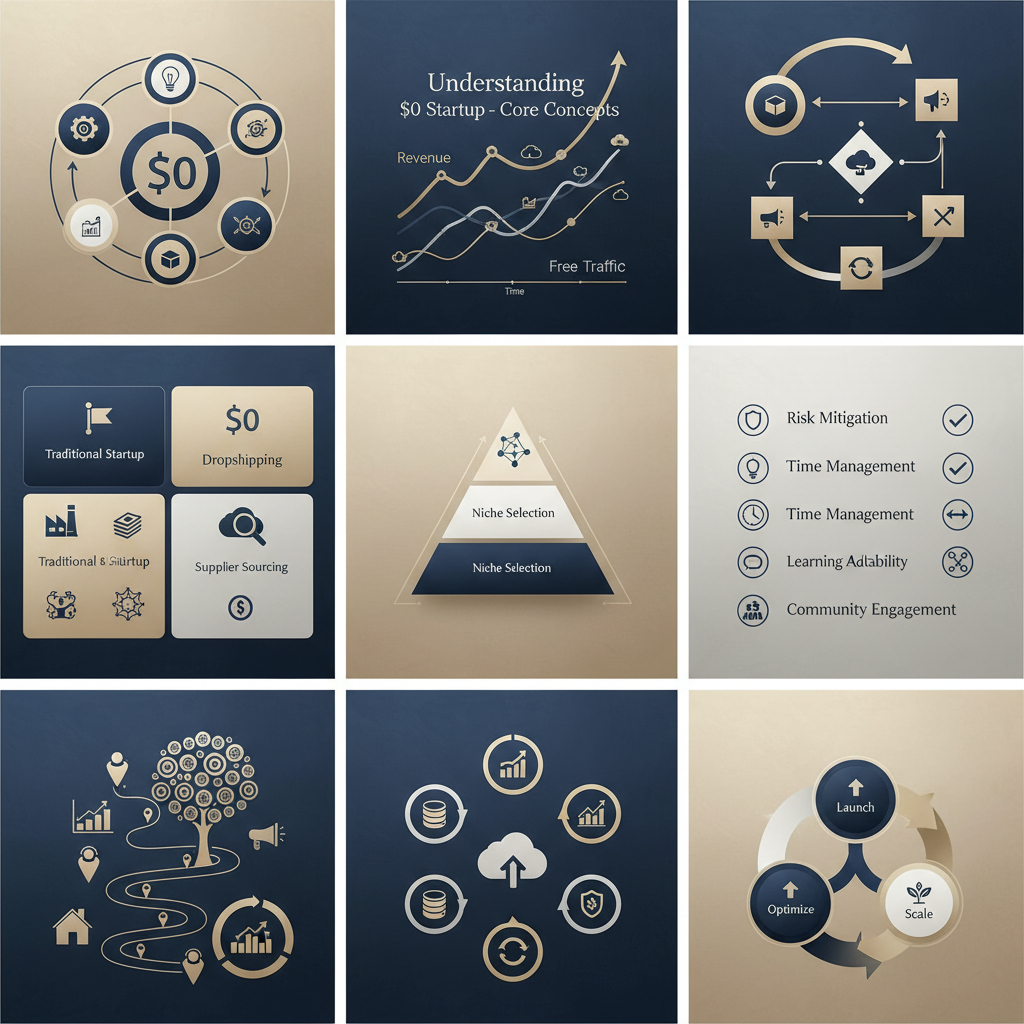 Understanding the $0 Startup – Core Concepts – Visual Guide
 Starting dropshipping for free technically means operating within the ‘freemium’ ecosystem of e-commerce. You utilize 3-day free trials or ‘pay-as-you-grow’ plans offered by platforms. According to txtcartapp.com, the core components involve a free trial on an e-commerce platform, a free sourcing app like DSers, and a zero-cost marketing strategy.
When you start for free, you aren’t paying for inventory, warehousing, or shipping upfront. This is the ‘magic’ of the dropshipping model. However, ‘free’ often comes with limitations such as ‘myshopify.com’ subdomains, which can hurt consumer trust. At ASG, we’ve observed that stores without a custom domain often see a 50% lower conversion rate compared to those with a professional .com extension.
| Component | Free Version | Professional Version |
| Platform | Shopify 3-Day Trial | Shopify Basic ($39/mo) |
| Domain | store-name.myshopify.com | storename.com ($14/yr) |
| Marketing | TikTok Organic | Meta/Google Ads ($20+/day) |
| Fulfillment | Manual Processing | Automated ERP (ASG/DSers) |
You are essentially acting as the middleman between a supplier and a buyer. In a free setup, you must manually find products on AliExpress or 1688, import them using free plans, and handle customer service yourself. As noted by oberlo.com, while you can start for less than $100, the lack of initial investment often means you have to work twice as hard to look legitimate to your audience.
Why Starting for Free Matters in 2026 – Trends & Data
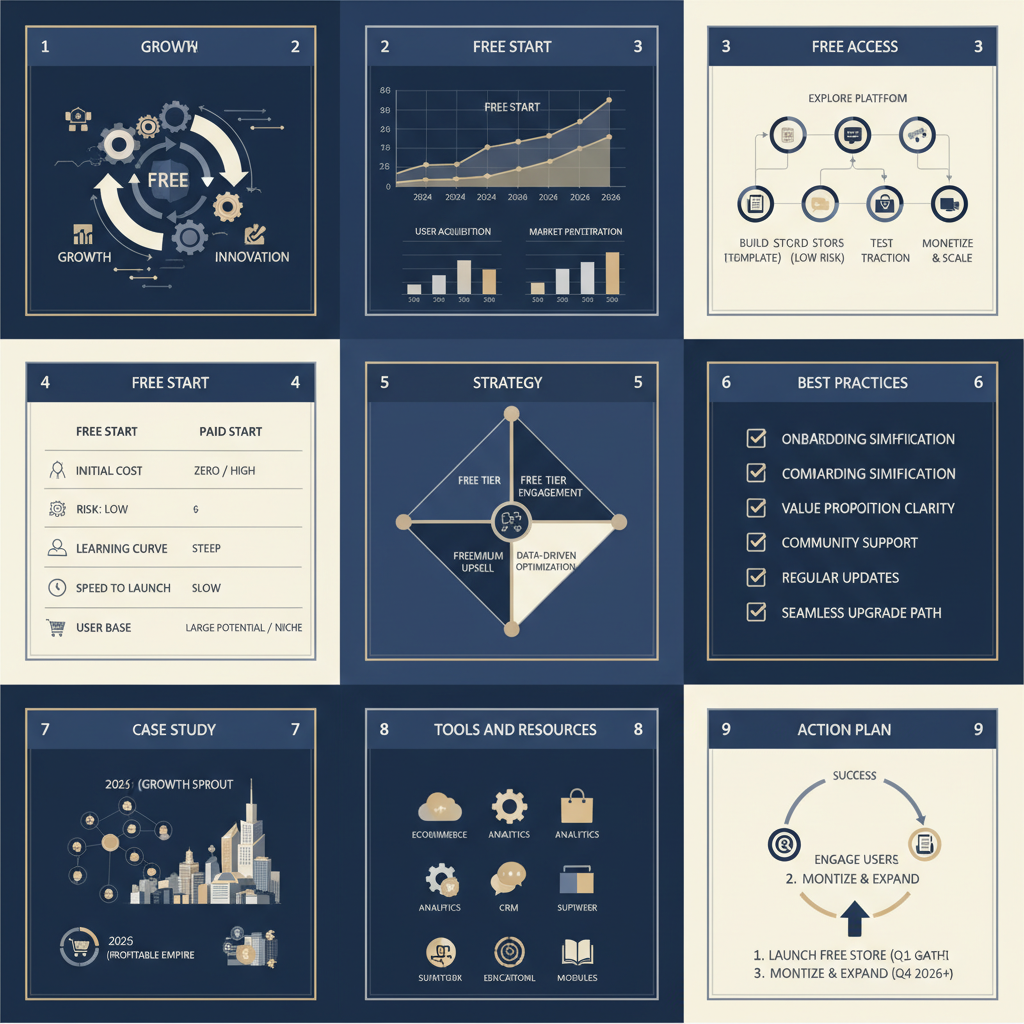 Why Starting for Free Matters in 2026 – Trends & Data – Visual Guide
 In 2026, the barrier to entry has never been lower, yet the competition for attention has never been higher. The ‘Free’ approach is now a legitimate ‘Beta Testing’ phase for savvy entrepreneurs. Instead of burning $2,000 on a product that might fail, sellers are using free tools to validate demand. Data from bigcommerce.co.uk suggests that dropshipping is increasingly used as a risk-free way to test trending products before committing to bulk inventory.
AI has revolutionized the $0 startup. In the past, you needed to hire a copywriter or a designer. Today, tools like ChatGPT and Canva (Free) allow you to generate high-quality product descriptions and social media creatives for zero cost. This ‘AI-powered bootstrapping’ is the dominant trend for 2026, allowing solo-preneurs to compete with mid-sized teams in terms of content output.
However, the ‘Free’ tier is becoming more restrictive. Platforms are shortening trial periods and increasing transaction fees for non-paying users. According to printify.com, while you can start with a couple of dollars, a budget of $50-$100 is now considered the ‘sweet spot’ for a healthy launch. At ASG, we see that 80% of ‘free’ stores fail within the first 14 days simply because the owners underestimate the time required to generate organic traffic.
Social commerce is the engine for free dropshipping. With TikTok and Instagram Reels prioritizing ‘entertainment’ over ‘follower count,’ a $0 budget store can still go viral. This shift from search-based SEO to discovery-based social algorithms is why starting for free is still a viable, albeit difficult, strategy in the current year.
Implementation Strategies – Your $0 Roadmap
If you are committed to the $0 path, your timeline must be aggressive. You have roughly 72 hours (the typical Shopify trial) to prove your concept. Step one is niche selection. Avoid saturated markets and focus on ‘problem-solver’ products that look great on video. As suggested by txtcartapp.com, you should use Google Trends and AliExpress (sorted by orders) to find 3-5 winning products in under 45 minutes.
Step two is store setup. Use a ‘Free’ Shopify theme like ‘Sense’ or ‘Dawn.’ Don’t spend days on the logo; use Canva’s free templates. The goal is a ‘Minimum Viable Product’ (MVP). Your product descriptions should focus on benefits, not features, which you can generate using AI tools to save time and ensure professional quality.
Step three is the hardest: Traffic. Since you have $0 for ads, you must become a content creator. You need to post 3 times a day on TikTok, Reels, and Pinterest. According to shopify.com, staying compliant with local laws is free, but you must ensure your ‘Refund Policy’ and ‘Terms of Service’ are clearly visible to build trust without a paid ‘Trust Badge’ app.
Fulfillment in the free stage usually happens via AliExpress and DSers’ free plan. You will have to manually pay for the product cost using your own credit card once a customer pays you. This ‘cash flow’ gap is a common hurdle. Ensure your payment gateway (like Shopify Payments or PayPal) is active, though be aware they may hold funds for 7-21 days for new, unverified accounts.
Common Mistakes – Lessons from Real Failures
The biggest mistake I see in $0 dropshipping is the ‘Ghost Town’ syndrome. This happens when a seller builds a store but doesn’t have a plan for traffic. Without ads, your store is invisible. Many beginners spend 40 hours designing a store and 0 hours making videos. In my experience at ASG, the most successful bootstrapped sellers spend 80% of their time on TikTok/CapCut and only 20% on their website.
Another fatal error is ignoring the ‘Hidden Costs.’ While the startup is free, the operation is not. You will eventually need a domain name. A ‘.myshopify.com’ URL screams ‘scam’ to modern shoppers who are increasingly wary of online fraud. As noted by oberlo.com, putting in a little cash upfront for a domain and a professional email makes you look far more legitimate.
| Mistake | Consequence | Solution |
| No Custom Domain | 0.5% Conversion Rate | Buy a .com domain ($14) |
| Generic Descriptions | High Bounce Rate | Use AI to write unique copy |
| Slow Shipping | High Chargebacks | Use ASG’s 6-10 day shipping |
| Over-designing | Wasted Time | Use a clean, free theme |
Finally, many free dropshippers fail to account for ‘Transaction Fees.’ Even on a free trial, platforms take a percentage of your sales. If you haven’t calculated your margins correctly—including the cost of the product, shipping, and the platform fee—you might actually lose money on every ‘free’ sale you make. Always use a profit margin calculator before setting your prices.
Pro Tips from Janson – Insider Insights
Here is the ‘CEO Secret’: The most successful ‘free’ dropshippers aren’t actually looking for $0 forever. They are looking for ‘Proof of Concept.’ Once they get their first 5-10 sales through organic TikTok traffic, they immediately reinvest that profit into a custom domain and professional branding. Don’t try to stay at $0; use it as a launchpad.
Leverage ‘Micro-Influencers’ for free. Instead of paying for shoutouts, offer to send a free sample (this will cost you the product price, roughly $5-$10) in exchange for a video review. This is the highest ROI marketing strategy for low-budget stores. According to bigcommerce.co.uk, success today comes from a strong customer experience, which starts with authentic social proof.
Focus on ‘High-Perceived Value’ items. If you are starting for free, you can’t afford to sell $5 items with $2 margins. You need ‘High Ticket’ or ‘High Margin’ products where a single sale can net you $20-$50. This profit allows you to buy your domain and Shopify subscription immediately. At ASG, we recommend products in the Home Decor or Tech Gadget niches for this reason.
Lastly, automate your backend as soon as possible. Even on a budget, using the free version of an ERP or a dedicated agent like ASG can save you hours of manual data entry. Your time is your most valuable asset when you have no money; don’t waste it on copy-pasting customer addresses into AliExpress.
Key Takeaways & Next Steps – Actionable Summary
Starting dropshipping for free is a high-reward, high-effort strategy. It is the perfect ‘school’ for learning e-commerce fundamentals without financial risk. However, you must be prepared to transition to a paid model as soon as you see traction. As printify.com points out, while you can start with $0, having $50-$100 set aside for ‘unavoidables’ like a domain and basic apps will significantly increase your odds of success.
Your immediate next steps: 1. Pick a niche and find 3 products. 2. Start a Shopify 3-day trial. 3. Create 10 TikTok videos using your phone. 4. Post them and analyze the views. If you get 1,000+ views and no sales, your website is the problem. If you get no views, your content is the problem.
Remember, dropshipping is a real business, not a hobby. Even if you start for free, you must treat your customers with the same respect as a multi-million dollar brand. This means clear communication, honest shipping times, and a fair refund policy. According to shopify.com, legal compliance and tax IDs (like an EIN) are often free to obtain and are essential for long-term growth.
At ASG Dropshipping, we support sellers at every stage. Once you’ve moved past the $0 phase and are ready to scale, we provide the stable supply chain and fast 6-10 day shipping you need to turn a ‘free trial’ into a sustainable brand. The journey from $0 to $10,000 a month starts with that first free video. Go make it.
Sources and further reading (selected)
- TxtCart: Comprehensive guide on free dropshipping tools and organic traffic strategies. Read more →
- Printify: Analysis of startup costs and the ‘sweet spot’ budget for new sellers. Read more →
- Oberlo: Historical context and realistic cost breakdowns for launching a store. Read more →
- Shopify: Legal and compliance guide for dropshipping businesses in 2026. Read more →
- BigCommerce: Industry insights on profit margins and competitive strategies. Read more →
- Google Trends: Essential free tool for product research and demand validation. Read more →
- AliExpress: Primary sourcing platform for the free dropshipping model. Read more →
- Canva: Free design tool for creating logos and social media content. Read more →
- IRS.gov: Official resource for obtaining a free Federal Tax ID (EIN). Read more →
- ASG Dropshipping: Expert source on global supply chain and fulfillment efficiency. Read more →


 Optimized by Seraphinite Accelerator