By Janson — CEO & Founder, ASG Dropshipping | Updated: April 7, 2026 | 18 min read
Key Takeaways
- HyperSKU is a platform-based fulfillment tool — shared supplier network, strong automation, no monthly fee, legitimate 7–12 day global shipping. For sellers under $5,000/month, it’s often the right call.
- A professional private agent is a dedicated supply chain partner — locked suppliers, per-unit QC inspection, NDA-protected data isolation. Structurally different from any shared platform.
- The decisive difference is IP protection and QC accountability. On HyperSKU, your bestselling product data flows through a shared supplier pool. With a private agent, your supplier relationships are exclusive and contractually protected.
- The revenue-stage framework: HyperSKU for $0–$5K/month (testing), evaluate at $5K–$15K, commit to a private agent at $15K+ where defect costs and brand needs exceed platform capability.
- Switching doesn’t have to be disruptive. A three-phase parallel transition — 30% → 70% → 100% — verifies performance before committing, with zero order interruption.
HyperSKU is a platform-based fulfillment service connecting dropshippers to a network of 2,000+ vetted Chinese suppliers with no monthly fee, 7–12 day global shipping, and Shopify/WooCommerce integration. A professional private dropshipping agent is a dedicated China-based fulfillment company that locks in exclusive supplier relationships, runs per-unit QC inspection on every order, and offers NDA-backed supply chain data isolation.
HyperSKU suits sellers under $5,000/month who need automation and low overhead. Professional private agents suit sellers above $15,000/month who need lower defect rates (0.3% vs industry average 8%), faster shipping (4–6 days US/EU), and brand-building infrastructure that shared platforms structurally cannot provide.

HyperSKU vs professional private agent: the right choice depends on your revenue stage — not personal preference. I’ve processed 5M+ orders through our Dongguan and Shenzhen warehouses. I’ve watched this debate play out hundreds of times — sellers who started on HyperSKU asking whether it’s time to switch.
The honest answer: it depends on one thing, and it isn’t personal preference. It’s your monthly revenue stage. HyperSKU and a professional private agent are built for different business phases — and using the wrong infrastructure at the wrong stage costs money every month it continues. This comparison covers what each option actually is, where the real differences sit, and the precise revenue thresholds that should drive your decision.
Table of Contents
- What Is HyperSKU and What Is a Private Dropshipping Agent?
- HyperSKU vs Private Agent — Side-by-Side Comparison
- Where HyperSKU Wins — And Where It Doesn’t
- The Revenue-Stage Decision Framework
- Final Thoughts
- FAQs
What Is HyperSKU and What Is a Private Dropshipping Agent?
HyperSKU is a China-based fulfillment platform founded in 2018 that connects dropshippers to a network of 2,000+ vetted suppliers through an automated dashboard with no monthly subscription fee. A private dropshipping agent is a China-based fulfillment company that acts as a dedicated supply chain partner — sourcing exclusively from locked supplier relationships, running per-unit QC inspection on every order, and maintaining complete separation of each client’s supply chain data.
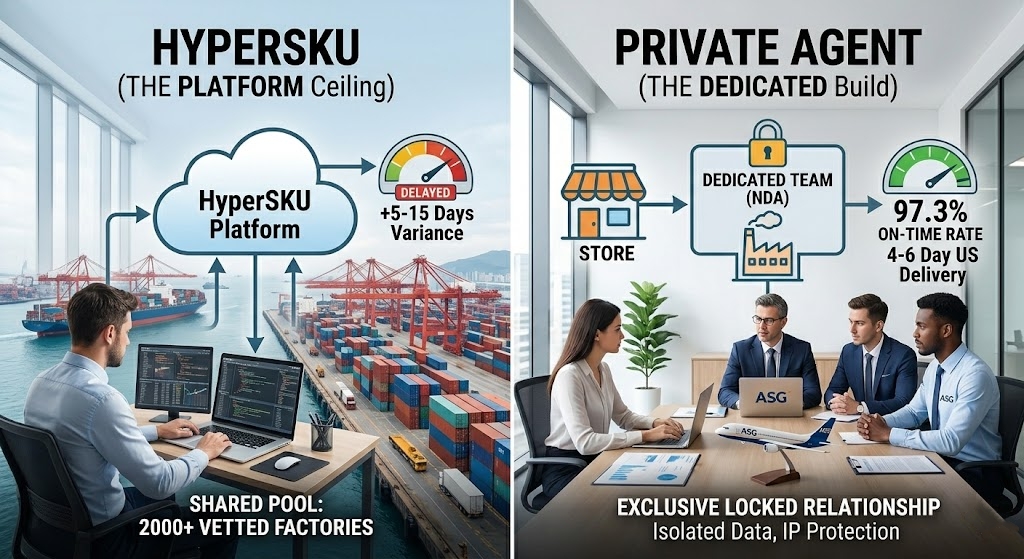
The structural difference: HyperSKU routes your orders through a shared supplier pool, while a professional private agent builds and protects a supplier infrastructure dedicated exclusively to your store.
HyperSKU — What It Actually Is
HyperSKU is one of the best-executed platform-based fulfillment tools in the market. Founded in 2018, HyperSKU has built an overall rating of 4.9 out of 5 stars on the Shopify App Store — among the highest for any dropshipping supplier.
The platform connects you to 2,000+ vetted Chinese suppliers, integrates natively with Shopify and WooCommerce, handles liquid and battery-containing items many agents won’t touch, and charges zero monthly fees. You pay per order fulfilled.
The automation is genuinely good. Order syncing, tracking updates, and inventory management happen without manual intervention. HyperSKU runs a comprehensive internal platform letting you see order details across all your stores from one dashboard.
For a seller managing multiple stores in the testing phase, that visibility is valuable. What HyperSKU is not: a dedicated supply chain partner. It’s a marketplace layer between you and Chinese suppliers — highly automated, well-supported, but a marketplace nonetheless. The supplier relationships belong to the platform, not to you.
Private Dropshipping Agent — The Two Types You Need to Know
Here’s a distinction almost every comparison article gets wrong. When people say “private dropshipping agent,” they’re using one term for two fundamentally different operations.
Type 1 — Individual private agents: Freelancers or small teams of 2–5 people who handle sourcing and fulfillment personally via WhatsApp and Excel. Private agents are essentially freelancers — most manage orders using Microsoft Excel or CSV files and don’t offer branding services, while professional agents have dedicated systems for bundling and splitting orders. The ceiling on individual agents is real: past 50–100 daily orders, their bandwidth becomes your problem.
Type 2 — Professional private agent companies: Structured businesses — 100 to 200+ person operations with dedicated QC teams, multiple warehouses, API integrations, and formal SLA commitments. ASG Dropshipping falls into this category: 200-person team, 4 warehouses across Dongguan and Shenzhen, 2,300+ vetted factory relationships, 10,000–20,000 daily orders.
Most comparison articles lump both types under “private agent” and argue private agents are less reliable than platforms. That argument applies to Type 1. It doesn’t apply to Type 2. Understanding what a professional dropshipping agent actually provides versus a platform like HyperSKU is the foundation for making this decision correctly.
The Architecture Difference That Changes Everything
HyperSKU’s model: Your store → HyperSKU platform → shared supplier pool. When you source through HyperSKU, you’re accessing suppliers who also fulfill orders for thousands of other HyperSKU clients. The platform vets these suppliers and automates logistics — but the supplier relationships are HyperSKU’s, not yours.
Professional private agent model: Your store → your dedicated account team → locked exclusive supplier relationships → isolated supply chain data. When ASG sources a product for you, that supplier relationship is documented, protected, and not shared with other clients. HyperSKU’s own positioning acknowledges this difference — their case for a platform over a private agent rests on automation and scalability, not supply chain exclusivity.
If you find a winning product on HyperSKU, that supplier is visible to the platform and potentially accessible to other sellers in the same network. Build that relationship through a private agent with supply chain isolation, and it stays yours — protected by NDA.
HyperSKU vs Private Agent — Side-by-Side Comparison
HyperSKU versus a professional private dropshipping agent differs across eight measurable dimensions. HyperSKU ships globally in 7–12 days with no monthly fee, platform-level QC, and shared supplier access. A professional private agent like ASG ships in 5–8 days globally (4–6 days US/EU), charges $0.50–$2.00 per order handling with no subscription, runs per-unit six-step QC on every order, and maintains exclusive supplier relationships protected by NDA.
The two models share zero monthly cost — but diverge significantly on defect rate (platform ~8% vs dedicated agent 0.3%), IP protection, and custom branding capability above basic thank-you cards and stickers.
| Dimension | HyperSKU | Professional Private Agent (ASG) |
| Supplier access | 2,000+ shared pool | 2,300+ exclusively locked factories |
| Global shipping | 7–12 days | 5–8 days (4–6 days US/EU) |
| QC standard | Platform-level inspection | 6-step per-unit + photo documentation |
| Defect rate | ~8% (platform avg, unverified) | 0.3% (documented, 5M+ orders) |
| Monthly fee | Free | Free ($0.50–$2.00 per order handling) |
| Custom packaging | Cards $0.08, stickers $0.10 | Full brand experience (box/tissue/inserts) |
| Platform integration | Shopify + WooCommerce only | Shopify App + API + Google Sheets |
| IP protection | Shared supplier pool risk | NDA + supply chain data isolation |
| Response time | Minutes (work hours only) | Under 20 min, 7×24 |
| US warehouse | 2–4 days (500 MOQ required) | 4–6 days (no MOQ, dedicated freight) |
| Liquid/battery items | Yes | Yes |
HyperSKU data from Sup Dropshipping and NicheDropshipping. ASG data from internal operational records, Q1 2026.
Pricing — What You Actually Pay
HyperSKU: No subscription. You pay product cost, shipping, and brand customization add-ons — thank-you cards at $0.08/order (min 200), stickers at $0.10/order (min 500). No explicit per-order handling fee for standard fulfillment — HyperSKU’s margin is embedded in supplier pricing. Professional private agent: No subscription. Factory-direct product cost (typically 10–15% below platform retail), shipping on dedicated freight, and $0.50–$2.00 per-order handling fee with volume discounts at 500+ daily orders.
The pricing comparison that actually matters isn’t subscription vs no-subscription. It’s total cost of ownership (TCO): product cost + shipping + handling fee + QC defect cost + return shipping + customer service labor + review damage. The industry average defect rate for platform-level sourcing without dedicated per-unit QC is approximately 8%.
At 50 daily orders and $30 AOV: defect cost on platform = $3,600/month; defect cost on dedicated agent at 0.3% = $135/month. That $3,465/month difference never appears on any invoice — it appears in your refund rate, customer service queue, and store review score.
Shipping Speed — The Real Numbers
HyperSKU delivers globally in 7–12 days; US fulfillment centers deliver in 2–4 days but require a 500-unit MOQ per product category. HyperSKU works with YunExpress and DHL as primary carriers with full tracking. ASG delivers 5–8 days globally, 4–6 days US/EU on pre-allocated dedicated freight — no MOQ requirement for fast delivery since speed comes from the freight lane, not pre-positioned domestic inventory.
The Q4 gap matters more than the standard-condition gap. HyperSKU routes through shared carrier capacity — November and December bring expansion as carriers prioritize express shipments. ASG’s pre-allocated dedicated freight maintained a 97.3% on-time rate at 23,000 daily orders during Q4 2024 peak. Shared carrier capacity structurally cannot replicate that consistency at volume.
Standard-condition shipping gap is 2–4 days. Q4 gap — shared vs pre-allocated freight — is where the difference becomes operationally significant. Comparing current shipping costs and defect exposure against dedicated fulfillment? See how the leading dropshipping agent alternatives compare on the metrics that actually drive profitability.
Where HyperSKU Wins — And Where It Doesn’t
HyperSKU genuinely wins on four dimensions: zero monthly fee reduces testing-stage overhead, strong English-language support with six-language capability reduces communication friction, native automation eliminates manual order processing at low-to-mid volume, and the platform handles liquid and battery-containing products that many agents refuse.
HyperSKU has four structural limitations that compound above 50 daily orders: shared supplier pool creates IP exposure risk for winning products, platform-level QC is not customized to individual SKU requirements, the US warehouse 2–4 day delivery requires a 500-unit MOQ most testing-stage products can’t meet, and the platform only integrates with Shopify and WooCommerce.
Where HyperSKU Genuinely Wins
Zero monthly fee with real automation. In the testing phase, every fixed cost is a sunk cost if the test fails. HyperSKU’s pay-per-order model means fulfillment infrastructure scales to zero when tests don’t work.
Liquid and battery product capability. Many dropshipping agents refuse these categories due to shipping complexity and hazmat regulations. HyperSKU handles both — a genuine niche advantage if your products require it.
HyperSKU’s 4 Structural Limitations
Limitation 2 — Platform QC Is Not Your QC. HyperSKU applies quality checks — but the standard is platform-level, designed for a broad threshold across thousands of product types. It’s not customized to your SKU tolerances or brand standards. Our six-step per-unit protocol — receiving, visual, functional, photo documentation, packaging, final verification — is executed against standards you set for your products.
That’s why our defect rate sits at 0.3% while platform-level sourcing averages approximately 8%. Understanding what dedicated QC in dropshipping actually involves is the most underestimated factor in this comparison.
The QC Cost You’re Not Calculating
The industry average defect rate for fulfillment without dedicated per-unit inspection is approximately 8%. Here’s what that means at different volumes with a $30 AOV:
| Daily Orders | Monthly Defect Cost @8% | Monthly Defect Cost @0.3% | Monthly Savings |
| 30 | $2,160 | $81 | $2,079 |
| 50 | $3,600 | $135 | $3,465 |
| 100 | $7,200 | $270 | $6,930 |
| 200 | $14,400 | $540 | $13,860 |
None of this appears on your HyperSKU invoice. It appears in refund requests, replacement orders, customer service labor, and review score suppression that increases cost per acquisition for every subsequent customer.
The Brand Building Gap
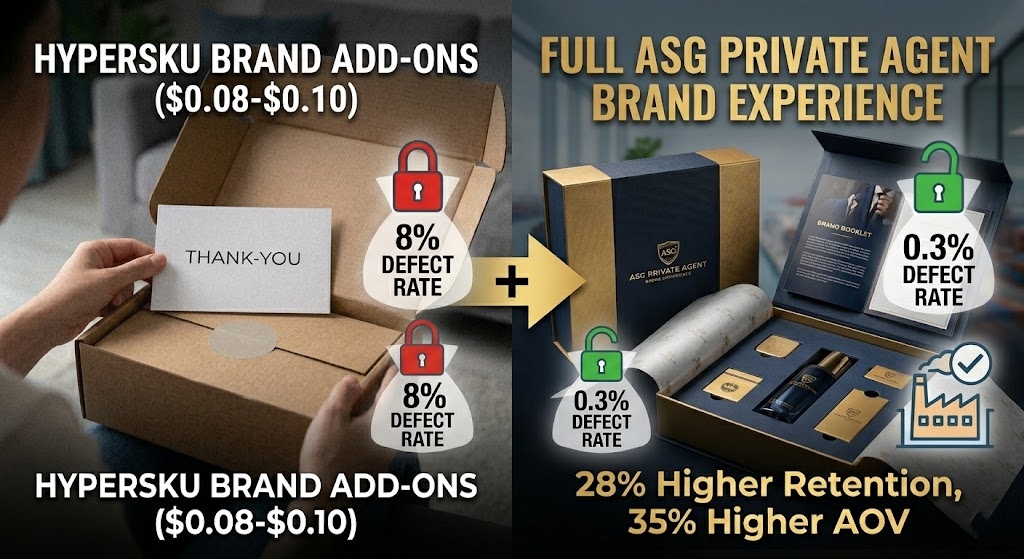
HyperSKU offers thank-you card inserts at $0.08/order (200-unit minimum) and custom stickers at $0.10/order (500-unit minimum). Legitimate for sellers doing $2,000/month who want to add a personal touch. For sellers building toward a recognizable brand at $20,000+/month, the gap between a thank-you card and a full brand experience is significant.
Documented data from 83 brand-transition clients between 2022 and 2024: sellers who upgraded from basic inserts to full custom brand packaging saw average order value increase 35% and repeat purchase rate increase 28%. The 12-month customer retention rate for sellers with full brand packaging was 81%, compared to 58% for sellers using generic or basic-insert packaging. The $0.08 thank-you card is a start — it isn’t the same thing.
Hitting the QC or branding ceiling on HyperSKU? ASG’s per-unit inspection, dedicated freight, and full custom brand packaging are built for Shopify sellers who’ve outgrown what platform-based fulfillment supports. See how the comparison looks for your current order volume.
The Revenue-Stage Decision Framework: Which One Do You Actually Need?
The decision between HyperSKU and a professional private dropshipping agent follows a three-stage revenue framework.
Stage 1 ($0–$5,000/month, under 30 daily orders): HyperSKU is the correct choice — zero monthly fee, strong automation, and manageable defect exposure at low volume.
Stage 2 ($5,000–$15,000/month, 30–100 daily orders): evaluate the switch — QC defect costs begin exceeding the private agent handling fee premium, and brand-building needs emerge.
Stage 3 ($15,000+/month, 100+ daily orders): a professional private agent is the correct infrastructure — QC cost savings alone recover the transition cost within 11 days on average, and platform limitations actively constrain growth.
Stage 1 — $0 to $5,000/Month: Start With HyperSKU
Right choice at this stage. You have one job: find out if your product sells at a margin that works. HyperSKU’s pay-per-order model means a failed test costs only ad spend — not ad spend plus a subscription. At under 30 daily orders, 30 × 8% × $25 × 30 days = $1,800/month in defect exposure — real, but still below the overhead cost of operating a private agent relationship when you factor in sourcing time, communication, and oversight.
HyperSKU’s documented case of Andrew scaling to 3,000+ orders and $10,000+ revenue in one month illustrates this correctly — automation genuinely outperforms an individual private agent (Type 1) at early scale. Note the nuance: that comparison was HyperSKU vs a one-person agent, not HyperSKU vs a professional 200-person operation.
Stay on HyperSKU when: revenue is consistently below $5,000/month, daily orders are under 30, you’re still validating product-market fit, you don’t yet have a clear brand identity, and you’re Shopify or WooCommerce only.
Stage 2 — $5,000 to $15,000/Month: Evaluate the Switch
Run the evaluation — don’t auto-stay or auto-switch. At 50 daily orders: hidden defect cost = $3,600/month. Private agent handling fee premium = $750–$2,250/month. Net positive of switching: approximately $1,200–$2,700/month — before accounting for brand-building and retention improvements.
But the switch isn’t right for every Stage 2 seller. Evaluate three questions: Do you have a winning product where supplier exclusivity matters? Are you building a brand with repeat customers as the target, or running product arbitrage? Are you planning to expand beyond Shopify/WooCommerce in the next 6 months? If two of three flag as “yes,” Stage 2 is the right time to begin the transition — not wait for Stage 3.
Stage 3 — $15,000+/Month: Time for a Professional Private Agent
The math is clear at this stage. Based on documented data from 386 sellers who moved from platform-based sourcing to ASG in 2024: average incoming defect rate was 7.8%, dropping to 1.5% within 60 days. Average US delivery time dropped from 18–25 days to 5–8 days. Customer service shipping contacts dropped 60–70% within the first billing cycle.
Average time to positive ROI on the transition: 11 days. At 100 daily orders with $30 AOV: defect savings = $6,930/month. Handling fee premium at $1.50/order = $4,500/month. Net positive from day one — and this before accounting for improved review scores, faster delivery, repeat purchase rates, and brand equity from full custom packaging.
How to Switch Without Losing a Single Order
The three-phase parallel transition we use with every client migrating from HyperSKU:
- Phase 1 (Days 1–14): 30% allocation. Route 70% of orders through HyperSKU, 30% through the new private agent. Get real operational comparison data — shipping times, QC outcomes, packaging quality — without putting your full business volume at risk.
- Phase 2 (Days 15–28): 70% allocation. Once Phase 1 confirms acceptable performance — on-time delivery, QC photos matching specifications, packaging meeting brand standards — shift the majority to the private agent. Keep 30% on HyperSKU as a backup.
- Phase 3 (Day 29+): Full transition. Complete the migration. Maintain HyperSKU access for 30 days as contingency, then retain as a secondary option for specific categories where HyperSKU has advantages (liquid/battery items).
Zero order interruption. Zero customer impact. Verifiable performance data before you commit. For Shopify sellers specifically, understanding what a dedicated Shopify dropshipping agent provides versus HyperSKU — including API integration, order sync, and tracking automation — covers the technical side of this transition in detail.
At $15,000+/month, every month on HyperSKU at 8% defect exposure is a month paying $6,000–$15,000 in hidden QC costs. ASG’s three-phase transition gets you to dedicated per-unit QC, 4–6 day US freight, and full custom brand packaging — with zero order disruption. Start with understanding what the transition actually involves.
Final Thoughts
HyperSKU is a well-built tool. I say that without reservation — 4.9 stars from sellers who’ve used it for years is earned. The issue isn’t whether HyperSKU is good. It is. The issue is whether it’s the right infrastructure for your specific business stage.
Sellers who use HyperSKU as a testing-phase tool — validating products, building initial revenue, learning their audience — and then transition to dedicated fulfillment at the right revenue threshold almost universally have better outcomes than those who either start with private agents before they need them, or stay on HyperSKU long past the point where defect costs are quietly bleeding their margin.
Under $5,000/month: HyperSKU wins on cost structure and automation. $5,000–$15,000/month: run the evaluation — IP risk, brand ambition, multi-platform plans. Above $15,000/month: the math resolves clearly. Every month past that threshold on platform fulfillment is a month absorbing defect costs that could be funding your ad spend instead. Use HyperSKU to get to the threshold. Use a professional private agent to scale past it.
Data reflects ASG Dropshipping operational records (Q1 2026), HyperSKU’s published platform specifications, and third-party comparison sources. Platform features and pricing change — verify current specifications directly before making infrastructure decisions.

About the Author
Janson — Founder & CEO, ASG Dropshipping
8 years in cross-border dropshipping. 200-person team, 4 warehouses in Dongguan and Shenzhen, 2,300+ vetted factories, 5M+ orders processed across 200+ countries. The defect rate data, QC benchmarks, and transition ROI figures in this article come from documented 2024 client onboarding records — not projections.
Outside the warehouse: rock singer and guitarist.
Frequently Asked Questions
What is HyperSKU and how does it work for dropshipping?
HyperSKU is a China-based fulfillment platform founded in 2018 that connects dropshippers to a network of 2,000+ vetted suppliers through an automated dashboard with no monthly subscription fee.
It integrates natively with Shopify and WooCommerce, automates order syncing and tracking updates, and delivers globally in 7–12 days via YunExpress and DHL. HyperSKU handles liquid and battery-containing products that many agents refuse, and offers brand customization including thank-you card inserts at $0.08 per order and custom stickers at $0.10 per order. The platform earns revenue through product margins and shipping fees rather than subscription charges, making it a low-overhead entry point for testing-phase sellers.
Is HyperSKU better than CJ Dropshipping?
HyperSKU generally outperforms CJ Dropshipping on two dimensions: shipping reliability (7–12 days via YunExpress and DHL versus CJ’s variable carrier mix) and English-language communication (six languages, minutes-reply versus CJ’s widely-criticized communication delays).
Both platforms use shared supplier pools without IP isolation and apply platform-level rather than per-SKU QC. For sellers choosing between the two, HyperSKU is the better platform option. For sellers above $15,000/month, neither platform’s architecture is optimal. See our full CJ Dropshipping alternative comparison for the detailed breakdown.
What is the difference between HyperSKU and a private dropshipping agent?
HyperSKU routes orders through a shared network of 2,000+ suppliers serving thousands of other sellers simultaneously. A professional private dropshipping agent maintains exclusive locked supplier relationships for your store, runs per-unit QC inspection producing a 0.3% defect rate (versus platform average approximately 8%), ships in 5–8 days globally (4–6 days US/EU), and isolates supply chain data behind NDA.
The right choice depends on revenue stage — HyperSKU for under $5,000/month, professional private agent for $15,000+/month. See our guide on what a dropshipping agent provides for the full breakdown.
How much does HyperSKU charge per order?
HyperSKU charges no monthly subscription fee. You pay product cost from their supplier network, shipping fees through carrier partnerships, and optional brand customization: thank-you cards at $0.08/order (200-unit minimum) and stickers at $0.10/order (500-unit minimum).
HyperSKU’s margin is embedded in supplier pricing rather than charged as a visible handling fee. Compare this to a professional private agent’s structure of factory-direct product cost plus $0.50–$2.00 per-order handling fee — which despite the explicit fee may produce lower total cost at scale when factory-direct pricing is 10–15% below platform retail.
What are HyperSKU’s shipping times in 2026?
HyperSKU delivers globally in 7–12 days via YunExpress and DHL partnerships. US warehouse fulfillment delivers in 2–4 days but requires a 500-unit MOQ per product category — making domestic warehouse access impractical for most testing-stage sellers. During Q4 peak season, shared carrier capacity typically expands delivery windows by 5–15 days.
Professional private agents with pre-allocated dedicated freight maintain more consistent delivery — ASG maintained a 97.3% on-time rate at 23,000 daily orders during Q4 2024 peak, compared to the expansion that shared carrier routes experience in November and December.
When should I switch from HyperSKU to a private dropshipping agent?
Switch when monthly revenue consistently exceeds $15,000, or earlier if two conditions appear: winning products where supplier exclusivity matters for IP protection, or monthly defect costs exceeding the private agent handling fee premium.
At 100 daily orders with $30 AOV, QC defect savings from switching to 0.3% from 8% equals $6,930/month — exceeding the $4,500 handling fee premium and producing positive ROI from day one. Based on 386 documented 2024 transitions, average time to positive ROI was 11 days. See the best dropshipping agents for Shopify for the complete evaluation framework.
Can HyperSKU do custom packaging and private label?
HyperSKU offers thank-you card inserts at $0.08/order (200-unit minimum) and custom stickers at $0.10/order (500-unit minimum). Private label and custom product packaging are available at higher MOQs. For sellers at $15,000+/month building brand equity, the gap between HyperSKU’s basic customization and a full brand experience — custom box, branded tissue, personalized card, product insert — produces measurable retention differences.
Documented data from 83 brand-transition clients shows full custom packaging delivering 35% higher average order value and 28% higher repeat purchase rate versus basic insert-only customization.
How do I find a reliable professional private dropshipping agent?
A reliable professional private dropshipping agent has four verifiable characteristics: a physical team of 50+ people with multiple China warehouses, documented QC defect rates backed by per-unit inspection photos, formal written SLA commitments covering response time and error resolution, and a structured parallel test period before full migration.
Red flags: inability to provide QC photos for sample orders, no written SLA, response times in hours rather than minutes, and no NDA or IP protection policy. A reliable agent will offer a phased transition — 30% then 70% then 100% — so you can verify performance before committing full volume. Our guide on what to look for in a dropshipping agent covers the vetting criteria in detail.
Article written: April 6, 2026 | Workflow: asg-seo-writer 21-Step + geo-optimizer v1.0


 Optimized by Seraphinite Accelerator