If you are running an e-commerce store today, you are likely feeling the squeeze of rising acquisition costs and a global market that never sleeps. The truth is that most shops fail not because they lack a good product, but because they lack a scalable engine. With global online retail sales projected to hit a staggering $6.8 trillion by 2028, according to data from stripe.com, the opportunity is massive, but the margin for error is razor-thin.
In this guide, I’m taking you behind the scenes of how we at ASG help over 1,000 clients navigate these waters. We will explore how an e-commerce business should consider using automation, flexible fulfillment, and data-driven unit economics to move from a ‘side hustle’ to a global brand. Whether you are a solo founder or managing a small team, these strategies are the exact blueprints used by the top 1% of sellers to maintain growth without burning out.
Key takeaways
- Prioritize unit economics: High gross margins are the only way to survive rising ad costs.
- Automate fulfillment: Use ERP integrations to handle orders in under 24 hours.
- Solve cart abandonment: Complexity kills sales; 70% of carts are lost to poor checkout UX.
- Leverage flexible supply chains: Move from local stock to hybrid dropshipping models.
- Focus on LTV over CAC: Retention is the growth multiplier in a saturated market.
Understanding the Foundations: Unit Economics and Product-Market Fit
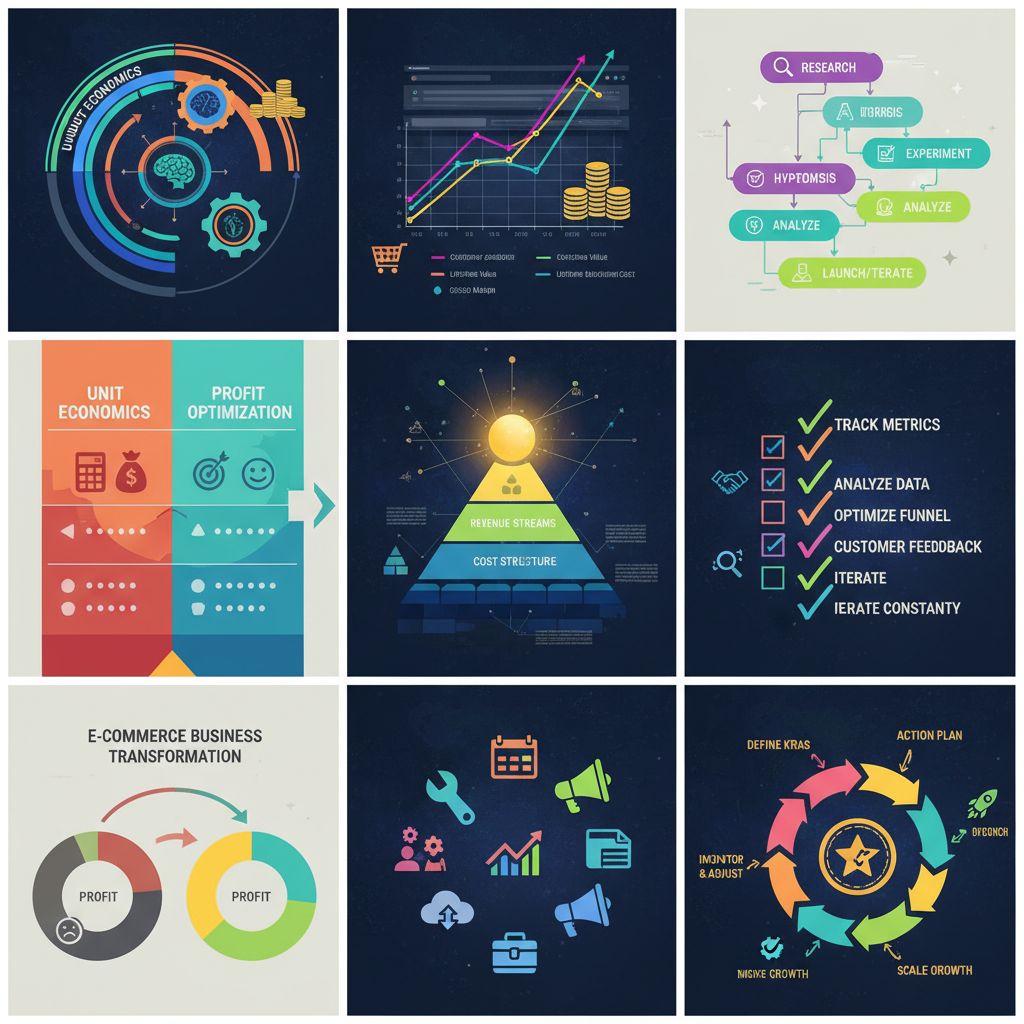 Understanding the Foundations: Unit Economics and Product-Market Fit – Visual Guide
 Before an e-commerce business considers using aggressive marketing, it must first master its unit economics. At ASG, we often see sellers focus on top-line revenue while their actual margins are being eaten alive by hidden shipping fees and returns. A sustainable business requires a high gross margin and a repeatable path to meet customer demand. According to stripe.com, sustainable growth is impossible if your margin collapses when fulfillment costs peak as volume increases.
The Three Pillars of Foundation
1. Gross Margin Health: You should aim for at least a 3x markup on your COGS (Cost of Goods Sold) to account for ad spend and operational overhead.
2. Product-Market Fit: Scaling a product that doesn’t solve a specific problem is just throwing money into a void. Use data to validate that your audience actually wants what you’re selling.
3. Repeatable Demand: Identify which channels—be it TikTok, Google, or Meta—provide a consistent Return on Ad Spend (ROAS).
| Metric | Target | Why it Matters |
| Gross Margin | 60% – 70% | Covers CAC and operating expenses |
| Contribution Margin | >20% | Actual profit after all variable costs |
| CAC:LTV Ratio | 1:3 | Ensures long-term business viability |
We tell our clients that if the math doesn’t work at 10 orders a day, it definitely won’t work at 1,000. Use this stage to trim the fat from your supply chain by negotiating directly with factories via agents like ASG.
Why Strategic Scaling Matters in 2026: Trends and Data
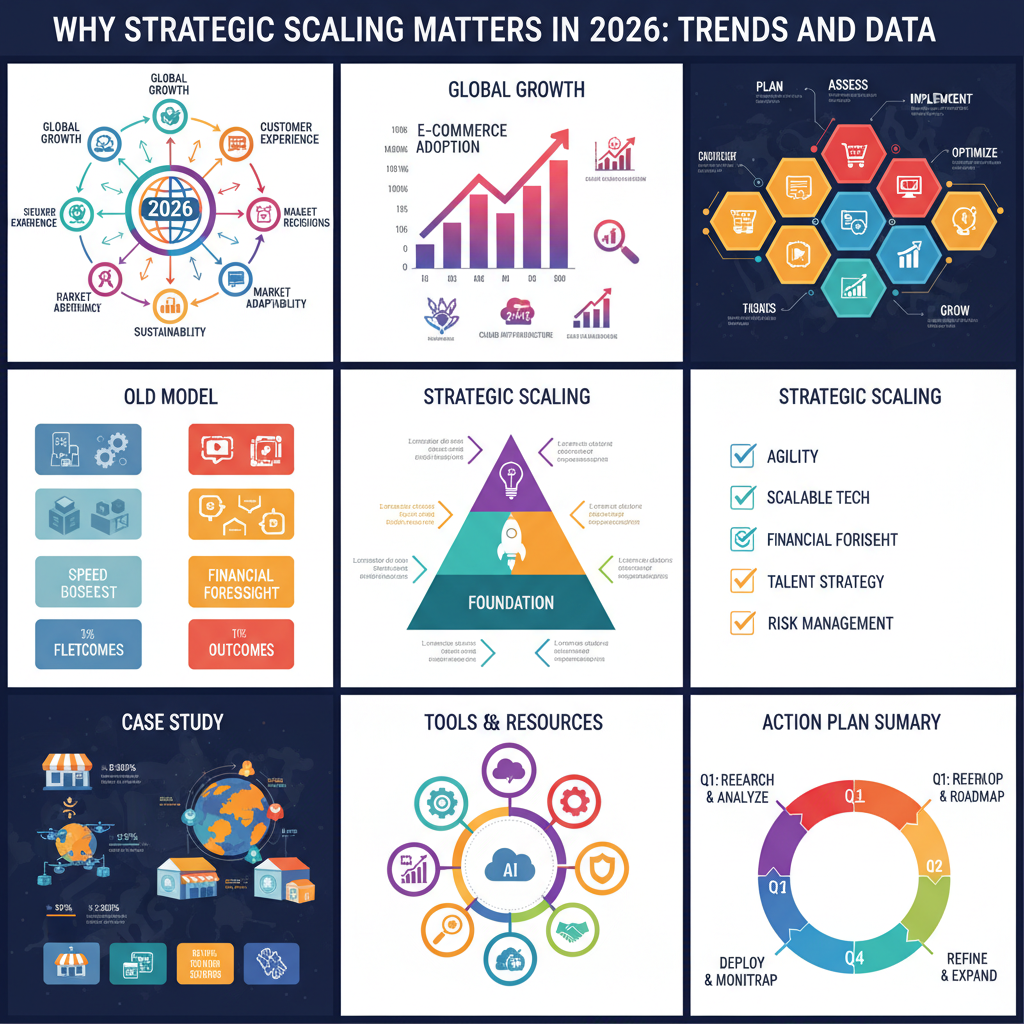 Why Strategic Scaling Matters in 2026: Trends and Data – Visual Guide
 The landscape of 2026 is dominated by ‘Agentic Commerce’ and AI-driven personalization. An e-commerce business must consider using technology not just as a tool, but as a core team member. Market data shows that more than 70% of online carts are abandoned, often due to a lack of stock or overly complex checkout processes. In a world where Amazon has set the ‘Next Day’ standard, your business cannot afford a 20-day delivery window.
Current Market Shifts
* Hyper-Personalization: AI now predicts what customers want before they search for it. If you aren’t using data to personalize the shopping experience, you are losing to those who are.
* Supply Chain Resilience: The era of ‘Just-in-Time’ inventory is being replaced by ‘Just-in-Case’ hybrid models. This involves keeping some stock in local warehouses while dropshipping the rest from China to balance risk.
* Social Commerce Dominance: Platforms like TikTok Shop have collapsed the funnel from discovery to checkout into a single click. Scaling here requires a supply chain that can handle ‘viral’ spikes of 5,000% in a single afternoon.
Implementation Strategies: From Manual to Automated
Once the foundation is set, the next step is implementation. An e-commerce business should consider using ERP (Enterprise Resource Planning) systems and Shopify applications to unify its data. As noted by stripe.com, unifying your data allows you to automate decisions that improve margins, such as dynamically shifting inventory between warehouses based on regional demand.
Practical Action Steps
1. Automate the Order Flow: Connect your store to an agent like ASG via API. When a customer buys, the order should automatically go to the factory without you clicking a single button.
2. Flexible Fulfillment: Don’t put all your eggs in one basket. Use a mix of air freight for speed and sea freight for cost-saving on bulk items.
3. Checkout Optimization: Simplify. Every extra field in your checkout form is a reason for a customer to leave. Use ‘one-click’ payment methods like Link or Apple Pay to reduce friction.
At ASG, we provide a dedicated Shopify app that handles this entire loop. Our users see an average reduction in fulfillment time by 48 hours simply by removing the manual data entry phase. This speed is what allows you to scale without needing to hire a massive team.
Common Mistakes to Avoid: Lessons from Real Failures
In my years as CEO of ASG, I’ve seen countless businesses fail during the scaling phase. The most common error is scaling a ‘leaky bucket’—spending more on ads while the backend fulfillment is broken. If your fulfillment costs peak as volume increases, as warned in stripe.com’s scaling guide, you are essentially paying for the privilege of losing money.
The ‘Fail’ List
* Over-ordering Inventory: Many sellers tie up all their cash in stock that doesn’t move. Use a dropshipping-first approach to test products before committing to bulk buys.
* Ignoring Customer Retention: It costs 5x more to acquire a new customer than to keep an old one. If you don’t have an email sequence or loyalty program, you’re leaving money on the table.
* Slow Shipping without Communication: Customers will forgive a delay if you tell them. They will never forgive being ghosted. Always provide tracking numbers within 24-48 hours.
* Poor Quality Control: Scaling bad products just leads to a scaling number of chargebacks. We always provide sample inspection videos to our clients to ensure the factory isn’t cutting corners as the order size grows.
Pro Tips from Janson: Insider Insights on Global Sourcing
As someone who lives and breathes the China-to-Global supply chain, here is my ‘unfair advantage’ advice. An e-commerce business should consider using custom branding even at the dropshipping stage. You don’t need to order 5,000 units to get your logo on a box. At ASG, we offer custom packaging and ‘thank you’ cards for orders as small as one unit.
The Janson Playbook
* The 80/20 Rule of Inventory: 80% of your sales will come from 20% of your products. Only move that 20% to local US/EU warehouses to offer 3-day shipping. Let the rest stay in the China warehouse to save on storage fees.
* Negotiate on Terms, Not Just Price: As you scale, ask your agent for better payment terms (like Net-7 or Net-15) rather than just a 5-cent discount. Cash flow is the oxygen of a growing business.
* Use Video for QC: Don’t trust static photos. Demand videos of the product being tested. We do this for all our high-volume sellers to prevent the dreaded ‘mass production’ quality drop.
Remember, your supplier is your partner, not just a vendor. If you treat them like a partner, they will prioritize your orders during the busy Q4 season.
Key Takeaways & Next Steps: Your 90-Day Scaling Plan
To wrap this up, scaling isn’t a single event; it’s a series of optimized systems working together. An e-commerce business must consider using a live financial system that balances liquidity with speed. According to stripe.com, turning your finances into a ‘live system’ helps you understand fixed versus variable costs at different scales.
Your 90-Day Action Plan
* Days 1-30: Audit your unit economics. If your contribution margin is below 20%, find a new supplier or raise your prices.
* Days 31-60: Automate. Integrate your Shopify store with ASG’s ERP to remove yourself from the fulfillment process.
* Days 61-90: Brand and Expand. Introduce custom packaging and start testing a new product line to cross-sell to your existing customers.
Scaling is hard, but it’s a lot easier when you have the right infrastructure. If you’re ready to stop playing small and start leveraging the power of the Chinese supply chain with the reliability of a professional agent, reach out to us at ASG. Let’s build your brand together.
Sources and further reading (selected)
- Stripe Resources – Scaling Ecommerce: Comprehensive guide on the foundations of scaling online retail, including supply chain and financial strategies. Read more →
- Stripe AU – Growth Mechanics: Exploration of how checkouts and inventory systems affect the ability of a business to grow sustainably. Read more →
- Stripe Canada – Technology in Ecommerce: Insights into how unifying data and automating decisions improves profit margins for global sellers. Read more →
- Shopify – Global Ecommerce Trends: Analysis of current trends in social commerce and AI-driven personalization for 2026. Read more →
- Statista – Retail E-commerce Sales: Global projections for e-commerce growth through 2028. Read more →
- Baymard Institute – Cart Abandonment Rate: Statistical breakdown of why 70% of users abandon carts during checkout. Read more →
- Harvard Business Review – The Value of Keeping Customers: A deep dive into why retention is more cost-effective than acquisition for scaling businesses. Read more →
- 1688.com – Direct Sourcing: The primary source for factory-direct pricing in the Chinese supply chain. Read more →
- USPS – International Shipping Standards: Guidelines on international delivery times and expectations for US-based customers. Read more →
- ASG Dropshipping Case Studies: Real-world data on how automated fulfillment reduced lead times for 1,000+ sellers. Read more →


 Optimized by Seraphinite Accelerator