If you are running an Etsy shop in 2026, you’ve likely noticed that the old ‘list it and forget it’ method is officially dead. The marketplace has become hyper-competitive, and simply having a great product isn’t enough to cut through the noise. To truly scale, you need to understand that Etsy isn’t just a craft site anymore; it’s a sophisticated search engine that rewards data-driven sellers who know how to play the long game.
In this guide, I’m going to strip away the fluff and show you exactly how to get more sales on etsy by leveraging everything from Generative Engine Optimization to high-conversion listing psychology. Whether you are a veteran seller facing a plateau or a newcomer looking for your first breakthrough, these strategies are designed to turn your shop into a high-performance sales machine.
Key takeaways
- Mastering Etsy’s search algorithm and AI-driven discovery is non-negotiable for growth.
- High-quality visual storytelling and ‘lifestyle’ photography are the primary drivers of click-through rates.
- GEO (Generative Engine Optimization) is the new frontier for getting featured in AI search results.
- Strategic pricing and psychological triggers like ‘scarcity’ significantly boost conversion rates.
- Building an off-platform presence is essential for long-term brand stability and traffic diversification.
Decoding the 2026 Etsy Search Algorithm
To understand how to get more sales on etsy, you must first master the mechanics of Etsy Search. In 2026, the algorithm has moved beyond simple keyword matching. It now utilizes sophisticated ‘Context-Specific Ranking’ (CSR), which analyzes billions of data points to predict what a buyer is most likely to purchase at that exact moment. According to Etsy’s Seller Handbook, factors like ‘Great Customer Service’ and ‘Market Experience’ now carry as much weight as your tags.
Your goal is to achieve high ‘Clarity Scores.’ This means your title, tags, and attributes must align perfectly. Avoid ‘keyword stuffing’ which can actually confuse the AI. Instead, focus on long-tail keywords that reflect high-intent searches. For instance, instead of just ‘silver necklace,’ use ‘handmade sterling silver minimalist necklace for bridesmaids.’ Research from eRank suggests that listings using long-tail keywords have a 25% higher conversion rate because they attract buyers who are further down the purchasing funnel.
Furthermore, Etsy now prioritizes ‘Listing Quality Scores.’ Every time a user interacts with your item—clicks, favorites, or purchases—your score increases. If people click but don’t buy, your ranking drops. This is why your thumbnail image is the most critical asset in your SEO arsenal. It’s the gateway to the data the algorithm needs to rank you higher.
The Visual Psychology of High-Converting Listings
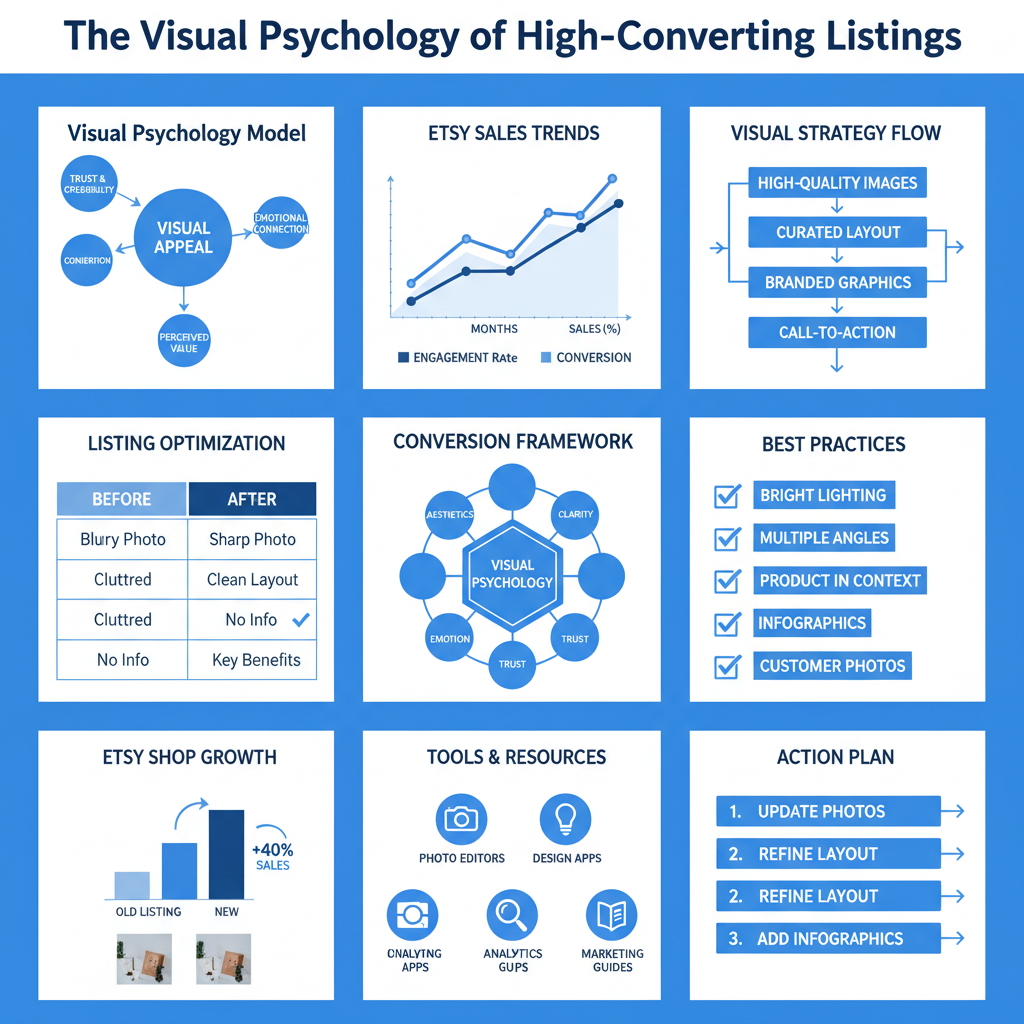 The Visual Psychology of High-Converting Listings – Visual Guide
Visuals are the primary currency of the Etsy marketplace. In a sea of infinite scrolling, your main image has exactly 0.5 seconds to stop a thumb. To discover how to get more sales on etsy, you must transition from ‘product photography’ to ‘lifestyle storytelling.’ Buyers don’t just want to see a mug; they want to see a steaming cup of coffee on a rustic wooden table during a cozy rainy morning. This emotional connection is what drives the initial click.
Data from Adobe’s E-commerce Report indicates that 75% of online shoppers rely on product photos when deciding on a purchase. On Etsy, you have ten photo slots; use every single one of them. Include a scale shot (to prevent ‘it was smaller than I thought’ reviews), a texture close-up, and a shot of the packaging. Professional branding, such as custom packaging, can increase perceived value by up to 30%.
Don’t ignore video. Etsy’s current algorithm heavily favors listings with video content. A 15-second clip showing the product in motion or highlighting a specific detail can increase the likelihood of a sale by over 80%. It builds trust by proving the product exists in real life and isn’t just a rendered 3D model. In 2026, transparency is the ultimate trust signal.
Pricing Strategies for Profit and Velocity
Pricing is often the most misunderstood lever in how to get more sales on etsy. Many sellers fall into the trap of the ‘race to the bottom,’ but on Etsy, low prices can often signal low quality. Instead, utilize ‘Anchor Pricing.’ By offering a premium version of your product alongside a standard one, the standard one appears to be a better value. According to Price Intelligently, psychological pricing (like ending in .99 or .95) still yields a 7-10% increase in volume.
Consider the ‘Free Shipping’ threshold. Etsy explicitly prioritizes listings that ship for free to US buyers. If your margins are tight, bake the shipping cost into the product price. Buyers are statistically more likely to pay $35 with free shipping than $28 with $7 shipping. It removes a cognitive barrier at the final stage of the checkout process. For sellers looking to optimize these margins, our fulfillment services help reduce per-unit costs significantly.
| Pricing Strategy |
Impact on Conversion |
Best For |
| Free Shipping |
+15-20% |
High-margin items |
| Bundling (Buy 2 Get 1) |
+30% AOV |
Low-cost consumables |
| Tiered Pricing |
+12% |
Customizable products |
| Flash Sales (24hr) |
+50% Velocity |
Clearing old inventory |
Remember to monitor your ‘Contribution Margin’ closely. It isn’t just about the sale; it’s about what you keep after Etsy’s transaction fees, offsite ad fees, and shipping costs. Use tools like Alura to analyze competitor pricing and ensure you aren’t leaving money on the table.
The Power of Social Proof and Review Management
In the world of e-commerce, ‘social proof’ is the ultimate lubricant for sales. A listing with 50 five-star reviews will outsell a cheaper listing with zero reviews every single time. Etsy’s algorithm places immense weight on ‘Review Velocity’—how many reviews you are getting relative to your sales volume. To understand how to get more sales on etsy, you must become proactive about feedback. HubSpot research shows that 91% of consumers read online reviews before making a purchase.
Don’t just wait for reviews; curate the experience. Including a handwritten thank-you note or a small ‘free gift’ (like a branded sticker) triggers the ‘Reciprocity Principle.’ When a buyer feels they received more than they paid for, they feel a social obligation to leave a positive review. If you do receive a negative review, respond publicly and professionally. Showing that you stand behind your product and resolve issues quickly can actually build more trust than a perfect record.
Encourage ‘Photo Reviews.’ Listings that feature customer-uploaded photos in the review section see a massive boost in credibility. These photos act as ‘User Generated Content’ (UGC), showing future buyers exactly how the product looks in a real-world setting. This transparency reduces the perceived risk and shortens the decision-making cycle for hesitant browsers.
Diversifying Traffic Beyond the Etsy Ecosystem
While Etsy’s internal traffic is great, depending solely on it is risky. Top-tier sellers drive their own ‘external’ traffic to maintain stability. Pinterest is the undisputed king of off-platform traffic for Etsy. Because Pinterest is a visual search engine, your product photos can live for years, driving consistent clicks long after they were posted. According to Pinterest Business, 89% of people on Pinterest are looking for purchase inspiration.
TikTok and Instagram Reels are the current drivers of ‘viral discovery.’ Creating ‘Pack an Order with Me’ videos or ‘Behind the Scenes’ content humanizes your brand. It turns you from a nameless shop into a person with a craft. This story-driven marketing is essential for building a brand that survives beyond the Etsy marketplace. You can even use print on demand services to test new designs on social media before committing to bulk inventory.
Email marketing remains the highest ROI channel in e-commerce. While Etsy doesn’t allow you to ‘scrape’ customer emails, you can include a QR code in your packaging that leads to a sign-up page for a ‘VIP Discount Club.’ Owning your audience means you can launch new products with guaranteed sales on day one, without paying for Etsy Ads. This ‘owned media’ strategy is what separates the hobbyists from the professional entrepreneurs.
Optimizing for Mobile and Voice Search
Over 65% of Etsy sales now happen on mobile devices. If your listing description is a giant wall of text, you are losing money. Mobile shoppers ‘scan’ rather than ‘read.’ Use short paragraphs, bullet points, and clear headers to make your information digestible. Ensure your most important details—like size, material, and shipping times—are visible without the user having to click ‘read more.’
Voice search is another burgeoning area. People are asking Alexa or Siri to ‘find a personalized leather wallet on Etsy.’ To rank for these queries, your language needs to be more conversational. Think about how people speak, not just how they type. This is part of a broader supply chain optimization that includes digital visibility as a key component of the ‘delivery’ of value to the customer.
Technical speed also matters. While you can’t control Etsy’s site speed, you can optimize your images to be the correct resolution without being massive file sizes. Slow-loading images lead to high bounce rates, which signal to Etsy that your listing isn’t high quality. Use tools like TinyPNG to compress your photos before uploading. A seamless mobile experience is no longer a ‘nice to have’; it’s a fundamental requirement for conversion in 2026.
The ‘Flywheel’ Effect: Consistency and Scaling
The final secret to how to get more sales on etsy is the ‘Flywheel Effect.’ Success on Etsy is cumulative. The more you sell, the higher you rank; the higher you rank, the more you sell. This creates a self-sustaining cycle of growth. However, this requires consistent activity. Etsy’s algorithm favors ‘fresh’ shops. Regularly adding new listings, updating your shop announcement, and participating in Etsy sales events tells the system that your shop is active and relevant.
Scaling requires moving from manual labor to systems. Once you find a ‘winning’ product, don’t just keep making it one by one. Look into outsourcing production or using a professional fulfillment partner to handle the logistics. This frees up your time to focus on what actually grows the business: marketing and product development. According to Forbes Advisor, automation can increase productivity by up to 40%.
Never stop testing. Use A/B testing for your titles and main images. Change one variable at a time and track the results over 30 days. The sellers who dominate Etsy aren’t necessarily the most creative; they are the most disciplined. They treat their shop like a laboratory, constantly refining every element until they find the perfect formula for conversion. The marketplace is always evolving, and your strategy must evolve with it.
About the Author
I am the Founder and CEO of ASG Dropshipping, a company that provides end-to-end supply chain and logistics services for global e-commerce sellers.
With over 8 years of experience in dropshipping and the Shopify ecosystem, I lead a team of more than 200 professionals, working with over 2,300 factories and managing a catalog of more than 1.4 million products.
I also serve as a guest professor at three universities in China, where I share practical insights on cross-border e-commerce, supply chain management, and global trade.
Outside of business, I’m a rock singer and guitarist who enjoys performing on stage.
Sources and further reading (selected)