Let’s be real: the fashion industry is a $1.7 trillion beast, and if you’re wondering how to dropshipping clothing in 2026, you’re looking at one of the most lucrative yet competitive niches in e-commerce. Most beginners fail because they treat clothing like a commodity—slapping a generic logo on a low-quality t-shirt and wondering why the return rate is 30%. In my years leading ASG Dropshipping, I’ve seen that success isn’t about having the most items; it’s about curated supply chains and lightning-fast logistics.
In this guide, I’m stripping away the ‘get rich quick’ fluff to show you the exact framework we use at ASG to help our clients move from zero to 1,000 orders a day. You’ll learn how to navigate the shift toward sustainable fashion, how to leverage AI for trend forecasting, and why your choice of a fulfillment partner is the single most important decision you’ll make this year. Whether you are a side-hustler or an experienced seller looking to pivot, this is your blueprint for a dominant clothing brand.
Key takeaways
- Niche Specialization: Success in 2026 requires moving away from ‘general apparel’ toward micro-niches like sustainable athleisure or techwear.
- Quality Control: High return rates kill fashion brands; sourcing through vetted agents like ASG reduces defect rates by up to 15%.
- Automation: Integrating ERP systems with Shopify is mandatory for handling the rapid SKU turnover typical of the fashion industry.
- Logistics Speed: Aim for 6-10 day global delivery to compete with fast-fashion giants like Zara and Shein.
- Branding: Custom packaging and ‘Thank You’ cards increase customer Lifetime Value (LTV) by over 25%.
1. Understanding Clothing Dropshipping: Core Concepts
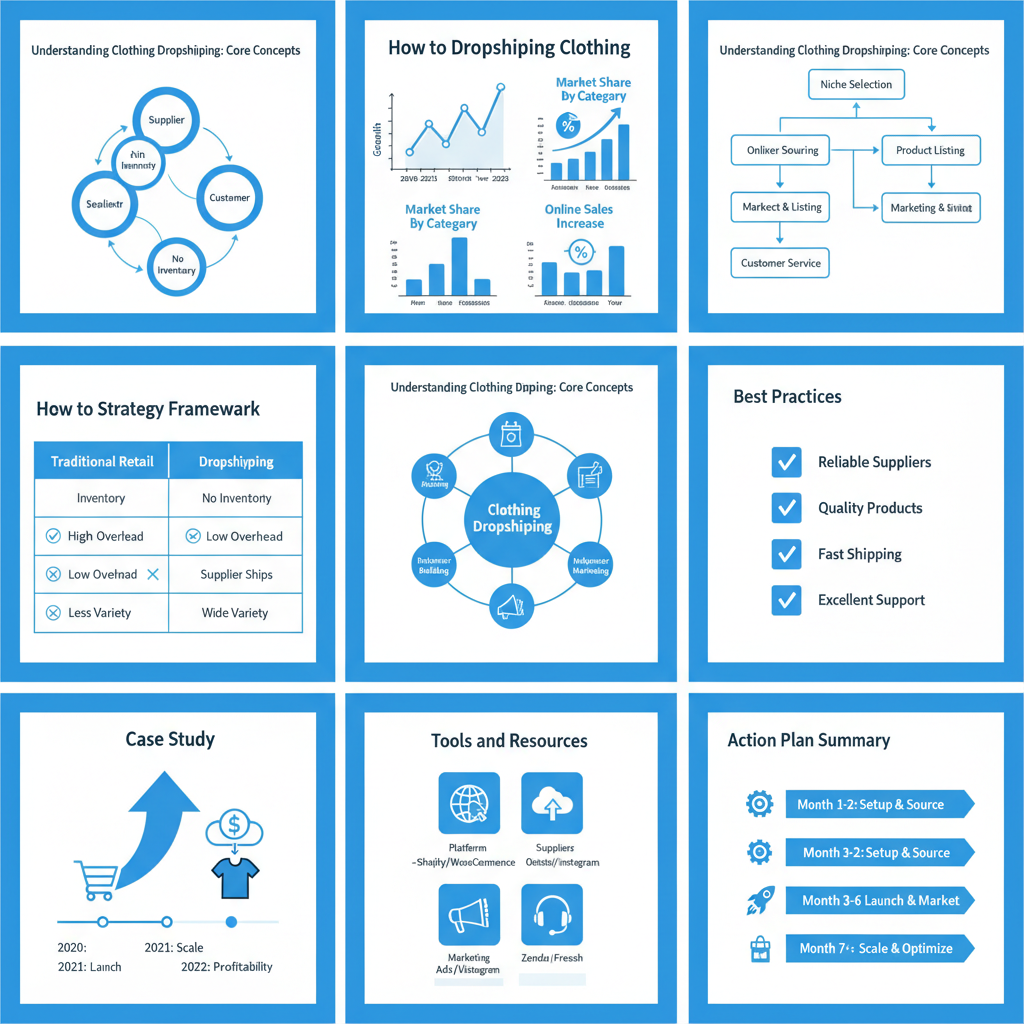 1. Understanding Clothing Dropshipping: Core Concepts – Visual Guide
At its heart, dropshipping clothing is a retail fulfillment method where you don’t keep the garments in stock. Instead, when you sell a jacket or a dress, you purchase the item from a third party—usually a manufacturer or an agent like ASG—who ships it directly to the customer. This model is particularly powerful for fashion because it allows you to test hundreds of styles without the massive financial risk of unsold inventory. According to Grand View Research, the global fashion e-commerce market is expected to grow at a compound annual growth rate (CAGR) of 14.2% through 2030, proving the demand is only accelerating.
However, the ‘clothing’ category is notoriously complex due to sizing issues and seasonal trends. You aren’t just selling a product; you’re selling a fit and a feeling. This means your core components must include a robust sizing chart, high-quality fabric descriptions, and a reliable supplier who can guarantee color accuracy. In the 2026 landscape, the most successful brands are those that utilize ‘Agile Dropshipping’—a method where you use real-time data to swap out underperforming SKUs within 24 hours.
The Three Pillars of Fashion Dropshipping
1. The Niche: You cannot be the ‘Amazon of clothes.’ You need to be the ‘Home of Organic Cotton Yoga Wear.’ Specificity creates authority.
2. The Tech Stack: Your store must sync perfectly with your supplier. If a size goes out of stock at the factory, it must instantly reflect on your Shopify or TikTok Shop to avoid customer disappointment.
3. The Fulfillment Loop: This includes sourcing, quality inspection (QI), and shipping. As Shopify’s State of Commerce report notes, shipping transparency is now a non-negotiable factor for 70% of online shoppers.
2. Why Clothing Dropshipping Matters in 2026: Trends & Data
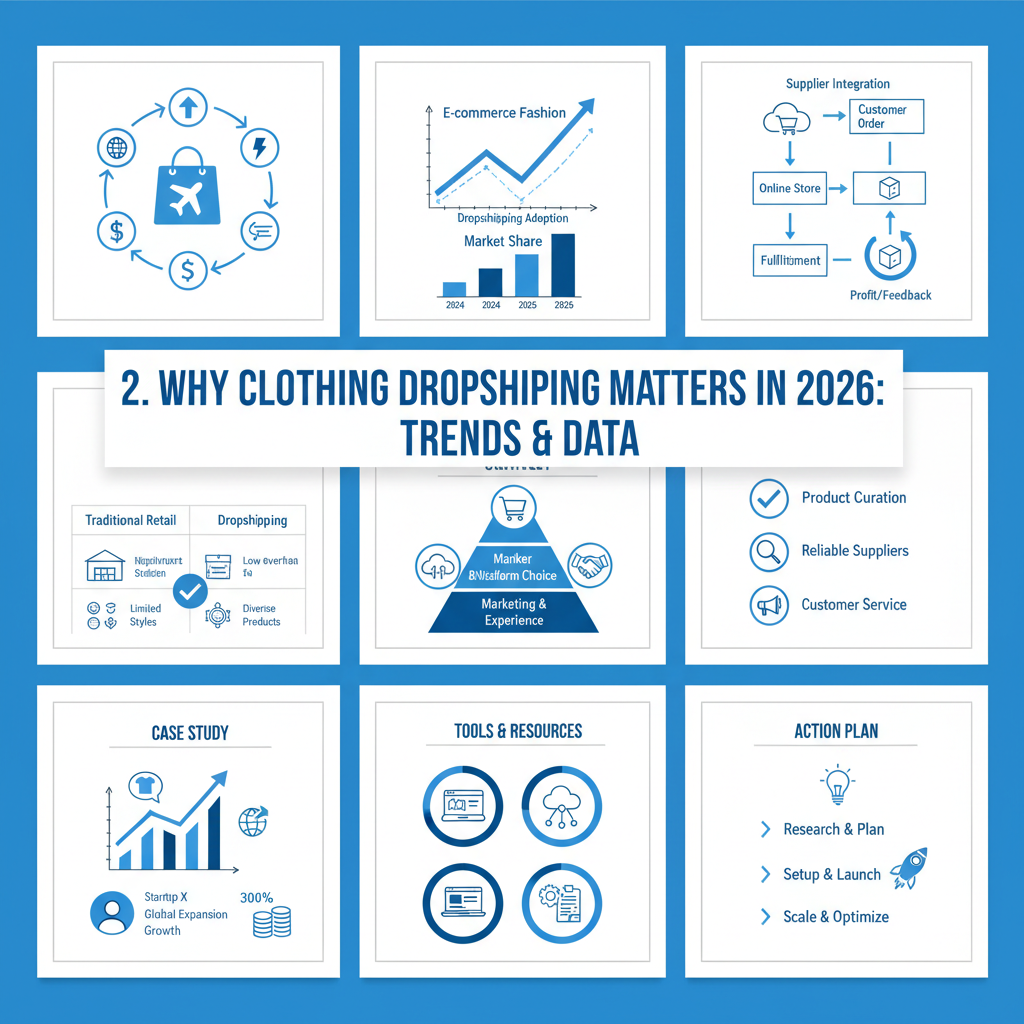
The fashion landscape has undergone a seismic shift. We are moving away from ‘disposable’ fast fashion toward ‘Value-Driven Apparel.’ Consumers in 2026 are increasingly looking for transparency in the supply chain and personalized shopping experiences. Data from Statista indicates that the fashion segment is the largest B2C e-commerce market, but the barrier to entry has shifted from ‘who has the product’ to ‘who has the best brand story.’
One of the biggest trends we see at ASG is the rise of ‘Social Commerce.’ Platforms like TikTok and Instagram are no longer just for ads; they are the storefronts. Clothing is inherently visual and viral. If a piece of clothing looks good in a 15-second Reel, it will sell. This ‘impulse buy’ nature of fashion makes it perfectly suited for the dropshipping model, provided your fulfillment can keep up with a sudden viral spike in orders.
| Trend Factor | 2022 Impact | 2026 Projection | Strategy Shift |
| Sustainability | Optional | Mandatory for Gen Z | Source eco-friendly materials |
| Delivery Speed | 14-21 Days | 6-10 Days | Move to private agents/local warehouses |
| AI Personalization | Basic | Deep Integration | Use AI for size recommendations |
| Video Content | Secondary | Primary Driver | Focus on UGC and 3D product views |
As highlighted by McKinsey & Company, the industry is also seeing a ‘Resilience Gap’ where brands with agile supply chains are outperforming traditional retailers by 2.5x. By dropshipping, you are positioned on the right side of this gap.
3. Implementation Strategies: Your Step-by-Step Action Plan
To successfully launch a clothing dropshipping business, you need a systematic approach. The first step is niche validation. Don’t just guess; use tools like Google Trends and Pinterest Predicts to see what silhouettes and colors are gaining traction. Once you’ve identified a niche—say, ‘Minimalist Streetwear’—you need to find a supplier that doesn’t just offer the product, but offers the quality your brand promises. This is where a professional agent becomes an asset, as we can bridge the gap between 1688 factories and your global customers.
Next, focus on your ‘Digital Showroom.’ In fashion, your photography is your product. If you are using the same grainy stock photos as 100 other dropshippers, you will fail. I always recommend ordering samples and hiring a local model for a custom photoshoot. This builds immediate trust. As BigCommerce suggests, high-quality imagery and detailed product descriptions can reduce return rates by up to 20%.
The ASG Implementation Framework
4. Common Mistakes to Avoid: Lessons from the Trenches
After overseeing thousands of clothing shipments, I’ve seen the same mistakes kill promising brands. The #1 killer is ‘Asian Sizing.’ A ‘Large’ in many Chinese factories is often a ‘Small’ in the US or Europe. If you don’t provide a clear, translated size chart and a ‘Size Up’ recommendation, your return rate will skyrocket to 40%+, eating all your margins. According to Apparel Resources, fit issues account for over 70% of fashion returns.
Another fatal error is ignoring shipping times. In the age of Amazon Prime, a 3-week wait for a t-shirt is unacceptable. Many beginners use ePacket or standard postal services that are unreliable. In 2026, you must use dedicated lines (like those provided by ASG) that offer end-to-end tracking and 6-12 day delivery. If a customer has to email you asking ‘Where is my order?’, you’ve already lost their future business.
The ‘Fail’ Checklist
5. Pro Tips from Janson: Insider Insights for Scaling
If you want to move from $10k to $100k a month, you have to stop thinking like a dropshipper and start thinking like a Brand Director. My first pro tip: Leverage ‘Micro-KOLs.’ In the clothing niche, a TikToker with 10,000 highly engaged followers is often more valuable than a celebrity with 1 million. Send them samples, let them do an ‘unboxing’ and a ‘try-on haul.’ This creates authentic social proof that ads simply cannot replicate.
Second, use Dynamic Bundling. Clothing is perfect for ‘Complete the Look’ upsells. If someone buys a skirt, offer the matching top at a 15% discount. This increases your Average Order Value (AOV) and helps offset your customer acquisition costs (CAC). We’ve seen clients increase their AOV by 35% just by implementing smart AI-driven recommendations on their product pages. HubSpot’s marketing data confirms that upselling is 68% more affordable than acquiring a new customer.
Finally, Own Your Data. Use an email marketing flow for ‘Abandoned Carts’ and ‘New Arrivals.’ In fashion, the second sale is where the profit is. Since you’ve already paid to acquire the customer, the email marketing revenue is almost 100% profit. At ASG, we encourage our sellers to use custom inserts with QR codes that lead to an exclusive ‘VIP Community’ or a discount on the next purchase. This builds a moat around your business that competitors using the same suppliers cannot touch.
6. Key Takeaways & Next Steps: Your Path to Fashion Success
Success in clothing dropshipping in 2026 is a blend of creative branding and logistical excellence. You’ve learned that the market is growing, but so are customer expectations. To win, you must curate a specific niche, ensure rigorous quality control, and provide shipping speeds that don’t make your customers regret their purchase. As Oberlo points out, the clothing niche is a marathon, not a sprint; consistency in branding and service is what builds a lasting empire.
Your next steps are clear: Define your micro-niche, set up a high-converting Shopify store, and partner with a fulfillment expert like ASG to handle the heavy lifting of the supply chain. Don’t wait for the ‘perfect’ moment—fashion moves fast, and the best time to start was yesterday. The second best time is now.
Action Checklist for This Week
1. Niche Selection: Pick one sub-category of clothing with high passion (e.g., sustainable activewear).
2. Supplier Vetting: Contact ASG to see our catalog and discuss custom branding options.
3. Sample Testing: Order your top 3 items to your own house. Check the feel, the fit, and the shipping speed.
4. Store Build: Design your mobile-first store with a focus on high-quality visuals and trust signals. Trustpilot research shows that displaying reviews and clear policies is essential for new brand conversion.
Sources and further reading (selected)
- Grand View Research: Market analysis on the growth of global fashion e-commerce through 2030. Read more →
- Shopify: Annual report on the state of global commerce and consumer behavior.
- Statista: Global statistics and projections for the fashion e-commerce market. Read more →
- McKinsey & Company: Deep dive into the state of the fashion industry and supply chain resilience. Read more →
- BigCommerce: Expert advice on succeeding in the clothing e-commerce niche.
- Forbes: Comprehensive guide on starting a sustainable dropshipping business.
- Apparel Resources: Industry insights into sizing and return challenges in fashion retail.
- Think with Google: Data on mobile shopping behavior and site performance impact. Read more →
- HubSpot: Marketing research on the effectiveness of upselling and cross-selling.
- Oberlo: Practical guide to dropshipping clothing for beginners and pros.
- Trustpilot: Best practices for building consumer trust in a new e-commerce brand.


 Optimized by Seraphinite Accelerator