The landscape of dropshipping ads has undergone a seismic shift as we enter 2025. If you are still trying to ‘hack’ the algorithm with complex interest targeting or manual bidding, you are likely burning your budget. Today, the game is won through high-quality creative assets and feeding the right data to AI-driven machines like Meta’s Advantage+ and Google’s Performance Max. At ASG, we’ve seen thousands of products succeed not because of a secret ‘winning interest,’ but because the seller mastered the art of visual storytelling and automated fulfillment.
In this guide, I’m pulling back the curtain on how we manage ads for our top-tier clients. Whether you are struggling with rising CPMs or trying to figure out where to spend your first $500, you will learn the exact frameworks required to build a sustainable, high-ROAS advertising engine. We will move past the basics and dive into the data-driven strategies that are actually moving the needle in the current e-commerce climate.
Key takeaways
- AI-Powered Automation: Leverage Meta Advantage+ and Google PMax for superior machine-learning optimization.
- Creative is the New Targeting: Focus on scroll-stopping UGC and short-form video rather than granular interest sets.
- Data Integrity: Implement Conversion API (CAPI) to bypass signal loss and improve tracking accuracy.
- Omnichannel Approach: Combine Google’s search intent with Facebook’s demand generation for maximum reach.
- Efficiency Benchmarks: Target an average CTR of 2.5% and look for CPCs around $0.60 to maintain profitability.
Understanding Dropshipping Ads in 2025: Core Concepts
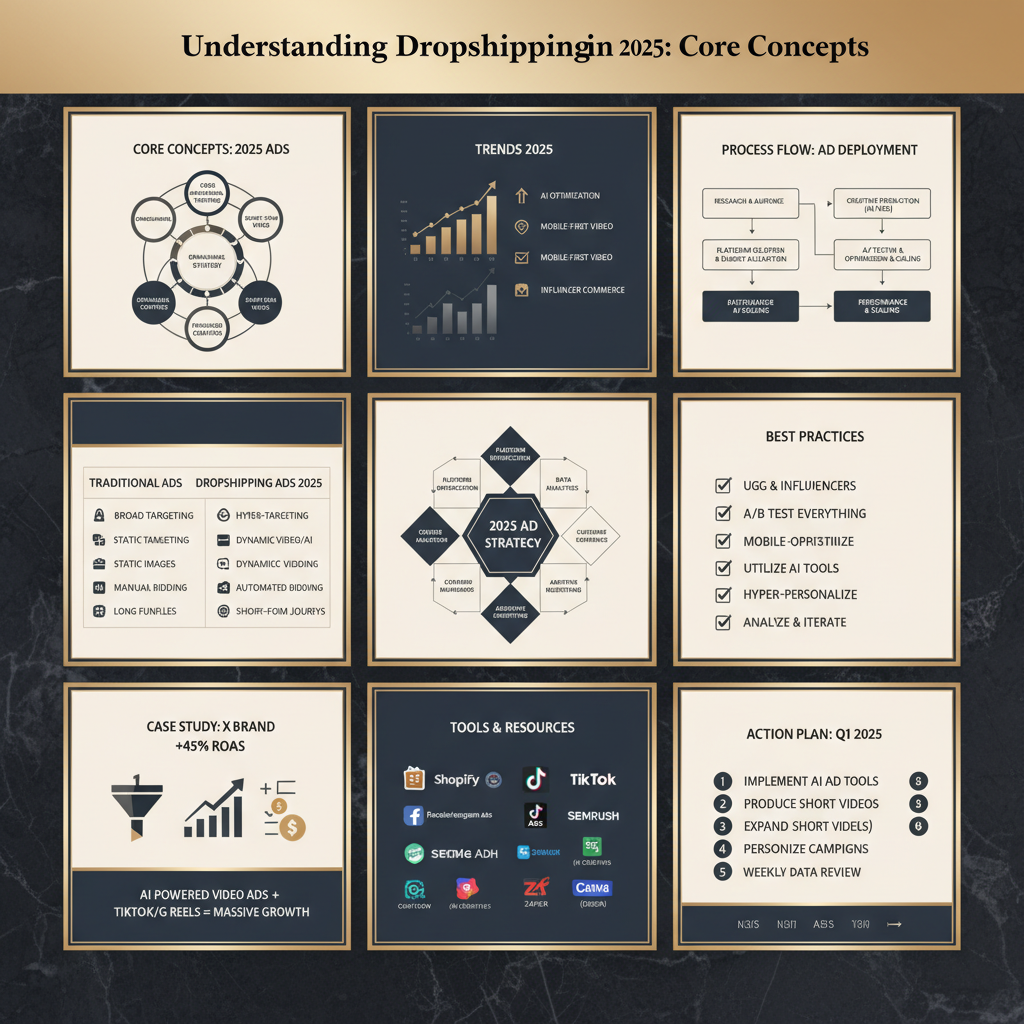 Understanding Dropshipping Ads in 2025: Core Concepts – Visual Guide
 Dropshipping ads in 2025 are no longer about ‘tricking’ a platform into finding customers; they are about providing the platform with enough high-quality data to let its AI do the work. The core components of a successful campaign now revolve around three pillars: Data Signals, Creative Diversity, and Offer Strength. According to digitaladvertisinghub.com, the shift toward hyper-granular machine learning means Meta now analyzes billions of data points to match ads with buyers better than any human could manually.
To start, you must understand the difference between ‘Demand Generation’ (Social Ads) and ‘Demand Capture’ (Search Ads). Social ads on platforms like TikTok and Instagram create a need by showing a product a user didn’t know they wanted. Conversely, Google Ads capture existing intent. As noted by shopify.com, Google is often more expensive per click but converts faster because the user is already looking for a solution.
At ASG, we recommend a ‘Hybrid Start.’ This involves using a small portion of your budget to test product-market fit on Facebook while simultaneously setting up a Google Shopping feed to catch high-intent traffic. This ensures you aren’t just relying on impulse buys but are also visible when a customer goes to ‘price check’ your item on Google.
Finally, the technical foundation—the Pixel and Conversion API (CAPI)—is non-negotiable. Without CAPI, you are losing roughly 30% of your conversion data due to privacy restrictions. Modern ads require a clean feedback loop so the algorithm knows exactly who purchased and who dropped off at checkout.
Why Creative Strategy Matters More Than Ever in 2025
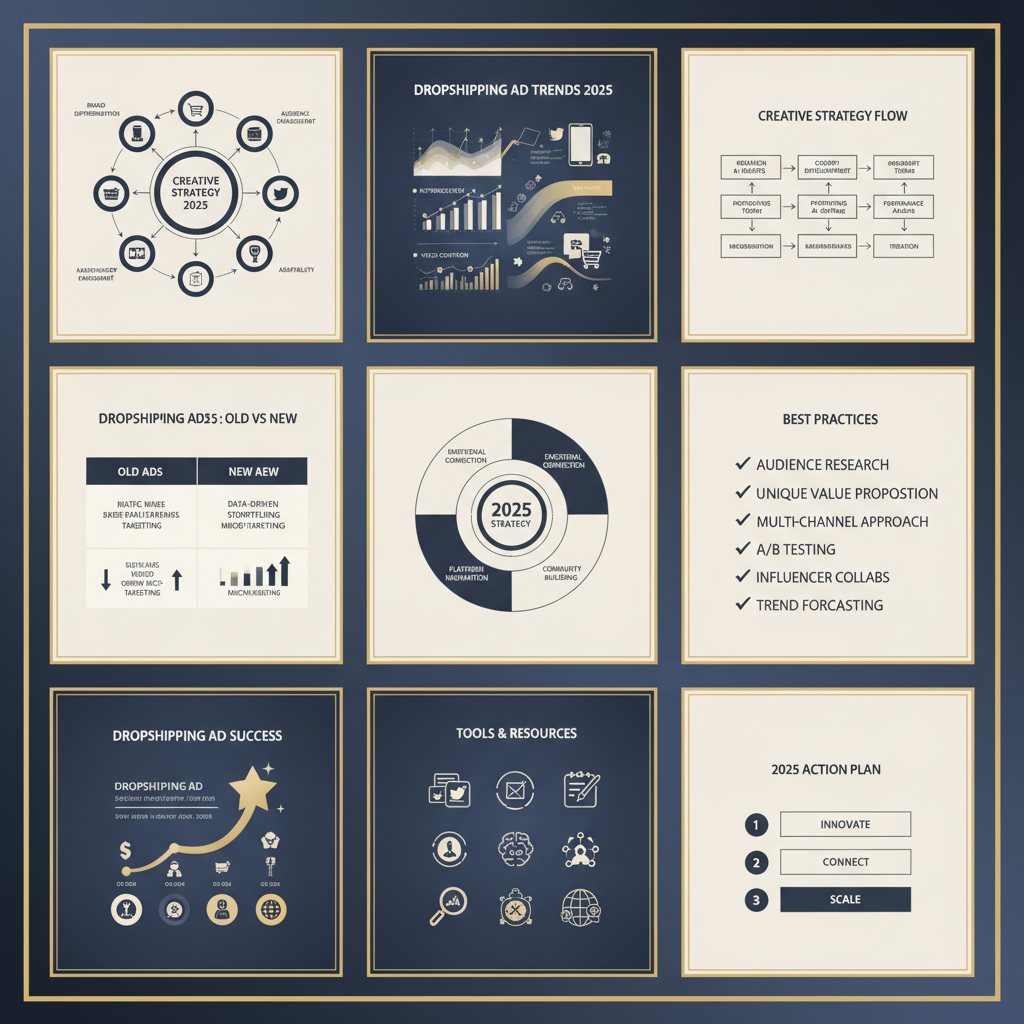 Why Creative Strategy Matters More Than Ever in 2025 – Visual Guide
 In previous years, you could win with a mediocre image and a ‘Buy Now’ button. In 2025, ‘Creative is the Targeting.’ This means the algorithm looks at the visual content of your ad to determine which audience segment will find it relevant. Research from trueprofit.io indicates that the average CTR for successful dropshipping ads has stabilized around 2.5%, a benchmark that requires high-engagement video content to achieve.
User-Generated Content (UGC) remains the king of formats. When a real person demonstrates a product, it builds immediate trust that a professional studio shot cannot replicate. According to dropshipping.com, video ads that keep viewers emotionally engaged within the first 3 seconds perform significantly better than traditional product-centric ads. You should aim for a mix of ‘Problem/Solution’ videos, ‘Unboxing’ clips, and ‘Social Proof’ testimonials.
| Ad Format | Purpose | Best Platform |
| Short-form Video (UGC) | High Engagement / Trust | TikTok / Reels |
| Carousel Ads | Product Features / Options | Facebook Feed |
| Collection Ads | Mobile Shopping Experience | Instagram |
| Static Image | Clean Product Presentation | Google Display |
We advise our clients to test at least 5 different creative angles for every new product. One might focus on the price, another on the utility, and a third on the emotional benefit. By letting the AI see which angle gets the most clicks, you allow the market to tell you how to scale.
Implementing the Advantage+ and PMax Framework
The manual days of ‘Interest: Yoga, Age: 25-34’ are largely over. In 2025, the most successful dropshippers utilize Advantage+ Shopping Campaigns (ASC). These campaigns automate targeting, bidding, and placements into a single streamlined process. As digitaladvertisinghub.com points out, ASC allows Meta to use its full AI power to find customers across the entire ecosystem, including Messenger and the Audience Network.
On the Google side, Performance Max (PMax) has become the standard. PMax uses a single campaign to show ads across Search, YouTube, Display, and Gmail. According to pagepilot.ai, disciplined Google campaigns can report average ROIs near 200% when they are fed high-quality product feeds and clear conversion signals. The key is to provide PMax with ‘Asset Groups’ that include varied headlines, descriptions, and videos.
To implement this effectively, start with a ‘Broad’ targeting approach. Remove all interest and lookalike filters and let the AI find the audience based on your creative. For budget, start with at least $25-$50 per day per product. This provides enough data for the machine to learn within the first 72 hours, which is the critical ‘Learning Phase’ for most modern ad platforms.
If your PMax or ASC campaigns aren’t performing, the issue is usually one of two things: your landing page speed or your product pricing. AI can find the buyer, but it can’t force them to buy a poorly priced item on a slow-loading site. We always ensure our ASG partners have their technical infrastructure optimized before we ramp up ad spend.
Common Pitfalls: Why 90% of Ad Campaigns Fail
The most common mistake I see is ‘Premature Scaling.’ Sellers often see two sales and immediately double their budget. This resets the algorithm’s learning phase and often leads to a spike in CPA. According to dropshipping.com, the recommended approach is to increase spend by only 20-30% every few days to keep the delivery stable.
Another fatal error is neglecting the ‘Post-Click’ experience. You can have the best ads in the world, but if your landing page takes more than 3 seconds to load, you are throwing money away. Data from pagepilot.ai suggests that targeting a page load time under 2.5 seconds is essential to prevent high bounce rates that signal to Google your ad is ‘low quality.’
| Mistake | Impact | Fix |
| Changing Ads Daily | Resets Learning Phase | Wait 3-7 days before editing |
| Weak Social Proof | Low Conversion Rate | Import reviews with photos |
| Hidden Shipping Costs | High Cart Abandonment | Offer free shipping or clear rates |
| Poor Tracking | Wasted Ad Spend | Install CAPI and Google GA4 |
Lastly, many dropshippers fail because they don’t account for the ‘Ad Fatigue’ cycle. In 2025, creative wears out faster due to the sheer volume of content users consume. If your ROAS starts to dip while your CPM remains steady, it is a clear signal that your audience has seen your ad too many times and you need to rotate in fresh creative assets immediately.
Pro Tips from Janson: Insider Scaling Strategies
When you find a winning product, scaling isn’t just about spending more on one ad; it’s about expanding your ‘Creative Surface Area.’ I always tell my clients to ‘remix’ their winners. If a 15-second video is working, create a 30-second version, a ‘Top 5 Reasons’ version, and a ‘Comparison’ version. This allows you to reach different segments of the same audience without hitting the fatigue wall.
Use ‘Horizontal Scaling’ alongside vertical budget increases. This means taking your winning creative and launching it in new geographic markets. If your product is a hit in the US, try the UK, Canada, or Australia. As digitaladvertisinghub.com notes, cross-platform reach allows you to amplify visibility at every touchpoint, reducing your reliance on a single market’s fluctuating CPMs.
Another pro tip is to leverage ‘Dynamic Creative Optimization’ (DCO). DCO lets you upload multiple headlines, images, and descriptions, and Meta’s AI automatically assembles them into the best-performing combination for each individual user. This is a massive time-saver for small teams who can’t manually split-test every possible variation.
Finally, focus on Lifetime Value (LTV). Most dropshippers are obsessed with the first sale. However, the real profit in 2025 is in the second and third sales. Use retargeting ads with dynamic product carousels to show customers items that complement their first purchase. According to trueprofit.io, retargeting often requires 1-3 touchpoints to convert, so don’t give up after the first ad view.
Key Takeaways & Next Steps for Your 2025 Strategy
Success in 2025 dropshipping ads requires a balance of AI automation and human creativity. You must feed the machine the right data and the right visuals, then step back and let it optimize. The benchmark for a healthy store is a conversion rate around 3.5%, as noted by pagepilot.ai. If you are below this, focus on your website before spending more on ads.
Your immediate action plan should be: 1) Verify your tracking (Pixel + CAPI), 2) Produce 5-10 UGC-style video creatives, and 3) Launch an Advantage+ Shopping Campaign with a broad audience. Monitor your metrics closely but avoid the urge to tinker with the campaign every few hours. Let the data accumulate over at least 7 days before making strategic pivots.
Remember, advertising is only half the battle. The other half is fulfillment. At ASG, we ensure our partners have 1-3 day processing times because we know that fast shipping leads to better reviews, which in turn lowers your ad costs through higher ‘Quality Scores’ on platforms like Facebook and Google. A great ad can sell a product once, but great service builds a brand.
As you scale, keep your eyes on the ‘Profit After Ad Spend’ (POAS) rather than just ROAS. Use tools like trueprofit.io to track your actual bottom line, accounting for COGS, shipping, and ad fees. This data-first mindset is what separates the hobbyists from the professional e-commerce entrepreneurs in 2025.
Sources and further reading (selected)
- Digital Advertising Hub: Comprehensive guide on 2025 Facebook ad strategies including machine learning and Advantage+ campaigns. Read more →
- TrueProfit: Analysis of Shopify store data regarding ad spend, CTR benchmarks, and profitability metrics. Read more →
- PagePilot AI: Deep dive into Google Ads for dropshipping, focusing on conversion rates and landing page optimization. Read more →
- Dropshipping.com: Technical guide on setting up Meta Business Manager, Pixel, and scaling budgets for e-commerce. Read more →
- Shopify UK Blog: Comparison of search intent vs. demand generation platforms for paid advertising. Read more →
- Meta for Business: Official documentation for Advantage+ Shopping Campaigns and AI automation. Read more →
- Google Ads Help: Official guide on Performance Max campaigns and asset group best practices. Read more →
- Statista: Market data on consumer behavior and impulse buying trends in digital retail. Read more →
- WordStream: Industry benchmarks for CPC and CPM across different e-commerce niches. Read more →
- Social Media Examiner: Expert podcast and article on the shift toward broad targeting and creative-led growth. Read more →


 Optimized by Seraphinite Accelerator