 How Do You Have to Pay Taxes on Dropshipping? (2025 Real Tax Solutions)
You’ve finally hit your first $10,000 month in dropshipping and the excitement is real. But then a thought hits you like a ton of bricks: how do you actually pay taxes on this? Many sellers ignore the taxman until a scary letter arrives, but trust me, that’s the fastest way to kill your business.
The truth is, dropshipping taxes are a bit of a maze because you’re often selling in countries where you don’t even live. Whether it’s US Sales Tax, European VAT, or local Income Tax, you need a solid plan. Let’s break down exactly what you owe so you can sleep better at night.
Key Takeaways
- You must pay Income Tax on your net profits in your home country.
- Sales Tax Nexus is triggered by physical presence or economic activity thresholds.
- VAT and GST apply to international sales in the UK, EU, and Australia.
- Proper bookkeeping is the only way to prove your deductible expenses to the IRS or local authorities.
Understanding the Basics of Dropshipping Taxes
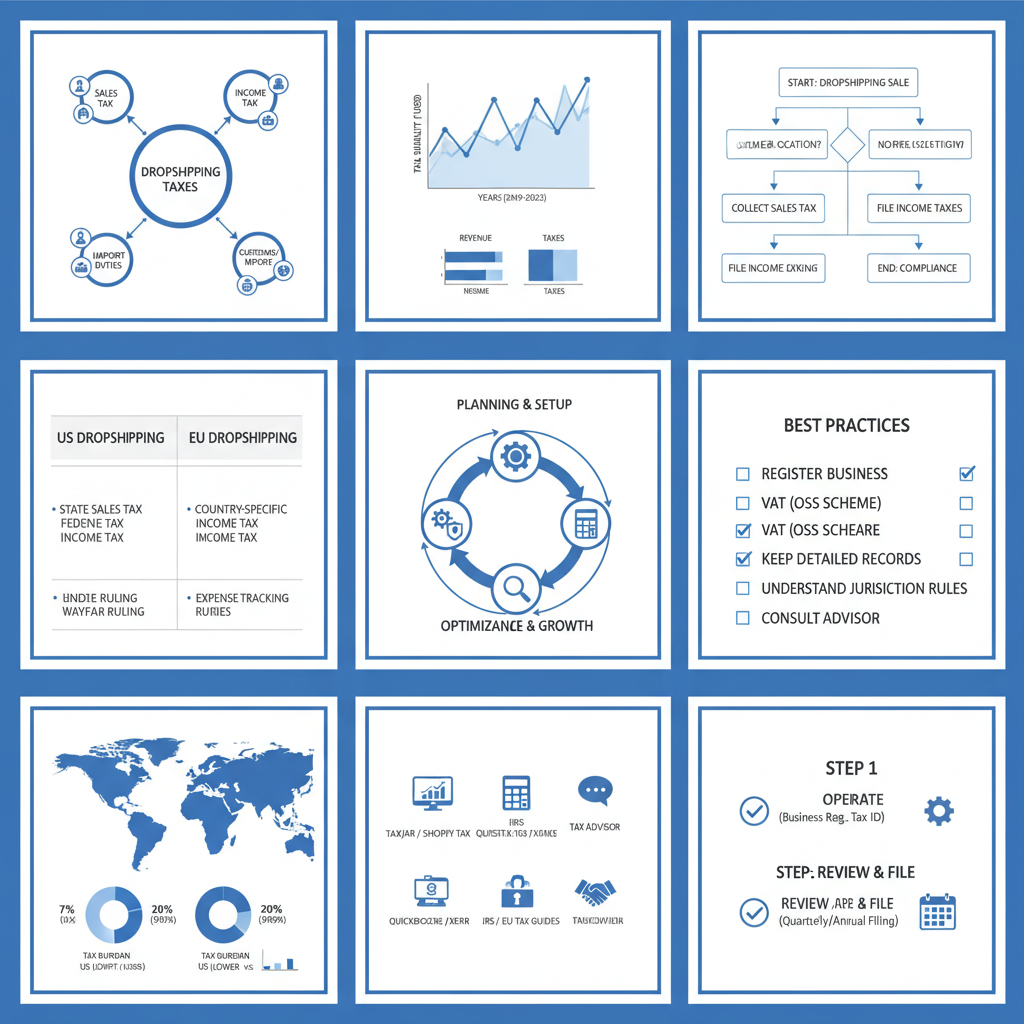 Understanding the Basics of Dropshipping Taxes – Visual Guide
 Before we dive into the deep end, let’s clarify what we’re actually talking about. In the world of e-commerce, you’re generally dealing with two main types of taxes: Income Tax and Sales Tax (or VAT/GST).
Income tax is what you pay on the money you keep after all your expenses—like product costs, ads, and ASG fulfillment fees—are deducted. Sales tax, on the other hand, is a consumption tax that you collect from the customer and pass on to the government. It’s not your money, but you’re responsible for moving it.
1. Income Tax vs. Sales Tax
Income tax is based on your annual profit. If you made $100,000 but spent $80,000 on ads and inventory, you only pay tax on the $20,000 left over. Sales tax is different; it’s a percentage added to the transaction price at the moment of purchase.
2. The Role of Your Business Entity
How you register your business—as a Sole Proprietorship, LLC, or Corporation—changes how you’re taxed. Most US-based dropshippers start as an LLC because it offers liability protection while allowing ‘pass-through’ taxation, meaning the business profits are reported on your personal tax return.
3. Why Documentation is King
You can’t just guess your numbers. You need a paper trail for every single dollar. This includes invoices from your suppliers, Shopify subscription fees, and even the cost of that laptop you bought for work. Without receipts, you can’t claim deductions, and you’ll end up paying way more than necessary.
Do You Have to Pay Sales Tax on Every Order?
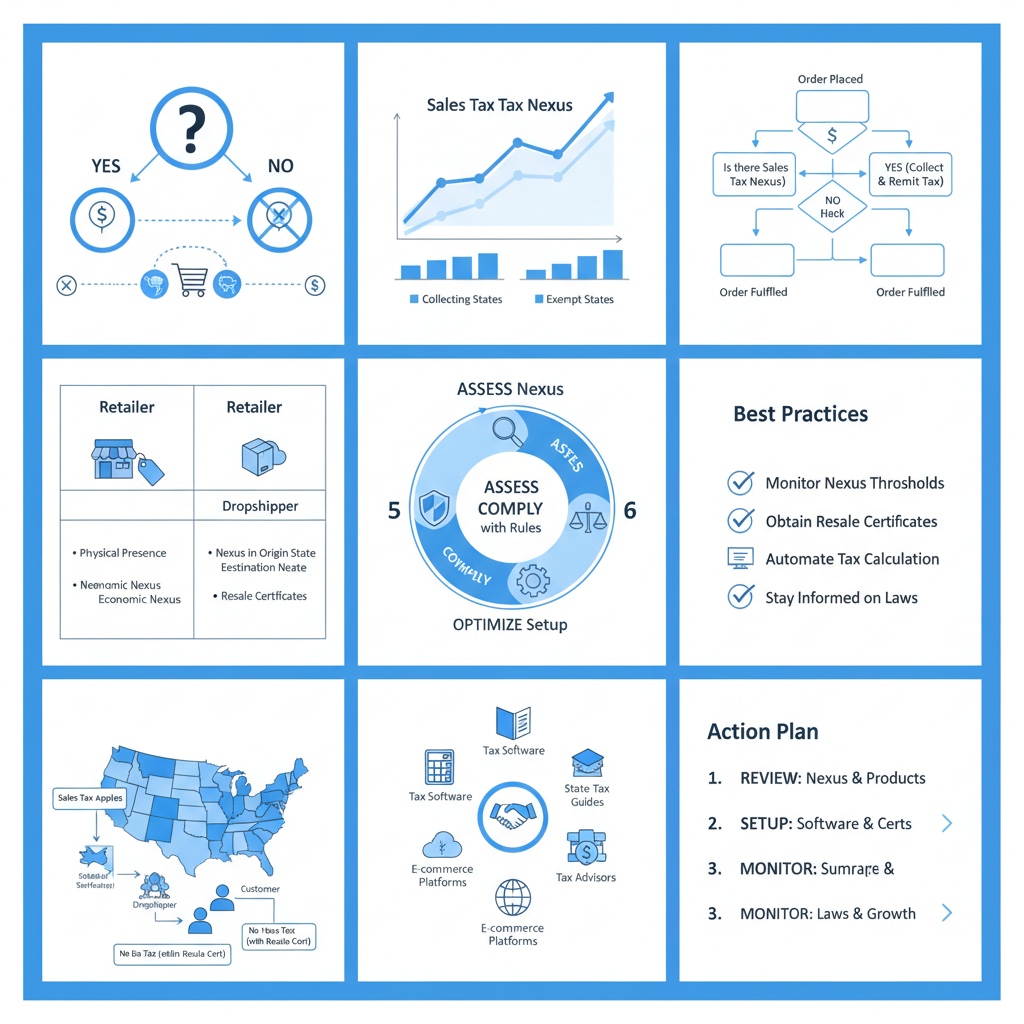 Do You Have to Pay Sales Tax on Every Order? – Visual Guide
 Here’s the deal: you don’t necessarily have to collect sales tax from every single person who buys from your store. In the US, it all comes down to a concept called ‘Nexus.’
Nexus is a fancy way of saying you have a ‘significant connection’ to a state. If you have nexus in a state, you’re legally required to collect sales tax from customers living there. If you don’t have nexus, you usually don’t have to collect it.
Step 1: Identify Physical Nexus
Physical nexus is triggered if you have an office, an employee, or inventory stored in a specific state. For example, if you use a 3PL warehouse in California to speed up shipping, you now have physical nexus in California.
Step 2: Check Economic Nexus Thresholds
In 2018, the Supreme Court changed the game with the Wayfair decision. Now, if you sell a certain amount—usually $100,000 in sales or 200 transactions—to customers in a state, you have ‘Economic Nexus.’ Even if you’ve never stepped foot in that state, you’re on the hook for their taxes.
Step 3: Register for Permits
You can’t just start collecting tax; you need a permit first. Collecting tax without a permit is actually illegal in many jurisdictions. Once you hit the threshold, apply for a sales tax permit through the state’s Department of Revenue website.
International Taxes: VAT, GST, and Beyond
If you’re selling outside the US, things get even more interesting. Europe and the UK use Value Added Tax (VAT), while Australia and Canada use Goods and Services Tax (GST).
Unlike US sales tax, VAT is often baked into the price or charged at the border. Since 2021, the EU has implemented the IOSS (Import One-Stop Shop) system to simplify VAT for low-value goods imported from outside the EU.
How VAT Works for Dropshippers
If you’re shipping from China to a customer in France, someone has to pay the VAT. If you use the IOSS system, you collect the VAT at checkout and pay it monthly. If you don’t, your customer might get a surprise bill from the courier before they can receive their package.
Learn more about old you have start.
GST in Australia and Canada
Australia requires you to register for GST once your sales to Australian consumers exceed $75,000 AUD in a 12-month period. Canada has similar rules for their GST/HST system. It’s easy to ignore these when you’re small, but once you scale, the tax authorities will find you.
Customs and Import Duties
When shipping internationally, your packages might be subject to import duties. Usually, in a dropshipping model, the ‘importer of record’ is the customer. However, to provide a better experience, many top-tier sellers use DDP (Delivered Duty Paid) shipping lines provided by agents like ASG to handle these costs upfront.
Managing these numbers manually is a nightmare. Thankfully, there are tools that sync with Shopify to automate the heavy lifting. I’ve seen sellers try to track nexus on a spreadsheet, and it always ends in tears.
| {cell} | {cell} | {cell} | {cell} | {cell} |
| Best For | US Sales Tax | Enterprise | Global VAT/GST | Sourcing Data |
| Automation | High | High | Medium | Manual Export |
| Starting Price | $19/mo | Custom | $49/mo | Free for Clients |
| Integration | Shopify/Amazon | All ERPs | Multi-platform | Shopify/ERP |
Choosing the Right Software
TaxJar is the gold standard for US-based sellers. It tells you exactly where you’re approaching nexus thresholds so you aren’t caught off guard. If you’re selling heavily in Europe, Quaderno is fantastic for handling those complex VAT invoices.
Why ASG Data Matters
While tax software tracks the ‘sell’ side, you need accurate data on the ‘buy’ side. ASG provides clear, downloadable invoices for every order we fulfill. This makes it easy for your accountant to see exactly what you spent on inventory and shipping, ensuring you don’t get overtaxed on your gross revenue.
Janson’s Personal Experience: The Day the IRS Emailed Me
Let me share a story from my early days. After 8 years in this industry, I’ve seen it all, but I’ll never forget my first ‘tax scare.’ Back in 2017, I was running a fitness niche store. I was so focused on scaling my Facebook ads that I completely ignored sales tax nexus in states like Florida and Pennsylvania.
One morning, I got a notice regarding a ‘tax discrepancy.’ I spent three weeks digging through old AliExpress receipts and PayPal logs. It was a mess. I realized then that being a ‘pro’ isn’t just about high ROAS; it’s about high-quality bookkeeping.
At ASG, we’ve helped thousands of sellers move from ‘hobbyist’ to ‘brand.’ I remember a client, Sarah, who almost lost her business because she didn’t realize she had economic nexus in 12 states. We helped her clean up her fulfillment data so her CPA could file back taxes correctly.
Learn more about old you have start.You know what? The peace of mind you get from being tax-compliant is worth every penny. It allows you to focus on the ‘simple and joyful’ part of entrepreneurship that we always talk about at ASG. Don’t let a $5,000 tax bill ruin your $50,000 profit year.
Case Study: Tax Compliance at Scale
In March 2024, Michael Thompson (male), a kitchen gadgets seller from Austin, USA, was struggling with his tax filings. He was doing roughly $45,000 in monthly revenue, but his previous agent provided messy, handwritten-style invoices that the IRS wouldn’t accept during a routine audit. He was facing potential penalties because he couldn’t prove his Cost of Goods Sold (COGS).
Solution: Michael switched to ASG Dropshipping to streamline his supply chain. Beyond just sourcing, we provided him with integrated digital invoicing through our ERP system. Every single transaction was timestamped, categorized, and matched to his Shopify order IDs. We also helped him set up a DDP shipping route to the EU to ensure his European customers weren’t hit with unexpected VAT charges.
Results: Within 60 days, Michael’s accountant was able to reconcile his entire year of books in record time. His daily orders grew from 80 to 220 as he regained the confidence to scale internationally. By 2024, his monthly revenue hit $110,000, and his tax liability was reduced by 15% simply because he could now accurately track and deduct every legitimate business expense.
Dropshipping Tax FAQs
Many sellers ask the same questions when tax season rolls around. Here are the most common ones cleared up.
1. Do I pay taxes in China if I source from there?
Generally, no. As a foreign buyer, you don’t pay Chinese income tax. However, you are responsible for taxes in the country where you are a tax resident and where your customers are located. You can learn more about international tax treaties here.
2. Can I deduct my ad spend from my taxes?
Absolutely. Facebook, Google, and TikTok ads are considered essential business expenses. According to Forbes, marketing costs are one of the biggest deductions for e-commerce businesses.
3. How does ASG help with tax documentation?
ASG provides automated invoicing for every order. This data is critical for your CPA to calculate your true profit. We ensure that your inventory costs are clearly separated from shipping fees.
4. What happens if I don’t pay sales tax?
States are becoming very aggressive. If they find you have nexus and haven’t collected tax, they can charge you for the back taxes plus heavy penalties. TaxJar has a great breakdown of the risks involved.
5. Do I need a tax ID for dropshipping?
Yes, if you’re in the US, you’ll likely need an EIN (Employer Identification Number). This is like a social security number for your business. You can apply for one for free on the IRS website.
6. Is dropshipping considered a ‘nexus’ in every state?
No. You only have nexus if you meet the physical or economic thresholds. BigCommerce provides an excellent guide on state-by-state thresholds.
Final Thoughts
Taxes might feel like a dark cloud over your dropshipping business, but they’re just another part of the game. Once you set up the right systems—like TaxJar for the sales side and ASG for the sourcing side—the process becomes automatic.
Don’t let the fear of numbers stop you from building your brand. Stay organized, keep your receipts, and always consult with a professional tax advisor to ensure you’re following the latest laws in your specific region.
At ASG, our mission is to make global entrepreneurship simple and joyful. By handling the messy parts of the supply chain and providing clear data, we give you the freedom to scale without the tax-time headache.
Dropshipping taxes are manageable if you start early.
The key is to treat your store like a real business from day one, not just a side hustle.
If you have any questions, feel free to comment below or contact us directly.
Janson is the CEO of ASG Dropshipping and a cross-border e-commerce expert with over 8 years of experience. He has helped over 6,000 sellers optimize their supply chains and scale their brands globally. His mission is to empower entrepreneurs through transparent and efficient fulfillment solutions.
Sources and Further Reading


 Optimized by Seraphinite Accelerator