If you’re running a footwear brand or a high-volume dropshipping store, finding the right manufacturing partner in China isn’t just about price—it’s about survival. Every year, China exports over $50 billion in footwear, but for every world-class factory, there are ten ‘trading companies’ posing as manufacturers that will vanish the moment a quality issue arises. As the CEO of ASG, I’ve spent years on the ground in Fujian and Guangdong, and I can tell you that the difference between a 15% margin and a 40% margin often comes down to how well you vet your source.
In this guide, I’m pulling back the curtain on the Chinese footwear industry. We’ll explore the specialized manufacturing hubs that define the global market, the technical audit process you need to follow to avoid substandard materials, and the automation strategies we use at ASG to streamline procurement. Whether you are looking for high-end leather or mass-market sneakers, this is the roadmap to finding a partner that scales with you.
Key takeaways
- Identify the right regional hub: Jinjiang for sneakers, Wenzhou for leather, and Putian for high-spec technical footwear.
- Always verify factory certifications like ISO 9001 and BSCI to ensure ethical and quality standards.
- Request ‘Sample Checking Videos’ and third-party inspections to mitigate the risk of material substitution.
- Understand the ‘Super Fake’ vs. OEM transition: Many Putian factories are shifting toward legitimate private label services.
- Leverage ERP and Shopify integration to automate order fulfillment and tracking once manufacturing is complete.
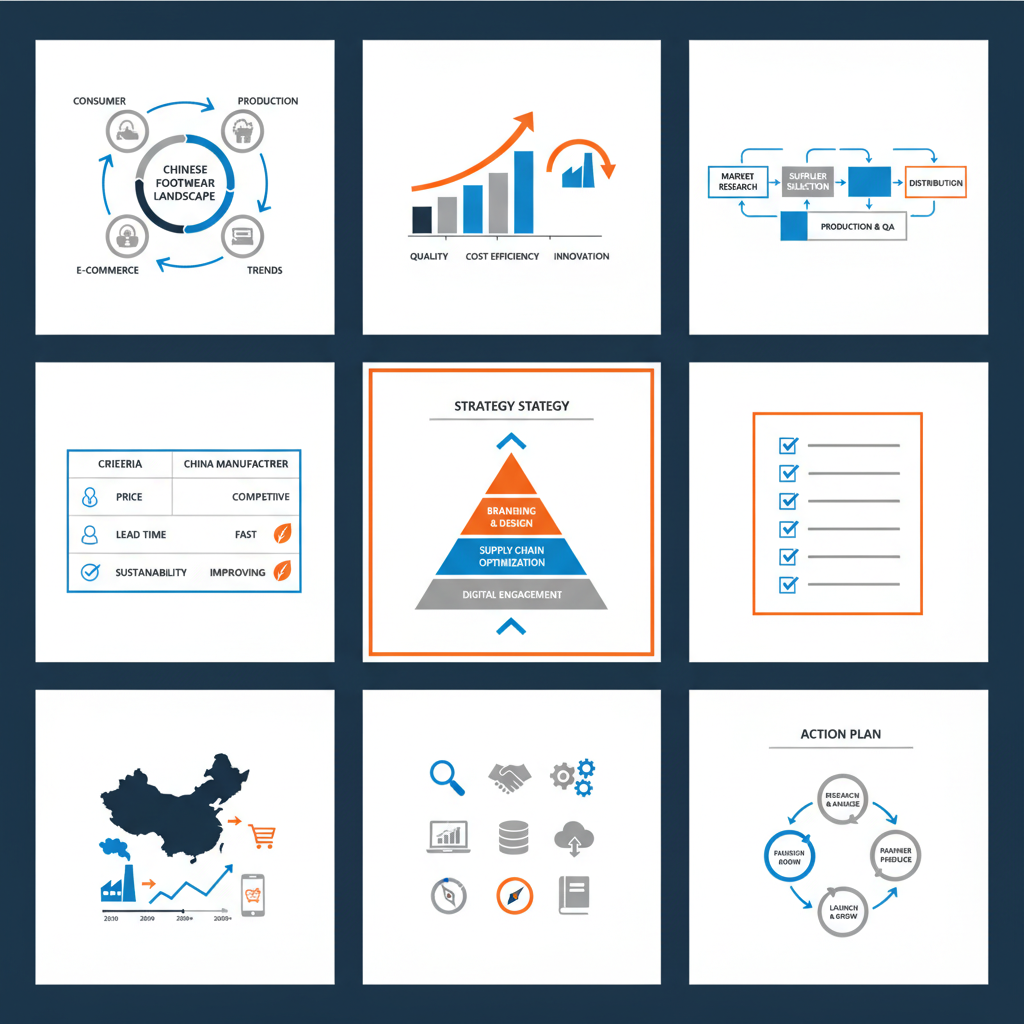 Understanding the Chinese Footwear Landscape – Visual Guide
 To find the best shoe manufacturer, you first have to understand that China is not a monolith; it is a collection of hyper-specialized clusters. According to cosmosourcing.com, China remains the global epicenter of footwear, producing over 12 billion pairs annually. This massive scale is possible because specific cities focus on specific types of shoes. If you are looking for leather dress shoes, you head to Wenzhou, the ‘Shoe Capital of China.’ If you need sports performance sneakers, Jinjiang is your destination.
At ASG, we emphasize the importance of matching your product niche to the regional expertise. Selecting a factory out of its natural element—like asking a leather boot factory to make knit sneakers—is a recipe for technical failure. These clusters have established supply chains for raw materials like EVA, TPU, and high-quality leathers, which lowers your costs through sheer proximity. sourcifychina.com notes that understanding these regional intricacies is essential for anyone interested in business or sustainability in the footwear space.
| Region | Primary Specialization | Key Characteristics |
| Jinjiang (Fujian) | Sports & Sneakers | World-class R&D, high automation |
| Wenzhou (Zhejiang) | Leather & Formal | Mature supply chain for hides and soles |
| Putian (Fujian) | High-End Replicas/OEM | Extreme attention to detail and materials |
| Dongguan (Guangdong) | Luxury & Designer | High-end craftsmanship, smaller MOQs |
Why China Manufacturing Matters in 2026
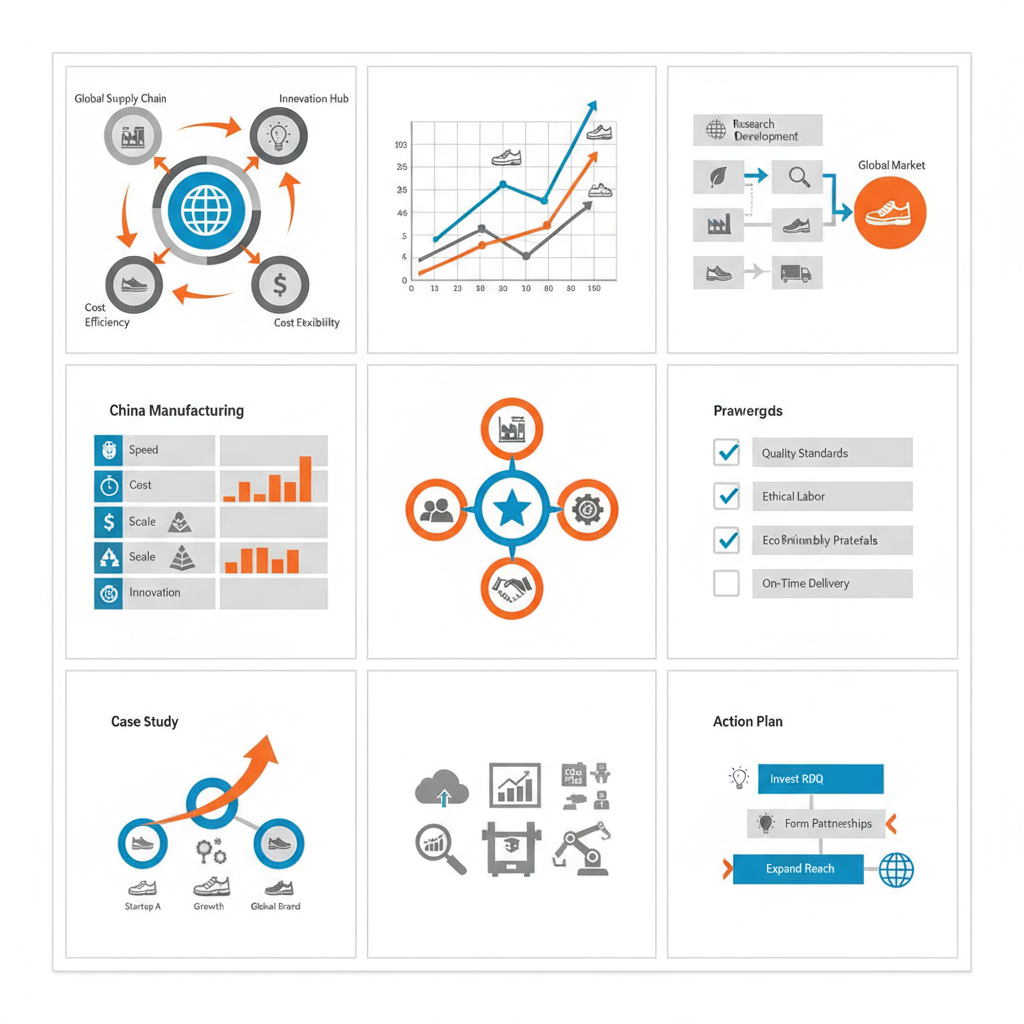 Why China Manufacturing Matters in 2026 – Visual Guide
 Despite shifting global trade dynamics, China’s footwear industry has evolved from a low-cost labor hub into a technological powerhouse. In 2026, the best manufacturers are no longer just selling labor; they are selling innovation. As sourcifychina.com points out, many top-tier factories like Yue Yuen have over 50 years of experience, providing a level of institutional knowledge that newer hubs in SE Asia cannot yet match.
We are seeing a massive trend toward sustainable materials—recycled ocean plastics, bio-based foams, and waterless dyeing processes. Brands that source from China today are gaining access to these cutting-edge materials faster than their competitors. Furthermore, the ability to scale from a few hundred pairs to several thousand is a flexibility unique to the Chinese infrastructure. cosmosourcing.com highlights that even with tariff fluctuations, the maturity of China’s supply chain continues to attract brands seeking customization and cost efficiency.
For my clients at ASG, the focus has shifted toward ‘Smart Manufacturing.’ This includes 3D knitting machines and automated cutting tables that reduce waste. When you partner with a manufacturer utilizing these technologies, you aren’t just getting a better price; you’re getting a product with fewer defects and a smaller environmental footprint.
Implementation: How to Vet a Manufacturer
The vetting process is where most entrepreneurs fail. You cannot rely on Alibaba gold supplier status alone. You must perform deep due diligence. According to sportssurge.alibaba.com, you should prioritize manufacturers that offer transparent processes, proper certifications, and real buyer feedback. Start by requesting their BSCI (Business Social Compliance Initiative) and ISO 9001 certificates. These aren’t just pieces of paper; they are proof that the factory operates under international standards of quality and ethics.
Step two is the sample phase. At ASG, we never allow a client to go to bulk production without a multi-stage sample check. We record high-definition ‘Sample Checking Videos’ that show the shoe’s flexibility, the strength of the glue bond, and the accuracy of the color matching. sourcifychina.com suggests that negotiating contracts and ensuring quality control are the pillars of a successful partnership with Chinese vendors.
—
The 4-Step Audit Checklist
1. Document Verification: Check business licenses and export permits.
2. On-site or Third-Party Inspection: Hire an agency (like QIMA) to visit the factory if you can’t go yourself.
3. Material Testing: Ensure the ‘genuine leather’ or ‘breathable mesh’ matches your specs via lab tests.
4. MOQ Negotiation: Many factories list high MOQs but will accept smaller ‘test’ runs if you show a clear growth plan.
Common Mistakes: Lessons from Real Failures
One of the most frequent mistakes I see is ‘Price Chasing.’ When a manufacturer offers a price that is 30% lower than the market average, they aren’t ‘efficient’—they are cutting corners. Usually, this happens in the midsole or the internal lining, parts of the shoe the customer can’t see but will definitely feel after two weeks of wear. sportssurge.alibaba.com warns that many factories use substandard materials or produce counterfeit-inspired designs that can lead to legal and quality issues.
Another fatal error is poor communication regarding technical specifications. If you don’t provide a detailed Tech Pack (including CAD drawings, material swatches, and size charts), the factory will fill in the blanks themselves. This lead to the ‘expectation vs. reality’ disaster. sourcifychina.com emphasizes that customization options are a key feature to evaluate when choosing a partner, as they dictate the final product’s performance.
Finally, neglecting the ‘Golden Sample.’ Once you approve a sample, that specific shoe must be kept as the benchmark for the entire production run. If the final shipment doesn’t match the Golden Sample, you have the legal and contractual leverage to demand a remake or a refund. Without it, you are at the manufacturer’s mercy.
Pro Tips from Janson: Insider Insights
As CEO of ASG, I always tell our clients: ‘Find the factory that is the right size for you.’ If you are a startup and you go to a massive factory that produces for Nike, you will be their lowest priority. Your orders will be delayed, and your emails will be ignored. Instead, find a mid-sized factory where your business actually matters to them. sourcifychina.com notes that wholesale shoe vendors in China offer unparalleled opportunities, but only if you choose one that aligns with your specific volume requirements.
Another insider tip is to leverage the ‘Transitioning’ factories in Putian. Historically known for replicas, many of these facilities are now moving into high-end OEM and ODM services. They have the best craftsmen in the world and are hungry to build legitimate brands. sportssurge.alibaba.com highlights that these factories are transitioning toward legitimate manufacturing services and can offer significant advantages in production speed.
Lastly, automate your backend. Manufacturing is only half the battle. Once the shoes are made, you need to get them to your customers. At ASG, we integrate our ERP directly with our clients’ Shopify stores. This ensures that the moment the factory finishes a batch, the tracking numbers are synced and the customers are notified. Automation is the only way to scale a footwear brand in 2026.
Key Takeaways & Next Steps
Finding the best shoe manufacturer in China requires a blend of geographic knowledge, rigorous vetting, and technical precision. You must move past the ‘lowest price’ mindset and focus on ‘total value,’ which includes quality consistency, lead times, and communication. The clusters in Fujian and Zhejiang remain the gold standard for global production, offering a depth of supply chain that is currently unmatched.
Your next step should be to define your Tech Pack and reach out to 3-5 factories in the appropriate regional hub. Request samples, ask for factory walkthroughs via video call, and never skip the third-party inspection. If you need help navigating this process, ASG provides a one-stop solution from factory sourcing to automated global fulfillment.
| Feature | ASG One-Stop Solution | Traditional Sourcing |
| Sourcing | Direct access to 2300+ vetted factories | Manual searching on directories |
| Quality Control | HD Video checks & on-site audits | Relying on factory’s word |
| Logistics | 6-10 days global delivery | 30+ days via standard freight |
| Automation | Shopify/ERP Integration | Manual spreadsheet management |
Sources and further reading (selected)
- Cosmo Sourcing: A comprehensive guide on regional shoe clusters and industry statistics in China. Read more →
- SportSurge (Alibaba): Expert buying guide for Putian-based footwear manufacturing and OEM services. Read more →
- Sourcify China – Manufacturing Guide: In-depth exploration of the craftsmanship and materials used in Chinese shoe production. Read more →
- Sourcify China – Top Manufacturers: Comparison of top tier Chinese shoe factories including Yue Yuen and AMC. Read more →
- Sourcify China – Wholesale Vendors: Guide to navigating wholesale vendors and establishing successful partnerships. Read more →
- QIMA: Leading quality control and supply chain audit service provider for footwear. Read more →
- BSCI Directory: Official database for verifying social compliance of manufacturing facilities. Read more →
- Statista – Footwear China: Market data and growth forecasts for the Chinese footwear industry. Read more →
- Shopify – Sourcing Products: Guide on integrating manufacturing with e-commerce platforms. Read more →
- ISO – ISO 9001 Quality Management: Official standards for quality management systems in manufacturing. Read more →


 Optimized by Seraphinite Accelerator