If you are still manually scrolling through AliExpress for hours or writing product descriptions from scratch, you are already losing the race. The dropshipping industry is projected to reach a staggering $537.8 billion by 2026, and the winners won’t be those who work the hardest, but those who leverage Artificial Intelligence to work the smartest. AI is no longer a futuristic concept; it is the ‘invisible assistant’ that handles everything from spotting winning trends before they go viral to managing 24/7 customer support without you lifting a finger.
In this guide, I’m pulling back the curtain on how we at ASG utilize AI to manage thousands of orders daily. You will learn the exact strategies to implement AI across your product research, creative marketing, and logistics. Whether you are a solo entrepreneur or managing a small team, this is your blueprint for transforming a standard store into a high-performance, automated revenue machine. Let’s dive into the practical reality of how to AI with dropshipping.
Key takeaways
- AI can automate up to 70% of routine dropshipping tasks, including order processing and customer support.
- Data-driven product research tools now use predictive analytics to identify ‘winning’ products 2-3 weeks before they trend on social media.
- Generative AI reduces content creation costs by 90% while improving SEO performance through optimized descriptions.
- Dynamic pricing algorithms help maintain competitive margins by adjusting prices based on real-time competitor data.
- AI-powered customer service agents provide 24/7 support, significantly reducing cart abandonment rates.
Understanding AI in Dropshipping: Core Concepts
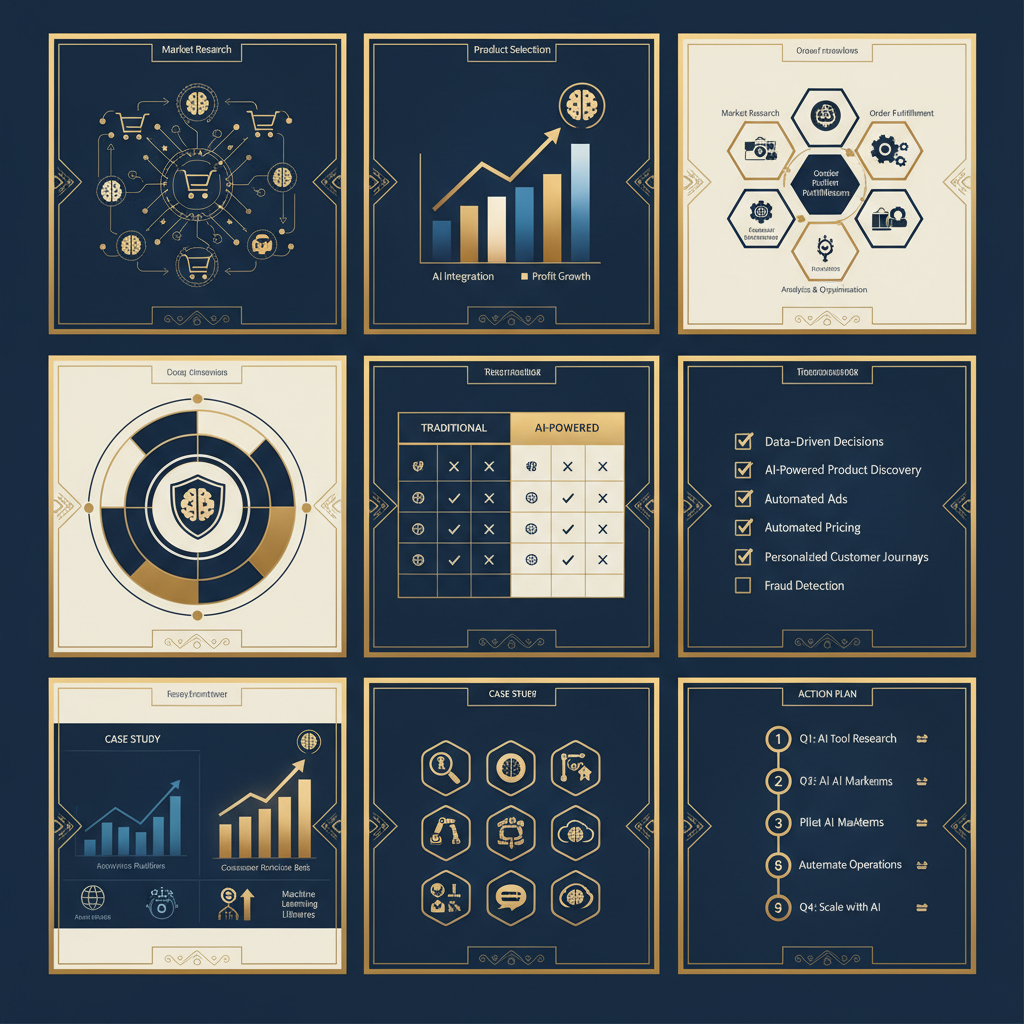 Understanding AI in Dropshipping: Core Concepts – Visual Guide
To master how to AI with dropshipping, you must first understand that AI isn’t just one tool—it’s an ecosystem of machine learning and natural language processing. At its core, AI dropshipping uses software to handle the most labor-intensive parts of the business. According to shopify.com, AI functions as a force multiplier, allowing businesses earning over $100k to scale without increasing their headcount. It bridges the gap between raw data and actionable business decisions.
The three pillars of AI in this space are Predictive Analytics, Generative Content, and Automated Logistics. Predictive analytics looks at historical sales data and social media signals to guess what will sell next. Generative content uses LLMs (Large Language Models) like ChatGPT to create persuasive copy and even high-fidelity product imagery. Automated logistics, which we specialize in at ASG, ensures that when a customer clicks ‘buy,’ the order is routed, processed, and tracked with zero human intervention.
By integrating these components, you move from being a ‘manager of tasks’ to a ‘strategist of systems.’ As noted by zendrop.com, AI provides the innovation needed to run leaner operations while maintaining high-quality output. This shift is essential because the barrier to entry for dropshipping has never been lower, making efficiency your only true competitive advantage in a crowded market.
Why AI Matters in 2026: The New Competitive Standard
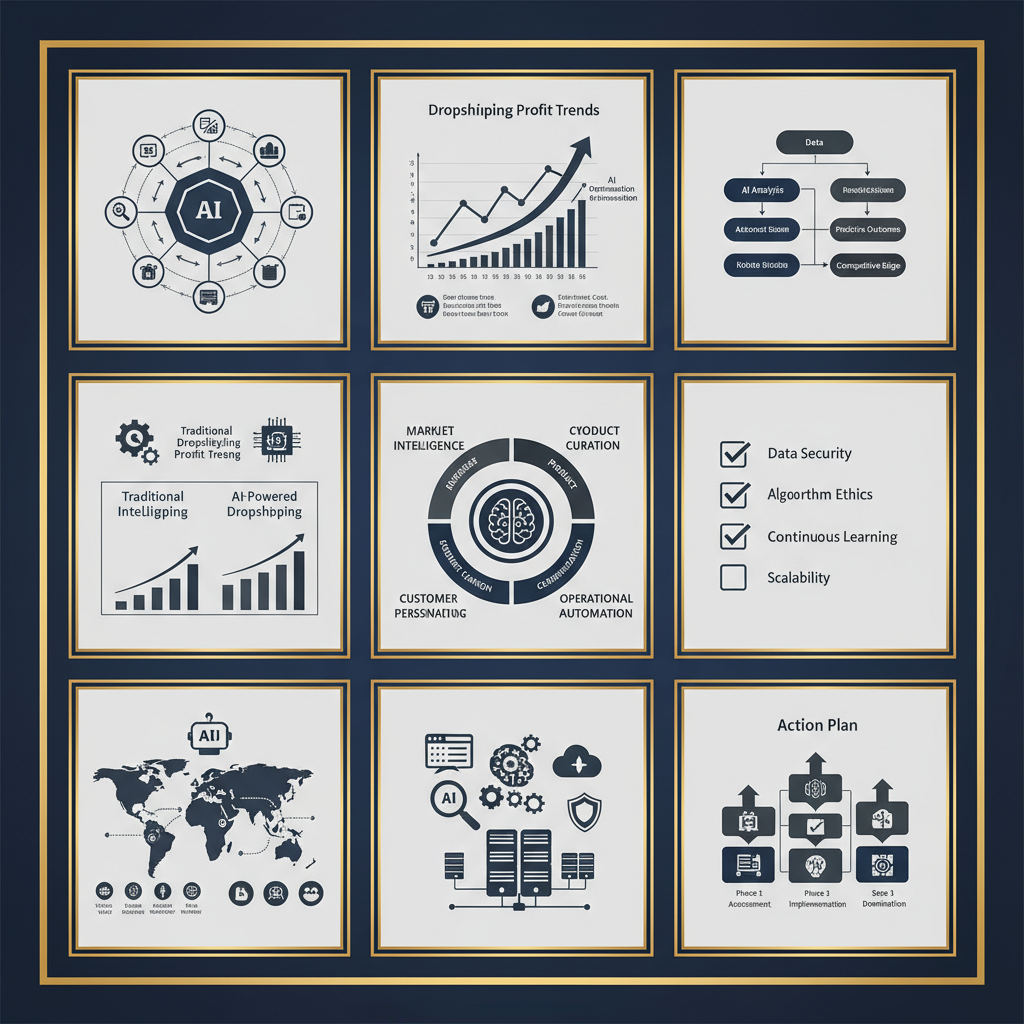 Why AI Matters in 2026: The New Competitive Standard – Visual Guide
The landscape of eCommerce has shifted from ‘search-based’ to ‘discovery-based.’ Customers no longer just search for what they want; AI algorithms on TikTok and Instagram show them what they might want. If your business isn’t using AI to meet them there, you’re invisible. instant.so highlights that 74% of retailers report that dropshipping has significantly reduced logistical costs when paired with automation. In 2026, speed is the ultimate currency, and AI is the only way to maintain it.
Consider the data: Global AI market growth is projected at a 37.3% CAGR through 2030. This means your competitors are already using tools to scrape your best-selling items and underprice you within minutes. To survive, you need dynamic pricing. According to txtcartapp.com, dynamic pricing allows you to maximize profits during peak demand and lower prices instantly when the market cools, effectively killing two birds with one stone: profit and customer satisfaction.
| Feature |
Manual Dropshipping |
AI-Enhanced Dropshipping |
| Product Research |
10+ Hours/Week |
< 1 Hour (Automated Scans) |
| Description Writing |
30 Mins/Product |
10 Seconds (SEO Optimized) |
| Customer Support |
9-5 (Human) |
24/7 (AI Chatbots) |
| Order Fulfillment |
Manual Entry |
Instant Sync & Ship |
This table illustrates the massive gap in operational efficiency. In a world where customer attention spans are shrinking, the ability to launch a store in 24 hours instead of two weeks is what separates the winners from the quitters.
Implementation Strategies: Step-by-Step AI Integration
Starting with AI doesn’t mean you need to replace your entire workflow overnight. Start with Product Research. Use tools like Minea or Sell The Trend which utilize AI to monitor sales velocity across thousands of Shopify stores. As shopify.com suggests, AI research tools identify trending products by analyzing market demand and competitor pricing far faster than a human ever could. Focus on products with a high ‘viral potential’ score.
Next, move to Content Creation. Don’t just copy-paste supplier descriptions. Use a generative AI tool to write search-optimized content that speaks to the customer’s pain points. zendrop.com recommends using AI to generate not just text, but also realistic backgrounds for product photos. This ‘contextual imaging’ allows you to take a basic factory photo and place it in a luxury living room setting, instantly increasing the perceived value of the item.
Finally, implement Automated Customer Service. Tools like Tidio or Lyro can handle up to 80% of common questions—like ‘Where is my order?’—without your involvement. This ensures your customers get instant replies even at 3 AM. According to txtcartapp.com, using conversational AI for abandoned cart recovery can increase your revenue by 10x by engaging customers in real-time through SMS and chat.
Common Mistakes to Avoid: Lessons from the Field
The biggest mistake I see sellers make is ‘Blind Automation.’ They set up an AI to write descriptions and never proofread them. This leads to ‘hallucinations’ where the AI claims a plastic watch is made of 24k gold. instant.so warns that while AI is efficient, it lacks the human touch required for brand storytelling. If your site sounds like a robot wrote it, your conversion rate will plummet because trust is the foundation of every sale.
Another pitfall is ignoring Data Privacy. When using AI tools to analyze customer behavior, you must ensure you are compliant with GDPR and CCPA. Many cheap AI plugins scrape data insecurely. As shopify.com notes, businesses earning over $100k prioritize secure automation. Don’t sacrifice your store’s security for a free tool that might get your merchant account banned.
Lastly, avoid ‘Tool Overload.’ You don’t need 20 different AI apps. Each app adds code to your site, which can slow down your page load speed—a major SEO killer. Select one core tool for research, one for creative, and one for logistics (like the ASG ERP system). Focus on deep integration rather than wide, shallow usage.
Pro Tips from Janson: Insider AI Insights
After helping over 1,000 clients at ASG, I’ve realized that the ‘secret sauce’ isn’t the AI itself, but the Prompt Engineering behind it. When you use ChatGPT to write an ad, don’t just say ‘write a Facebook ad.’ Instead, give it a persona: ‘Act as a world-class direct-response copywriter. Write a hook-heavy ad for a busy mom who needs this ergonomic baby carrier.’ This specificity is what creates high-converting copy. zendrop.com emphasizes that AI is a tool for ‘leaner human effort,’ not a total human replacement.
Another pro tip: Use AI for Predictive Inventory. If you see a product starting to trend in the AI data, don’t just keep dropshipping it one by one. Use the data to justify a small bulk order to a local warehouse. This reduces shipping time from 10 days to 2 days. According to txtcartapp.com, AI demand forecasting helps you manage supplier stock flow so you never run out of inventory during a scaling phase.
At ASG, we use AI to audit our 2,300+ factory partners. We don’t just take their word for it; we use algorithms to track their fulfillment speed and defect rates. If a factory’s performance dips, our system flags it before it affects your customers. That is how you use AI to build a sustainable brand, not just a temporary store.
Key Takeaways & Next Steps: Your AI Action Plan
The future of dropshipping belongs to the ‘Cyborg Entrepreneur’—the human who uses AI to amplify their creativity and speed. To get started, your first 24 hours should be spent auditing your current bottlenecks. If you’re spending too much time on support, install an AI chatbot. If your ads aren’t converting, use a generative AI to split-test 10 different hooks. shopify.com confirms that AI is an ‘operational force multiplier’ that is now essential for survival.
Your next step is to integrate your store with a high-performance fulfillment partner like ASG. Our ERP system acts as the ‘brain’ for your logistics, ensuring that your AI-driven sales are met with AI-driven fulfillment. As instant.so points out, leveraging AI for eCommerce personalization is the fastest way to increase Customer Lifetime Value (LTV).
Don’t wait for the ‘perfect’ time. The AI wave is here, and it’s moving fast. Start small, automate one task this week, and scale as your confidence grows. If you’re ready to see how a professional agent can handle the heavy lifting of your AI-driven store, contact us at ASG. Let’s build your automated empire together.
Sources and further reading (selected)
- Shopify India: Comprehensive guide on using AI tools for business process automation and scaling. Read more →
- Zendrop Blog: Analysis of 19 essential AI use cases for maximizing profit margins in dropshipping. Read more →
- Instant.so: Insights into AI-powered retail and logistical cost reduction strategies. Read more →
- TxtCart App: Expert guide on using conversational AI to 10x dropshipping profits. Read more →
- Shopify Global: Updated 2026 report on the top 10 AI tools for online store management. Read more →
- Grand View Research: Market data on the $196B+ AI industry growth trends. Read more →
- Statista eCommerce: Projected growth data for the global dropshipping market through 2026. Read more →
- Google Trends: Search volume data for ‘AI eCommerce’ showing rising entrepreneurial interest. Read more →
- Minea: Leading AI tool for ad spying and product trend analysis. Read more →
- Tidio AI: Documentation on how AI bots handle 80% of customer inquiries automatically. Read more →