By Janson — CEO & Founder, ASG Dropshipping | Updated: April 7, 2026 | 16 min read
Key Takeaways
- AliExpress is right for testing products at zero infrastructure cost — unworkable above 20 daily orders due to 15%+ defect rates and 15–30 day shipping.
- CJ Dropshipping solves AliExpress’s speed problem with 3–7 day CJPacket delivery and the best multi-platform integration (Shopify + TikTok Shop + Amazon) — still a shared platform with platform-level QC.
- Zendrop offers the cleanest US-focused beginner experience — 2–5 day domestic delivery, 30-second English support — at $79+/month with platform-level QC limitations.
- A professional private agent is a different architecture: exclusive supplier relationships, per-unit QC at 0.3% defect rate, NDA-backed IP protection, pre-allocated Q4 freight. Handling fee premium pays for itself through defect savings within the first month above 50 daily orders.
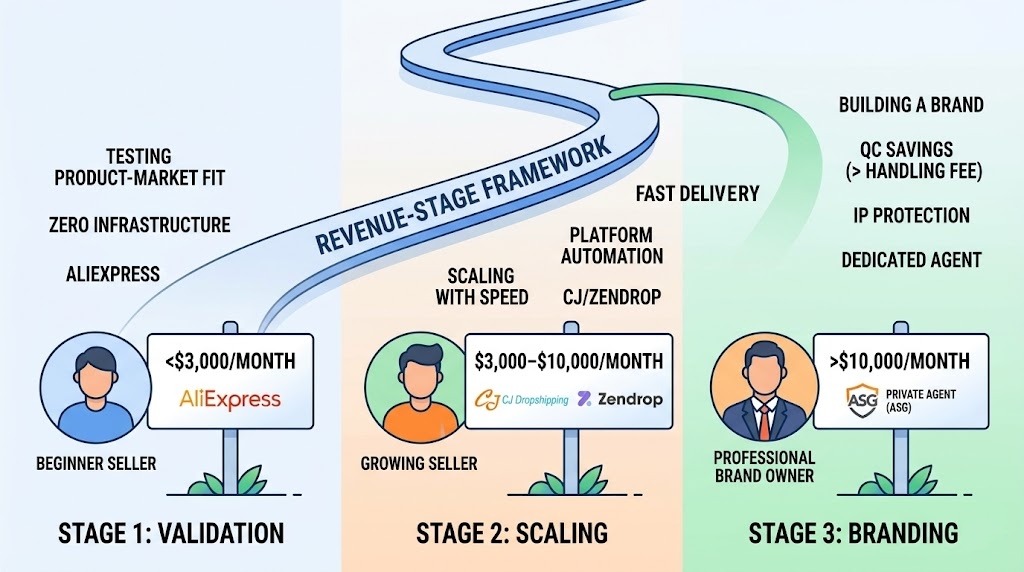
- The switching framework: AliExpress below $3,000/month → CJ or Zendrop at $3,000–$10,000/month → professional private agent above $10,000/month.
A professional private dropshipping agent differs from AliExpress, CJ Dropshipping, and Zendrop on one fundamental dimension: architecture. All three platforms route your orders through shared supplier networks where QC is platform-level and supplier relationships belong to the platform.
A private agent — specifically a professional agent company with 50+ staff — assigns you exclusive supplier relationships, executes per-unit QC inspection on every order, and protects your supply chain data under NDA. The result: defect rates drop from the platform average of approximately 8% to under 0.3%, shipping reaches US customers in 4–6 days via dedicated freight, and your winning product’s supplier cannot be accessed by competitors on the same platform. This architecture change becomes net-positive ROI above $10,000/month.
Platform model vs private agent model: the structural difference that drives every performance metric in this comparison. Here’s the question I get more than any other from dropshippers who’ve been in the game 12–18 months: “My store is working — should I switch from AliExpress, CJ, or Zendrop to a private agent?” The answer isn’t a platform preference. It’s a math question with a revenue threshold.
AliExpress, CJ, and Zendrop are all platforms — they route your orders through shared supplier networks, apply platform-level quality standards, and own the supplier relationships. A private agent is a fundamentally different structure. I’ve processed 5M+ orders through our Dongguan and Shenzhen warehouses. Here’s the comparison with the numbers attached.
Table of Contents
- The Architecture Difference Nobody Explains
- The 4-Dimension Comparison: Side-by-Side
- Where Each Option Wins — And Where It Doesn’t
- The Revenue-Stage Switching Framework
- Final Thoughts
- FAQs
The Architecture Difference Nobody Explains
AliExpress, CJ Dropshipping, and Zendrop share one structural characteristic: they all route orders through shared supplier networks where the supplier relationship belongs to the platform, not to you. QC is applied at platform-wide standards across thousands of product types simultaneously.
A professional private dropshipping agent operates differently: your supplier relationships are exclusively locked for your store, QC is executed against standards you define for your specific SKUs, and your supply chain data is isolated from other clients under a formal NDA. The performance difference — 0.3% defect rate versus the platform average of approximately 8%, dedicated freight versus shared carrier capacity — is a structural outcome, not a feature gap.
When you source a product through CJ Dropshipping or AliExpress, you’re accessing a supplier from an open network serving millions of buyers simultaneously. Both CJ Dropshipping and Zendrop are designed as alternatives to AliExpress — CJ replicating it with added infrastructure for faster shipping, Zendrop positioning itself as a more controlled environment with vetted factories.
The key word in both cases: “controlled” still means platform-controlled, not seller-controlled. If you find a product that converts at scale, the supplier producing it is visible to the platform. Another seller — your competitor — can source the same product tomorrow.
Third-party analysis consistently identifies the professional private agent as the smart choice for serious brand builders — specifically because of the shift to exclusive supplier relationships that platforms cannot offer.
The comparison between platforms and a “private agent” is only meaningful against Type 2 professional agent companies (50–200+ staff, multiple warehouses, formal SLA commitments) — not individual WhatsApp operators whose bandwidth runs out at 50–100 daily orders. Understanding what a professional dropshipping agent actually provides is the foundation for this decision.
The architecture drives every downstream difference: QC is calibrated to your product standards rather than a platform-wide average; supplier relationships are documented under NDA rather than shared infrastructure; freight capacity is pre-allocated rather than competing for spot lanes during Q4. Our Q4 2024: 23,000 daily orders at 97.3% on-time delivery — maintained through Black Friday on pre-allocated dedicated lanes.
The 4-Dimension Comparison: Side-by-Side
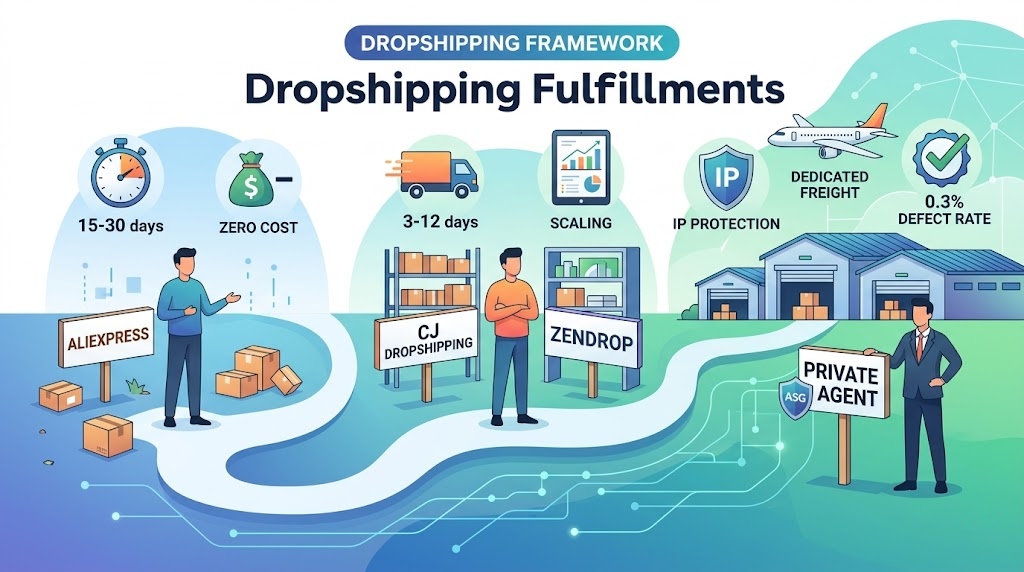
Comparing AliExpress, CJ Dropshipping, Zendrop, and a professional private agent: shipping speed (AliExpress 15–30 days; CJ 7–12 days via CJPacket; Zendrop 3–9 days US warehouse; private agent 5–8 days globally, 4–6 days US dedicated freight), QC defect rate (AliExpress ~15%+; CJ/Zendrop ~8% platform average; private agent 0.3% per-unit documented), product cost (AliExpress/CJ at retail marketplace pricing; private agent factory-direct 10–15% below platform), and IP protection (AliExpress/CJ/Zendrop share supplier data; private agent provides NDA-backed exclusive sourcing). Monthly hidden QC cost at 50 daily orders and $30 AOV: platform agents at 8% = $3,600/month; private agent at 0.3% = $135/month.
| Dimension | AliExpress | CJ Dropshipping | Zendrop | Private Agent (ASG) |
| Global shipping | 15–30 days | 7–12 days | 7–15 days intl | 5–8 days |
| US delivery | 20–35 days | 3–7 days | 2–5 days (US WH) | 4–6 days dedicated |
| QC defect rate | ~15%+ unverified | ~8% platform avg | ~8% platform avg | 0.3% per-unit |
| Product cost | Retail marketplace | Platform pricing | Platform + premium | Factory-direct (−10–15%) |
| Monthly fee | Free | Free | $79+/month | Free ($0.50–$2.00/order) |
| IP protection | None | None | None | NDA + data isolation |
| Q4 freight | Worst affected | Shared network | US WH stable / intl affected | Pre-allocated dedicated |
| Platform integration | Via DSers/third-party | Shopify + TikTok + Amazon | Shopify native | Shopify App + API |
| Supplier exclusivity | None | None | None | Locked exclusive |
Shipping data from MediumTalk 2026 platform comparison and CJ’s 2026 supplier ranking. ASG data from internal Q1 2026 records.
Dimension 1 — Shipping Speed and Q4 Consistency
The old AliExpress ePacket model often took 3–4 weeks — both CJ and Zendrop enable significantly faster shipping in 2026. CJ’s CJPacket delivers 3–7 days. Zendrop’s US warehouse delivers in 2–5 days domestically; international orders from China run 7–15 days. Q4 caveat applies to both — CJ uses shared carrier networks saturating in November. A private agent with pre-allocated dedicated freight doesn’t face this variable: our Q4 2024 was 23,000 daily orders at 97.3% on-time through Black Friday.
Q4 is where dedicated freight versus shared carrier network diverges most sharply — and when it matters most to your business. Dimension 2 — QC Defect Rate and the Hidden Monthly Cost
Dropshippers switch away from AliExpress primarily because of slow shipping, inconsistent quality, and unreliable sellers — which are QC symptoms. Moving to CJ or Zendrop fixes the shipping problem but not the QC architecture problem, because both apply platform-level standards across shared supplier networks. The formula: Daily orders × defect rate × AOV × 30 days = monthly hidden QC cost.
| Fulfillment Option | Defect Rate | Monthly Cost @50 orders/$30 AOV | Monthly Cost @100 orders |
| AliExpress | ~15%+ | $6,750+ | $13,500+ |
| CJ Dropshipping / Zendrop | ~8% (platform avg) | $3,600 | $7,200 |
| Private Agent (ASG) | 0.3% | $135 | $270 |
None of these costs appear on any platform invoice — they show in your refund rate, customer service queue, and Shopify review score. For a detailed breakdown of what per-unit inspection actually involves, see our guide on quality control in dropshipping.
Dimension 3 — Product Cost and Margin Structure
AliExpress and CJ price products at marketplace retail levels. CJ negotiates prices directly with manufacturers when sourcing custom products — a genuine advantage — but standard catalog products remain platform-priced. Zendrop adds $79+/month on top of product cost. A professional private agent sources factory-direct — typically 10–15% below equivalent platform pricing. At 50 daily orders and $30 AOV, that cost reduction produces $4,500–$6,750/month in additional margin before accounting for QC defect savings.
Dimension 4 — IP Protection and Supplier Exclusivity
This dimension doesn’t exist on AliExpress, CJ, or Zendrop. All three are platforms — your product sourcing data flows through shared infrastructure. If you validate a product at 3× ROAS, the supplier producing it is visible to anyone on the same platform.
Our 83 brand-transition clients who built proprietary product relationships through ASG saw average order value increase 35% and repeat purchase rate increase 28% versus sellers running identical products through shared platform sourcing. The differentiator wasn’t the product — it was the exclusive sourcing relationship competitors couldn’t replicate.
Where Each Option Wins — And Where It Doesn’t
AliExpress wins for absolute beginners below $3,000/month — zero cost, infinite catalog, no commitment. CJ Dropshipping wins for multi-platform sellers needing Shopify, TikTok Shop, and Amazon integration with 3–7 day delivery and no monthly fee. Zendrop wins for US-focused beginners needing English-first support, clean automation, and 2–5 day domestic delivery.
A professional private agent wins above $10,000/month — where per-unit QC defect savings ($3,600–$7,200/month at 50–100 daily orders), exclusive supplier IP protection, and pre-allocated Q4 freight all exceed the handling fee premium, producing positive ROI from the first month of transition.
AliExpress — The World’s Largest Testing Lab
AliExpress remains the go-to for beginners because of its accessibility and low entry cost — 100M+ products, zero account requirements, individual sellers competing on price. At 10 daily orders and 15% defect rate: 10 × 30 × 15% = 45 defective deliveries/month — painful but manageable. Product testing speed outweighs QC precision at this volume. Where it runs out: dropshippers specifically look for alternatives because of slow shipping, inconsistent quality, and unreliable sellers — at 50 daily orders, 15% defect rate produces 225 defective deliveries per month.
| Dimension | Score | Notes |
| Product discovery | ⭐⭐⭐⭐⭐ | Unmatched catalog depth |
| Shipping speed | ⭐⭐ | 15–30 days, not viable for scale |
| QC reliability | ⭐ | No inspection layer, ~15%+ defect |
| IP protection | ⭐ | Fully open marketplace |
| Cost | ⭐⭐⭐⭐ | Lowest entry cost |
Best for: Sellers at $0–$3,000/month validating product-market fit before investing in supply chain infrastructure.
CJ Dropshipping — The Platform That Outgrew AliExpress
CJ assigns each seller a personal agent reachable via chat or WhatsApp, carries a Trustpilot rating of approximately 4.9/5, and fully integrates with TikTok Shop US since 2023 — across Shopify, WooCommerce, BigCommerce, Wix, Magento, eBay, and Amazon. That multi-channel integration depth is the best of any platform. 50+ warehouses worldwide delivering in 3–7 days to major markets produces a meaningful upgrade from AliExpress.
Where it runs out: because CJ relies on various manufacturers, quality and fulfillment times may vary depending on the specific supplier. Platform QC doesn’t apply your standard to your products. See our full CJ Dropshipping alternative comparison for where platform limitations become operational ceilings.
| Dimension | Score | Notes |
| Multi-platform integration | ⭐⭐⭐⭐⭐ | Best TikTok Shop + Amazon coverage |
| Shipping speed | ⭐⭐⭐⭐ | 3–7 days via CJPacket, 50+ global WH |
| QC reliability | ⭐⭐⭐ | Platform-level, varies by supplier |
| IP protection | ⭐⭐ | Shared supplier network |
| Cost | ⭐⭐⭐⭐⭐ | No monthly fee |
Best for: Multi-platform sellers ($3,000–$10,000/month) running Shopify + TikTok Shop + Amazon who need broad catalog access and no monthly fee.
Zendrop — Simplicity at a Price
Zendrop offers 24/7 live chat with 30-second average response, on-site supplier inspections, and US warehouse products with Amazon-like delivery speeds. For a beginner launching their first Shopify store targeting US customers, Zendrop removes every supply chain complexity.
Where it runs out: Zendrop positions itself as more controlled than AliExpress — but “more controlled” still means platform-controlled, not seller-controlled. The $79+/month subscription compresses margin. Most critically: your winning product’s sourcing relationship belongs to Zendrop, not to you.
| Dimension | Score | Notes |
| Ease of use | ⭐⭐⭐⭐⭐ | Best beginner experience |
| US delivery | ⭐⭐⭐⭐⭐ | 2–5 days domestic |
| QC reliability | ⭐⭐⭐ | On-site inspections, platform-standard |
| IP protection | ⭐⭐ | Shared supplier network |
| Cost | ⭐⭐⭐ | $79+/month subscription |
Best for: US-focused beginners ($0–$5,000/month) who want clean automation and English-first support without managing supplier complexity.
Professional Private Agent — Different Architecture, Different Ceiling
Per-unit inspection on every order calibrates your defect rate to your product — not a platform average. Exclusive supplier relationships protect your winning product’s sourcing contractually. Pre-allocated dedicated freight keeps Q4 from collapsing delivery when revenue is highest.
Our 83 brand-transition clients who upgraded to full custom brand packaging saw AOV increase 35% and repeat purchase rate increase 28%. The product didn’t change. The customer experience did. Where it runs out: below $10,000/month, platform automation outweighs QC precision. Onboarding takes 1–2 weeks — not a 10-minute app install.
| Dimension | Score | Notes |
| QC reliability | ⭐⭐⭐⭐⭐ | Per-unit, 0.3% defect rate documented |
| IP protection | ⭐⭐⭐⭐⭐ | NDA + exclusive supplier lock |
| Shipping speed | ⭐⭐⭐⭐⭐ | 5–8 days global, 4–6 days US |
| Q4 performance | ⭐⭐⭐⭐⭐ | Pre-allocated dedicated freight |
| Ease of setup | ⭐⭐⭐ | 1–2 week onboarding vs app install |
Best for: Sellers above $10,000/month where QC defect savings, IP protection, and brand-building infrastructure all exceed platform convenience.
Using CJ Dropshipping or Zendrop and hitting the QC or IP ceiling? ASG’s three-phase parallel transition — 30% to 70% to 100% over four weeks — lets you verify performance with real orders before committing full volume. See how the transition works for Shopify sellers.
The Revenue-Stage Switching Framework: Which One at Which Stage?
The correct fulfillment infrastructure follows a three-stage revenue framework. Stage 1 ($0–$3,000/month, under 20 daily orders): AliExpress — zero cost, infinite product testing, manageable defect exposure. Stage 2 ($3,000–$10,000/month, 20–80 daily orders): CJ Dropshipping or Zendrop — faster delivery, lower defect rate than AliExpress, without the overhead of a private agent relationship. Stage 3 ($10,000+/month, 80+ daily orders): professional private agent — per-unit QC defect savings ($3,600–$7,200/month at 50–100 daily orders) exceed the handling fee premium, IP protection becomes business-critical, and pre-allocated Q4 freight prevents peak-season review damage.
| Monthly Revenue | Daily Orders | Recommended | Core Reason |
| $0–$3,000 | Under 20 | AliExpress | Zero cost, validate product first |
| $3,000–$10,000 | 20–80 | CJ or Zendrop | Speed + QC upgrade, platform automation |
| $10,000+ | 80+ | Professional private agent | QC savings exceed handling fee from day one |
At $0–$3,000/month your job is finding a product that sells. AliExpress is the right tool. At 10 daily orders and 15% defect rate: 10 × 30 × 15% = 45 defective deliveries/month — manageable. When to graduate: when shipping complaint contacts exceed 10% of monthly order count, or monthly refund costs cross $300.
At $3,000–$10,000/month: many sellers use a hybrid approach — Zendrop for fast US shipping on core products, CJ for broader catalog coverage or countries Zendrop doesn’t serve as well. Choose CJ when running multiple platforms. Choose Zendrop when you want the cleanest automation with 30-second English support response on a Shopify-only US-focused store.
Three signals it’s time to graduate to a private agent:
Signal 1: Monthly shipping complaint rate exceeds 8% of order volume. At 50 daily orders (1,500/month), that’s 120 complaint contacts — at $3–$5 labor each, $360–$600/month in invisible overhead.
Signal 2: Monthly refund and reship costs cross $500 — where QC defect savings from a private agent ($3,465/month at 50 daily orders) exceed the handling fee premium ($750–$2,250/month). Net positive from day one.
Signal 3: You have a winning product at consistent volume and you’re worried about competitors sourcing through the same platform. Platform sourcing offers zero IP protection.
Above $10,000/month the economics are clear. At 80 daily orders with $30 AOV: platform QC cost (8%) = $5,760/month; private agent QC cost (0.3%) = $216/month; QC savings = $5,544/month. Private agent handling fee at $1.50/order = $3,600/month. Net positive: $1,944/month from day one.
Documented from 386 sellers who transitioned from platform-based sourcing to ASG in 2024: average defect rate 7.8% dropping to 1.5% within 60 days. US delivery time dropped from 18–25 days to 5–8 days. Customer service shipping contacts dropped 60–70% within the first billing cycle. Average time to positive ROI: 11 days.
The Manchester case: a UK home goods seller processing 200 daily orders switched to ASG. Delivery: 12 to 6 days. Quality complaint rate: 8.5% to 1.8%. Order volume six months later: 200 to 480 daily. Transition cost recovery: 11 days. The three-phase transition protocol — 30% then 70% then 100% over four weeks — produces zero order interruption. For Shopify sellers, the dedicated Shopify agent comparison covers the technical integration and transition protocol in full detail.

Final Thoughts
AliExpress, CJ Dropshipping, and Zendrop are all legitimate tools at the right revenue stage. None of them are wrong for beginners — they’re wrong for sellers who’ve outgrown them and haven’t made the infrastructure change yet.
The cost of staying on the wrong infrastructure past your revenue threshold isn’t visible on any invoice. It’s in your defect rate, customer service overhead, review score trajectory, and Q4 delivery performance when revenue is highest and shared freight capacity is worst. Those costs compound every month you delay.
AliExpress to find what sells. CJ or Zendrop to scale with speed and automation. A professional private agent to build a business with QC accountability, IP protection, and freight consistency that platforms structurally cannot replicate. The math tells you when to move — and it does so well before the damage becomes visible.
All ASG operational data reflects documented Q1 2026 records. Competitor data from published platform specifications current as of April 2026.

About the Author
Janson — Founder & CEO, ASG Dropshipping
8 years in cross-border dropshipping. 200-person team, 4 warehouses in Dongguan and Shenzhen, 2,300+ vetted factories, 5M+ orders processed. Revenue-stage transition data and defect rate figures come from documented 2024 operational records.
Outside the warehouse: rock singer and guitarist.
Frequently Asked Questions
What is the difference between a private dropshipping agent and CJ Dropshipping?
CJ Dropshipping routes your orders through a shared supplier network serving thousands of sellers simultaneously, applying platform-level QC across all product types. A professional private dropshipping agent assigns your store exclusive supplier relationships locked under NDA, executes per-unit QC against your specific product standards, and maintains dedicated freight.
The defect rate difference: CJ’s platform average approximately 8% produces $3,600/month in hidden costs at 50 daily orders and $30 AOV; a private agent’s 0.3% produces $135/month. CJ’s advantage is multi-platform integration — Shopify, TikTok Shop, Amazon — and zero monthly fee, making it the right choice at $3,000–$10,000/month before QC savings justify a private agent relationship.
Is a private dropshipping agent better than AliExpress?
A professional private dropshipping agent is better than AliExpress above $10,000/month where per-unit QC defect savings exceed the handling fee premium. Below $3,000/month, AliExpress is the better choice — zero infrastructure cost, infinite product catalog.
AliExpress defect rate runs approximately 15%+ on unverified marketplace sellers versus a private agent’s 0.3% — at 50 daily orders and $30 AOV, that gap produces $6,750/month versus $135/month in hidden costs. Switch when monthly defect costs exceed $300–$500 and shipping complaints exceed 8–10% of order volume. See our full guide on what a dropshipping agent provides for the complete framework.
When should I switch from AliExpress to a private agent?
Switch from AliExpress to a private agent when two of three signals appear: shipping complaint rate exceeds 10% of monthly order volume, monthly defect-related costs exceed $300–$500, or you have a winning product where supplier exclusivity matters. The recommended intermediate step is CJ Dropshipping or Zendrop at $3,000–$10,000/month — reducing defect exposure from 15%+ to approximately 8% and cutting delivery to 3–12 days before the full private agent transition is economically justified above $10,000/month.
Is Zendrop worth it compared to a private agent?
Zendrop is worth it for US-focused Shopify sellers at $0–$5,000/month who need clean automation, 30-second English support, and 2–5 day domestic US delivery. Above $10,000/month, Zendrop’s $79+/month subscription and platform-level 8% defect rate become structural limitations.
At 50 daily orders, the hidden cost gap between Zendrop’s 8% and a private agent’s 0.3% is $3,465/month — exceeding the subscription cost plus the private agent’s handling fee premium. The transition makes economic sense above $10,000/month; below it, Zendrop’s operational simplicity outweighs the economics of switching.
Can a private agent ship faster than CJ Dropshipping?
Under normal conditions, comparable: private agent 4–6 days versus CJ 3–7 days via CJPacket. The meaningful difference is Q4 consistency: CJ uses shared carrier networks expanding to 15–25 day delivery during November–December as carriers prioritize express shipments.
A private agent with pre-allocated dedicated freight maintains 4–6 day US delivery through Q4 — ASG’s Q4 2024 performance was 97.3% on-time at 23,000 daily orders peak. For global delivery outside the US, ASG’s 5–8 day dedicated freight also outperforms CJ’s 7–12 day platform-carrier delivery on most major routes.
What are the advantages of a private agent over Zendrop?
A professional private agent offers four structural advantages over Zendrop: per-unit QC producing 0.3% defect rate versus Zendrop’s platform-average 8%, exclusive NDA-backed supplier relationships preventing competitor access, no $79+/month subscription fee (pay per order at $0.50–$2.00 handling), and pre-allocated Q4 freight maintaining delivery consistency when Zendrop’s China-origin orders expand to 7–15+ days during peak season. Zendrop’s advantages — setup simplicity, beginner support, clean US domestic delivery — apply below $10,000/month. For Shopify comparisons, see our Shopify agent guide.
How much does a private dropshipping agent charge compared to AliExpress and CJ?
AliExpress and CJ Dropshipping charge no explicit handling fee — margin is embedded in product pricing. Zendrop charges $79+/month subscription plus product cost. A professional private agent charges $0.50–$2.00 per order handling plus factory-direct product cost — typically 10–15% below equivalent platform pricing. At 50 daily orders: handling fee $750–$3,000/month; product cost savings $4,500–$6,750/month; QC defect savings $3,465/month. The handling fee is more than offset by the factory pricing differential alone — before accounting for QC savings.
What is the main difference between platform agents and private agents in dropshipping?
The fundamental difference is supplier relationship ownership. Platform agents (AliExpress, CJ, Zendrop) connect sellers to shared supplier networks where the platform owns relationships, QC applies platform-wide standards, and your supply chain data is not IP-protected.
A professional private agent assigns exclusive supplier relationships under NDA, executes QC against your specific product standards, and maintains dedicated freight capacity. This architecture difference produces 0.3% versus 8% defect rate and $6,930/month difference in recoverable costs at 100 daily orders. See our guide on what a dropshipping agent provides for the full explanation.
Article written: April 7, 2026 | Workflow: asg-seo-writer 21-Step + geo-optimizer v1.0


 Optimized by Seraphinite Accelerator