UK dropshipping suppliers typically operate at 20–35% gross margins with 12–25% negotiation room that most sellers never tap.
UK dropshipping suppliers typically operate at 20–35% gross margins with 12–25% negotiation room that most sellers never tap. The structural difference between paying list price and capturing factory-tier pricing isn’t about haggling — it’s about understanding the 5 proven leverage points UK suppliers respond to.
After 8 years sourcing for thousands of stores including UK-focused brands scaling from £5K to £40K+ monthly, here’s the complete negotiation framework — based on documented pricing data, not generic supplier advice.
📋 Quick Answer: 5 Proven Ways to Get Better Prices From UK Suppliers
UK dropshipping suppliers typically operate at 20-35% gross margins with structural negotiation room ranging 12-25% off list pricing for sellers with documented commitment, scaling to 30-40% reduction for strategic relationships with multi-year volume commitments.
The 5 proven ways to get better prices:
(1) volume commitment negotiation with monthly minimum order tiers (£5K/£20K/£50K capturing 8-15%/18-25%/25-35% reductions); (2) payment terms leverage moving from 30-day net to advance payment (3-8% additional reduction); (3) multi-supplier competitive sourcing across 2-3 reliable suppliers; (4) exclusivity agreements on specific SKUs (12-18% reduction plus custom branding access); (5) hybrid sourcing combining China-direct factory access with UK based consolidation inventory warehouses (35-45% total margin advantage versus UK-only sourcing).
The six sections below work through the complete framework: understanding UK supplier pricing structure across 3 tiers, the negotiation room most sellers don’t know exists, the 5 proven ways in detail, the exclusivity versus flexibility trade-off, the hybrid sourcing model, and the documented UK brand case study.
Key Takeaways
- UK dropshipping suppliers operate across 3 tiers — native UK manufacturers (15–20% of market, highest pricing), UK distributors of imported goods (45–55%, medium pricing), and UK-warehoused China-origin suppliers (30–40%, lowest pricing).
- Typical negotiation room with UK suppliers ranges 12–25% off list pricing for sellers demonstrating £50K+ annual commitment, scaling to 30–40% reduction for strategic relationships with multi-year volume commitments.
- The 5 proven ways: volume commitment, payment terms leverage, multi-supplier competitive sourcing, exclusivity agreements, and hybrid sourcing.
- Volume commitment tiers produce documented pricing reductions: £5K monthly capturing 8–15%, £20K monthly capturing 18–25%, £50K monthly capturing 25–35%.
- Hybrid sourcing — combining China-direct factory access with UK consolidation warehouses — captures 35–45% total margin advantage versus exclusively sourcing from UK dropshipping suppliers.
- A documented 12-week case: £5,500 monthly to £42,000 monthly revenue, 28% to 58% gross margin, 2.4-day average UK delivery through hybrid sourcing transition.
Table of Contents
- UK Dropshipping Suppliers — Understanding the Pricing Structure
- The Negotiation Room Most Sellers Don’t Know Exists
- 5 Proven Ways to Get Better Prices
- Exclusivity vs Flexibility — Trade-off Analysis
- The Hybrid Sourcing Model (China-Direct + UK Consolidation)
- The Margin Math + Real UK Brand Case Study
- FAQs
UK Dropshipping Suppliers — Understanding the Pricing Structure
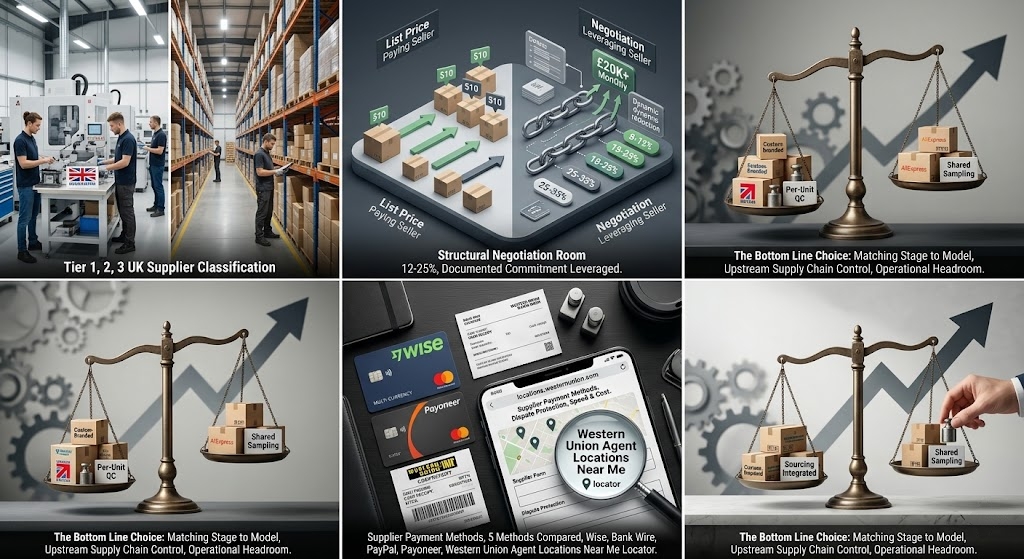
UK dropshipping suppliers operate across 3 distinct tiers with structurally different pricing models. Tier 1 native UK manufacturers (15-20% of UK supplier market) offer the highest pricing but fastest delivery times and full regulatory compliance.
Tier 2 UK distributors of imported goods (45-55% of market) operate at medium pricing with varying compliance documentation.
Tier 3 UK based warehoused China-origin suppliers (30-40% of market) provide the lowest pricing with variable quality and communication standards. Understanding which tier each prospective supplier operates within is the foundational step before negotiation — pricing flexibility, lead times, and quality consistency vary structurally by tier.
The 3-tier UK supplier landscape — with tier identification determining realistic negotiation expectations before commercial conversations begin.
The 3-tier UK supplier landscape:
| Supplier Tier |
Market Share |
Pricing Level |
Typical Gross Margin |
Negotiation Flexibility |
| Tier 1: Native UK manufacturers |
15–20% |
Premium (highest) |
30–45% |
Limited (8–15%) |
| Tier 2: UK distributors of imported goods |
45–55% |
Medium |
22–35% |
Moderate (15–25%) |
| Tier 3: UK-warehoused China-origin |
30–40% |
Lowest |
15–25% |
Flexible (20–35%) |
ASG documented UK supplier categorisation: Tier 1 native UK manufacturers represent 15–20% of UK supplier market with highest pricing but lowest delivery times and full regulatory compliance; Tier 2 UK distributors of imported goods represent 45–55% of market with medium pricing and varying compliance;
Tier 3 UK-warehoused China-origin suppliers represent 30–40% of market with lowest pricing and variable quality standards.
Why tier identification matters before negotiation:
Tier 1 native UK manufacturers (Made in Britain certified producers, regional artisan workshops, specialty manufacturers) carry pricing premium reflecting genuine UK production costs — labour, regulatory compliance, premium materials.
Negotiation room is structurally limited because cost basis is real, not markup. Strategy: accept premium pricing where Made-in-Britain positioning justifies retail markup to end customers.
Tier 2 UK distributors of imported goods (typically importing from EU, Turkey, India, or China with UK warehousing and customer service) carry markup over import cost. Negotiation room ranges 15–25% reflecting genuine markup compression opportunity. Strategy: leverage volume commitments and competitive sourcing across multiple Tier 2 suppliers.
Tier 3 UK-warehoused China-origin suppliers operate the largest markup over factory cost (often 200–400% markup on Chinese factory pricing). Negotiation room is widest (20–35%) but quality consistency requires careful vetting. Strategy: significant negotiation leverage available, but vet quality thoroughly before scaling volume.
For complete framework on testing UK suppliers before committing — including the 4-week vetting protocol that surfaces operational reality before pricing negotiations begin — the guide on dropshipping supplier in UK covers the testing methodology in depth.
Companies House UK business verification documentation provides public records on UK supplier business registration, directors, and financial standing — the foundational verification step before tier classification and pricing negotiation.
Key Takeaway: UK dropshipping suppliers operate across 3 structurally different tiers with distinct pricing flexibility ranges.
Tier identification determines realistic negotiation expectations — Tier 1 native UK manufacturers carry premium pricing reflecting genuine costs (limited negotiation room), Tier 2 distributors carry import markup (moderate room), Tier 3 UK-warehoused China-origin suppliers carry largest markup (widest room).
Identifying tier classification before negotiation prevents wasted effort on Tier 1 suppliers and missed opportunity on Tier 3.
The Negotiation Room Most Sellers Don’t Know Exists
UK dropshipping suppliers operate with structural negotiation room that 70-80% of sellers never tap. Typical negotiation flexibility with reliable UK suppliers ranges 12-25% off list pricing for sellers with £50K+ annual commitment demonstrated, scaling to 30-40% reduction for sellers establishing strategic relationships with multi-year volume commitments and exclusive product line agreements.
The negotiation room exists because UK suppliers structurally operate at 20-35% gross margins with 8-15% supplier margin defended (operating costs, warehousing, fulfilment infrastructure) and 12-25% markup available for negotiation. Sellers paying full list pricing are subsidising other sellers’ negotiated reductions.
The 12–25% negotiation room exists between supplier defended margin floor (8–15%) and market-rate markup ceiling (20–35%).
Why the negotiation room exists structurally:
UK suppliers operating at 20–35% gross margins have a defended margin floor (typically 8–15% covering warehousing, customer service, returns processing, fulfilment infrastructure) and a markup ceiling that’s market-rate rather than cost-justified. The 12–25% range between these floors is the genuine negotiation room.
The structural reasons sellers don’t access this room:
- Most sellers don’t ask — assuming list pricing is fixed because UK supplier listings present pricing without negotiation context
- Sellers without commitment data have no leverage — vague “we’re growing fast” positioning doesn’t move pricing; documented £20K+ monthly order history does
- Single-supplier dependence eliminates competitive pressure — suppliers know they’re not competing for the business
- 30-day payment terms are accepted as default — moving to advance payment captures additional 3–8% reduction that sellers don’t realise is available
ASG documented UK supplier negotiation room analysis: typical negotiation room with UK dropshipping suppliers ranges 12–25% off list pricing for sellers with £50K+ annual commitment demonstrated, scaling to 30–40% reduction for sellers establishing strategic relationships with multi-year volume commitments and exclusive product line agreements.
The compounding impact at scale:
A 15% pricing reduction on a store sourcing £10,000 monthly from UK suppliers captures £18,000 annual margin protection. The same 15% reduction at £30,000 monthly captures £54,000 annual. The same reduction at £100,000 monthly captures £180,000 annual.
The negotiation room isn’t theoretical — it’s structural margin sitting between supplier list price and supplier defended margin floor. The sellers who learn to access it capture compounding advantages that fund customer acquisition spend that scales them past competitors paying full list pricing.
British Chambers of Commerce business advisory research consistently identifies supplier negotiation as a high-leverage opportunity for small business profitability — with documented impact compounding across every order for the duration of supplier relationships.
Key Takeaway: UK dropshipping suppliers operate with 12-25% structural negotiation room that most sellers never tap. The room exists between supplier defended margin floor (8-15%) and market-rate markup ceiling (20-35%). Sellers paying full list pricing are subsidising other sellers’ negotiated reductions.
The 5 proven ways below systematically access this negotiation room across different leverage dimensions.
5 Proven Ways to Get Better Prices
The 5 proven ways to get better prices from UK dropshipping suppliers:
(1) volume commitment negotiation with documented monthly minimum order tiers (£5K capturing 8-15% reduction, £20K capturing 18-25%, £50K capturing 25-35%);
(2) payment terms leverage moving from 30-day net terms to advance payment (3-5% reduction) or full prepayment on production (5-8% additional);
(3) multi-supplier competitive sourcing across 2-3 reliable suppliers with overlapping SKU mixes (5-10% reduction plus inventory redundancy);
(4) exclusivity agreements on specific SKUs (12-18% reduction plus custom branding access);
(5) hybrid sourcing combining China-direct factory pricing with UK based consolidation warehouses (35-45% total margin advantage).
The 5 proven ways stack multiplicatively to produce 25–40% total pricing reduction versus list pricing.
💼 Way 1: Volume Commitment Negotiation
The foundational leverage. UK suppliers typically offer tiered reductions for documented monthly minimum order commitments.
ASG documented volume commitment data: UK suppliers offer 8-15% reduction for committed monthly minimum orders of £5,000+, scaling to 18-25% reduction at £20,000+ monthly commitments, and 25-35% reduction at £50,000+ monthly commitments with 12-month minimum term.
The negotiation requires documented commitment — bank statements, prior order history, or escrow deposits backing the volume promise. Sellers without documented commitment data face structurally limited negotiation room regardless of stated intentions.
💳 Way 2: Payment Terms Leverage
The under-utilised leverage. Standard UK supplier terms are 30-day net (payment due 30 days after invoice). Moving to faster payment captures additional pricing reductions.
ASG documented payment terms leverage data: moving from 30-day net terms to advance payment (50% upfront plus 50% on shipment) typically captures 3-5% pricing reduction from UK suppliers due to working capital benefit; full prepayment on production captures 5-8% additional reduction for SKUs requiring manufacturing versus stock items.
The 3-13% total reduction stacks on top of volume commitment reductions, compounding the total negotiation outcome. For complete framework on agent verification before payment commitments, the guide on find a reliable dropshipping agent covers methodology.
🏁 Way 3: Multi-Supplier Competitive Sourcing
The competitive pressure leverage. Working with 2-3 UK suppliers simultaneously on overlapping SKU mixes creates competitive pressure that captures additional pricing reduction.
ASG documented multi-supplier competitive sourcing approach: working with 2-3 UK suppliers simultaneously on overlapping SKU mixes typically produces 5-10% pricing reduction through competitive pressure plus inventory redundancy that prevents stockout exposure during peak season demand spikes.
The approach requires operational coordination across multiple supplier relationships but eliminates single-point-of-failure dependence that allows suppliers to maintain pricing without negotiation.
🤝 Way 4: Exclusivity Agreements on Specific SKUs
The strategic leverage. Exclusive product line agreements with UK suppliers (single-buyer commitment on specific SKUs) typically capture 12-18% pricing reduction plus custom branding capabilities including private labelling, custom packaging, and product modifications.
ASG documented exclusivity agreement data: the trade-off is operational inflexibility if supplier quality or capacity issues emerge during the exclusivity period — sellers cannot easily switch suppliers on exclusive SKUs without legal exposure.
The strategy fits high-margin SKUs where brand differentiation justifies the operational risk; the strategy doesn’t fit commodity SKUs where supplier switching capability matters more than pricing reduction.
🌐 Way 5: Hybrid Sourcing — China-Direct Plus UK Consolidation
The structural leverage that bypasses UK supplier markup entirely. Hybrid sourcing combines China-direct factory sourcing (8-15% factory cost on bulk inventory) with UK consolidation warehouses (5-7 day DDP shipping to UK customers) to capture total margin advantages of 35-45% versus sourcing exclusively from UK dropshipping suppliers.
The hybrid model requires inventory pre-positioning but eliminates UK supplier markup capture — instead capturing factory-tier pricing directly through dropshipping agent relationships while preserving fast shipping to UK customers. For complete framework on the broader fulfilment model decision, the guide on dropshipping agent vs 3PL covers the structural difference.
The compounding impact of stacking ways:
The 5 ways aren’t either/or — they stack multiplicatively. A seller combining Way 1 (volume commitment, 18% reduction) plus Way 2 (advance payment, 5% additional reduction) plus Way 3 (multi-supplier competitive sourcing, 7% additional reduction) captures approximately 28% total pricing reduction versus full list price.
The compounding mathematics: combining ways typically produces 25–40% total reduction rather than the simple sum of individual reductions because each way creates leverage that strengthens the other ways.
Volume commitment makes payment terms negotiation easier because supplier wants to lock in the volume; competitive sourcing makes exclusivity discussions on specific SKUs more credible because supplier wants commitment despite competitive alternatives.
Statista UK ecommerce market data documents UK dropshipping as a £3+ billion annual market with sustained growth — making structural pricing optimisation a critical competitive lever for stores scaling within UK markets.
Key Takeaway: The 5 proven ways — volume commitment, payment terms leverage, multi-supplier competitive sourcing, exclusivity agreements, hybrid sourcing — stack multiplicatively to produce 25-40% total pricing reduction versus full list pricing.
Each way creates leverage that strengthens the other ways. Sellers applying single ways capture incremental reduction; sellers stacking all 5 ways capture compounding structural advantage.
Exclusivity vs Flexibility — Trade-off Analysis
The exclusivity versus flexibility trade-off determines whether 12-18% pricing reduction from exclusive agreements justifies the operational inflexibility cost. Exclusive product line agreements with UK dropshipping suppliers capture 12-18% pricing reduction plus custom branding capabilities (private labelling, custom packaging, product range modifications) for committed SKUs.
The operational cost: inability to easily switch suppliers on exclusive SKUs without legal exposure if supplier quality or capacity issues emerge. The strategy fits high-margin SKUs where brand differentiation justifies operational risk; the strategy doesn’t fit commodity SKUs where supplier switching capability matters more than pricing reduction.
The exclusivity trade-off: 12–18% pricing reduction plus custom branding versus operational inflexibility if supplier issues emerge.
The complete trade-off matrix:
| SKU Category |
Exclusivity Fit |
Recommended Approach |
Rationale |
| High-margin branded SKUs |
Strong fit |
Pursue exclusivity |
Brand differentiation justifies risk |
| Custom-developed products |
Strong fit |
Exclusivity required |
Custom development requires commitment |
| Seasonal trend items |
Poor fit |
Avoid exclusivity |
Trend volatility makes flexibility critical |
| Commodity SKUs |
Poor fit |
Multi-supplier sourcing |
Switching capability matters more than reduction |
ASG documented exclusivity agreement data: exclusive product line agreements with UK suppliers typically capture 12–18% pricing reduction plus custom branding capabilities; the trade-off is operational inflexibility if supplier quality or capacity issues emerge.
When exclusivity makes sense:
Exclusivity agreements work best when three conditions align simultaneously: the SKU is high-margin enough to justify operational risk, the supplier has documented quality consistency over 6+ months of trial period, and the seller has alternative sourcing options ready if exclusivity needs to be terminated.
The high-margin condition matters because exclusive SKU disruption costs operational capacity that commodity competition can’t justify. The quality consistency condition matters because exclusivity locks the seller into supplier quality variation that competitive sourcing would normally hedge.
The alternative sourcing readiness matters because exclusivity termination requires backup capacity to prevent customer experience disruption.
When exclusivity creates structural risk:
Exclusivity creates risk when sellers commit before supplier track record is established or when single-SKU dependence concentrates business risk into one supplier relationship. Sellers signing exclusivity agreements in the first 3 months of supplier relationship typically face capacity, quality, or communication issues that flexible sourcing would have allowed easier resolution.
The structural insight: exclusivity is a tool for mature supplier relationships with documented performance, not a strategy for relationship establishment. Use the first 6+ months of UK supplier relationships for documented performance validation; consider exclusivity once track record supports the operational risk.
Key Takeaway: Exclusivity agreements capture 12-18% pricing reduction plus custom branding access on committed SKUs, but require accepting operational inflexibility if supplier issues emerge.
The strategy fits high-margin branded SKUs and custom-developed products where brand differentiation justifies risk; the strategy doesn’t fit commodity SKUs or seasonal trend items where switching capability matters more. Use exclusivity for mature supplier relationships with documented 6+ month performance, not for relationship establishment.
The Hybrid Sourcing Model (China-Direct + UK Consolidation)
The hybrid sourcing model bypasses UK dropshipping supplier markup entirely by combining China-direct factory sourcing through dropshipping agents with UK based consolidation warehouses for final-mile delivery.
ASG documented hybrid sourcing model: combining China-direct factory sourcing (8-15% factory cost on bulk inventory) with UK consolidation warehouses (5-7 day DDP shipping to UK customers) captures total margin advantages of 35-45% versus sourcing exclusively from UK dropshipping suppliers.
The hybrid model requires inventory pre-positioning but eliminates the structural UK supplier markup capture that compresses margins for stores sourcing exclusively through UK-warehoused suppliers.
The hybrid sourcing model bypasses UK supplier markup entirely while preserving UK customer experience metrics.
The hybrid sourcing architecture:
The model operates across two integrated supply chain segments:
- China-direct segment — factory-direct sourcing through dropshipping agent relationships, capturing 8–15% factory cost on bulk inventory orders that would cost 25–40% through UK suppliers
- UK consolidation segment — inventory pre-positioned in UK warehouses with 5–7 day DDP shipping to UK customers, preserving the fast shipping and next day delivery capability that UK customers expect
The two segments connect through DDP (Delivered Duty Paid) shipping arrangements that handle UK customs pre-clearance, VAT registration, and import documentation — eliminating the customer-facing complexity that direct China shipping would introduce.
Why hybrid sourcing produces the largest margin advantage:
The structural advantage compounds across multiple dimensions simultaneously:
- Factory-direct pricing capture — eliminates the 200–400% markup that UK-warehoused China-origin suppliers apply over factory cost
- UK-resident shipping speed — preserves customer experience parity with UK-domestic suppliers despite China-direct sourcing
- Custom branding access — enables private labelling, custom packaging, and product modifications at small-to-medium MOQs (100–500 units) versus UK supplier MOQs (typically 1,000+ units)
- Quality control depth — per-unit QC at China-side fulfilment catches defects before UK shipment, reducing UK returns processing costs
The result: 35–45% total margin advantage versus UK-only sourcing while preserving UK customer experience metrics that determine repeat purchase rates.
Royal Mail Business Services documentation provides the final-mile delivery infrastructure that supports hybrid sourcing operations — with documented UK delivery performance that matches or exceeds UK-domestic supplier capabilities when properly configured.
Key Takeaway: The hybrid sourcing model — China-direct factory sourcing through dropshipping agents plus UK based consolidation warehouses — captures 35-45% total margin advantage versus UK-only sourcing while preserving UK customer experience metrics.
The model bypasses UK supplier markup entirely while maintaining fast shipping capability. The structural advantage compounds across factory-direct pricing, custom branding access, and per-unit QC depth.
The Margin Math + Real UK Brand Case Study
The margin math at £15,000 monthly UK ecommerce revenue: exclusive UK supplier sourcing produces 25-35% gross margins (£3,750-£5,250 monthly gross profit); strategic UK supplier negotiation with 5 proven ways stacked produces 40-50% gross margins (£6,000-£7,500 monthly); hybrid sourcing with China-direct plus UK consolidation produces 55-65% gross margins (£8,250-£9,750 monthly).
The 30 percentage point margin expansion from exclusive UK sourcing to hybrid sourcing represents £54,000-£72,000 annual margin protection compounded across every order. A documented 12-week ASG case: £5,500 monthly to £42,000 monthly revenue, 28% to 58% gross margin, 2.4-day average UK delivery through hybrid sourcing transition.
The margin math at £15K monthly UK revenue produces 30 percentage point gross margin expansion from exclusive UK sourcing to hybrid sourcing.
The complete margin comparison at £15,000 monthly UK revenue:
| Sourcing Approach |
Gross Margin |
Monthly Gross Profit |
Annual Gross Profit |
| UK supplier exclusive (list price) |
25–35% |
£3,750–£5,250 |
£45,000–£63,000 |
| UK supplier with negotiation |
40–50% |
£6,000–£7,500 |
£72,000–£90,000 |
| Hybrid sourcing (China-direct + UK consolidation) |
55–65% |
£8,250–£9,750 |
£99,000–£117,000 |
| Direct factory contract (Tier 1, 10K+ MOQ) |
60–70% |
£9,000–£10,500 |
£108,000–£126,000 |
A documented 12-week case study:
Documented UK Brand Case Study · 2024
A UK-based ecommerce store sourcing exclusively from UK dropshipping suppliers transitioned to ASG hybrid model with China-direct sourcing plus UK consolidation. Pre-transition: £5,500 monthly revenue, 28% gross margin, dependence on single UK supplier.
Post-transition (12 weeks): £42,000 monthly revenue, 58% gross margin, 2.4-day average UK delivery from consolidation warehouse, diversified supplier base reducing single-point-of-failure exposure.
ASG documented case (2024): A UK-based ecommerce store sourcing exclusively from UK dropshipping suppliers transitioned to ASG hybrid model. Pre-transition: £5,500 monthly revenue, 28% gross margin, dependence on single UK supplier. Post-transition (12 weeks): £42,000 monthly revenue, 58% gross margin, 2.4-day average UK delivery, diversified supplier base.
Why the case study matters:
The transformation demonstrates 4 simultaneous structural changes from a single sourcing model transition:
- Margin expansion from 28% to 58% — captured factory-direct pricing previously paid as UK supplier retail markup
- Revenue scaling from £5,500 to £42,000 monthly — the margin expansion funded customer acquisition spend that the prior margin couldn’t sustain
- Delivery time maintenance at 2.4 days average — preserved UK customer experience parity with UK-domestic supplier sourcing
- Supplier diversification — eliminated single-point-of-failure exposure from exclusive UK supplier dependence
The 12-week timeline reflects the compounding effect across multiple dimensions simultaneously. The store team did not scale operationally during the transition — operational improvements came entirely through hybrid sourcing infrastructure capacity application.
McKinsey UK retail research consistently identifies hybrid sourcing as a structural margin advantage for UK ecommerce operations — with documented outcomes superior to operations sourcing exclusively through UK supplier infrastructure.
Key Takeaway: The margin math at £15K monthly UK revenue produces 30 percentage point gross margin expansion (£54,000-£72,000 annual margin protection) from exclusive UK sourcing to hybrid sourcing.
The documented £5,500 to £42,000 monthly case demonstrates that e-commerce stores transitioning to hybrid sourcing capture compounding structural advantages: margin expansion, revenue scaling, delivery time maintenance, and supplier diversification simultaneously.
Operating UK ecommerce at £5K+ monthly revenue and ready to evaluate hybrid sourcing combining China-direct factory pricing with UK consolidation warehouses delivering 5-7 day DDP to UK customers?
ASG’s documented metrics — under 1.8% defect rate, under 20-minute communication response, 5-7 day UK DDP delivery — reflect 8 years of UK market operational optimisation. Contact ASG here.
About the Author
Janson — Founder & CEO, ASG Dropshipping
8 years sourcing for thousands of UK-focused ecommerce stores including documented hybrid sourcing transitions across Tier 1, Tier 2, and Tier 3 UK supplier categorisations.
200-person team, 4 warehouses in Dongguan and Shenzhen with UK consolidation partnerships, 5M+ orders processed across 200+ countries with documented 5-7 day UK DDP shipping performance.
The 3-tier UK supplier landscape analysis, 5 proven negotiation ways framework, exclusivity vs flexibility trade-off methodology, hybrid sourcing model architecture, and case studies in this article reflect ASG’s operational records across 8 years of UK market optimisation.
Contact: janson@asgdropshipping.com | WhatsApp: +86 189 1525 6668
Frequently Asked Questions
1.How do I negotiate better prices with UK dropshipping suppliers?
Negotiate better prices with UK dropshipping suppliers through 5 proven ways that stack multiplicatively:
(1) volume commitment with documented monthly minimum order tiers (£5K/£20K/£50K capturing 8-15%/18-25%/25-35% reductions); (2) payment terms leverage from 30-day net to advance payment (3-8% additional reduction); (3) multi-supplier competitive sourcing across 2-3 suppliers (5-10% reduction); (4) exclusivity agreements on specific SKUs (12-18% reduction plus custom branding); (5) hybrid sourcing with China-direct factory access plus UK consolidation (35-45% total margin advantage).
Combining all 5 ways typically produces 25-40% total reduction versus list pricing.
2.What are the best UK dropshipping suppliers?
The best UK dropshipping suppliers depend on the tier matching your product positioning.
Tier 1 native UK manufacturers (Made in Britain certified producers) offer fastest delivery and full regulatory compliance at premium pricing — best for stores building UK-domestic brand positioning.
Tier 2 UK distributors of imported goods offer medium pricing with varying compliance — best for stores at £20K+ monthly revenue with negotiation leverage.
Tier 3 UK-warehoused China-origin suppliers offer lowest pricing with variable quality — best for stores starting out but requiring careful vetting before scaling volume. Hybrid sourcing combining China-direct factory access with UK consolidation typically outperforms all 3 UK supplier tiers on margin.
3.How do I find reliable UK dropshipping suppliers?
Find reliable UK dropshipping suppliers through 4-week vetting protocol: Week 1 documented verification via Companies House (business registration, directors, financial standing); Week 2 sample order testing covering product quality, packaging, delivery time, and customer service responsiveness; Week 3 communication response benchmarking across 5 time periods; Week 4 reference checks with existing customers and supplier capability validation.
The protocol surfaces operational reality before commercial commitment. For complete framework on the testing methodology, the guide on dropshipping supplier in UK covers vetting in depth.
4.Are UK dropshipping suppliers cheaper than China?
UK dropshipping suppliers are typically 200-400% more expensive than China-direct factory sourcing on identical SKUs, reflecting UK warehousing costs, faster shipping capabilities, customs pre-clearance, and English-language customer service.
The pricing gap creates structural opportunity for hybrid sourcing models that combine China-direct factory pricing (8-15% factory cost) with UK consolidation warehouses (5-7 day DDP shipping) — capturing factory-tier pricing while preserving UK customer experience. Stores sourcing exclusively from UK suppliers pay the structural retail markup that hybrid sourcing eliminates.
5.What is the typical wholesale markup for UK dropshipping?
Typical wholesale markup for UK dropshipping suppliers ranges 20-35% gross margin across the supplier base, with structural negotiation room of 12-25% off list pricing available for sellers with documented commitment.
Tier 1 native UK manufacturers operate at 30-45% gross margins (limited negotiation room reflecting genuine UK production costs); Tier 2 UK distributors operate at 22-35% margins (moderate negotiation room); Tier 3 UK-warehoused China-origin suppliers operate at 15-25% supplier margins but apply 200-400% markup over factory cost (widest negotiation room with quality variation risk).
6.How do MOQ negotiations work with UK suppliers?
MOQ (minimum order quantity) negotiations with UK suppliers depend on tier and SKU type.
Tier 1 native UK manufacturers typically require 100-500 unit MOQs for stock items, scaling to 1,000-5,000 units for custom development. Tier 2 distributors offer flexible MOQs from 50-200 units on stock inventory. Tier 3 UK-warehoused China-origin suppliers typically offer 10-50 unit MOQs reflecting their dropshipping operational model.
For custom branding through UK suppliers, MOQs typically start at 200-500 units; through hybrid sourcing combining China-direct with UK consolidation, custom branding becomes available at 100-200 unit MOQs. For complete framework on dropshipping agent capabilities, the guide on what is a dropshipping agent covers the operational scope.