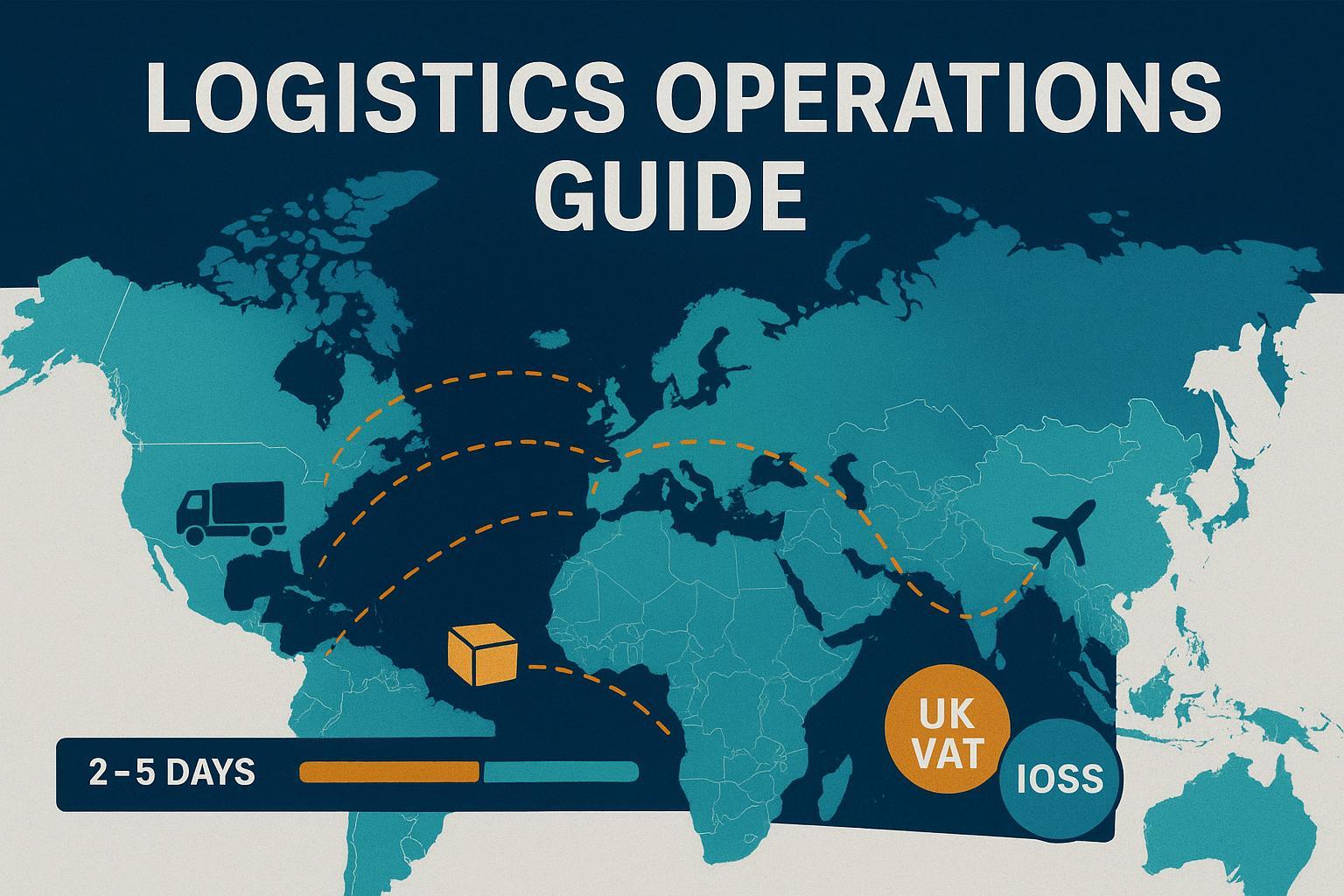
If you run a mature dropshipping operation, you don’t need fluff—you need dependable ranges, the levers to shrink them, and the compliance notes that keep parcels moving. This guide brings conservative, cited benchmarks for the USA, EU, and UK, plus practical playbooks to help you hit sub‑7‑day delivery where it’s feasible without blowing up margin. What’s the point of an ambitious SLA if you can’t keep it week after week?
How to interpret these dropshipping shipping times
Not all “shipping times” are guarantees. Carriers often publish delivery aims, which vary by origin/destination, day of handoff, and peak calendars. Treat ranges as planning bands, not promises, and verify lane specifics with official calculators before you set SLAs. As a rule of thumb, add a 1–2 business day buffer during peak or when your cut‑off misses the carrier’s acceptance scan.
Use carrier tools for ZIP/postcode specifics and network updates.
Build SLAs for the 75th percentile, not the median—outliers happen.
For hybrid networks (consolidators handing to national posts), factor in injection schedules.
At‑a‑glance ranges by region (conservative)
Region/lane | Common service family | Typical delivery aim (working days) | Notes |
|---|
USA domestic | USPS Ground Advantage | 2–5 | Check ZIP‑to‑ZIP via USPS Service Standards; aims vary by RPDC distance. |
| USPS Priority Mail | 1–3 | Aim, not a guarantee; verify for your ZIP pairs. |
| UPS Ground | 1–5 | Use UPS Time & Cost calculator; watch peak surcharges/closures. |
| FedEx Ground/Home | 1–5 (contiguous), 3–7 (AK/HI) | See FedEx service docs and holiday guides. |
CN→USA | Economy vs faster programs | ~15–45 economy; select fast lanes 5–10 | Broad guidance; no consistent official SLAs—use cautious language. |
EU domestic | DPD/GLS/PostNL/Colissimo | 1–2 domestic | Country‑specific; verify with local calculators. |
Intra‑EU cross‑border | DPD/GLS/PostNL | 2–6 | Lane‑dependent; remote areas may add a day. |
UK domestic | Royal Mail Tracked 24/48 | ~next day / ~2 days (aims) | Treat as aims; verify current Royal Mail pages. |
| Evri Standard | 2–3 (ParcelShop), 3–5 (collection) | Aims from Evri terms/service pages. |
| Parcelforce express | Next day (24), 48‑hour | Time‑definite options available (AM/10:00). |
These are conservative planning bands. Always validate with carrier calculators and service pages for your exact origin/destination pair.
USA: carrier specifics and the sub‑7‑day playbook
USPS
Ground Advantage: expected delivery 2–5 business days across the U.S.; verify per ZIP using the official tool. See the USPS business page and service standards for details in 2025–2026 contexts per the agency’s communications: USPS Ground Advantage overview and USPS Service Standards lookup. Holiday readiness and refinements for 2025 were reiterated in USPS newsroom releases.
Priority Mail: commonly described as 1–3 business days (aims). USPS highlights seasonal preparedness rather than guarantees; confirm for your lanes via the Service Standards tool and newsroom updates such as the 2025 holiday communications: USPS holiday readiness updates (2025).
UPS
FedEx
Cross‑border CN→USA
Economy parcels often take roughly 15–45 days; faster lanes can achieve 5–10 days in select corridors when linehaul and customs processes align. Official, uniform SLAs are sparse, so treat any promise skeptically and confirm with your provider’s current lane data.
Playbook to hit sub‑7‑day delivery in the USA
Place inventory closer to demand. Use a 2–3 node 3PL network to reduce ground zones; target 1–3 day ground coverage for 80%+ of orders.
Set a realistic cut‑off. Align your order cut‑off with the carrier’s acceptance scan; push pick/pack to meet late drop‑offs ahead of peak.
Route by SKU and lane. Lightweight SKUs can ride USPS Ground Advantage efficiently; higher‑value or urgent SKUs may justify Priority or UPS/FedEx ground with better time‑in‑transit for specific ZIP pairs.
Buffer during peak. Add 1–2 days to customer‑facing SLAs in November–January and when weather or network advisories are active.
EU: domestic, intra‑EU patterns and IOSS notes
Domestic and intra‑EU ranges DPD France’s Predict home delivery references 24–48 hours domestically and 2–6 working days across Europe, with remote area caveats: DPD Predict (France) page and DPD France terms. GLS and other national posts/parcel networks commonly support next‑day aims in dense markets; always use the local country calculator for precise expectations. As a directional reference, see GLS France overview and PostNL’s international brochure that frames intra‑EU shipments as typically several days longer than domestic: PostNL international delivery times brochure.
IOSS for ≤ €150 consignments Using IOSS lets non‑EU sellers collect VAT at checkout and declare/remit centrally, which reduces clearance friction and surprise charges for customers. The European Commission reaffirmed IOSS’s central role and announced the removal of the €150 customs duty exemption threshold in 2026 policy timelines; see the Commission’s note: EU to remove €150 customs duty exemption in 2026 policy timeline. For national VAT rules references, see the Commission’s OSS/IOSS hub (example country page): National VAT rules reference.
EU sub‑7‑day playbook To keep most domestic orders within 1–2 working days and cross‑border in roughly 2–5, localize stock where demand concentration justifies it (for example, DE/NL/FR nodes), enable IOSS on ≤ €150 consignments to prevent consignee VAT holds, use DDP‑style arrangements for higher values when appropriate, and pre‑advise clean data (HS codes, values, IOSS ID when relevant). Before scaling, run a small set of test orders on each lane to validate performance and exceptions.
UK: Royal Mail/Evri/Parcelforce and post‑Brexit VAT
Carrier aims and options
Royal Mail’s Tracked portfolio is commonly positioned as Tracked 24 (~next day) and Tracked 48 (~two days) as delivery aims. Verify details and any current aim statements directly via the official portal: Royal Mail Tracked services.
Evri’s published aims: ParcelShop drop‑off 2–3 working days; courier collection 3–5 working days, counted from the drop‑off/collection day and excluding weekends/bank holidays: Evri terms and conditions and Evri services/prices.
Parcelforce offers next‑day (express24) and 48‑hour services, with time‑definite options like expressAM or express10; see Parcelforce express services and the product pages for time‑definite delivery windows: express10 and expressAM. Network advisories are posted here: Parcelforce service updates.
VAT and import rules after Brexit
The UK does not use IOSS. VAT is due on low‑value imports, and the government has proposed removing the customs duty relief for consignments ≤ £135, with consultation running into 2026 and removal by 2029 at the latest. Review the policy consultation materials: GOV.UK consultation on low‑value imports and its consultation PDF.
UK sub‑7‑day playbook For domestic deliveries, pair Tracked 24 (aim) or Parcelforce next‑day for urgent orders with a clear cut‑off; use Evri standard for budget‑sensitive SKUs where 2–3 day aims are acceptable. For imports, ensure VAT is collected appropriately at point of sale for low‑value goods and consider DDP arrangements to prevent consignee‑side delays. Maintain clean data (HS codes, values) and monitor carrier service updates.
Practical SOPs to actually reduce delivery time (and exceptions)
Supplier and SKU vetting
Routing rules and local warehousing
Cut‑offs and customer promises
Exception policy
Tools you can use (neutral mention)
Disclosure: ASG is our product. ASG can be used to compare lane options, set routing rules, and centralize tracking workflows. Alternatives include ShipStation, Easyship, and AfterShip. Choose the platform that integrates cleanly with your cart, supports customs data pre‑advice, and offers lane‑level reporting.
FAQ and glossary (concise)
What’s the difference between an “aim” and a guarantee? An aim is the carrier’s target under normal conditions; a guarantee adds a refund or credit policy if missed. Most economy services list aims.
What’s IOSS and when should I use it? For imports into the EU with an intrinsic value ≤ €150, IOSS lets you collect VAT at checkout and remit centrally, typically reducing delays at customs.
DDP vs DDU—when does it matter? DDP (duties and taxes paid) shifts tax/fee handling to the shipper and usually avoids consignee‑side holds; DDU (unpaid) can cause delays and unhappy customers when bills arrive at delivery.
Closing thought
Benchmarks get you in the right ballpark; disciplined routing, clean data, and honest SLAs keep you winning week after week. Validate your lanes monthly, watch carrier advisories, and tune your promises before peak hits.


 Optimized by Seraphinite Accelerator