By Janson — CEO & Founder, ASG Dropshipping | Updated: April 5, 2026 | 15 min read
DHgate cross-border logistics operates across four shipping tiers in 2026: economy (20–40 days, cheapest), standard (10–20 days, most common), express via DHL/FedEx/UPS (3–7 days, highest cost), and local warehouse fulfillment (2–5 days, limited product availability). DHgate does not control shipping directly — each of its 2+ million sellers selects their own carrier and processing timeline, creating significant delivery time variance even between sellers offering identical products. For dropshippers, this structural limitation means logistics quality is seller-dependent, not platform-guaranteed, and compounds into QC, dispute, and customer service problems as order volume grows above 50 daily orders.
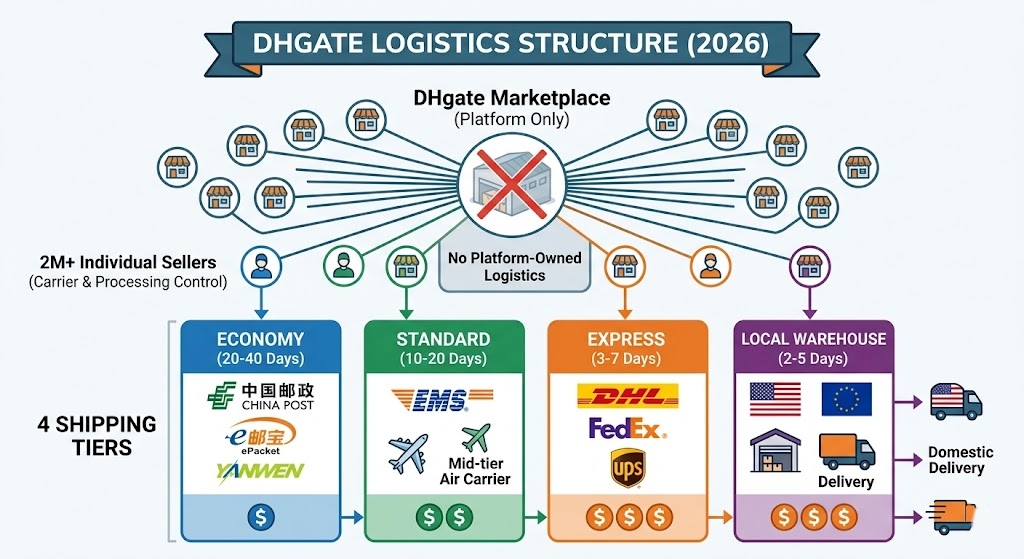
DHgate’s four shipping tiers: the gap between “15-day delivery estimate” and actual delivery often comes from hidden processing time and carrier variance that the platform’s model doesn’t control. Here’s a question I get from dropshippers constantly: “Why is my DHgate order taking so long when the listing said 15-day delivery?” The short answer is that DHgate’s “15-day delivery” estimate is a seller input, not a platform guarantee. DHgate connects 36+ million buyers across 200+ countries with 2+ million suppliers — but it doesn’t own a single warehouse, employ a single logistics operator, or control a single shipment.
That’s the structural reality of DHgate logistics. Not a bug — it’s how the platform is built. Once you understand it, you can make smarter decisions about when to use DHgate, which shipping methods to select, and when the platform has stopped being the right infrastructure for your business.
Table of Contents
- How DHgate Cross-Border Logistics Actually Works in 2026
- The Real Problems with DHgate Logistics (And Why They’re Structural)
- How to Make DHgate Logistics Work — And When to Switch
- Final Thoughts
- FAQs
How DHgate Cross-Border Logistics Actually Works in 2026
DHgate cross-border logistics in 2026 functions as a marketplace-facilitated shipping system where individual sellers — not DHgate itself — select carriers and processing timelines for each order. The platform supports four delivery tiers: economy shipping via China Post, ePacket, or Yanwen (20–40 days to the US), standard shipping via mid-tier carriers (10–20 days), express shipping via DHL, FedEx, or UPS (3–7 days), and local warehouse fulfillment from US or EU facilities (2–5 days).
DHgate provides buyer protection and a dispute mechanism, but does not inspect packages, guarantee carrier performance, or allocate freight capacity in advance — making delivery outcomes dependent on individual seller practices rather than platform-level logistics standards.
The 4 Shipping Tiers — Time and Cost Reality
In 2026, DHgate shipping times range from 2 days to over 40 days depending on which tier you select at checkout. Here’s the complete breakdown with realistic delivery windows — not seller estimates, but what actually happens in practice:
| Shipping Tier | Carriers | US Delivery (Normal) | US Delivery (Q4) | Typical Cost |
| Economy / Free | China Post, ePacket, Yanwen, 4PX | 20–40 days | 30–55 days | Free–$3 |
| Standard | EMS, CPS, mid-tier air | 10–20 days | 15–30 days | $3–$12 |
| Express | DHL, FedEx, UPS, TNT | 3–7 days | 5–10 days | $20–$40+ |
| Local Warehouse | Seller’s US/EU stock | 2–5 days | 2–7 days | Varies |
Delivery ranges from Do Dropshipping’s 2026 DHgate shipping analysis and Fulfillbot’s carrier-specific data. Q4 ranges reflect shared carrier capacity pressure October–December.
Carrier-specific US delivery times break down as follows: DHL 3–4 days, UPS 5 days, FedEx 4–6 days, EMS 15 days, air freight 5–14 days, sea freight 30–45 days. These are transit times only — seller processing time adds another 1–15 days before the carrier clock starts. The math on express shipping also breaks quickly for low-AOV products: at $20–$40+ per express shipment on a $15–$30 product, the shipping cost often exceeds the product cost, destroying the margin that made DHgate attractive in the first place.
What Happens Between Order and Delivery: The Hidden Steps
Most buyers calculate delivery time from order placement to doorstep. The actual timeline has three distinct phases, and only one appears in the carrier’s delivery estimate.
Phase 1 — Seller processing time (1–15 days). After you place an order, the seller picks, packs, and hands the package to a carrier. This processing time is not included in the shipping time shown by carriers — it happens first. Standard orders process in 1–3 days. Custom or out-of-stock items can take 7–15 days before a carrier touches them.
Phase 2 — International transit (varies by tier). Economy shipments frequently sit in Chinese sorting centers for 3–7 days before departing, generating “where is my order” messages from customers who see no tracking movement. Phase 3 — Customs and last-mile delivery.
Customs inspection adds 2–7 days for standard packages, more if documentation is incomplete. The practical implication: a “10–20 day standard shipping” listing might actually total 3 days processing + 15 days transit + 5 days customs + 3 days last-mile = 26 days total. That gap between listed estimate and actual delivery is where most DHgate customer complaints originate.
DHgate’s US and EU Local Warehouses — When They Actually Help
DHgate’s local warehouses — US facilities delivering in roughly 7 days and European facilities in 3–5 days — solve the international shipping problem for a narrow subset of products. When a listing shows “Ships from US,” the package ships domestically without international customs friction. The significant limitation: local warehouse availability covers a small fraction of DHgate’s catalog, concentrates in high-velocity general merchandise, and reflects seller-held inventory that can deplete without listing updates. For dropshippers running diverse catalogs, assuming local warehouse availability isn’t a reliable operational strategy.
Understanding how shipping from China compares across different fulfillment models — marketplace platforms versus dedicated freight lines — becomes important once your business moves past the early testing stage.
The Real Problems with DHgate Logistics (And Why They’re Structural)
DHgate logistics has four structural problems that compound as order volume grows: the platform does not control carrier selection or performance for any of its 2+ million sellers, meaning delivery time variance is seller-dependent rather than platform-guaranteed; there is no QC inspection mechanism between the seller’s warehouse and your customer; shared carrier capacity collapses during Q4 peak season without any pre-allocation for individual sellers; and dispute resolution through DHgate’s buyer protection takes 5–90 days, requiring sellers to absorb costs upfront. Each problem is manageable below 50 daily orders.
Above that threshold, all four compound simultaneously into customer service costs, refund exposure, and review damage that erodes store margin faster than the product cost savings justify.
Based on 8 years running fulfillment operations in Dongguan and Shenzhen — processing 5M+ orders for 5,000+ global sellers — I can tell you that DHgate’s logistics problems aren’t operational failures. They’re built into the platform’s architecture. Understanding the architecture tells you exactly where the ceiling is.
Problem 1 — DHgate Doesn’t Control Who Ships Your Order
DHgate does not ship products itself. It relies entirely on sellers to arrange shipping using whatever carriers the seller chooses. The shipping method you select at checkout tells the seller which tier you want — economy, standard, or express — but does not guarantee which specific carrier fulfills that tier, or how quickly the seller processes before handoff.
This creates three invisible layers of variance. Carrier selection variance: two sellers offering “standard shipping” on the same product may use EMS (12-day delivery) or a low-tier air consolidator (25-day delivery) — both qualify as “standard,” but the customer experience is completely different. Processing time variance: some sellers ship within 24 hours, others take 7–10 days.
Carrier downgrade risk: sellers can substitute carriers within the same service class without buyer notification — legal under DHgate’s terms, frustrating in practice. For dropshippers, when customer complaints accumulate, the problem isn’t easily traceable to a single fixable cause because the variable sits outside your control.
Problem 2 — Zero QC Between Order and Your Customer
Every DHgate order ships from the seller’s location to your customer without any intermediate inspection. The first quality check occurs when your customer opens the box. According to Statista, around 93% of UK shoppers experienced delivery issues in 2023 — reflecting the broader reality of marketplace-facilitated international shipping where QC is entirely seller-dependent. In 2025, EU RAPEX reported 17 unsafe products traced back to DHgate sellers, underscoring that the platform’s self-declaration quality model creates real exposure.
The formula that quantifies the cost at scale: Daily orders × industry average defect rate × AOV × 30 days = monthly hidden QC cost. At 50 daily orders with an 8% defect rate and $30 AOV: 50 × 8% × $30 × 30 = $3,600/month in defect-related costs. This 8% figure is the industry average for unverified supplier channels with no dedicated QC protocol between seller and customer.
At ASG Dropshipping, our dedicated six-step per-unit inspection across 5M+ orders produces a 0.3% defect rate — a 27× reduction that exists entirely because a human checks each product before it goes in a box. Understanding what dedicated quality control in dropshipping actually involves makes the comparison concrete.
Problem 3 — Q4 and Peak Season Logistics Collapse
DHgate’s logistics runs on shared carrier capacity with no pre-allocated freight lines, no dedicated container slots, and no priority queue for high-volume sellers during peak periods. Every November and December, every DHgate seller competes for the same carrier capacity as every other Chinese shipper. Economy and standard tiers that run 20–40 days under normal conditions extend to 30–55 days during Q4 as carriers prioritize express shipments and sorting centers saturate.
This compounds specifically for dropshipping businesses because Q4 is when revenue peaks. A seller doing 30 daily orders in August might do 80–120 in November — the very period when volume is highest is when DHgate’s shared infrastructure performs worst. Our Q4 2024 operational data from our Dongguan and Shenzhen warehouses shows how differently this plays out on dedicated infrastructure: at a peak of 23,000 orders per day, we maintained a 97.3% on-time delivery rate — made possible by pre-allocated dedicated freight lines booked months in advance rather than competing for spot capacity. DHgate sellers have no equivalent mechanism.
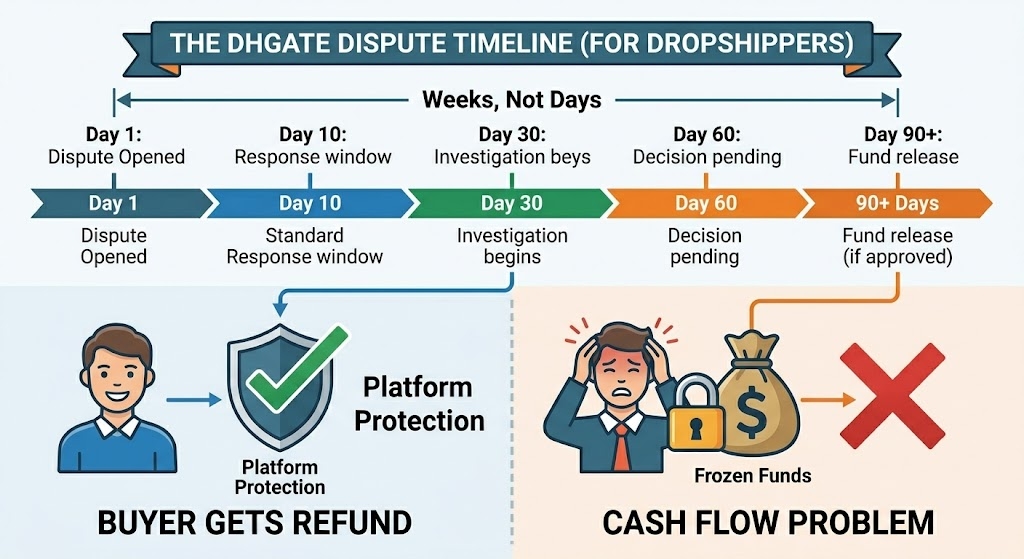
DHgate economy and standard tier during Q4: shared carrier capacity pressure expands delivery windows by 10–20 days exactly when order volume — and customer expectations — are highest. Problem 4 — Dispute Resolution Adds Weeks, Not Days
DHgate provides genuine buyer protection — funds held in escrow until delivery confirmation. For buyers, this is meaningful security. For dropshippers operating at scale, the dispute timeline creates a real cash flow problem. If tracking shows no information beyond the promised shipping time plus 10 days, buyers can dispute and request a refund — but resolution takes 5–90 days depending on dispute type and seller responsiveness.
For a dropshipping operation, this means absorbing the refund or reship cost immediately to protect your store rating, then waiting 5–90 days to recover from DHgate. At 50 daily orders with a 3% dispute rate, that’s 1–2 unresolved disputes opening daily, each with its own resolution clock. At 200 daily orders, dispute management alone requires dedicated staff time that appears nowhere in your product cost calculation.
Running 30+ daily orders on DHgate and finding logistics problems consuming more management time than the cost savings justify? The issue is structural — DHgate hands logistics decisions to individual sellers rather than maintaining platform-level standards. See how dedicated fulfillment infrastructure changes the logistics equation for Shopify sellers scaling past what marketplace platforms were built to support.
How to Make DHgate Logistics Work — And When to Switch
Making DHgate cross-border logistics work for dropshipping requires matching shipping method to order volume, product value, and destination: economy shipping is viable below 10 daily orders where individual dispute management is tractable; standard shipping suits 10–50 daily orders where delivery consistency affects review scores; express shipping via DHL/FedEx/UPS at $20–$40+ only makes sense on products with $50+ AOV where shipping cost doesn’t compress margin below viability.
Three signals indicate DHgate logistics has become a cost rather than a savings: customer shipping complaints exceeding 10% of order volume, refund and reship costs exceeding $500/month, or consistent volume above 50 daily orders heading into Q4 on economy or standard tier.
The Carrier Selection Framework: Match Method to Volume and Product
Under 10 daily orders (testing stage): Economy shipping is acceptable. At 10 daily orders and 8% defect rate, roughly 24 defective deliveries per month is manageable if painful. Choose economy when product cost is under $15 and you’ve set honest delivery expectations. Avoid it for fragile products, time-sensitive deliveries, or anything where a 40-day delivery window generates a chargeback before the package arrives.
10–50 daily orders (early scaling): Standard shipping becomes the operational minimum. Standard shipping offers a balance of cost and speed — not as slow as economy, not as expensive as express. At 30 daily orders, the standard tier premium of roughly $5 per order over economy equals $4,500/month — against which you get fewer “where is my order” contacts, fewer refund requests, and faster review accumulation. At this volume, standard tier almost always pays for itself in customer service labor savings alone.
Express shipping (DHL/FedEx/UPS) — specific use cases only: Express shipping via DHL, FedEx, or UPS delivers in 3–7 days but at $20–$40+ per shipment. The product AOV must support it — on a $20 product, a $25 express cost means you’re spending more on logistics than the product. Use express when AOV is above $50, the product is time-sensitive, or you’re running a test campaign on a high-margin product where delivery speed directly affects review quality. Don’t build express into standard fulfillment for low-to-mid AOV products — the math breaks immediately.
50+ daily orders — where DHgate’s model shows its limits: Above 50 daily orders, structural problems compound faster than carrier tier upgrades can compensate. You need consistent delivery performance, QC accountability, and carrier capacity that isn’t subject to Q4 collapse. This is where the infrastructure conversation becomes necessary.
How to Track DHgate Shipments (And What “No Update” Actually Means)
Tracking DHgate shipments requires understanding that different tiers produce radically different tracking experiences. The workflow: retrieve your tracking number from “My Orders” in your DHgate account — appears 24–72 hours after the seller ships — then enter it at 17track.net, which aggregates data from Chinese carriers including Yanwen, 4PX, China Post, ePacket, and all major express carriers.
Interpret updates by tier: economy shipping shows no movement for 3–10 days after “order shipped” while the package sits in a Chinese sorting center — this is normal, not a problem. Standard shipping updates every 2–5 days during transit. Express (DHL/FedEx/UPS) provides near real-time updates from pickup through delivery.
Open a buyer protection dispute if no tracking movement appears beyond the promised window plus 10 days — and build a weekly tracking audit into your operations for orders approaching their delivery window before the protection period closes.
The 3 Signals That Tell You DHgate Logistics Is Costing More Than It’s Saving
Signal 1: Customer shipping complaints exceed 10% of monthly order volume. At 50 daily orders (1,500/month), that’s 150 shipping complaint contacts per month — at $3–$5 of labor per contact, $450–$750/month in overhead that doesn’t appear on your DHgate invoice.
Signal 2: Monthly refund and reship costs exceed $500. At 50 daily orders with 8% defect rate and $30 AOV: 50 × 30 days × 8% × $30 = $3,600/month in defect exposure. Even at 70% dispute recovery, you’re absorbing $1,080/month in unrecovered costs plus dispute management overhead.
Signal 3: Consistent 50+ daily orders heading into Q4 on economy or standard tier. Economy that averages 25 days in October averages 40–55 days in November and December. Customer complaints, dispute rate, and review damage all peak when your revenue is highest. The decision to upgrade must happen before Q4, not during it.
When two of the three signals appear simultaneously, the transition economics from DHgate to a private fulfillment agent are net positive from the first month.
What a Private Agent Actually Changes About Your Logistics
Based on our documented transition data from sellers who moved from DHgate-adjacent marketplace sourcing to dedicated fulfillment infrastructure: average defect rate drops from 7.8% to 1.5% within 60 days of switching to per-unit QC inspection. Average delivery time to US customers drops from 18–25 days on standard tier to 5–8 days on dedicated freight. Customer service contacts related to shipping typically drop 60–70% within the first billing cycle.
The Manchester case makes this concrete. A UK-based home goods seller processing 200 daily orders switched from marketplace sourcing to ASG’s dedicated fulfillment infrastructure in mid-2023. Delivery time dropped from 12 days to 6 days. Quality complaint rate dropped from 8.5% to 1.8%. Six months after the transition, daily order volume had grown to 480 — driven by improved review scores and the repeat purchase rate that better delivery experience produced. The cost of the transition was recovered in 11 days based on the defect cost elimination alone.
Understanding what a dropshipping agent actually provides versus a marketplace platform is the starting point for evaluating whether the transition makes sense at your current order volume. For Shopify sellers specifically, the dedicated Shopify fulfillment agent comparison covers the infrastructure differences in detail, including how the transition works without order interruption.
Seeing Signal 1 or Signal 2 in your current DHgate operation? The structural problems don’t improve with scale — they compound. ASG Dropshipping handles per-unit QC inspection, dedicated freight to the US in 4–6 days, and custom packaging on every order for Shopify sellers who’ve outgrown what marketplace platforms were designed to support. See how the transition works.

Final Thoughts
DHgate’s cross-border logistics is exactly what it is: a marketplace-facilitated shipping system where individual sellers make individual decisions, and the platform aggregates the results. For early-stage dropshippers testing products with low daily order volumes, that system is workable — the cost savings are real, the product variety is genuine, and the structural limitations are manageable.
The ceiling becomes visible around 50 daily orders. Not because DHgate gets worse at that threshold, but because your business requirements get more demanding. You need delivery consistency, not just average delivery performance. You need QC accountability before products reach customers, not dispute recovery after they don’t. You need carrier capacity that doesn’t evaporate in Q4 when your revenue is highest.
The three-signal framework in this guide tells you when you’ve crossed that threshold — before the damage compounds into your review score and P&L rather than after. Shipping complaints above 10% of volume, refund and reship costs above $500/month, and 50+ daily orders heading into Q4 on economy or standard tier. When two appear together, the infrastructure conversation isn’t optional anymore.
DHgate built a genuinely impressive cross-border commerce platform. It wasn’t built to be the logistics backbone of a scaling dropshipping operation. Knowing the difference — and knowing when to upgrade — is what separates the operators who hit $50,000/month from the ones who plateau at $5,000/month wondering why better ads aren’t fixing the problem.
All operational data reflects ASG Dropshipping’s documented fulfillment records and carrier performance benchmarks as of Q1 2026. DHgate’s shipping methods, carrier partnerships, and buyer protection terms change — verify current specifics directly with your sellers before making fulfillment decisions.

About the Author
Janson — Founder & CEO, ASG Dropshipping
8 years in cross-border dropshipping and fulfillment. 200-person team, 4 warehouses in Dongguan and Shenzhen, 2,300+ vetted factories, 5M+ orders processed across 200+ countries. The carrier data and transition benchmarks in this article come from documented operational records — not projections.
Outside the warehouse: rock singer and guitarist.

Frequently Asked Questions
How long does DHgate cross-border shipping take in 2026?
DHgate cross-border shipping in 2026 takes 20–40 days on economy tier via China Post, ePacket, or Yanwen; 10–20 days on standard shipping via EMS or mid-tier air carriers; 3–7 days on express shipping via DHL, FedEx, or UPS; and 2–5 days from local US or EU warehouses where available.
These transit times do not include seller processing time — typically 1–3 days for stocked items, up to 7–15 days for custom or out-of-stock products — which adds to the total delivery window before the carrier clock starts. During Q4 peak season, economy and standard shipping tiers expand by 10–20 days due to shared carrier capacity pressure.
Why is DHgate shipping so slow compared to what sellers promise?
DHgate shipping appears slower than promised because delivery estimates shown at checkout reflect carrier transit time only — they exclude seller processing time, Chinese customs clearance, and last-mile handoff to local carriers, which collectively add 5–15 days to the total delivery window. DHgate also does not control which specific carrier sellers use within each tier, meaning two sellers offering “standard shipping” may use carriers with 12-day versus 25-day delivery windows.
The platform’s buyer protection and dispute mechanism addresses late delivery, but the structural variance — seller-selected carriers without platform-level performance guarantees — is built into how DHgate’s marketplace model operates.
What shipping methods does DHgate offer for dropshipping?
DHgate sellers offer four primary shipping categories: economy shipping via China Post, ePacket, Yanwen, or 4PX (20–40 days, often free); standard shipping via EMS or mid-tier air carriers (10–20 days, $3–$12); express shipping via DHL, FedEx, UPS, or TNT (3–7 days, $20–$40+); and local warehouse shipping from US or EU seller-held inventory (2–5 days, limited availability by product).
The shipping method is selected by the buyer at checkout, but the specific carrier within that tier is chosen by the seller — buyers should confirm available carriers on the individual product page before purchasing.
How do I track a DHgate international shipment?
To track a DHgate international shipment, retrieve your tracking number from “My Orders” in your DHgate account — this appears 24–72 hours after the seller ships. Enter the tracking number at 17track.net, which aggregates tracking data from Chinese carriers including Yanwen, 4PX, China Post, ePacket, and all major express carriers. Economy shipping typically shows no tracking movement for 3–10 days after the initial “shipped” notification while the package sits in Chinese sorting centers — this is normal.
Express shipping via DHL or FedEx provides near real-time updates. If no tracking movement appears for more than 10 days beyond the promised delivery window, open a buyer protection dispute. For a full comparison of how shipping from China works across fulfillment models, our guide covers the carrier options in detail.
Is DHgate reliable for dropshipping logistics in 2026?
DHgate is reliable for dropshipping below 50 daily orders where delivery time variance is manageable within your customer service capacity. Above 50 daily orders, structural limitations compound: no platform-level QC, seller-selected carriers without performance guarantees, and shared freight capacity that collapses during Q4.
The industry average defect rate for unverified supplier channels without dedicated QC runs at approximately 8% — meaning 50 daily orders produces roughly 120 defective deliveries per month requiring customer service, refunds, and dispute management.
For dropshippers scaling past 50 daily orders, a private fulfillment agent with per-unit inspection and dedicated freight produces meaningfully better outcomes. See our guide on what a dropshipping agent provides for the full comparison.
How much does DHgate shipping cost for international orders?
DHgate international shipping costs vary by tier: economy shipping is often free or $1–$3 via China Post or ePacket on lightweight items; standard shipping via EMS or mid-tier air runs $3–$12 depending on weight and destination; express shipping via DHL, FedEx, or UPS costs $20–$40+ per shipment with additional charges for remote areas and heavier items.
Air freight for bulk orders runs $5–$15 for small packages and $15–$30 for medium packages; sea freight runs $30–$45+ for larger shipments. Actual cost depends on the shipping method selected, destination country, product dimensions, and whether the seller subsidizes freight in the product price or passes it through at checkout.
Does DHgate have warehouses in the US for faster shipping?
DHgate has seller-operated local warehouses in the US and Europe — not DHgate-owned or managed facilities. When a product listing shows “Ships from US,” the individual seller has pre-positioned inventory domestically, which delivers in approximately 2–5 days without international customs delays. The significant limitation: local warehouse products represent a small fraction of DHgate’s total catalog, concentrate in high-velocity general merchandise, and seller stock can deplete without listing updates — reverting subsequent orders to China-origin shipping.
For dropshippers targeting US customers who need consistently fast delivery across a broad catalog, DHgate local warehouse availability is insufficient as a primary logistics strategy.
When should I switch from DHgate to a private dropshipping agent?
Switch from DHgate to a private dropshipping agent when any two of three signals appear simultaneously: customer shipping complaints exceeding 10% of monthly order volume, monthly refund and reship costs exceeding $500, or consistent daily volume above 50 orders heading into Q4 on economy or standard shipping tier. At 50 daily orders with an 8% defect rate and $30 AOV, monthly hidden defect cost reaches $3,600 — against which a private agent’s handling fee premium typically recovers within 11 days based on defect cost elimination alone.
A private agent reduces defect rate from approximately 8% to 0.3%, delivers to US customers in 4–6 days versus DHgate’s 10–40 days, and maintains delivery consistency through Q4 on pre-allocated dedicated freight. Our Shopify dropshipping agent guide covers the full transition framework.
Article written: April 5, 2026 | Workflow: asg-seo-writer 21-Step + geo-optimizer v1.0 | Replaces May 2025 version


 Optimized by Seraphinite Accelerator