If you already ship hundreds or thousands of orders a month, “good” dropshipping isn’t just about finding a supplier. It’s a governed operation you can audit: procurement discipline, multi‑stage QC, predictable SLAs, deep integrations, and transparent billing you can check against the invoice. This guide focuses on reliable dropshipping services for DTC brands that need stability at scale.
Your goal with any provider is simple: fewer defects, faster and more accurate deliveries, and clear levers to scale without breaking your CX or gross margin. This Ultimate Guide lays out the complete service list established DTC brands should expect—mapped to tiered packages and measurable outcomes.
Key takeaways
The most reliable dropshipping services for DTC brands combine procure–inspect–store–ship under one roof with auditable QC and SLAs.
Expect modern benchmarks such as ≥99% order accuracy, same‑day ship by cutoff for most orders, and 2–5 business days for many domestic ground deliveries (lane‑dependent) backed by reputable sources like Shopify and carrier standards.
Tiered packages (Basic / Standard / Advanced) help you match cost to control: stricter AQL levels, deeper integrations, and faster receiving/returns appear at higher tiers.
Private label and packaging are feasible at low MOQs in 2026 when scoped smartly; complex molds or formulations raise MOQs and lead times.
Integration quality is a differentiator: real‑time webhooks and clean SKU mapping reduce oversells and post‑purchase friction.
What DTC brands should expect from a 3PL partner
A DTC‑ready 3PL or dropshipping provider is an extension of your operations, not just a parcel shipper. The baseline today includes procurement support, inbound receiving, inventory control, pick–pack–ship, track and trace, returns/refurbishment, customer support, branding options, and robust systems integrations.
Industry leaders emphasize measurable reliability. As of 2026, enterprise guidance points to ≥99% order accuracy, high on‑time delivery rates, and same‑day fulfillment for most orders placed before cutoff, with inbound receiving typically stocked within 24–48 hours. See the enterprise perspective in Shopify’s comprehensive overview of third‑party logistics and DTC fulfillment, which highlights accuracy and same‑day standards as core to the value proposition. For operational context, GoBolt’s fulfillment and WMS explainers discuss inventory accuracy targets near or above 97% when modern systems are in place. Sources: the discussion of end‑to‑end 3PL standards in Shopify’s enterprise guide and GoBolt’s WMS and fulfillment operations content.
For delivery times, lane and service level matter. USPS, UPS, and FedEx publish norms like 2–5 business days for U.S. ground services, 2–3 days for domestic “standard” tiers, and next‑day options for express—while DHL and USPS list 3–10 days for many international services depending on product and destination. Always verify with carrier calculators; peak windows can shift standards.
The complete service taxonomy (mapped to outcomes)
Procure: Supplier discovery and vetting, sample orders, compliance checks, and negotiated MOQs.
Inspect and assure quality: Multi‑stage inspections—DUPRO (during production), PSI (pre‑shipment), and outbound FQC—using ISO 2859‑1 sampling plans and defined AQL levels.
Store and manage inventory: Directed putaway, cycle counts, lot/expiry/serial tracking as needed, and inventory accuracy governance.
Pick, pack, and ship: Same‑day fulfillment by cutoff, validated barcode scanning, cartonization logic, and multi‑carrier rate shopping.
Track and notify: End‑to‑end visibility, proactive exceptions handling, branded notifications if desired.
Returns and refurbishment: RMA flows, grading (A/B/C), return‑to‑stock timelines, refurb/repack, and disposition rules.
Support and governance: Ticket SLAs, weekly operations reviews, root‑cause analysis, and continuous improvement.
Branding and packaging: Private label options, custom packaging, inserts, compliance labeling, and sustainability choices.
Why it matters: each component ties back to measurable KPIs—order accuracy, on‑time delivery, inventory accuracy, return processing time, and cost per order.
Tiered packages with indicative SLAs
Below is a concise capability matrix for aligning spend to control. Treat these as reference ranges; verify any promise in writing and test in onboarding. We highlight where dropshipping services for DTC brands typically differ by tier.
Package | Procurement & QC | Fulfillment & Delivery | Integrations | Branding & MOQs | Governance |
|---|
Basic | Supplier vetting, samples; PSI at AQL major 2.5, minor 4.0 | Same‑day ship ≥90% by cutoff; order accuracy ≥99.0%; receiving to stock ≤48h; domestic ground 2–5 days typical | Prebuilt Shopify/Amazon connectors; daily sync | Stock packaging; starter custom packaging ≥100–200 units | Ticket support; monthly ops review |
Standard | Vetting + DUPRO on risk SKUs; PSI at tighter AQL major 1.5–2.5 | Same‑day ship ≥95%; order accuracy ≥99.5%; receiving ≤24–48h; improved exception handling | Real‑time webhooks; inventory and order sync; partial cancel/edits | Custom packaging and inserts; private label low‑to‑mid MOQs (500–1,000+) | Ticket + dedicated AM; biweekly ops review; RCA on misses |
Advanced | Structured supplier onboarding; routine DUPRO + outbound FQC; optional 100% inspection for critical lots | Same‑day ship ≥98%; order accuracy 99.8–99.9%; receiving ≤24h; carrier optimization and SLAs by lane | API access, event‑driven flows, sandbox; ERP/WMS integration | Full private label, molds/tooling; compliance labeling; sustainability options | Dedicated ops pod; weekly S&OP; continuous improvement plan |
Benchmark sources for these ranges include Shopify’s enterprise 3PL guidance for accuracy and same‑day norms and GoBolt’s WMS operations content for inventory accuracy. Carrier service standards from USPS/UPS/FedEx/DHL inform delivery expectations.
Quality control you can audit
Think of QC as your insurance policy upstream. ISO 2859‑1 sampling (AQL) lets you set the “worst tolerable” defect rate by class: critical, major, minor. Many consumer brands use AQL 0 for critical, 1.0–2.5 for major, and 2.5–4.0 for minor defects at the PSI stage. Using General Level II strikes a balance between cost and assurance. Reputable inspection specialists and explainers detail how AQL selection impacts sample size and acceptance numbers; see QIMA’s primer and AQIService’s guides for practical tables and what “AQL 2.5” means on the floor.
Cadence matters. DUPRO during production catches drift before it becomes a rework project. A final random PSI decides ship vs rework. For higher‑risk SKUs or premium lines, add outbound FQC at the warehouse and, if needed, 100% inspection for limited runs.
What to ask providers to share:
The exact AQLs by defect class and inspection level they’ll commit to.
Example inspection reports with photos and corrective actions.
How they quarantine, rework, or dispose of failed lots.
Integrations and automation in dropshipping services for DTC brands
Clean data flows are the difference between smooth CX and stock‑out chaos. For Shopify stores, favor approved connector apps or direct integrations that use real‑time webhooks (order created, fulfillment update, inventory adjustment) and GraphQL Admin API for scale. For Amazon, understand how MCF or connector apps map shipping promises to what carriers actually deliver. Establish one system as the inventory source of truth, and test edge cases—bundles/kits, preorders, holds—before go‑live. If you’re shortlisting dropshipping services for DTC brands, make integration reliability a top criterion.
Here’s a simple systems view that many DTC brands adopt:
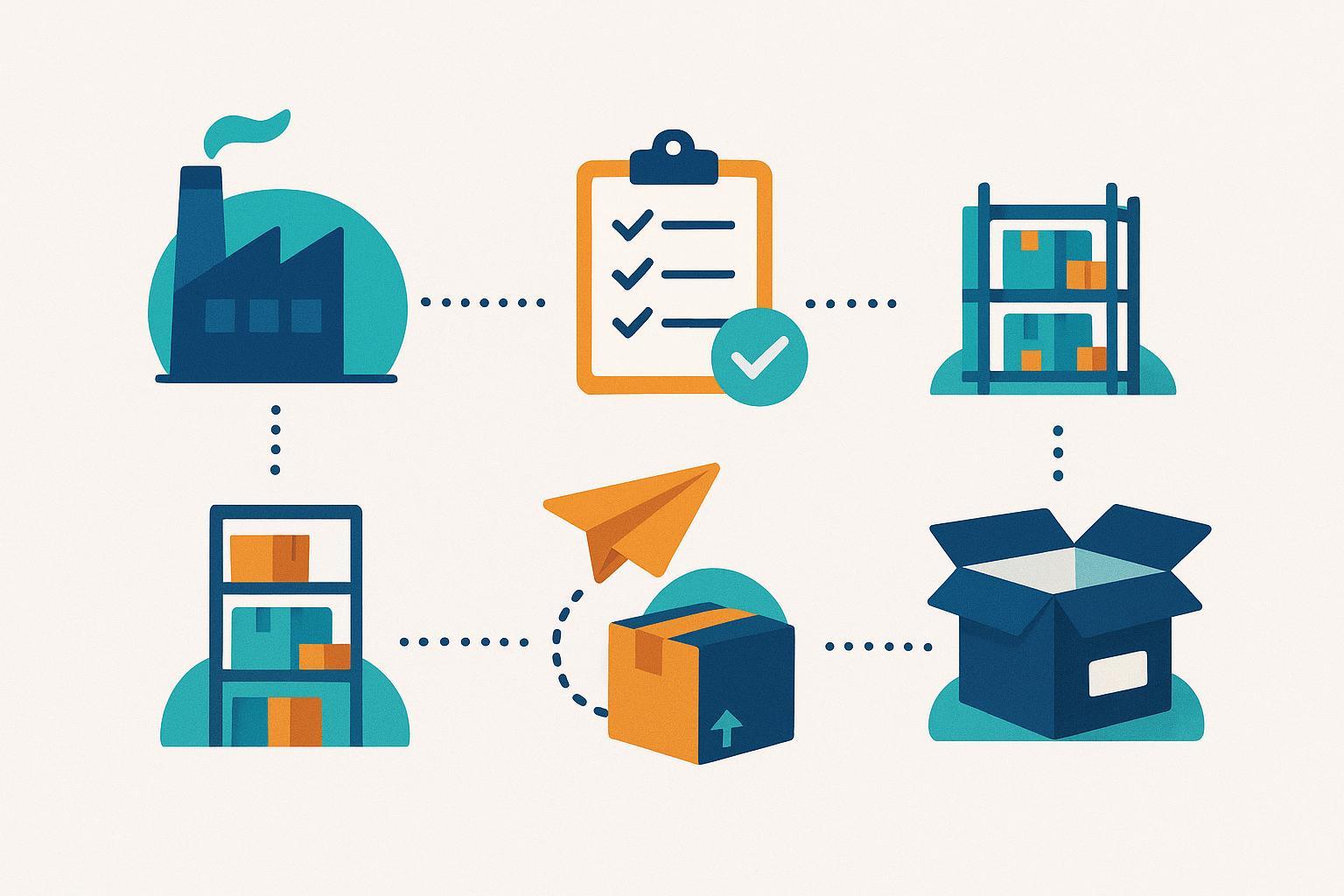
Practical workflow example — disclosure included:
Disclosure: ASG is our product.
A brand connects Shopify and Amazon listings to the OMS/WMS. When an order is created, a webhook triggers allocation based on inventory and promised speed. The QC module checks whether the SKU requires inspection hold (e.g., initial batch with tighter AQL). Pickers scan items; packing confirms dimensions and selects the optimal carrier/service. Tracking events flow back to Shopify/Amazon, updating customers in real time. Comparable providers follow similar event‑driven patterns—evaluate based on stability, error handling, and monitoring.
For integration best practices and event patterns, see Shopify’s enterprise guidance on 3PL integrations and unified commerce APIs, as well as Amazon MCF and connector app documentation.
Transparent billing, pricing components, and SLA governance
Here’s the deal: “mystery invoices” are optional. Ask providers to expose rate components up front—storage, receiving, pick/pack, packaging, postage, surcharges (fuel, demand), project fees—and to specify dispute windows and audit cadences. Global carriers increasingly publish demand surcharges and base rates, improving transparency. Logistics leaders also point to automation that improves invoice accuracy and visibility, which you can leverage for SLA governance. When comparing dropshipping services for DTC brands, insist on this transparency to keep landed costs predictable.
What a good SLA package includes:
Clearly defined metrics: order accuracy, same‑day ship by cutoff, on‑time delivery by scan, inventory accuracy, receiving lead time, return‑to‑stock time.
Targets by tier (see the matrix above) and lanes (domestic vs cross‑border).
Reporting cadence and a root‑cause/continuous‑improvement loop.
An escalation matrix and service credits tied to misses.
Relevant context on pricing transparency and commitments appears in DHL Group investor materials on digitalization and surcharges, as well as FedEx’s public demand surcharge pages.
Provider evaluation scorecard and negotiation checklist
Use this section to pressure‑test any “dropshipping services for DTC brands” pitch. Ask for evidence and run small pilots.
Scorecard prompts:
Procurement & QC: Show supplier vetting SOP, standard AQLs, and 2 recent inspection reports.
Fulfillment: Provide last‑quarter pick accuracy and same‑day ship performance by cutoff.
Inventory: Share inventory accuracy from cycle counts and the WMS method used to calculate it.
Integrations: Demo real‑time stock sync and error‑handling for order edits, cancellations, and bundles.
Returns: Show door‑to‑disposition times and write‑off rates by category.
Billing: Provide a sample invoice with all line items mapped to the rate card; explain dispute process.
Governance: Share the escalation matrix, meeting cadence, and examples of corrective action plans.
Negotiation checklist:
Lock cutoffs by warehouse/time zone; define peak adjustments.
Define inspection scope (DUPRO/PSI/FQC), AQLs, and who pays for rework.
Publish carrier selections by promise (economy/standard/express) and add a change‑management rule.
Set data ownership, API limits, and sandbox timelines; require monitoring and alerting.
Agree on a returns grading standard and refund/exchange SLAs.
Add service credits for misses beyond a threshold and a structured review cadence.
Sources and further reading (selected)
Next steps
If you’re evaluating providers, run a 2–4 week pilot with 1–3 SKUs across two lanes (domestic ground and express), and measure order accuracy, same‑day ship rate, on‑time delivery, and return‑to‑stock.
If you want a neutral walk‑through of a pilot plan and a sample SLA, we can help. Disclosure: ASG is our product, and we offer the tiered capabilities described here; we’re happy to share a detailed matrix and templates so you can compare providers on equal terms.


 Optimized by Seraphinite Accelerator