By Janson — CEO & Founder, ASG Dropshipping |
Updated: March 30, 2026 | 18 min read
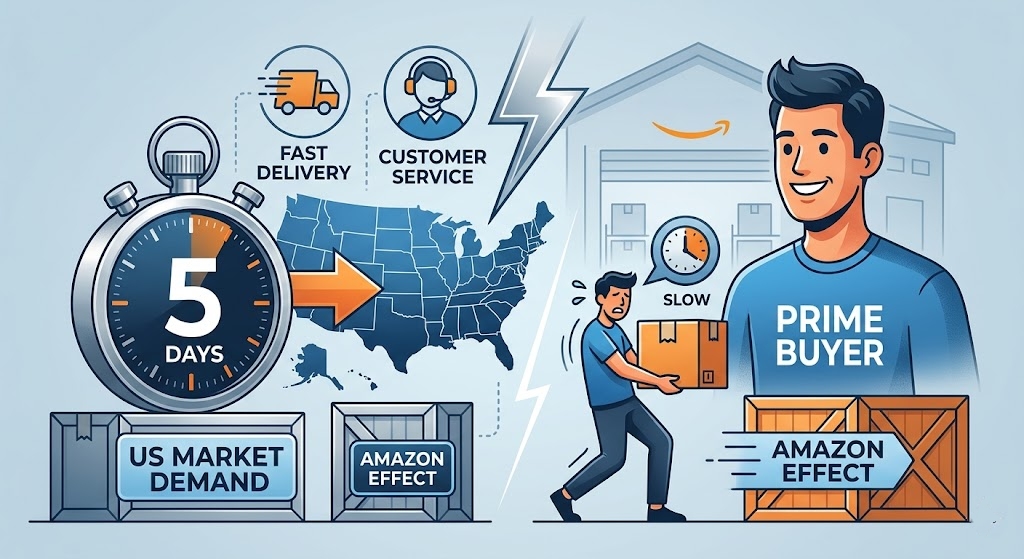
The US market has the highest buyer expectations in dropshipping — and the lowest tolerance for slow shipping. Amazon conditioned 200 million Prime members to expect delivery in five days or less. If your agent cannot get close to that window, your conversion rate pays the price regardless of how good your ads are. Here is what actually works.
The best dropshipping agents for the US market in 2026 are: ASG Dropshipping (best overall, 4–6 day China-to-US dedicated freight, 0.3% defect rate), CJ Dropshipping (best catalog breadth), Zendrop (best US warehouse access, 2–5 day domestic), NicheDropshipping (best for private label), HyperSKU (best for automation), and Spocket (best for US/EU-based suppliers).
The right choice depends on your daily order volume and whether you need China-origin cost advantages or domestic US delivery speed.
Key Takeaways
- “Best for the US market” means two different things. A China-based agent with dedicated US freight lines (4–6 days) serves different needs than a US-based supplier warehouse (2–3 days, higher product cost). Most comparison articles conflate these two categories — they require separate evaluation criteria and suit different business stages.
- Shipping speed is the first filter, not the last. 88% of US consumers consider fast delivery a key purchase factor (National Retail Federation). At 100+ daily orders, every additional day of average delivery time produces measurably higher customer service costs, dispute rates, and review score suppression.
- QC model determines your return rate, not your product. AliExpress-style direct shipping produces 8%+ defect rates. A professional agent with full per-unit inspection produces 0.3%. At 200 daily orders with a $60 average order value, that gap costs approximately $26,000 per month in returns, replacements, and disputed charges.
- The 2026 tariff environment has changed the US calculation. New US import tariff structures make US warehouse pre-stocking more financially attractive for confirmed winning products in affected categories. China-based agents who offer hybrid models — China fulfillment for testing, US warehouse for proven SKUs — are better positioned for sellers above 100 daily orders.
- Stage determines the right agent. Under 50 daily orders: catalog accessibility and low friction matter most. 50–200 daily orders: QC consistency and shipping speed become financial decisions. Above 200 daily orders: dedicated freight, written SLA, OEM capability, and IP protection are non-negotiable for a defensible US market position.
The best dropshipping agents for the US market in 2026 fall into two categories: China-based agents with dedicated US freight lines (4–6 day delivery, lower product cost, full QC capability) and US-based or hybrid agents with domestic warehouse stock (2–5 day delivery, higher product cost, no customs delay).
ASG Dropshipping leads the China-based category with 4–6 day dedicated air freight, a documented 0.3% defect rate across 5M+ orders, and a 20-minute written response SLA. Zendrop leads the US warehouse category with 2–5 day domestic delivery.
CJ Dropshipping offers the broadest catalog. NicheDropshipping specializes in private label. HyperSKU leads on automation infrastructure. Spocket provides the largest US and EU-based supplier network. Optimal choice depends on daily order volume, product validation stage, and whether delivery speed or COGS optimization is the primary competitive need.
Table of Contents
- What the US Market Actually Demands
- The 5 Criteria That Separate Good Agents From Great Ones
- ASG Dropshipping — Best Overall
- CJ Dropshipping — Best Catalog Breadth
- Zendrop — Best US Warehouse Access
- NicheDropshipping — Best for Private Label
- HyperSKU — Best for Automation
- Spocket — Best US/EU Supplier Network
- Full Comparison Table
- Decision Framework by Store Stage
- FAQs
What the US Market Actually Demands From a Dropshipping Agent
The US dropshipping market in 2026 has three non-negotiable requirements: delivery speed within a window Amazon Prime has conditioned buyers to expect (5–7 days maximum for general consumer products), a QC model that keeps return rates below 3% in a market where payment processors monitor dispute ratios closely, and logistics infrastructure that does not collapse under Q4 volume spikes.
The US represents over 40% of total Shopify merchant revenue globally — and also has the highest consumer expectations, the most active dispute and chargeback culture, and the most Amazon-influenced delivery benchmarks of any major dropshipping market.
Most dropshipping agent comparisons treat the US market as just another destination. It is not. It is the market where delivery speed expectations are set by a company — Amazon — that loses money on Prime shipping in order to make it the default consumer expectation. Every Shopify seller targeting the US is implicitly competing against that benchmark, whether they acknowledge it or not.
I have seen this pattern repeatedly across ASG’s client base. A seller doing $30,000 per month in the UK sustains 10–12 day delivery without significant customer service problems. The same seller, same product, same price point, targeting US customers — starts experiencing disputes, negative reviews, and chargeback attempts at that exact delivery window.
The US buyer expectation is structurally different, and the operational requirements for serving it are different as a result.
The Amazon Effect on Delivery Expectations
According to Shopify’s merchant research, 52% of US online shoppers expect delivery within 3–5 days, and 28% consider free fast shipping the most important purchase factor. According to Baymard Institute’s research, shipping delays cause 22% of cart abandonments before checkout is even completed.
A dropshipping agent that cannot reliably deliver to US customers within 7 days — consistently, not occasionally — creates a structural customer experience problem that no amount of great product selection or advertising will fix.
Two Types of “US Dropshipping Agent” — Which One Do You Need?
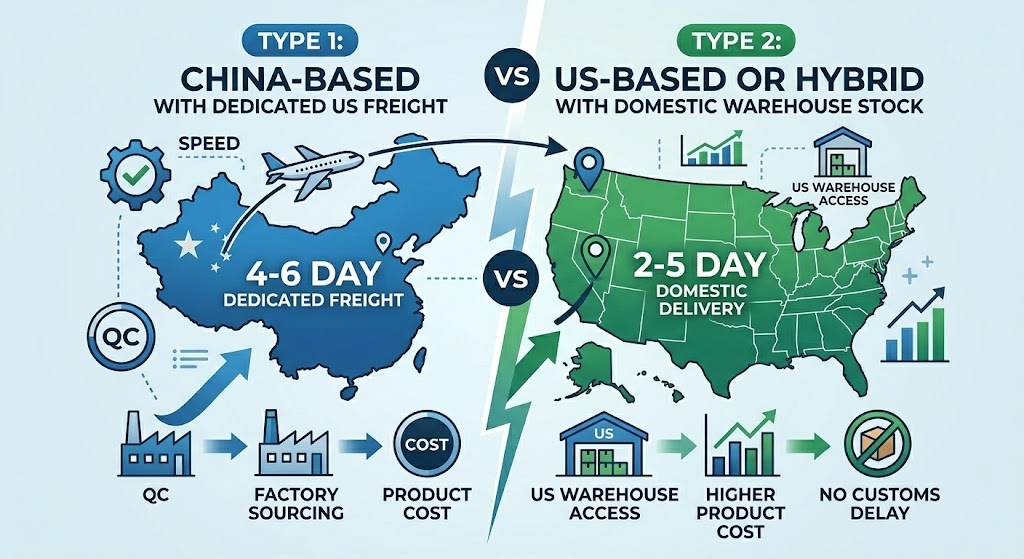
Type 1: China-based agents with dedicated US freight lines. Professional fulfillment operations based in China — Dongguan, Shenzhen, Yiwu — that source factory-direct, perform QC inspection, and ship to the US via dedicated air freight delivering in 4–6 days.
They offer China’s cost advantages (factory-direct pricing 12–18% below platform catalog rates) combined with shipping speeds approaching domestic US performance. ASG Dropshipping, CJ Dropshipping, NicheDropshipping, and HyperSKU operate in this category.
Type 2: US-based or hybrid agents with domestic warehouse stock. Services that pre-stock inventory in US fulfillment centers and fulfill orders domestically in 2–5 days. Zendrop and Spocket operate primarily in this category. The trade-off: higher product costs and narrower catalogs.For a complete breakdown of what a professional dropshipping agent actually does and how these two models differ structurally, that guide covers the operational differences in detail.
The 2026 Tariff Consideration
New US import tariff structures in 2026 have increased landed costs on certain China-origin product categories. The impact varies significantly by product — electronics and specific consumer goods face higher rates than apparel, home accessories, or beauty products.
According to US Customs and Border Protection guidance, the applicable rate depends on HS code classification — now a meaningful cost decision, not an administrative formality.
The strategic response most serious US-market sellers are adopting: China-based agent for product testing (low risk, broad catalog access), with selective migration of confirmed winning SKUs to US warehouse pre-stock once daily volume justifies the inventory commitment.
The 5 Criteria That Separate Good Agents From Great Ones for the US Market
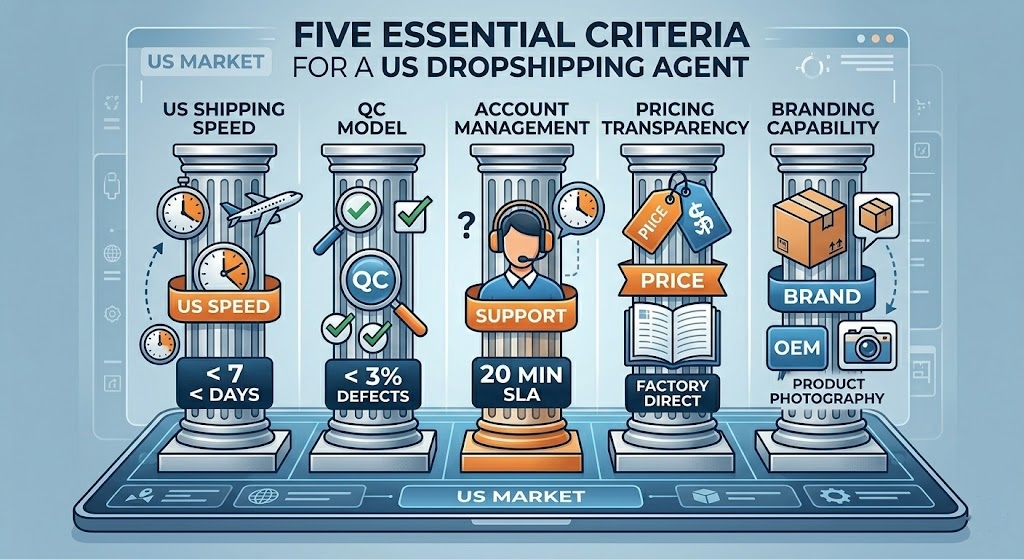
Five criteria determine whether a dropshipping agent is genuinely equipped for the US market in 2026: US shipping speed (under 7 days consistently on the 90th percentile, not best-case), QC model (full per-unit inspection producing under 3% defect rate, not tier-dependent spot-checking), account management response time (under 20 minutes with a written SLA), pricing transparency (documented factory-direct cost structure, not hidden platform markups), and brand or OEM capability (custom packaging and product development without factory-level MOQs).
An agent that scores well on three of five is adequate. An agent that scores well on all five is the right partner for a US market operation above 50 daily orders.
Most sellers evaluate agents on price and advertised shipping time. Both are almost useless as selection criteria in isolation. Price without COGS structure context tells you nothing about total landed cost. Advertised shipping time without loss rate and consistency data tells you nothing about actual customer experience.
1. US Shipping Speed — The Non-Negotiable
The benchmark is not “what is your fastest delivery time.” It is “what is your delivery time on the 90th percentile order” — the window that 90% of shipments meet or beat, not just the ones that happen to fly on the right day with no customs delay. A China-based agent needs to deliver to the US in under 7 days on the 90th percentile to be competitive in 2026.
What to ask any agent before signing: “What is your average delivery time to the US in Q4?” Q4 is when standard shipping capacity fills up and delivery windows expand. Any agent who cannot give you a specific Q4 delivery window with data is either running on shared carrier capacity without guaranteed slots or has not operated at sufficient volume to know their Q4 performance.
2. QC Model and US Return Rate Impact
The US has the highest return rate expectations of any major e-commerce market. The average e-commerce return rate is 17–20% across categories. Defective products from poor QC add directly on top of that baseline — a seller running 8% product defect rates on top of 17% base returns is managing 25%+ total return exposure, at which point most payment processors flag the account.
The QC question to ask every agent is not “do you do quality control” — every agent claims to. The question is “do you inspect every unit, or do you do batch sampling?” Full per-unit inspection produces defect rates under 1% in professional operations.
Batch sampling produces variability — sometimes 2%, sometimes 8% — with no predictability. Unpredictable quality is operationally more damaging than consistently average quality because it makes scaling decisions impossible.
3. Account Management and Response Time
The US market generates customer service emergencies at a higher rate than other markets — US buyers are more likely to file disputes, contact their bank for chargebacks, and leave public reviews when something goes wrong.
The practical requirement: a dedicated account manager with a documented response SLA under 20 minutes, available via direct communication — not a shared support ticket queue — covering US business operation hours at minimum. A written SLA is not a premium feature. It is a basic accountability mechanism.
4. Pricing Transparency and COGS Structure
The platform markup problem is the most common hidden cost in dropshipping agent relationships. A platform-based agent shows a product price from their catalog. That price includes the supplier’s margin, the platform’s margin, and sometimes a fulfillment markup — all presented as a single line item with no visibility into its construction.
A transparent agent structure: factory-direct cost plus a handling fee ($0.50–$2.00 per order) plus shipping at documented carrier rates. Every component is visible and auditable. At 200 daily orders on a $20 product, the difference between platform catalog pricing and factory-direct pricing at 12–18% below catalog represents $14,400–$21,600 per month in COGS savings.
5. Brand and OEM Capability for the US Market
Selling a generic product in a market where Amazon lists the same item from 40 sellers simultaneously is a losing position. A capable agent for the US market needs custom packaging without factory-level MOQs, product photography for US advertising, OEM/ODM capability for private labeling, and IP protection through supply chain isolation.
For context on how platform-based agents compare to private fulfillment operations on brand-building dimensions, that comparison covers the structural differences in detail.
1. ASG Dropshipping — Best Overall for US Market (China-Based) Top Pick
ASG Dropshipping is a China-based professional fulfillment operation founded in 2019, headquartered in Dongguan with 4 warehouses across Dongguan and Shenzhen, a 200-person team, 2,300+ vetted factories, and 5M+ orders processed across 5,000+ global sellers.
For the US market: dedicated air freight lines deliver in 4–6 days, six-step full per-unit QC produces a documented 0.3% defect rate, factory-direct pricing runs 12–18% below platform catalog rates, and dedicated account managers operate on a written 20-minute response SLA via direct WhatsApp.
Best suited for Shopify sellers at 50+ daily orders building a US brand who need factory-direct cost structure, documented QC, and a fulfillment partner with written service commitments.
I am going to be upfront: ASG is my company. I am ranking it first because the data supports it — not because it is mine. If you want to verify that claim independently, the five criteria from the previous section are the framework. Run every agent on those dimensions and compare the outcomes. ASG wins on four of five for US-market sellers above 50 daily orders.
The one dimension where platform models may beat it is catalog browsability for product discovery — where a pre-built product catalog has a structural advantage over sourcing-on-demand.
US Shipping Performance
ASG’s dedicated air freight lines to the US deliver in 4–6 days from Dongguan and Shenzhen warehouses on pre-allocated freight capacity — fixed flight schedules rather than available space in shared carrier queues.
In 2024, ASG processed peak-season orders reaching 23,000 units per day during Q4 while maintaining a 97.3% on-time delivery rate. That Q4 performance is what separates a freight operation with genuine pre-allocated capacity from one routing through shared special lines hoping for available space.
QC and Return Rate Protection
Every unit passes through six documented inspection steps before dispatch: arrival check, visual inspection, functional testing, photo documentation, packaging verification, and dispatch review.
Based on ASG’s 2024 transition data across 386 documented client onboardings — including US-market sellers who previously used CJ Dropshipping, HyperSKU, and AliExpress — the average incoming defect rate was 7.8%. After switching to ASG’s full per-unit inspection, the average dropped to 1.5% within 60 days. The average time to positive ROI on the transition was 11 days.
Pricing and Brand Building
Factory-direct sourcing through 2,300+ vetted factories produces pricing 12–18% below platform catalog rates. At 200 daily orders on a $20 product, that gap produces $14,400–$21,600 per month in COGS savings before defect cost reduction.
ASG’s 10-person in-house design team handles OEM/ODM as a core service — custom packaging, branded inserts, product photography, and private label development available without factory-level minimums.
From 2022 to 2024, ASG supported 83 sellers through white-label to proprietary product transitions: average order value up 35%, repeat purchase rate up 28%.
Documented US Case
In February 2024, a Texas-based home goods seller transitioned to ASG from a platform-based agent. At transition: 200 daily orders, 8.5% complaint rate, 12-day average delivery. At 60 days post-transition: 560 daily orders, 1.8% complaint rate, 6-day average delivery.
The complaint rate improvement came from QC. The order volume growth came from ROAS recovery — margin previously absorbed by defect costs and customer service was redirected into paid advertising that converted at higher rates because the customer experience had improved.
| Dimension |
ASG Performance |
| US shipping speed |
4–6 days (dedicated freight) |
| Q4 on-time rate |
97.3% (2024 data) |
| Defect rate |
0.3% (5M+ orders) |
| Response SLA |
20 minutes, written, 7×24 |
| Product cost |
12–18% below platform catalog |
| Monthly fee |
$0 (per-order handling only) |
| OEM/ODM |
Yes, 10-person design team |
| IP protection |
Written NDA, supply chain isolation |
| Best for |
50+ orders/day, US brand building |
2. CJ Dropshipping — Best for Catalog Breadth
CJ Dropshipping is a China-based fulfillment platform founded in 2015, offering one of the largest product catalogs in the dropshipping agent space with warehouses in China, the US, Germany, and several other countries. For the US market: standard China-to-US shipping runs 7–12 days on CJ’s standard lines, with faster options through CJ Packet and premium express.
US warehouse inventory delivers in 3–7 days domestically for stocked products. QC is documented but not full per-unit inspection on all orders — standard is spot-check with deeper inspection available on request. Best suited for sellers at the product discovery and validation stage who need broad catalog access, low-friction onboarding, and platform integration with Shopify and TikTok Shop.
CJ Dropshipping is the most widely used platform-based agent in the dropshipping space. That scale is both its greatest strength and its most significant limitation for US market sellers above the product testing phase. The strength: one of the broadest catalogs available through a single interface — millions of SKUs across virtually every consumer category, with direct Shopify and TikTok Shop integration.
The limitation: at 100+ daily orders targeting US consumers, the trade-offs in QC consistency, response time, and shipping reliability become measurable business costs.
According to CJ Dropshipping’s own shipping guide, their goal is to help sellers “meet requirements like TikTok’s 3-day dispatch/11-day delivery rule” — which itself tells you the baseline delivery window they are optimizing for. Eleven days to US delivery is workable for product testing.
It is below the competitive threshold for sellers building a US brand above 50 daily orders. CJ is right for the US market during product discovery and for sellers who can pre-stock confirmed winning products in CJ’s US warehouse. For a full view of where CJ Dropshipping ranks against the full field of alternatives, that comparison covers six options with specific data on each.
| Dimension |
CJ Dropshipping Performance |
| US shipping speed |
7–12 days standard / 3–7 days US warehouse |
| QC model |
Spot-check, tier-dependent |
| Response time |
Shared support, business hours |
| Product cost |
Platform catalog pricing |
| Monthly fee |
$0 |
| Catalog size |
Millions of SKUs |
| OEM/ODM |
Basic branding and packaging |
| IP protection |
Shared network, no isolation |
| Best for |
Product testing, catalog discovery |
3. Zendrop — Best for US Warehouse Access
Zendrop is a dropshipping fulfillment platform offering access to over one million products sourced from China and the United States with native Shopify integration and automated order processing. For the US market: Zendrop’s US warehouse delivers confirmed products in 2–5 days domestically — the fastest delivery option available through any platform-based agent for US customers. China-origin fulfillment runs 5–8 business days.
Subscription pricing starts at $49 per month for the Pro plan. Best suited for Shopify sellers at 30–150 daily orders who have confirmed winning products and want the fastest possible domestic US delivery without building a separate 3PL relationship.
Zendrop’s primary competitive advantage for US market sellers is simple: domestic US delivery on confirmed products at a speed approaching Amazon Prime performance. The US warehouse capability is the core differentiator — but it is also the most misunderstood feature.
Not everything in Zendrop’s catalog is available from the US warehouse. The US warehouse serves pre-stocked products only. On-demand China-origin fulfillment runs at standard China-to-US speeds.
The practical workflow: use China-origin fulfillment during product testing, migrate confirmed winning products to US warehouse pre-stocking once daily order volume justifies the inventory commitment. At 30–50 daily orders on a confirmed product, pre-stocking 200–300 units converts a 5–8 day delivery window into a 2–5 day window — often paying for the inventory investment within two to three weeks.
The subscription fee ($49/month Pro plan) at 100 daily orders represents less than $0.02 per order — negligible relative to the delivery speed benefit. The relevant cost comparison is Zendrop’s catalog product prices (which include platform margin) versus factory-direct pricing from a private agent.
| Dimension |
Zendrop Performance |
| US shipping speed |
2–5 days (US warehouse) / 5–8 days (China) |
| QC model |
Supplier accountability model |
| Response time |
Platform support, tier-based |
| Product cost |
Platform catalog pricing + subscription |
| Monthly fee |
$49–$79/month |
| Catalog size |
1M+ products |
| OEM/ODM |
Basic packaging customization |
| IP protection |
Shared network |
| Best for |
Confirmed products, US speed priority |
4. NicheDropshipping — Best for Private Label US-Focused Sellers
NicheDropshipping is a China-based sourcing and fulfillment agent headquartered in Yiwu, offering dedicated account management, product sourcing from Chinese factories, quality inspection, branded packaging, and fulfillment across 18+ shipping options. For the US market: standard China-to-US delivery runs 7–12 days, with faster options available at additional cost.
The platform operates on a sourcing-agent model — you request specific products and a dedicated agent sources them. Best suited for Shopify sellers at 30+ daily orders who are building private-label or white-label brands for the US market and need end-to-end sourcing, branding, and fulfillment pipeline management.
NicheDropshipping’s positioning is specific and honest: they focus on Shopify sellers who want to build branded dropshipping operations rather than resell catalog commodities. According to NicheDropshipping’s documentation, they have supported 3,000+ Shopify dropshippers with a stated threshold of 30+ daily orders as the point where their service model delivers the most value. The dedicated agent model — one assigned sourcing agent per client — is the core differentiator.
The delivery window to the US at 7–12 days standard sits below the competitive threshold for US sellers above 50 daily orders in consumer categories where Amazon has set expectations, which is the primary limitation for scaling US operations through NicheDropshipping.
| Dimension |
NicheDropshipping Performance |
| US shipping speed |
7–12 days standard |
| QC model |
Per-client inspection, documented |
| Response time |
Dedicated agent, response varies |
| Product cost |
Sourcing-based, competitive |
| Monthly fee |
$0 (project fees may apply) |
| OEM/ODM |
Yes, core capability |
| IP protection |
Agent-based protection |
| Best for |
30+ orders/day, private label focus |
5. HyperSKU — Best for Automation-First Sellers at Mid Volume
HyperSKU is a China-based dropshipping fulfillment platform founded in 2018, connecting sellers to 2,000+ vetted suppliers with no monthly subscription fee, automated Shopify and WooCommerce integration, and 7–12 day delivery to the US via YunExpress and DHL special lines. It carries a 4.9/5 rating on the Shopify App Store across 2,000+ reviews.
For the US market: HyperSKU’s automation infrastructure — bulk order fulfillment, automated tracking sync, real-time inventory updates — reduces operational overhead for sellers managing multiple product lines simultaneously. Best suited for US-market Shopify sellers at 20–100 daily orders who prioritize platform automation and accessible branded packaging over factory-direct pricing or full per-unit QC.
HyperSKU earns its position on the strength of its platform execution quality. The 4.9/5 Shopify App Store rating reflects genuine positive experiences from sellers using the platform within its designed operating range.
The automation layer is where HyperSKU genuinely outperforms pure agent-model operations for US sellers managing multiple stores simultaneously — bulk order fulfillment, automatic tracking upload, inventory monitoring across product lines, and real-time pricing comparison across suppliers.
For a US seller running three Shopify stores in the product testing phase with 10–20 active SKUs each, HyperSKU’s centralized dashboard significantly reduces management time versus separate agent relationships per store.
The US market limitation mirrors the structural constraint affecting all platform-based agents at scale: 7–12 day delivery sits at the boundary of US buyer tolerance, QC is tier-dependent rather than full per-unit, and there is no written 24/7 SLA. At 20–50 daily orders these trade-offs are acceptable.
At 100+ daily orders in competitive US consumer categories, each gap produces compounding operational costs. According to HyperSKU’s Shopify App Store listing, they offer 5–12 day worldwide delivery. For a detailed breakdown, see our HyperSKU vs private dropshipping agent comparison.
| Dimension |
HyperSKU Performance |
| US shipping speed |
7–12 days standard |
| QC model |
Tier-dependent |
| Response time |
Business hours, no written SLA |
| Product cost |
Platform catalog pricing |
| Monthly fee |
$0 |
| Shopify rating |
4.9/5 (2,000+ reviews) |
| OEM/ODM |
Basic via Brandli service |
| Best for |
20–100 orders/day, automation priority |
6. Spocket — Best for Fully US/EU-Based Supplier Network
Spocket is a dropshipping platform that curates a supplier network with approximately 80% US or EU-based suppliers, delivering to US customers in 2–7 business days without customs clearance delay. Subscription pricing starts at $39.99 per month.
Best suited for US-market sellers who prioritize fully domestic supply chains, want to avoid tariff exposure on China-origin goods in 2026, sell in categories where US or EU manufacturing quality is a marketing differentiator, or need 2–7 day delivery without pre-stocking inventory in a warehouse.
Spocket occupies a specific and defensible position that none of the China-based agents on this list can replicate: a product catalog that is genuinely, verifiably US and EU-sourced, with delivery times that do not involve international customs clearance. The tariff context matters significantly here — new US import tariff structures in 2026 have increased effective landed costs on certain China-origin categories.
For sellers in higher-tariff categories, a US-based supplier network that avoids tariff exposure entirely may produce better overall unit economics than China-based agents with lower base product costs.
The trade-off is cost structure. According to Spocket’s published platform data, plans start at $39.99 per month and US/EU supplier product costs run 30–50% higher than comparable China-origin products. That premium narrows advertising margin significantly and may make certain products economically unviable at competitive US retail price points.
Spocket works when the product category and marketing positioning justify the premium. It does not work as a cost-competitive option in mainstream categories where China-origin sourcing defines the price floor.
| Dimension |
Spocket Performance |
| US shipping speed |
2–7 business days (US suppliers) |
| Supplier origin |
80% US and EU based |
| Product cost |
30–50% higher than China-origin |
| Monthly fee |
$39.99–$99.99/month |
| Tariff exposure |
None for US-origin products |
| OEM/ODM |
Supplier-dependent |
| Best for |
US-sourced positioning, tariff-sensitive categories |
Full Comparison: 6 Best Dropshipping Agents for the US Market
| Dimension |
ASG |
CJ Dropshipping |
Zendrop |
NicheDropshipping |
HyperSKU |
Spocket |
| US shipping speed |
4–6 days dedicated freight |
7–12 days / 3–7 days US warehouse |
2–5 days US warehouse / 5–8 days China |
7–12 days standard |
7–12 days |
2–7 days (US suppliers) |
| QC model |
Six-step full per-unit inspection |
Spot-check, tier-dependent |
Supplier accountability |
Per-client inspection |
Tier-dependent |
Supplier-dependent |
| Defect rate |
0.3% (5M+ orders) |
Not documented |
Not documented |
Not documented |
Not documented |
Not documented |
| Response SLA |
20 min, written, 7×24 |
Shared support, business hours |
Platform support, tier-based |
Dedicated agent, varies |
Business hours, no written SLA |
Platform support |
| Monthly fee |
$0 |
$0 |
$49–$79 |
$0 |
$0 |
$39.99–$99.99 |
| Pricing model |
Factory-direct + handling fee |
Platform catalog |
Platform catalog + subscription |
Sourcing-based |
Platform catalog |
US/EU supplier (30–50% higher) |
| Catalog access |
1.4M+ SKU + on-demand |
Millions of SKUs, browsable |
1M+ products |
On-demand sourcing |
2,000+ vetted suppliers |
Curated US/EU catalog |
| OEM/ODM |
Full pipeline, 10-person team |
Basic branding |
Basic packaging |
Yes, core capability |
Basic via Brandli |
Supplier-dependent |
| IP protection |
Written NDA, full isolation |
Shared network |
Shared network |
Agent-based |
Shared network |
US-based, lower exposure |
| Shopify integration |
Native app + API |
Native app, TikTok Shop |
Native, Shopify-first |
App + order sync |
Native app, 4.9/5 |
Native, multi-platform |
| Q4 reliability |
97.3% on-time, pre-allocated |
Shared capacity, variable |
US warehouse unaffected |
Not documented at scale |
Shared capacity, variable |
Domestic US, unaffected |
| Best for |
50+ orders/day, US brand building |
Testing phase, catalog discovery |
Confirmed products, US speed |
30+ orders/day, private label |
20–100 orders/day, automation |
US-sourced, tariff-sensitive |
Data based on documented platform specifications and ASG operational records as of March 2026. Defect rates for non-ASG agents not publicly published — comparison reflects industry norms for respective QC model types.
How to Choose: Decision Framework by Store Stage
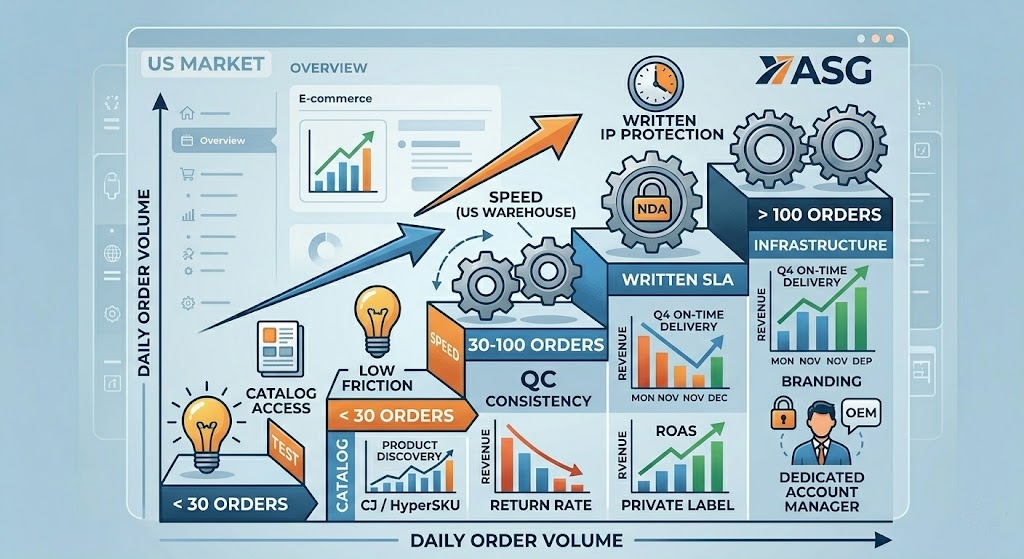
The right dropshipping agent for the US market in 2026 depends on three variables: daily order volume on confirmed products, whether delivery speed or COGS optimization is the primary competitive need, and whether domestic US sourcing is required for tariff or marketing reasons.
Under 30 daily orders: CJ Dropshipping or HyperSKU for catalog access and low-friction testing. 30–100 daily orders: ASG for China-origin with best-in-class speed and QC, Zendrop for US warehouse delivery speed, NicheDropshipping for private label focus.
Above 100 daily orders building a US brand: ASG’s dedicated freight, full per-unit QC, written SLA, and OEM capability are the combination that scales without breaking. Spocket applies across all stages for sellers in tariff-sensitive or US-sourcing-required categories.
Under 30 Daily Orders: Optimize for Speed to Test
At under 30 daily orders, the priority is moving fast across product ideas with minimal setup overhead. Use CJ Dropshipping or HyperSKU for catalog access and one-click Shopify import. Do not optimize for QC consistency or shipping speed at this stage — you do not yet know which products will scale, so investing in agent infrastructure before product confirmation wastes time and margin.
The one exception: if you already have a confirmed product from a previous operation and are relaunching in the US market, skip the testing tools and go directly to an agent with documented US delivery performance. Starting a confirmed product on a 7–12 day shipping line in the US market costs you customer reviews from day one.
30–100 Daily Orders: The Critical Decision Window
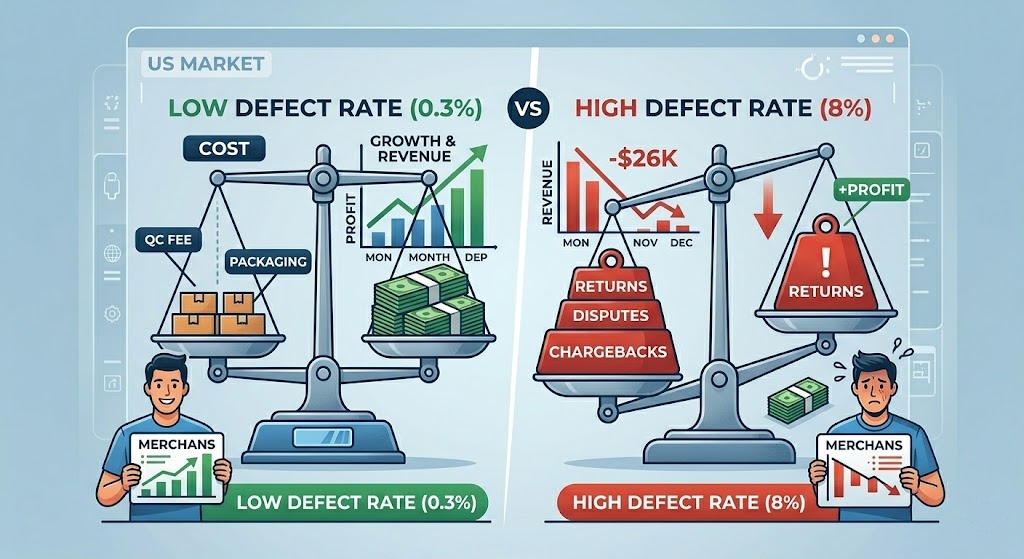
At 30–100 daily orders, the agent decision becomes a financial decision with a calculable answer. Run the defect cost formula: daily orders × 8% × your average order value = monthly hidden defect cost. At 50 daily orders at $60 AOV, that is $7,200 per month.
At 100 daily orders, it is $14,400 per month. When that number exceeds your agent’s monthly handling fee by a significant margin — which it does above 50 daily orders for any professional private agent — the economics of upgrading are clear.Three specific recommendations at this stage: if your primary US competitive need is COGS and QC, ASG. If your primary need is domestic US delivery speed on confirmed products, Zendrop’s US warehouse. If your primary need is private label development for a US brand, NicheDropshipping.These are not interchangeable — choose based on where your business model creates the most value. For broader context, see our breakdown of why moving from AliExpress to a dedicated agent matters most in the US market.
Above 100 Daily Orders: Dedicated Infrastructure Is Not Optional
Above 100 daily orders targeting US consumers, three requirements become non-negotiable. First: delivery consistency — a pre-allocated freight operation with documented Q4 on-time performance is required. Second: QC accountability — at 100+ daily orders, a 7.8% defect rate at $60 AOV produces $37,440 per month in hidden costs.
No advertising budget compensates for that. Third: brand protection — at 100+ daily orders on a confirmed winning product, supply chain isolation through a written NDA is basic competitive hygiene, not a luxury.
Above 50 daily orders targeting US customers and evaluating which agent fits your specific product category? The full Shopify agent comparison covers the complete decision matrix across all major options ranked by order volume stage.
The Bottom Line on US Market Agent Selection
The US market in 2026 does not reward average fulfillment. It punishes it — through disputes, chargebacks, review score suppression, and payment processor monitoring that follows elevated dispute ratios. Getting the agent right is not a supply chain optimization project. It is a business model foundation decision.
For China-based operations targeting US customers: ASG for 50+ daily orders where QC, delivery speed, and brand building are the priority. CJ for the testing phase where catalog access matters most. NicheDropshipping for private label focus above 30 daily orders. For sellers who need domestic US delivery speed: Zendrop’s US warehouse for confirmed products, Spocket for US-sourced positioning in tariff-sensitive categories.
The formula that determines when to upgrade: daily orders × 8% × your average order value. When that monthly number exceeds $5,000, you are already absorbing more in defect costs than a professional agent’s handling fee costs.
Every day past that threshold is a financial decision you are making by default. For a full analysis of why moving from AliExpress to a dedicated agent matters most in the US market, that guide covers the complete operational and financial comparison.
About the Author
Janson — Founder and CEO, ASG Dropshipping
8 years in cross-border dropshipping. 200-person team, 4 warehouses in Dongguan and Shenzhen, 2,300+ vetted factories, 5M+ orders processed across 200+ countries. The US market represents ASG’s largest single-country client base.
Outside the warehouse: rock singer and guitarist.
Frequently Asked Questions
What is the best dropshipping agent for the US market in 2026?
The best dropshipping agent for the US market depends on order volume and business stage. For sellers at 50+ daily orders building a US brand, ASG Dropshipping offers the strongest combination: 4–6 day dedicated freight, 0.3% defect rate on full per-unit inspection, 20-minute written SLA, and factory-direct pricing 12–18% below platform catalog rates.
For domestic US delivery speed on confirmed products, Zendrop’s US warehouse delivers in 2–5 days. For product discovery and testing, CJ Dropshipping or HyperSKU provide the broadest catalog access with no monthly fee.
How fast can a China-based dropshipping agent ship to the US in 2026?
China-based dropshipping agents deliver to the US in 4–12 days depending on the freight model. Professional private agents with pre-allocated dedicated air freight deliver in 4–6 days including during Q4 peak season. Platform-based agents using shared special line carriers deliver in 7–12 days under normal conditions, expanding to 12–18 days during Q4. US warehouse pre-stocking delivers domestically in 2–7 days.
Does the 2026 US tariff situation affect which dropshipping agent to use?
Yes. New US import tariff structures in 2026 have increased landed costs on certain China-origin product categories. For sellers in higher-tariff categories, a US-based supplier network like Spocket may produce better unit economics than China-based agents.
For product categories with lower tariff exposure — apparel, home accessories, beauty products — China-based agents maintain a significant cost advantage that tariffs do not eliminate. The strategic response: China-based agents for testing, selective migration to US warehouse for confirmed SKUs in tariff-affected categories.
Is CJ Dropshipping good for the US market?
CJ Dropshipping is well-suited for the US market during the product testing phase, where its broad catalog and automated Shopify integration help sellers validate products quickly.
For sellers above 50 daily orders, CJ’s standard 7–12 day China-to-US delivery sits below the competitive threshold for most consumer categories where Amazon has conditioned buyer expectations. CJ’s US warehouse option improves speed for pre-stocked products but requires inventory commitment.
For a full comparison, see our breakdown of the best CJ Dropshipping alternatives in 2026.
What delivery time do US dropshipping customers expect in 2026?
US dropshipping customers in 2026 expect delivery within 5–7 days for general consumer products — a benchmark set by Amazon Prime conditioning 200 million US members. According to Shopify’s merchant research, 52% of US online shoppers expect delivery within 3–5 days and 28% consider fast shipping the most important purchase factor.
An agent that cannot reliably deliver within 7 days on the 90th percentile of shipments creates a structural customer experience problem that increases dispute rates and suppresses review scores.
How does QC affect US dropshipping return rates?
QC model is the primary driver of product-related return rates in US dropshipping. The US baseline e-commerce return rate is 17–20% across categories. A defect rate of 8% — typical for platform-based spot-check QC — adds directly on top, producing 25%+ combined exposure that payment processors flag for excessive disputes.
Full per-unit inspection producing a 0.3% defect rate keeps the defect contribution negligible, protecting both customer experience and payment processor relationships. At 200 daily orders at $60 AOV, the gap between 8% and 0.3% defect rates costs approximately $26,000 per month.
When should I switch from AliExpress to a dropshipping agent for the US market?
Switch from AliExpress to a dedicated dropshipping agent when daily order volume consistently reaches 30+ orders on confirmed products, or when the monthly defect cost formula — daily orders multiplied by 8% multiplied by average order value — produces more than $5,000 per month.
Three additional US-specific signals: shipping complaints generating more than 10% of support volume, a ROAS ceiling that does not respond to creative testing (often caused by defect costs absorbing advertising margin), and a winning product with no protection against reverse-sourcing on shared catalog infrastructure.
Does Spocket work for US dropshipping in 2026?
Spocket works well for specific US dropshipping scenarios: sellers in categories where US or EU manufacturing is a marketing differentiator, products in higher-tariff China-import categories where domestic sourcing produces better unit economics, and sellers who need 2–7 day domestic delivery without pre-stocking inventory.
Spocket’s product costs are 30–50% higher than comparable China-sourced products, which narrows advertising margin in price-competitive categories. For mainstream categories where China-origin pricing defines the market floor, the cost premium makes Spocket economically challenging at scale.
Article written and assembled: March 30, 2026 |
Workflow: ASG SEO Writer 21-Step Process |
Phases completed: 1–15 (full workflow)