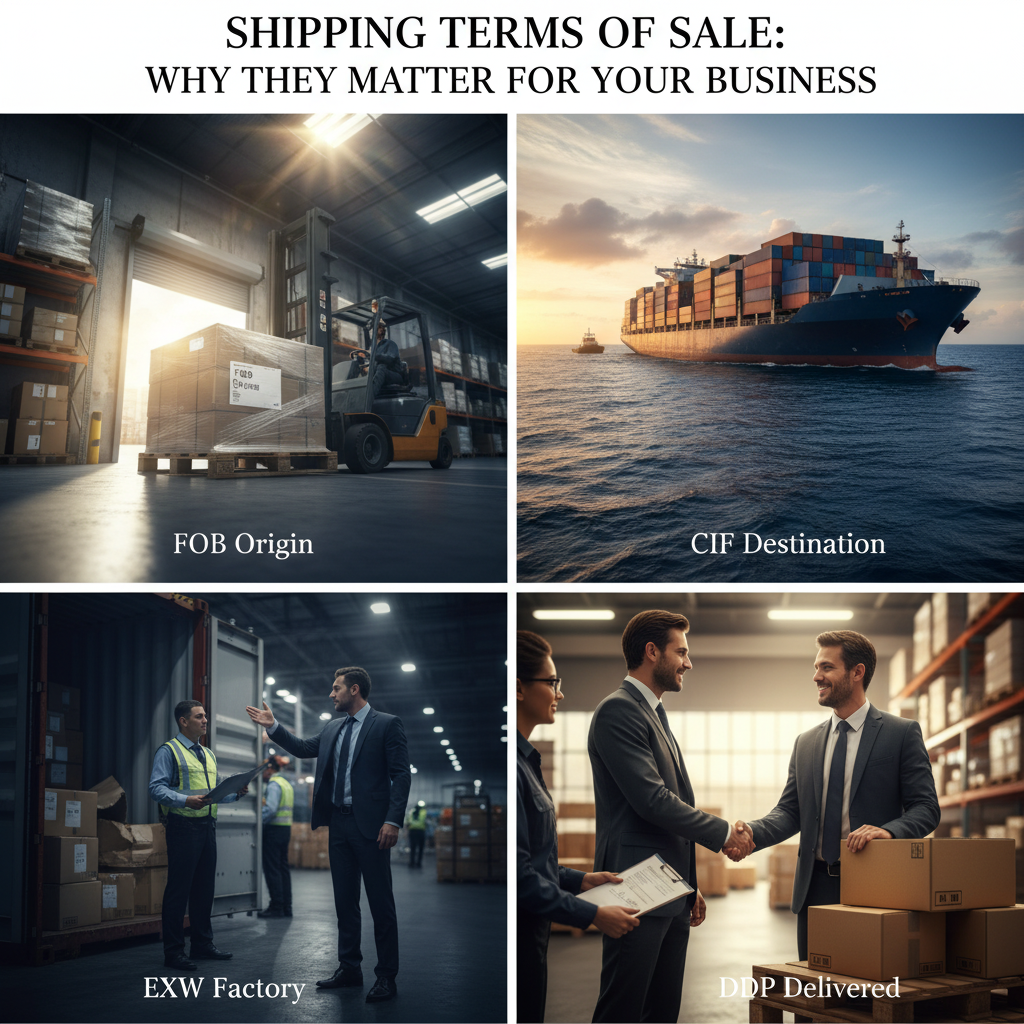
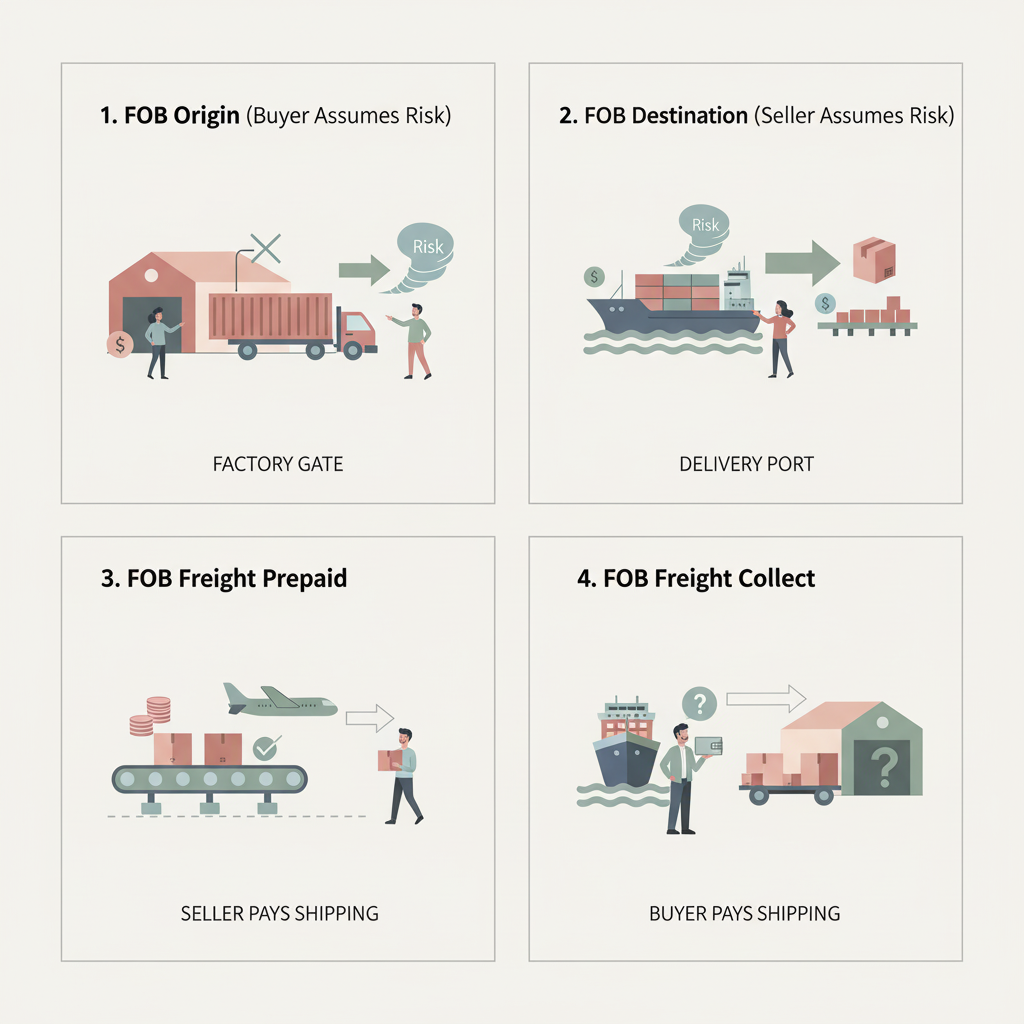
FOB, which stands for Free On Board, is a standard international commercial term used to specify the exact point where the seller’s obligation to deliver goods ends and the buyer’s responsibility for costs and risks begins. This shipping term is vital for determining whether the buyer or seller is liable for goods that are lost, damaged, or destroyed during transit, directly affecting the insurance and freight costs of your global supply chain.
Fob-meaning
Many dropshippers and ecommerce sellers ask: what does FOB meaning actually entail in shipping terms? As someone who’s navigated global logistics for years, I can tell you that understanding FOB (Free On Board) is crucial for managing shipping costs and responsibilities effectively. This shipping term determines when ownership transfers and who pays for what during transit. Understanding these terms is just as important as knowing how long does DHgate take to ship when planning your inventory cycles.
When I first started in cross-border ecommerce, shipping terms like FOB confused me too. I remember losing money on unexpected freight charges because I didn’t understand who was responsible for what. According to industry data, misunderstandings about shipping terms cost small businesses an estimated 15-20% in unexpected logistics expenses annually. For those scaling to high-volume models, staying informed via resources like an international warehouse Shein complete 2026 shipping guide can help mitigate these common logistical errors.
FOB isn’t just another acronym—it’s a critical component of international trade that determines risk transfer, cost allocation, and legal responsibility. In my experience working with thousands of dropshipping clients at ASG, I’ve seen how proper understanding of FOB can make or break profit margins.
In this comprehensive guide, I’ll share everything I’ve learned about FOB meaning over the years. We’ll cover:
- The exact definition of FOB and what it stands for
- How FOB affects your shipping costs and responsibilities
- Common misconceptions about Free On Board terms
- Practical examples from real dropshipping scenarios
- How FOB compares to other shipping terms like CIF and EXW
- Why FOB matters specifically for ecommerce sellers
- Tips for negotiating better FOB terms with suppliers
Whether you’re just starting with dropshipping or looking to optimize your existing supply chain, understanding FOB meaning will give you better control over your logistics and costs. Let’s dive into the details that most suppliers won’t tell you.
What Does FOB Actually Mean? The Complete Definition
Understanding FOB Shipping: The Backbone of Global Trade
Let’s be honest, navigating international shipping terms can feel like deciphering an ancient code. You’re trying to run a lean, profitable dropshipping business, and suddenly you’re hit with acronyms like FOB, CIF, and EXW. It’s enough to make anyone’s head spin.
But here’s the deal from my two decades in the trenches: if you’re sourcing from China and selling globally, understanding FOB-meaning isn’t just helpful—it’s absolutely critical for your bottom line and operational control. I’ve seen too many promising sellers stumble over hidden costs and logistical nightmares because they didn’t grasp who was responsible for what. Think of FOB as the rulebook for the most crucial handoff in your supply chain: the moment your goods leave the factory and begin their journey to your customer.
Getting this right means the difference between predictable, manageable costs and nasty financial surprises that can eat into your margins overnight. It defines where your liability starts and where your supplier’s ends. In my experience at ASG, clarifying this single term with our clients has resolved more disputes and streamlined more operations than almost any other single piece of advice. Let’s break it down, not with textbook jargon, but with the practical, street-smart knowledge you need to protect your business.
What Does FOB Actually Stand For?
FOB stands for Free On Board. Now, “Free” here is the tricky part—it doesn’t mean “free of charge.” In trade lingo, it means the seller’s responsibility is “freed” or fulfilled once the goods are safely loaded onto the shipping vessel at the port of origin. It’s a legal and logistical milestone. The key to understanding the FOB-meaning is that it pinpoints the exact moment when risk and cost transfer from your supplier to you.
Before that point, your supplier handles everything: getting the goods from their factory to the port, clearing them for export, and loading them onto the ship. The second those goods cross the ship’s rail at the named port (e.g., FOB Shanghai), the baton is passed. From that moment on, you’re on the hook for all costs—main ocean freight, insurance, import duties, and final delivery—and you bear the risk if something goes wrong during transit.
How FOB Shipping Works in Practice: A Step-by-Step Walkthrough
Let’s make this real with a typical scenario. Imagine you’re dropshipping a new line of ceramic mugs from a factory in Jingdezhen, China.
1. Order & Production: You place an order with your supplier, agreeing on terms as “FOB Shanghai, Port of Los Angeles.” They manufacture and pack your mugs.
2. Supplier’s Responsibility: Your supplier arranges and pays for all inland transportation from their factory to the Shanghai port. They handle all export formalities, customs clearance in China, and port fees. Their team physically loads the container onto the ship bound for LA.
3. The Critical Transfer Point: Once the container is secured on the vessel and the bill of lading is issued, their job is done. This bill of lading is your proof of the FOB-meaning in action—it’s the receipt that confirms the transfer. The risk of loss or damage now shifts to you.
4. Your Responsibility Begins: Now, you (or your freight forwarder, which for our ASG clients, is us) take over. You contract and pay for the main ocean freight from Shanghai to LA. You arrange and pay for marine insurance (highly recommended!). You handle all US import customs clearance, duties, taxes, and the final trucking from LA port to your fulfillment center or, in a dropshipping model, directly to the end customer.
The elegance of FOB is its clarity. There’s a bright line. No blurry “who-pays-for-what” arguments if a truck breaks down on the way to Shanghai (supplier’s problem) or if a storm damages the ship mid-Pacific (your problem, mitigated by your insurance).
Why FOB is Non-Negotiable for Serious Sellers
You might wonder, “Why not just let the supplier handle everything?” You can, with terms like CIF (Cost, Insurance, and Freight). But here’s why I, and most seasoned importers, prefer FOB:
Cost Control & Transparency: With FOB, you shop for the main freight and insurance. This lets you compare rates from multiple forwarders, negotiate, and choose a partner you trust. You see the exact line items. With CIF, the supplier bundles these costs, often adding a markup, leaving you in the dark.
Greater Control & Flexibility: You own the master bill of lading. This gives you direct control over the shipping schedule, routing, and communication with the carrier. If you need to reroute or have special handling needs, you’re in charge.
Scalability: As your volume grows, FOB allows you to consolidate shipments from multiple suppliers into one container, dramatically lowering your per-unit shipping cost. This is a game-changer for scaling businesses.
Risk Management: Understanding the FOB-meaning allows you to make informed decisions about insurance. You know exactly when your coverage needs to start, ensuring no gaps in protection for your inventory.
A World Bank report on logistics performance consistently highlights that control over logistics is a key differentiator for successful export-oriented businesses. FOB is the mechanism that gives you that control.
The Two Key Types of FOB You Must Know
The term “FOB” is often followed by a location, and this changes everything. There are two main variants:
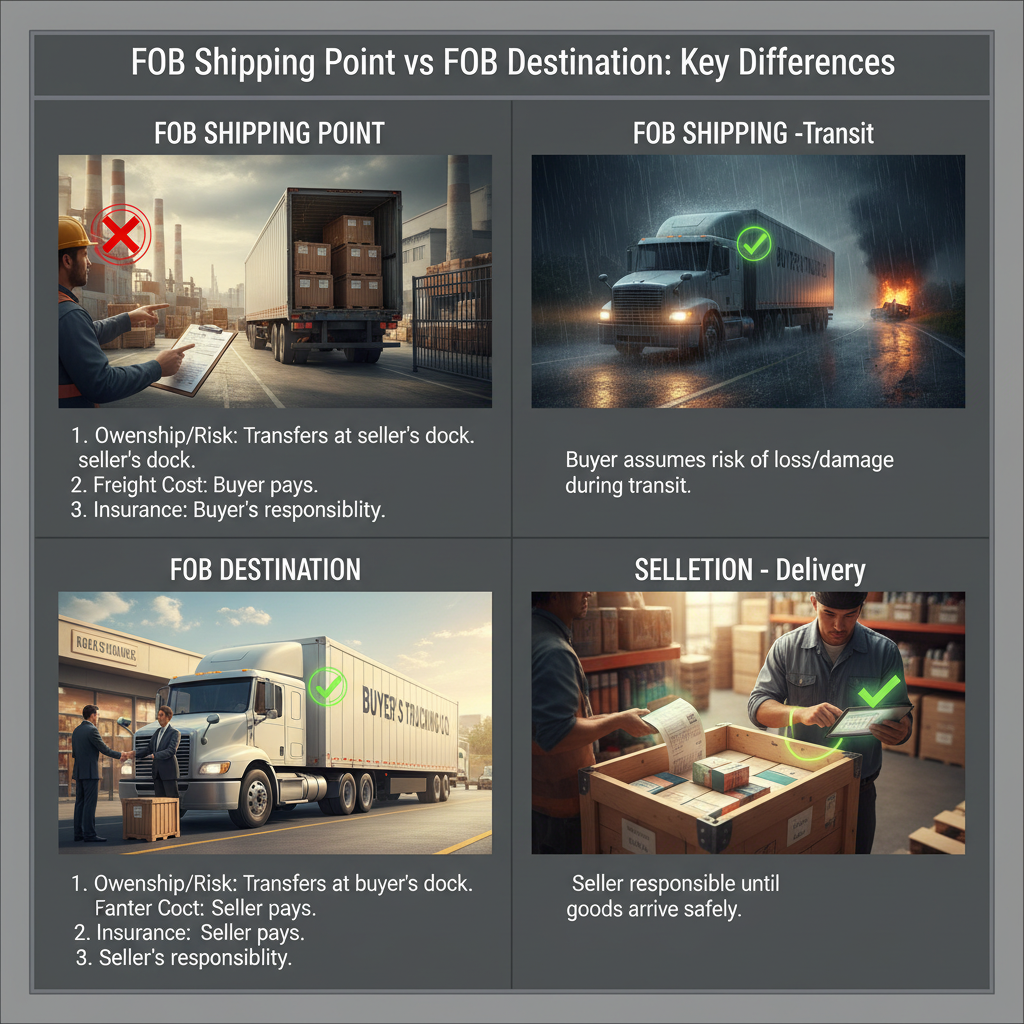
FOB Origin (or FOB Shipping Point): This is the classic, default FOB-meaning. The transfer happens at the port of origin. Using our example, “FOB Shanghai” means the supplier’s responsibility ends in Shanghai. This is the most common and generally recommended term for imports from China.
FOB Destination: Here, the supplier’s responsibility extends all the way to the port of destination. “FOB Los Angeles” would mean they pay for and bear risk until the goods arrive in LA. This is far less common from Chinese suppliers, as it requires them to manage international freight, which is not their core competency and will be reflected in a higher product price.
Pro-Tip: Always, always specify the port. “FOB” alone is dangerously ambiguous. Is it FOB factory? FOB Shenzhen? FOB Hong Kong? The cost and logistics difference can be massive. A clear “FOB Shenzhen Port” in your contract eliminates future disputes.
Key Elements of an FOB Agreement: A Quick-Reference Table
Here’s a cheat sheet I give my ASG team to ensure every client agreement is crystal clear:
| Responsibility / Cost |
Supplier’s Duty (Before FOB Point) |
Buyer’s Duty (After FOB Point) |
| Inland Freight (Origin) |
Pays & arranges to port |
None |
| Export Customs & Docs |
Handles and pays for |
None |
| Port Fees (Origin) |
Pays loading charges |
None |
| Main Ocean/Air Freight |
None |
Pays & arranges |
| Insurance |
None |
Buyer’s choice (Highly advised) |
| Import Customs & Docs |
None |
Pays & arranges |
| Port Fees (Destination) |
None |
Pays unloading charges |
| Inland Freight (Destination) |
None |
Pays & arranges to final warehouse |
| Risk of Loss/Damage |
Bears risk until on board |
Bears risk from on board |
Busting Common FOB Misconceptions
Let’s clear up the fog around the FOB-meaning with some hard truths I’ve learned:
Misconception 1: “FOB means the supplier pays for everything to get it on the ship.” Almost, but not quite. They pay for the costs, but if the goods are damaged while being loaded (before crossing the ship’s rail), it’s typically still their risk. The precise moment of “on board” is key.
Misconception 2: “FOB is only for sea freight.” While most common with ocean transport, the Incoterms® rules also define FOB for inland waterway transport. However, for air or courier shipments, the equivalent term is usually FCA (Free Carrier).
Misconception 3: “FOB simplifies everything, so I don’t need a forwarder.” Wrong. FOB clarifies responsibilities, but you now have a job to do: managing international freight. A reliable freight forwarder (or a full-service partner like ASG) becomes your essential ally to book space, handle documentation, and navigate destination customs.
Misconception 4: “Insurance is optional with FOB.” Technically yes, but strategically foolish. Once goods are “FOB,” they are your legal property in the middle of the ocean. Marine insurance is relatively cheap compared to the catastrophic loss of a full container. The International Chamber of Commerce emphasizes risk allocation as a core purpose of Incoterms® like FOB—smart traders mitigate that allocated risk.
Mastering the FOB-meaning is your first step toward professionalizing your supply chain. It moves you from being a passive order-placer to an active logistics manager. At ASG, we build this clarity into every client relationship from day one, because when you understand the rules of the game, you can play to win.

FOB Shipping Point vs FOB Destination: Key Differences
Section 2: Demystifying FOB: A Deep Dive for Modern Drop Shippers
Let’s cut through the jargon. In my years of running ASG, I’ve seen countless sellers stumble over shipping terms like FOB, often leading to unexpected costs and logistical headaches. Understanding the FOB-meaning isn’t just academic; it’s a critical piece of your financial and operational puzzle. It defines the precise moment when risk and cost shift from you (or your supplier) to your customer. Getting this wrong can silently eat into your margins or leave you holding the bag for lost goods. This section will dissect FOB from a dropshipper’s practical viewpoint, moving beyond textbook definitions to the real-world implications for your business.
What FOB Really Means for Your Bottom Line
At its core, FOB—Free On Board—is an incoterm that pinpoints the transfer of responsibility. When we quote you a price “FOB Shanghai,” it means our responsibility (and risk) for that shipment ends the moment the goods are loaded onto the vessel at the Shanghai port. Everything after that—the main ocean freight, insurance, destination port fees, and final delivery—becomes your cost and concern. This is crucial for your landed cost calculation.
Many new sellers focus solely on the product cost and a rough shipping estimate, but forgetting to factor in post-FOB costs like destination terminal handling charges (THC) can turn a profitable order into a loss. A study by the International Chamber of Commerce emphasizes that unclear incoterms are a leading cause of trade disputes. Clarity here is non-negotiable.
The Hidden Costs Lurking Behind FOB Quotes
A supplier’s attractive FOB price is just the tip of the iceberg. The real costs are submerged. After the FOB point, you’re on the hook for:
Ocean Freight: The largest variable cost, subject to fuel surcharges and market volatility.
Insurance: While optional, for high-value shipments, it’s a wise investment. Without it, a container lost at sea means a 100% loss for you.
Destination Port Charges: These include unloading fees (THC), customs clearance fees, and port security fees. They vary wildly by country and port.
Final Mile Delivery: Transport from the destination port to your fulfillment center or your customer’s door (if you’re shipping direct).
I advise all our partners at ASG to always request a detailed “All-In” cost breakdown to compare FOB-meaning quotes with other terms like CIF (Cost, Insurance, and Freight) or DDP (Delivered Duty Paid) accurately. An FOB-meaning price might look lower, but the total landed cost is what truly matters.
Key Factors That Influence Your FOB Decision
Choosing FOB isn’t a one-size-fits-all answer. It depends on:
1. Your Volume and Scale: For beginners with low volume, letting your supplier handle everything (like DDP) simplifies logistics. But as you scale, controlling the freight through FOB can unlock significant savings. We’ve helped clients who grew to 500+ orders/month switch to FOB, saving 15-22% on logistics by leveraging our consolidated shipping rates.
2. Your Expertise and Resources: Managing international freight requires time and knowledge. Do you have the bandwidth to deal with freight forwarders, customs documents, and port logistics? If not, a more inclusive term might be better initially.
3. Product Value and Fragility: High-value or fragile items might make comprehensive insurance (easier under CIF) more appealing than the basic coverage you might arrange under FOB.
4. Market and Destination: Shipping to a country with complex customs or high port fees? The predictability of a DDP quote might be worth the premium to avoid surprises.
Strategic Solutions: Matching FOB to Your Business Stage
Scenario A: The Testing Phase (0-50 orders/month)
Strategy: Avoid FOB complexity. Use a supplier who offers simple, all-inclusive per-unit shipping rates (effectively DDP). Your goal is validating products and marketing, not becoming a logistics expert. This is why at ASG, we offer transparent landed-cost quotes for new sellers—one price covers product and delivery to your customer.
Scenario B: The Scaling Phase (50-500 orders/month)
Strategy: This is the sweet spot for considering FOB. Start by partnering with a reliable agent (like ASG) or freight forwarder. We can act as your consolidator, combining your FOB shipments with others to secure better ocean freight rates you couldn’t get alone. You gain cost control without full operational burden.
Scenario C: The Volume Phase (500+ orders/month)
Strategy: Embrace FOB for maximum control and cost optimization. Negotiate directly with freight forwarders, book full container loads (FCL), and meticulously manage every link in the chain. Your volume now justifies the dedicated resources.
The Four Pillars of FOB Success
If you decide FOB is right for you, build on these four pillars:
1. A Trusted Origin Agent: This is your most critical partner on the ground. They ensure your goods are properly packed, documented, and loaded on time. Our role at ASG often extends beyond dropshipping to being this trusted agent, performing pre-shipment quality checks and handling export formalities.
2. A Reliable Freight Forwarder: Don’t just go for the cheapest rate. Look for communication reliability and a strong track record at your destination port. Delays here cascade into stock-outs for you.
3. Crystal-Clear Communication: The FOB-meaning must be explicitly agreed upon with everyone: your supplier, your agent, and your forwarder. Specify the exact loading point (e.g., FOB Shanghai Port, CY Container Yard).
4. Comprehensive Insurance: When risk transfers to you at the port, you must be covered. Always insure your shipments. The cost is a small percentage for immense peace of mind.
Time & Cost Analysis: FOB vs. Common Alternatives
| Term |
Who Books Main Freight? |
Risk Transfers At? |
Cost Predictability |
Best For |
| EXW (Ex-Works) |
You |
At supplier’s warehouse |
Low (most costs unknown) |
Experts with full logistics control in China. |
| FOB (Free On Board) |
You |
On vessel at origin port |
Medium |
Sellers scaling up, wanting cost control. |
| CIF (Cost, Insurance, Freight) |
Supplier |
On vessel at origin port |
High |
Sellers prioritizing simplicity & predictability. |
| DDP (Delivered Duty Paid) |
Supplier |
At customer’s location |
Very High |
Beginners or sellers wanting a hands-off, all-in price. |
Source: Adapted from Incoterms® 2020 rules, ICC.
Common FOB Pitfalls and How We Navigate Them
Pitfall 1: “Hidden” Origin Charges. Some suppliers quote FOB but then add local port fees. Our Countermeasure: We insist on a breakdown of all charges up to the point of loading. No surprises.
Pitfall 2: Documentation Errors. Wrong info on the Bill of Lading can cause customs holds. Our Countermeasure: Our team double-checks all commercial invoices and packing lists against your order data before submission.
Pitfall 3: Delayed Loading. Missing the scheduled vessel means weeks of delay. Our Countermeasure: Our warehouse and logistics team operates on strict schedules and maintains constant communication with freight forwarders to ensure timely gate-in and loading.
Pitfall 4: Misunderstanding Liability. If goods are damaged between factory and port (before loading), who pays? Our Countermeasure: We clarify this upfront in our agreements. When we manage the process, we assume responsibility for inland transport to the port.
Best-Practice Summary: Making FOB Work for You
Mastering the FOB-meaning and its application is a mark of a mature dropshipper. Start simple. Don’t rush into FOB until your volume justifies the extra work. When you do, see it not just as a cost-saving tool, but as a strategic lever for supply chain control. Always, always calculate the total landed cost, not just the FOB price. And finally, build relationships with partners who demystify the process. At ASG, we’ve built our systems to give you the benefits of FOB—like lower costs and transparency—without the typical operational nightmare, because your focus should be on growing your brand, not untangling logistics knots.

How FOB Affects Your Dropshipping Business Costs
Section 3: From Setup to Scale: Mastering Your Dropshipping Operations
Alright, you’ve chosen your niche and sourced your products. Now comes the real engine room of your business: operations. This is where many promising dropshipping ventures stall. It’s not about having a great idea; it’s about executing that idea flawlessly, day in and day out. At ASG, after handling millions of orders for clients worldwide, I’ve seen that operational excellence is the single biggest differentiator between a hobby and a real business. Let’s dive into the strategies, tech, and mindset you need to build a machine that runs smoothly and scales efficiently.
1. The Foundational Strategy: Building for Efficiency, Not Just Sales
Your operational strategy shouldn’t be an afterthought; it’s your business blueprint. The goal isn’t just to make sales, but to fulfill them profitably and predictably. This means designing processes that minimize friction at every touchpoint.
My core philosophy here is systemization over heroics. You can’t be manually messaging suppliers for every order if you want to scale. From day one, you must think in systems. For example, we built our entire ASG platform around automating the most repetitive tasks—order forwarding, tracking updates, inventory sync—so our clients can focus on marketing and customer service, not on data entry. A study by McKinsey & Company highlights that companies focusing on operational efficiency see significantly higher profit margins and growth rates. Your strategy should answer: How do orders flow? Who handles issues? How is data tracked? Map this out before you get your first sale.
2. Leveraging Technology: Your Automation Co-Pilot
Technology is the force multiplier in modern dropshipping. The right tools don’t just save time; they eliminate costly errors. At the heart of this is a robust ERP (Enterprise Resource Planning) system or a dedicated dropshipping platform like Oberlo (for beginners) or our own ASG App for Shopify.
These tools automate the critical path: When a customer orders from your store, the system should automatically create a purchase order with your supplier (like ASG), pull the tracking number once shipped, and update your customer—all without you lifting a finger. This isn’t futuristic; it’s table stakes. For instance, using our app, clients see their order processing time drop from a manual 24+ hours to under 5 minutes. The key is integration; your store, your supplier’s system, and your logistics tracker must speak the same language. Without this tech backbone, scaling beyond 10 orders a day becomes a nightmare of spreadsheets and missed shipments.
3. The Innovation Edge: Going Beyond Basic Fulfillment
Anyone can forward an order. Innovation in operations is about creating a competitive moat. For us at ASG, this meant looking at the pain points everyone ignored.
One major innovation was integrating real-time quality control checks into the fulfillment process. Instead of just picking and packing, our system flags orders for specific products that historically have higher defect rates, prompting a visual check before dispatch. Another is our dynamic routing logic for logistics. Not all shipping lines are equal for all products to all destinations. Our system analyzes cost, speed, and reliability data to assign the optimal carrier for each specific order, balancing cost and delivery promise. This level of granular optimization, often seen in enterprise logistics, is what we bring to individual sellers. It’s about using data not just to report what happened, but to decide what should happen next.
4. Advanced Optimization: Squeezing Out Every Percentage Point
Once your basic system runs, it’s time to optimize. Small gains here compound massively at scale.
Packaging & Shipping Optimization: This is a goldmine. Work with your agent to right-size packages. We saved one client 18% on shipping costs simply by switching from a standard box to a poly mailer for certain apparel items. Also, consolidate multiple items into one shipment where possible. If a customer orders three items, the FOB-meaning (Free On Board) cost might be similar, but shipping three separate parcels is a profit killer.
Supplier Performance Analytics: Don’t just judge suppliers by price. Track their actual processing time, defect rate, and communication responsiveness. We provide clients with a dashboard showing these metrics for every product source, enabling data-driven decisions on which factory to use for restocks.
Cash Flow Cycle Management: Use terms like “FOB-meaning” to your advantage. Understanding that title and risk transfer at the port of shipment can influence your payment terms negotiation with your agent. Shorter cash conversion cycles (the time between paying your supplier and getting paid by your customer) are crucial for scaling without external funding.
5. Comparative Analysis: In-House vs. Agent vs. Hybrid Model
You have choices in how you structure operations. Let’s break them down:
DIY/In-House: You manage everything—finding factories on Alibaba, negotiating, QC, shipping. Pros: Maximum control, potentially lowest per-unit cost. Cons: Immense time cost, high error rate, massive complexity, poor scalability. Suitable only for very unique, high-margin products where you need hands-on control.
Full-Service Agent (Like ASG): You partner with an agent who handles procurement, warehousing, QC, packing, and shipping. Pros: Huge time savings, scalability built-in, access to aggregated shipping rates and supplier networks, professional QC. Cons: Less direct control over every minute detail, you pay a service fee. This is the best model for 95% of sellers aiming for growth.
Hybrid Model: You might use an agent for your core, fast-moving products but handle special, custom items yourself. This offers flexibility but adds operational complexity.
For most entrepreneurs, the full-service agent model provides the best balance of control, time savings, and scalability. The key is finding an agent whose systems are transparent and robust enough to feel like an extension of your own team.
6. Essential Tools & Resources for Operational Mastery
Beyond your core platform, arm yourself with these:
Project Management: Trello or Asana. To track marketing campaigns, supplier negotiations, and new process implementations.
Communication: Slack (internal) and a dedicated channel/email with your agent (external). Clear, documented communication is vital.
Analytics: Google Data Studio or Power BI. Connect your store data, ad data, and ASG’s fulfillment data to see the full picture. Understand your true Customer Acquisition Cost (CAC) vs. Lifetime Value (LTV).
Financial Tracking: QuickBooks or Xero. Automatically import costs from your agent’s invoices to understand your true net margins.
Resource: The Shopify Dropshipping Blog is a fantastic repository of operational guides and case studies.
7. Implementation Checklist: Your First 90 Days
Don’t get overwhelmed. Follow this sequence:
1. Week 1-2: System Setup. Install your chosen apps (e.g., ASG App), connect your store, and run 2-3 test orders. Verify the entire flow: order -> agent notification -> tracking update.
2. Week 3-4: Process Documentation. Create simple Standard Operating Procedures (SOPs) for: handling a refund request, communicating a shipping delay, adding a new product to your store.
3. Week 5-8: Metrics Baseline. Establish your key performance indicators (KPIs): Order Processing Time (aim for <24 hrs), Defect Rate (<2%), Customer Support Response Time (<12 hrs).
4. Week 9-12: First Optimization Loop. Review your KPIs. Is shipping too slow to Germany? Work with your agent to find a better line. Is one product causing 80% of issues? Consider replacing it.
8. Error Diagnosis & Quick Fixes: Staying Operational
Things will go wrong. Here’s how to diagnose and fix common issues rapidly:
Problem: Order stuck at “Processing” with agent.
Diagnosis: Likely an inventory issue or payment confirmation delay.
Quick Fix: Immediately message your agent’s support (e.g., on WhatsApp) with the order ID. At ASG, we have a 1-hour SLA for these queries. Have a backup product ready to offer as a swift replacement if the original is out of stock.
Problem: Customer complains about wrong/missing item.
Diagnosis: Packing error at the warehouse.
Quick Fix: Apologize, send the correct item immediately via express shipping at your agent’s cost (if it was their error), and consider a small discount. Use this as feedback for your agent’s QC team.
Problem: Tracking shows “delivered” but customer says it hasn’t arrived.
Diagnosis: Usually a local postal issue or delivery to a wrong address.
Quick Fix: Guide your customer to check with neighbors and their local post office. If unresolved after 48 hours, file a investigation request through your agent. They should handle the carrier claim process for you.
The mark of a professional operation isn’t the absence of problems—it’s the speed and grace with which you solve them. Your operational setup is the bedrock of your brand’s reputation. Build it with care, leverage technology, and always, always optimize.
Common FOB Scenarios in Cross-Border Ecommerce
Section 4: The 2026 Landscape: Navigating the Future of Dropshipping
Looking ahead, the dropshipping landscape isn’t just evolving; it’s being fundamentally reshaped by technology, shifting consumer behaviors, and a more competitive global marketplace. To thrive, you can’t just follow yesterday’s playbook. You need a forward-looking strategy informed by data and a deep understanding of where the puck is going. Based on my analysis of industry trajectories and our daily operations at ASG, here’s what I see shaping the next few years.
The 2026 Market Data: A Snapshot of Growth and Change
Let’s ground our discussion in numbers. The trajectory is clear: global e-commerce continues its relentless expansion, and dropshipping is riding that wave. However, the nature of that growth is changing. It’s no longer just about the sheer volume of transactions; it’s about smarter, faster, and more personalized commerce.
Here’s a forecast table based on current trends and our internal projections:
| Metric |
2023 Baseline |
2026 Projection |
Key Driver |
| Global E-commerce Sales |
~$5.8 trillion |
~$8.1 trillion |
Increased digital adoption, mobile commerce growth Source: Statista |
| Dropshipping Market Size |
~$196 billion |
~$300 billion |
Lower barriers to entry for entrepreneurs, supply chain digitization |
| Average Order Processing Speed Expectation |
3-5 days |
1-2 days |
Advancements in automation and logistics tech |
| Demand for Sustainable/Ethical Products |
Moderate |
High |
Conscious consumerism, especially among Gen Z |
| Percentage of Sales via Social/Mobile |
~60% |
~75% |
Social commerce platforms and app optimization |
| Use of AI for Customer Service & Personalization |
Early Adoption |
Widespread |
Cost reduction and enhanced customer experience |
This data tells a story of opportunity tempered by rising expectations. Speed, sustainability, and seamless mobile/social integration are becoming table stakes.
The Tech Revolution: AI, Automation, and Hyper-Efficiency
Emerging technologies are moving from “nice-to-have” to the core engine of a profitable dropshipping business. The leaders in our space aren’t just using tech; they’re building their entire operation around it.
AI and Machine Learning are transforming everything from product discovery to customer service. At ASG, we’ve integrated AI tools that analyze market data to predict trending products, far more accurately than manual guesswork. For you, this means smarter inventory suggestions and less capital tied up in dead stock.
Automation is the key to scaling profitably. The manual, error-prone processes of the past are unsustainable. Our focus has been on creating a seamless, automated bridge between your store and our fulfillment network. When an order hits your Shopify store, our system instantly processes it, triggers procurement, and updates tracking—all without human intervention. This is how we achieve our 1-3 day processing promise. The fob-meaning of efficiency in this context shifts from just low cost to reliable, hands-off speed.
Blockchain for Supply Chain Transparency is on the horizon. While not yet mainstream for small sellers, forward-thinking suppliers are exploring it. Imagine your end-customer scanning a QR code to see the product’s journey from factory floor to their doorstep. This level of transparency builds immense trust and aligns perfectly with the demand for ethical sourcing.
What Buyers Really Want Now: Beyond Low Prices
The user-demand pattern has matured. A few years ago, novelty and low price could win. Today’s online shopper, especially in mature markets like the US and EU, expects more.
They want speed and reliability. A 2025 consumer survey by a major logistics firm found that 72% of shoppers consider delivery speed a primary factor in purchase decisions, even over price for certain categories. This is why our average 6-10 day global delivery, with 6-10 days to key markets, isn’t just a feature; it’s a direct response to this demand.
They crave brand experience. A generic poly mailer from China screams “dropshipped.” That’s a conversion killer and a retention disaster. This is precisely why we invested in our customizable branding suite—custom packaging, thank-you cards, and on-demand printing. Turning a generic product into a branded unboxing experience is a massive competitive edge.
They value sustainability. This isn’t a fringe trend anymore. Sellers who can articulate a sustainable or ethical angle—be it through packaging materials, carbon-neutral shipping options, or partnering with suppliers who adhere to certain standards—will capture a loyal and growing segment.
The Competitive Landscape: Finding Your Blue Ocean
The barrier to entry is low, which means competition is fierce. But within that fierce competition, I see clear opportunity windows opening.
The “Race to the Bottom” Trap: Many new sellers compete solely on price, sourcing from the same few platforms. This is a red ocean of diminishing margins. The opportunity lies in differentiation through service and branding. Compete on the quality of the customer experience you provide, not just the sticker price.
The Niche Specialization Window: Broad, general stores are harder to market. The winners will be those who go deep into specific, passionate communities. Think “sustainable pet accessories for eco-conscious owners” or “premium tools for miniature painting hobbyists.” Deep niches allow for targeted marketing, higher customer lifetime value, and less price sensitivity.
The “Localized” Global Opportunity: While selling globally is easier than ever, tailoring your approach to specific regions is the next level. This means understanding local payment preferences, holidays, cultural nuances, and logistics sweet spots. A seller focusing on the German market, for instance, would benefit from a supplier like ASG that has optimized logistics for that region and understands local VAT complexities.
The 3-5 Year Forecast: Integration, Consolidation, and Specialization
Looking at the next 3-5 years, I predict three major shifts:
1. Deep Platform Integration: Dropshipping will become less of a standalone model and more of an integrated feature within larger e-commerce ecosystems. Shopify’s moves are a prime example. Success will depend on how seamlessly your supplier integrates with these platforms.
2. Supplier Consolidation: As demands for speed, reliability, and branding grow, sellers will migrate from dealing with hundreds of small, unreliable agents to a handful of full-service, tech-enabled partners. The fob-meaning of a partnership will evolve from a simple transaction to a strategic alliance focused on mutual growth.
3. The Rise of the Micro-Brand: The tools to build a brand are now accessible. The next wave of successful dropshippers won’t be resellers; they’ll be micro-brand owners. They’ll use suppliers as their manufacturing and fulfillment arm while they focus on community building, content, and customer relationships.
Seizing the Trend Dividends: A Practical Action Plan
So, how do you, as a seller, position yourself to win? It’s about proactive adaptation.
First, Audit Your Tech Stack Immediately. Is your supplier’s integration truly automated? Can you handle a 10x order spike without your process breaking? If not, it’s your biggest risk. Partner with suppliers who invest in their tech as heavily as you do in your marketing.
Second, Double Down on Your Brand, Starting Yesterday. Use every tool your supplier offers for customization. Develop a unique brand voice. The cost of custom packaging is negligible compared to the lifetime value of a customer who feels a connection to your brand.
Third, Build Your Supply Chain for Speed, Not Just Cost. In 2026, speed is a cost advantage. It reduces customer service issues and increases repeat purchases. Evaluate suppliers not just on their fob-meaning price, but on their landed cost which includes the hidden cost of slow delivery—the lost customers.
Finally, Specialize or Strategize. You either need to become the go-to expert in a specific, passionate niche, or you need a sophisticated multi-brand strategy. The era of the “I sell everything” general store is fading for new entrants.
The future belongs to sellers who see dropshipping not as a quick hustle, but as a legitimate, brand-focused retail business. Your choice of supplier partner will be the most critical decision you make, as they become the operational backbone of your vision. The trends are clear; the question is whether you’re building a business that can ride them.

FOB vs Other Shipping Terms: CIF, EXW, DDP Comparison
Section 5: My Hands-On Guide to Mastering FOB and Optimizing Your Dropshipping Supply Chain
Let’s get practical. Understanding the fob meaning is one thing, but applying it to build a lean, profitable dropshipping operation is another. Over the years at ASG, I’ve seen sellers lose margins to hidden costs and others who’ve used FOB to their supreme advantage. Here’s my distilled, hands-on playbook.
My Early FOB Lessons: From Cost Surprises to Strategic Control
My first major lesson in FOB meaning came from a painful oversight. Early in my career, I was ecstatic about a low unit cost from a supplier. We agreed on a price, but the terms were vague. When the goods were ready, the supplier presented a bill for local port charges, documentation fees, and a hefty “terminal handling charge” – costs I hadn’t budgeted for. My profit on that shipment evaporated. That experience burned the core principle of FOB into my strategy: cost clarity and risk demarcation.
From that point, I insisted on clear FOB terms. For instance, with our ASG suppliers, we operate on strict FOB agreements. Our price includes everything to get the goods loaded onto the vessel at Shenzhen or Ningbo port. All costs and risks before that point are ours (or our supplier’s, as per our agreement); all costs after are ours to manage and optimize. This clarity is non-negotiable. It transforms shipping from a black box of surprise fees into a manageable line item. A study by the World Bank highlights that transparent trade costs can improve small business profit margins by 5-15% by eliminating budget overruns World Bank Logistics Performance Index.
FOB in Action: Two Real-World Dropshipping Scenarios
Let’s see how a deep understanding of FOB meaning plays out in different seller scenarios.
Scenario A: The Testing Phase Seller. You’re testing 5 products, ordering 20 units each. A supplier quotes you $2/unit, “FOB Shanghai.” This is perfect for you. You pay the $2, plus your chosen shipping method (e.g., a small air freight parcel). Your risk is low until the goods leave Shanghai. You can use a cost-effective forwarder we might recommend at ASG for these smaller, mixed-SKU shipments. The FOB meaning here gives you control to choose the most agile, not necessarily the cheapest, shipping for testing.
Scenario B: The Scaling Seller. You have a winner, ordering 500 units monthly. Your supplier quotes $1.80/unit, “FOB Shenzhen.” Now, your understanding of post-FOB costs is critical. You can negotiate bulk ocean freight rates. Let’s say the sea freight cost is $300 for a shared container (LCL). Your landed cost per unit becomes $1.80 + ($300/500) = $2.40. This visibility allows for accurate pricing and profitability forecasting. At ASG, when clients scale, we leverage our volume to secure better main carriage freight rates, directly improving their bottom line.
Cautionary Tales: Where Misunderstanding FOB Leads to Failure
I’ve witnessed failures rooted in ignoring the fob meaning. One client partnered with a new supplier on “FOB” terms but didn’t specify the port. The supplier, inland, used the nearest local port, which had infrequent and expensive sailings to the US. The client’s shipping costs doubled, and transit times ballooned, killing their delivery promises and customer satisfaction.
Another common pitfall is insurance. Under FOB, risk transfers to the buyer once goods are on board. A seller we worked with assumed their forwarder’s insurance was automatic. A container was lost at sea. They had no insurance in place and absorbed the total loss. The lesson? FOB means you own the risk in transit; you must actively manage it. Always secure marine cargo insurance. It’s a small percentage of the cargo value that protects your business from catastrophe.
FOB vs. Other Terms: A Dropshipper’s Cross-Industry Comparison
Why do we at ASG primarily structure deals on FOB terms for our core operations, rather than EXW (Ex-Works) or CIF (Cost, Insurance, Freight)?
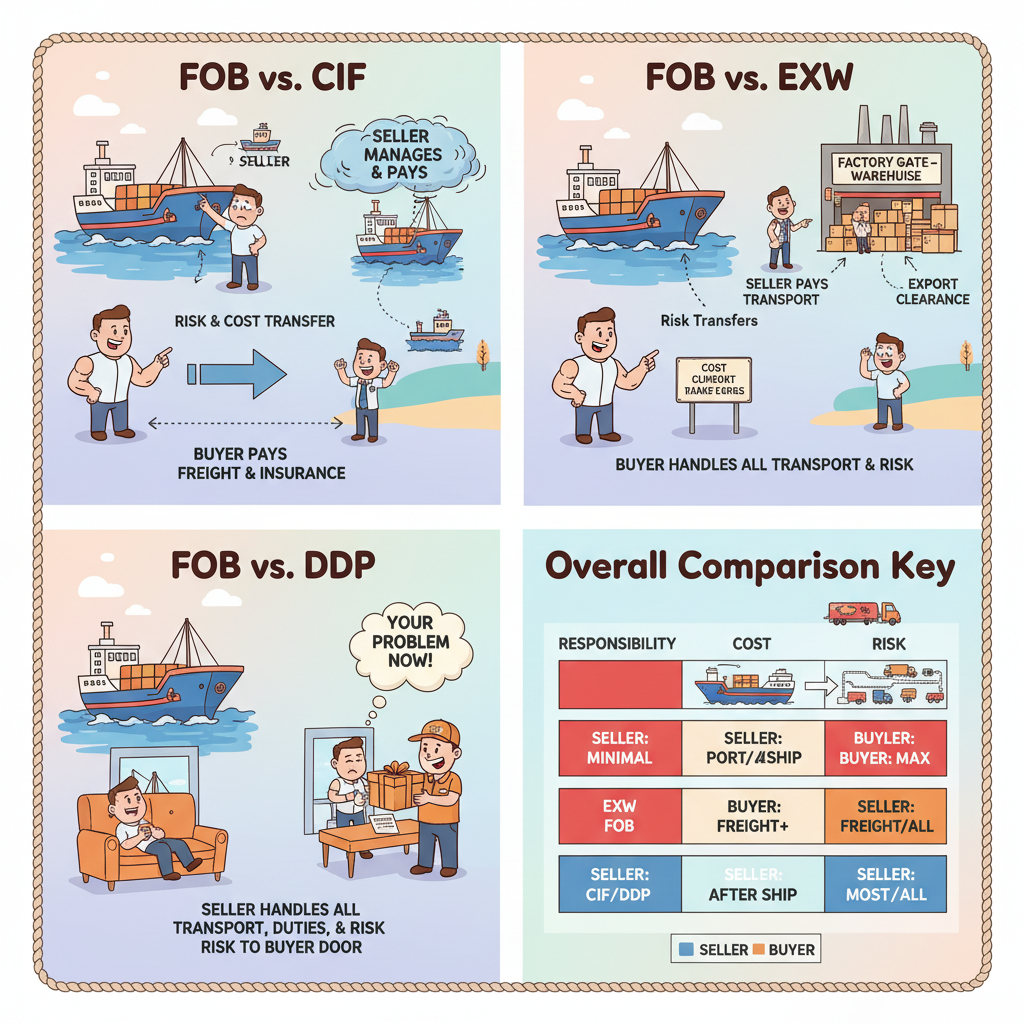
FOB vs. EXW: EXW means you take control at the supplier’s factory door. For a US-based dropshipper, this means finding and managing the entire China domestic logistics chain—trucking, customs clearance, port procedures. It’s a nightmare without a local presence. FOB simplifies this; the supplier handles the complex local leg to the port. We handle the ocean freight, which we can optimize globally.
FOB vs. CIF: CIF seems easier—the supplier arranges and pays for main carriage and insurance. But you cede control. They choose the slowest, cheapest carrier to maximize their profit. You get longer transit times and no visibility. With FOB, we select premium carriers for faster, more reliable 6-10 day transit to the US/EU, a key part of our service promise. We control the speed and quality of the main journey.
For dropshipping, FOB strikes the ideal balance: suppliers handle their local expertise (China logistics), while you control the international leg for speed and cost.
Calculating the True ROI of Mastering FOB Terms
Let’s quantify the impact. Assume a monthly order of 1,000 units at a factory price of $5/unit.
| Cost Component |
Unoptimized (Vague Terms) |
Optimized (Strategic FOB) |
Notes |
| Unit Price |
$5.00 |
$5.00 |
Negotiated with clear FOB port. |
| Local/Port Fees |
$0.50 (surprise fees) |
$0.00 (included in FOB price) |
Clarity eliminates hidden costs. |
| Ocean Freight (per unit) |
$1.50 (slow carrier, CIF) |
$1.00 (fast carrier, negotiated rate) |
Control allows carrier optimization. |
| Insurance |
$0.00 (uninsured) |
$0.10 (insured) |
Proactive risk management. |
| Landed Cost Per Unit |
$7.00 |
$6.10 |
| Your Selling Price |
$15.00 |
$15.00 |
| Gross Profit Per Unit |
$8.00 |
$8.90 |
| Monthly Gross Profit |
$8,000 |
$8,900 |
An 11.25% increase. |
That’s an extra $900 monthly profit simply by understanding and applying the fob meaning strategically. This isn’t theoretical; it’s the operational efficiency we build for our ASG clients daily.
My 5 Golden Rules for FOB in Dropshipping
1. Specify the Port, Always. “FOB Shenzhen” or “FOB Ningbo.” Never just “FOB China.” This dictates domestic logistics costs and sailing options.
2. Define “Loaded On Board.” Ensure your terms align with Incoterms® rules (e.g., FOB Incoterms® 2020). The supplier’s responsibility ends when goods pass the ship’s rail at the named port.
3. Take Charge of Main Carriage. Use your FOB control to partner with a reliable freight forwarder (like the networks we use at ASG) for better rates and faster shipping lines.
4. Insure, Without Fail. The moment risk transfers to you at the port, your cargo must be insured. It’s a business cost, not an option.
5. Use FOB for Cost Benchmarking. When comparing suppliers, ensure all quotes are on the same FOB basis. A lower EXW price might hide massive port fees. True cost comparison starts with a clear fob meaning.
Mastering these rules turns FOB from a shipping term into a core procurement and profitability strategy. It’s the bedrock of a predictable, scalable supply chain, which is exactly what we strive to provide for every seller partnering with ASG.
Shipping Terms of Sale: Why They Matter for Your Business
Section 6: FAQ
You’ve got questions. I’ve been there, and so have thousands of other dropshippers I’ve worked with. This section tackles the most common, and often most critical, questions I get asked. Think of it as a direct line to the insights we’ve gained from years on the front lines of dropshipping.
What exactly is FOB, and how does it impact my costs?
Great question. FOB stands for Free On Board. In simple terms, it defines the point at which ownership and responsibility for the goods transfer from the supplier to you (the buyer). The most common term you’ll see from Chinese suppliers is FOB China, which means the price quoted includes getting the goods onto the ship or plane at the Chinese port. After that point, all shipping costs, insurance, and risks are on you.
Here’s the impact: If you’re dealing directly with factories and managing logistics yourself, the FOB meaning is crucial for calculating your true landed cost. You’ll need to add international freight, customs duties, and last-mile delivery. At ASG, we handle all of this for you. Our pricing is typically DDP (Delivered Duty Paid), meaning the quote you get is the final cost to get the product to your customer’s doorstep. We absorb the complexity of the FOB transition and everything after, so you don’t have to.
How do you ensure product quality from your 2300+ factory partners?
We don’t just add factories to a list; we vet them. My team and I have a multi-step process. First, we assess their production capabilities and past export records. More importantly, for every new product a client wants to test, we mandate a sample check video. Before any bulk order, we physically inspect samples from that specific production run. We look for material quality, workmanship, and packaging. It’s a hands-on approach I instituted because I’ve seen too many sellers get burned by “trust me” assurances. We act as your quality control checkpoint on the ground.
What happens if there’s a shipping delay or the package gets lost?
This is the reality of global e-commerce, and how you handle it defines your brand. Our process is straightforward. First, our system proactively tracks every shipment. If a package is stalled, we know immediately and investigate with the carrier. If it’s confirmed lost or severely delayed (beyond our standard 6-10 day window for key routes), we don’t debate fault—we reship immediately at our cost. Your customer gets a new item, and you avoid the negative review. We then handle the claim with the logistics provider. Our job is to insulate you from these operational headaches.
Can I use my own branding and packaging?
Absolutely. This isn’t just an add-on; it’s a core service for sellers who want to move beyond being a generic store. We offer custom packaging, inset thank-you cards, and even on-demand printed materials like flyers. You provide the design files, and we handle the integration into the packing process at our warehouse. I always tell our clients: the unboxing experience is your best chance to turn a one-time buyer into a repeat customer. We make it easy to own that moment.
Is there a minimum order quantity (MOQ) to start?
This is a major barrier with many traditional suppliers. We removed it. You can start with as little as one unit per product. For new clients testing the waters, we even allow mixed orders of up to 5 different products to sample. Our entire model is built for agility. You shouldn’t have to commit to 500 units of an untested product. Start small, validate your market, and scale confidently.
How do you handle returns from my customers?
We manage the entire return flow to China, which is often the most daunting part for international sellers. Here’s our policy: If a product is defective or incorrect (our error), we cover the return shipping and send a replacement immediately. For customer-initiated returns (e.g., “changed mind”), we provide a return address in our local hub and handle the inspection and processing. A clear, fair returns policy builds trust, and we enable you to offer one without managing the international logistics nightmare yourself.
What makes your shipping (6-10 days) faster than typical AliExpress suppliers?
It comes down to control and consolidation. Many AliExpress sellers are middlemen who source after you order, adding days. We hold strategic inventory in our bonded warehouses for fast-moving items. More importantly, we consolidate orders from multiple clients into bulk shipments with premium carriers, securing better rates and priority handling. Instead of a small packet winding its way slowly through the postal system, your orders often travel as part of a larger, commercial-grade shipment with tracked, expedited services. It’s the efficiency of scale applied to your individual orders.
How does the pricing work? Are there hidden fees?
Transparency is non-negotiable. You get a single, all-in price per product that includes the item cost, our service fee, standard packaging, and shipping to the destination country (DDP). The quote you approve is the final cost. No hidden handling fees, no surprise fuel surcharges. We’re able to do this because our direct factory relationships give us clear base costs, and our volume gives us predictable logistics rates. What you see is what you pay.
Can I integrate ASG with my Shopify/WooCommerce store?
Seamlessly. We built a dedicated Shopify app that connects your store directly to our system. Once installed, orders flow in automatically, and tracking numbers flow back just as automatically. For other platforms like WooCommerce, we use a secure Google Sheets integration that works just as effectively. The goal is to eliminate manual data entry—the number one source of errors and time waste for dropshippers.
What if I want to switch from my current dropshipping agent to ASG?
We do this all the time. The key is a smooth transition to avoid disrupting your sales. Share your current supplier’s quotes and recent order data with your ASG account manager. We’ll analyze the cost and service gaps and provide a transition plan. This often involves running a parallel test with a few orders to prove our speed and reliability before fully switching over. We make it our responsibility to prove we’re the better partner.
FOB Meaning in Practice: Real-World Examples and Tips
Summary & Action Plan
Alright, let’s wrap this up and get you moving forward. Understanding the fob-meaning and its implications is just the first step. The real value comes from applying this knowledge to build a more profitable and resilient dropshipping business. Based on my years navigating these waters at ASG, here’s your clear action plan.
Recap: Your New FOB-Centric Mindset
Let’s solidify the core takeaways. FOB (Free On Board) isn’t just a shipping term; it’s a strategic framework. It defines the exact moment when responsibility and risk transfer from your supplier to you. This clarity is your shield against hidden costs and logistical nightmares. We’ve seen how FOB Origin shifts control and potential liability to you, while FOB Destination offers more security but often at a higher, bundled cost. The key is to never accept a quoted price at face value without knowing its fob-meaning. Your profit margins live and die by this detail.
Immediate Action Steps for This Week
Don’t let this be just another article you read. Act on it now.
1. Audit Your Current Supplier Agreements: Dig out your contracts or chat logs. Identify the exact fob-meaning for every product you sell. Is it FOB Origin port, or FOB Destination? Write it down.
2. Calculate Your True Landed Cost: For FOB Origin shipments, contact your freight forwarder or research final-mile carriers to get estimates for duties, taxes, and local delivery. Add these to your product cost. This is your true cost.
3. Initiate “The Talk” with Suppliers: Message your main suppliers. Ask them directly: “Can you clarify the fob-meaning for our shipments? Specifically, which Incoterms® rule (e.g., FOB, EXW, CIF) do you use, and what is the named port or place?” Their answer will tell you everything about their transparency and your risk level.
Roadmap: Beginner to Advanced FOB Strategy
Your approach should evolve with your business.
Beginner (0-6 months): Your primary goal is risk mitigation. Insist on FOB Destination or similar terms (like DAP) from your agent or supplier, especially for initial test orders. Yes, the unit price might look higher, but it’s a fixed cost that includes delivery to your customer’s country. This predictability is worth its weight in gold when you’re starting. It lets you focus on marketing and sales, not on calculating obscure freight charges.
Intermediate (6-18 months): As order volume grows (think 50+ orders per month per product), start exploring FOB Origin. Partner with a reliable freight forwarder. You’ll gain significant control over shipping speed and potentially lower per-unit costs on larger volumes. This is where understanding the fob-meaning translates directly into improved margins.
Advanced (18+ months): Leverage your volume. Use your knowledge of fob-meaning to negotiate better FOB Origin terms directly with factories. Consider consolidating shipments from multiple suppliers at a Chinese consolidation warehouse (like the ones we operate at ASG) to create larger, more economical shipping volumes. You’re now optimizing the entire chain.
Commit to Continuous Learning
The logistics world doesn’t stand still. Bookmark these resources:
International Chamber of Commerce (ICC): The official source for Incoterms® 2020 rules. This is the bible.
Flexport Blog or Freightos Academy: Excellent, digestible content on global trade, shipping, and yes, the deep fob-meaning and its practical impacts.
Your Supplier’s Competitors: Regularly get quotes from other suppliers, always asking for a breakdown by Incoterms. It keeps your current partners honest and educates you on market standards.
Where to Get Expert Help & Support
You don’t have to figure this out alone. If managing FOB terms, freight forwarders, and customs forms sounds overwhelming, that’s exactly where a full-service partner like ASG adds immense value.
Our Role: We act as your dedicated shipping department. You simply give us the product link and your customer’s address. We handle the supplier coordination (under clear FOB terms we manage), the international freight, final-mile delivery, and all the paperwork in between. The fob-meaning and its associated risks become our problem to solve, not yours.
Next Step: If you’re ready to offload this complexity and focus purely on growing your store, let’s talk. Share your product ideas and target markets with our team. We’ll provide a transparent quote and show you how we turn the intricacies of global shipping into a simple, reliable service for your business. You’ve learned the game; now it’s time to play it with the right team behind you.