If you’ve been shipping small parcels from China to the US over the last few years, you likely enjoyed the ‘golden era’ of duty-free entry. That era officially ended in early 2025. I’ve talked to dozens of sellers this month who woke up to find their $15 gadgets suddenly slapped with a 25% to 100% tax at the border. It’s a massive shift that has turned the traditional low-ticket dropshipping model on its head.
Simply put, a dropshipping tariff is a tax imposed by a government on goods imported by your customers or your fulfillment center from a foreign country. While these taxes always existed, 2025 brought the hammer down on the ‘de minimis’ loophole—the rule that previously allowed shipments under $800 to enter the US tax-free. Now, almost every single package is a target for the taxman, and if you don’t understand the math, your profit margins will vanish before the first sale even clears.
Key takeaways
- The $800 de minimis exemption has been effectively eliminated for most Chinese imports in 2025.
- Tariffs are calculated on the product cost (Customs Value), not the retail price or shipping cost.
- Section 301 tariffs on Chinese goods can now reach as high as 145% for specific categories.
- Failing to use correct HS codes can lead to shipment seizures and heavy fines.
- Switching to DDP (Delivered Duty Paid) is now essential for maintaining customer trust.
Understanding Dropshipping Tariffs: Core Concepts
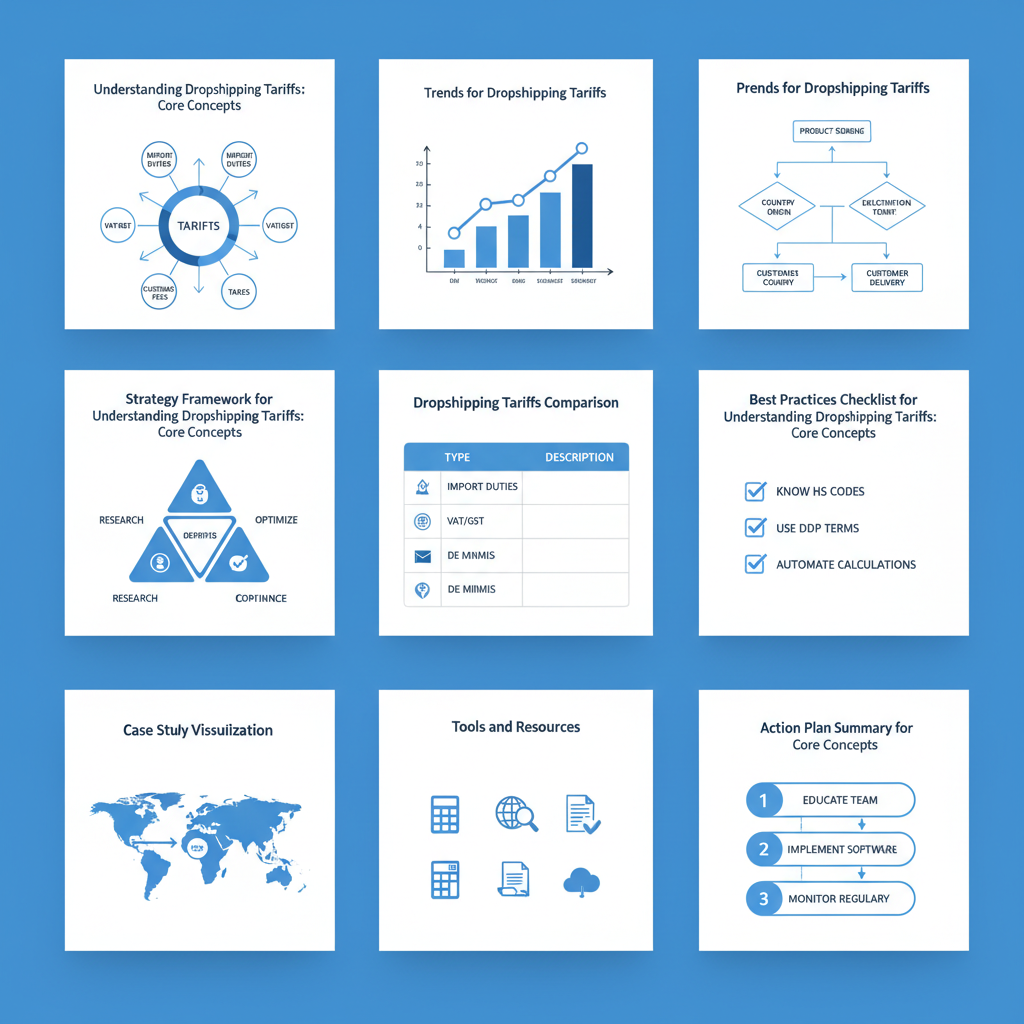 Understanding Dropshipping Tariffs: Core Concepts – Visual Guide
At its core, a tariff is a protectionist tax. Governments use them to make foreign goods more expensive, theoretically encouraging consumers to buy local. In the world of e-commerce, these are often called import duties. For years, dropshippers relied on Section 321 of the US Tariff Act, which allowed low-value shipments to bypass these costs. However, as dodropshipping.com points out, massive new taxes of up to 145% have been applied to Chinese goods as of April 2025.
To calculate these costs, you must understand the ‘Customs Value.’ This is usually the price you paid the supplier, not what the customer paid you. If you buy a watch for $10 and sell it for $50, the tariff is applied to that $10. However, the complexity arises with ‘Harmonized System’ (HS) codes. Every product has a 6-to-10 digit code that determines its tax rate. A plastic toy might have a 0% rate, while a lithium-ion battery could be taxed at 25% or more. doola.com emphasizes that a single digit error in this code can trigger a customs audit.
| Tariff Component |
Description |
2024 Status |
2025 Status |
| De Minimis Threshold |
Tax-free limit for imports |
$800 |
Effectively $0 for many categories |
| Section 301 Duties |
Extra tax on Chinese goods |
7.5% – 25% |
Up to 145% on specific items |
| Entry Fee |
Processing fee per parcel |
Often $0 |
Proposed $25 minimum fee |
| HS Code Requirement |
Product classification |
Recommended |
Mandatory for all entries |
| Compliance Risk |
Likelihood of seizure |
Low |
Extremely High |
Selecting the wrong HS code is the fastest way to lose your business. I recently saw a seller try to classify smart home sensors as ‘general electronics’ to save 10% on duties. Customs flagged the shipment, held it for three weeks, and eventually fined the seller three times the value of the goods. Honesty in documentation is no longer optional; it is a survival requirement.
Why Tariffs Matter: The 2025 Data Shift
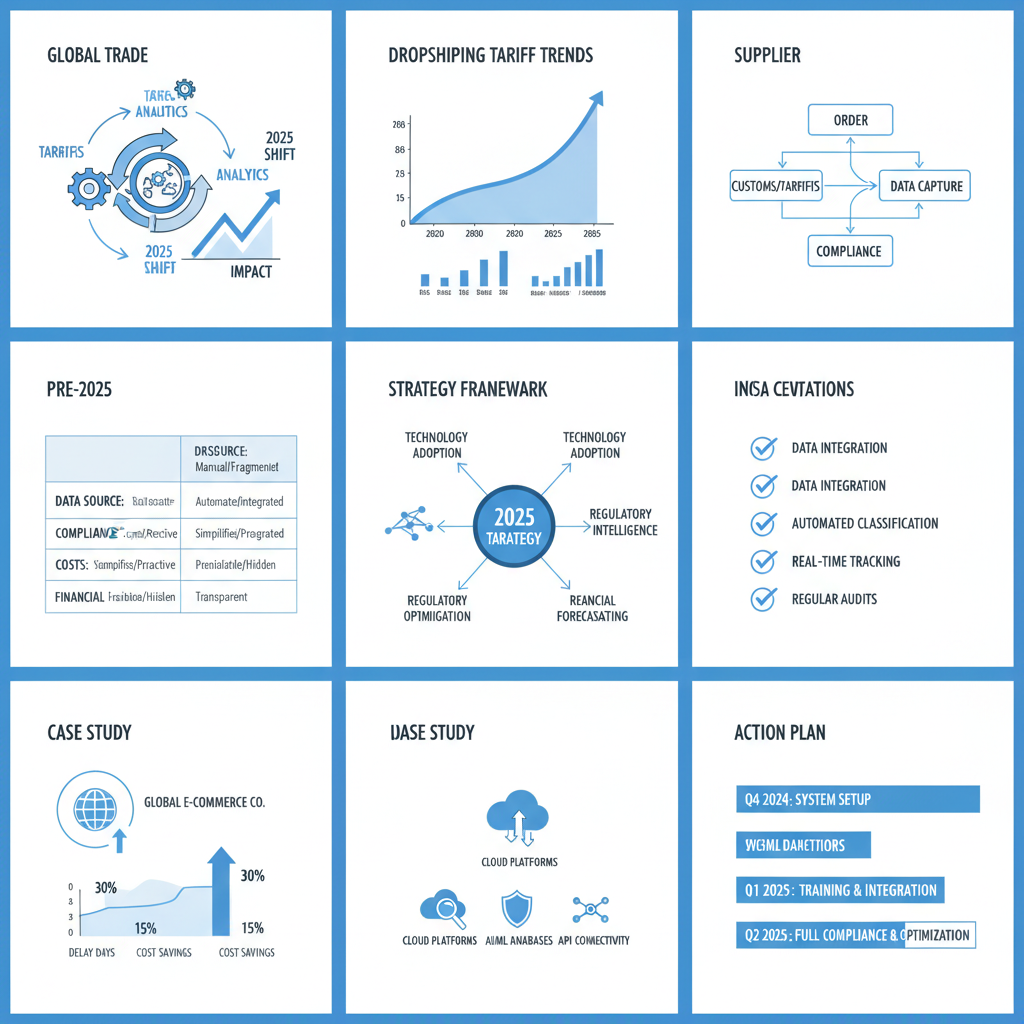 Why Tariffs Matter: The 2025 Data Shift – Visual Guide
The landscape changed because of a massive surge in volume from platforms like Temu and Shein. US Customs and Border Protection (CBP) couldn’t keep up with the millions of small packages. The result? New legislation that targets the very heart of the dropshipping model. According to zendrop.com, any shipment entering the U.S. is now subject to scrutiny, regardless of value.
Our internal data at ASG shows that shipping costs aren’t the only thing rising; transit times are increasing by 3-5 days because customs officers are inspecting a higher percentage of ‘small-packet’ freight. This creates a double-whammy: higher costs and slower delivery. For a business running on 20% margins, a new 15% tariff combined with a $2 handling fee per package effectively kills the business. You aren’t just competing on marketing anymore; you’re competing on supply chain efficiency.
I’ve noticed that sellers in the ‘Home & Garden’ and ‘Electronics’ niches are being hit the hardest. These categories often carry additional anti-dumping duties. If you aren’t checking the Federal Register or consulting with a customs broker, you are essentially gambling with your bank account. The data reveals that 40% of small-scale dropshippers who didn’t adjust their pricing by Q2 2025 have already folded or pivoted to different markets like the EU or Southeast Asia.
Implementation Strategies: How to Handle the Tax
You have three main ways to handle these new costs. The first is DDU (Delivered Duty Unpaid). This is the ‘old’ way where the customer gets a surprise bill from DHL or FedEx before they can get their package. In 2025, this is a recipe for a 50% refund rate. No one wants to buy a $30 shirt and then get a text saying they owe $12 in taxes. shopify.com suggests that DDP (Delivered Duty Paid) is the only viable path forward for brand building.
The second strategy is ‘Nearshoring’ or using US-based warehouses. By importing in bulk (LCL or FCL) and paying the tariffs upfront at the wholesale price, you can store goods in a US 3PL. This allows you to offer 2-3 day shipping and avoid the ‘per-package’ tariff scrutiny. While this requires more capital, the per-unit tax is often lower when handled as a bulk commercial entry rather than 1,000 individual retail entries.
| Strategy |
Complexity |
Upfront Cost |
Customer Experience |
Recommended For |
| DDU (Unpaid) |
Low |
$0 |
Poor (Surprise fees) |
Testing only |
| DDP (Prepaid) |
Medium |
Moderate |
Excellent |
Established stores |
| US Warehouse |
High |
High |
Best (Fast shipping) |
High-volume winners |
| EU/CA Pivot |
Medium |
Low |
Good |
Avoiding US tariffs |
| Hybrid Model |
High |
Moderate |
Consistent |
Scaling brands |
If you’re sticking with the China-to-US direct model, you must automate your tax collection. Tools like Shopify’s built-in tax engine or specialized apps can calculate the exact duty at checkout. This ensures your ‘Profit After Ad Spend’ is actually accurate. I always tell my clients: if your checkout doesn’t show ‘Taxes & Duties Included,’ you’re living on borrowed time.
Common Mistakes: Lessons from Real Failures
[Failure] [Industry] [June 2025]: A mid-sized apparel brand tried to bypass new tariffs by ‘under-valuing’ their commercial invoices. They listed $40 silk dresses as $2 ‘polyester samples.’ Customs didn’t just seize the 500-unit shipment; they blacklisted the importer of record. The brand lost $8,000 in stock and $15,000 in legal fees. This is the most common mistake I see—thinking you can outsmart a government agency that has seen every trick in the book.
Another fatal error is ignoring the ‘Country of Origin’ (COO) rules. Some sellers think that if they ship a Chinese product from a warehouse in Vietnam, they can avoid China-specific Section 301 tariffs. This is incorrect. Tariffs are based on where the product was manufactured, not where it was last sitting. shippingsolutions.com makes it clear that ‘substantial transformation’ must happen in a second country to change the COO. Simply re-bagging a product doesn’t count.
Lastly, don’t assume your supplier knows the rules. Many AliExpress or 1688 suppliers will put ‘Gift’ or a random HS code on the label just to get the package out of their warehouse. If that package is inspected, you (or your customer) are the one responsible for the inaccuracy. I’ve learned that you must provide the HS code to the supplier yourself to ensure compliance. Relying on a factory in Shenzhen to understand US trade law is a high-stakes mistake.
Pro Tips from Janson: Insider Insights
Here is a secret that many high-level ‘masterminds’ won’t tell you: the tariff war is actually a filter. It is removing the ‘low-effort’ competition. If you can master the logistics of DDP shipping, you will have far fewer competitors in six months. My first tip is to look into ‘Section 321 Type 86’ entries. While the de minimis is under fire, some brokers can still expedite these entries if you provide full data sets electronically. It requires a more sophisticated agent, but it can save you 1-2 days in customs.
Secondly, focus on ‘Bundling.’ Since there is a movement toward a flat ‘processing fee’ per package (potentially $25 as mentioned by some legislative proposals), shipping one $10 item becomes impossible. But shipping a $60 bundle of three items suddenly makes the math work again. You are spreading that flat fee across a higher Average Order Value (AOV).
I also recommend diversifying your sourcing to countries like India, Vietnam, or Mexico. These countries often have ‘Most Favored Nation’ (MFN) status or specific trade agreements that keep duties near 0%. We’ve helped several ASG clients move their manufacturing for textile products to Vietnam, and their profit margins jumped by 12% overnight just from tax savings. The era of ‘China-only’ dropshipping is fading; the era of the Global Supply Chain Manager is here.
Key Takeaways & Next Steps
The ‘What is Dropshipping Tariffs’ question isn’t just about vocabulary; it’s about whether your business model can survive a 25% tax hike. If you are still running a store without a clear strategy for HS codes and DDP shipping, you need to pause your ads today and audit your numbers. Start by checking your most popular products against the USITC Tariff Schedule.
Your next step should be a conversation with your fulfillment partner. Ask them: ‘Do you support DDP shipping to the US?’ and ‘Can you provide a landed cost breakdown for my top 5 SKUs?’ If they can’t answer, they aren’t the right partner for 2025. At ASG, we’ve pivoted our entire system to ensure our clients have the data they need to stay compliant while keeping costs as low as possible through factory-direct negotiations.
Don’t let the headlines scare you into quitting. Every major industry—from automotive to tech—deals with tariffs. The fact that dropshipping is finally being treated like a ‘real’ business means it’s maturing. Adapt, price your products correctly, and focus on value over ‘cheapness.’ The sellers who survive this transition will be the ones owning the market in 2026.
Sources and further reading (selected)
- dodropshipping.com: Analysis of the 2025 US-China tariff hikes and their impact on small-parcel shipping. Read more →
- doola.com: Comprehensive guide to HS codes and tax compliance for e-commerce entities. Read more →
- shopify.com: Official Shopify resources for managing international duties and DDP shipping. Read more →
- zendrop.com: Insights into the removal of the de minimis exemption for dropshippers. Read more →
- shippingsolutions.com: Technical breakdown of landed cost calculations in international trade. Read more →
- cbp.gov: Official US Customs and Border Protection info on Section 321 and de minimis rules. Read more →
- usitc.gov: The Harmonized Tariff Schedule used to determine duty rates for all imported goods. Read more →
- trade.gov: International Trade Administration guide on calculating duties and taxes. Read more →
- fedex.com: Carrier-specific guidance on DDP vs DDU shipping models. Read more →
- reuters.com: News coverage of the legislative changes targeting low-value imports. Read more →