By Janson Wang — CEO & Founder, ASG Dropshipping | Updated: April 9, 2026 | 20 min read
Key Takeaways
- Most sellers choose wrong — they evaluate agents by reputation and conversation, not by verifiable performance data. The right framework uses five quantifiable criteria with pass/fail thresholds, not gut feel.
- Two types of agents exist and they’re not interchangeable: individual operators (1–5 people, WhatsApp-managed, bandwidth ceiling at 50–100 daily orders) versus professional agent companies (50–200+ staff, written SLA, API integration). Only Type 2 scales with a serious dropshipping operation.
- QC defect rate is the most expensive criterion to get wrong. At 50 daily orders and $30 AOV, a documented 0.3% defect rate costs $135/month in defect cost; what an undocumented rate costs you depends on where it actually sits — and it never appears on any invoice.
- Q4 freight capacity is a separate criterion from standard shipping speed. An agent delivering in 7 days in August can deliver in 22 days in November on shared carrier capacity. Always evaluate Q4 performance separately.
- The 2-week test protocol — 20–30 units with QC photo documentation in 72 hours, then 5 units to a real delivery address — costs $100–$200. Skipping it costs thousands in live order problems.
Choosing a dropshipping agent requires evaluating five criteria in order of business impact: shipping speed with Q4 freight reliability (benchmark: under 7 days to US/EU consistently including peak season, with pre-allocated dedicated freight rather than shared carrier capacity), QC defect rate with documented photo evidence (benchmark: under 1% per-unit with photo documentation on every order — an undocumented defect rate is a monthly cost that never shows up on an invoice), pricing structure including all hidden fees and IP protection via formal NDA, communication response time with written SLA commitments (benchmark: under 4 hours, ideally under 20 minutes with 7×24 coverage), and scalability with verified platform integration capability. Before committing, run a 2-week test: 20–30 sample units with QC photo documentation requested within 72 hours, followed by 5 units shipped to a real address to verify actual door-to-door delivery time.
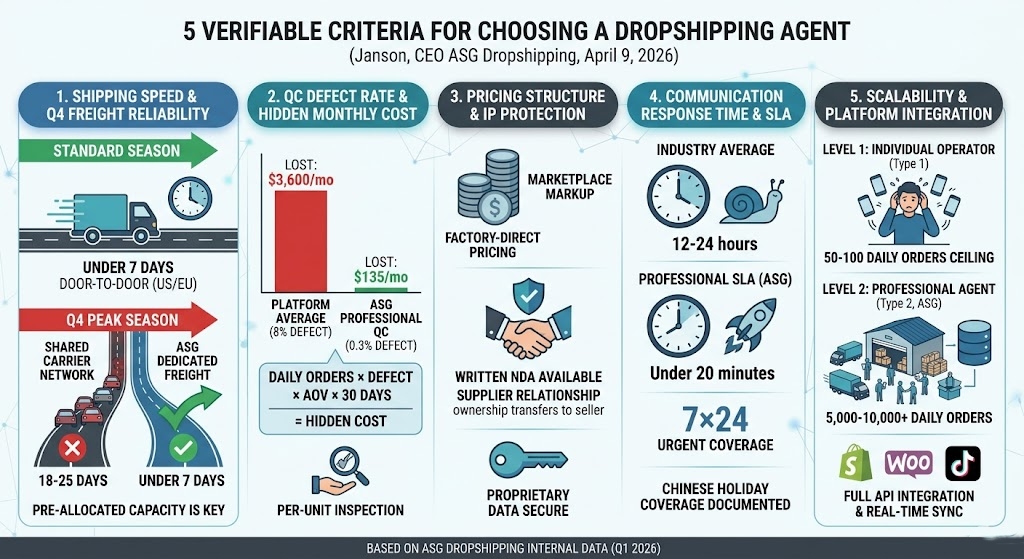
The five-criterion framework with pass/fail benchmarks — and the 2-week test protocol that validates every claim before you commit live order volume.
Most dropshipping sellers choose their agent the wrong way. They read a recommendation in a Facebook group, check the agent’s website, have a few good conversations on WhatsApp, and decide the person seems trustworthy. Three months later they’re dealing with 12% complaint rates, 18-day delivery windows during Q4, and a supplier relationship shared with six direct competitors.
An agent isn’t a product you can evaluate by looking at it. It’s a supply chain partner whose performance only becomes visible under real order volume. Here’s the five-criterion framework — with specific pass/fail thresholds — I use after processing 5M+ orders through our Dongguan and Shenzhen warehouses. Understanding what a qualified dropshipping agent actually provides is the foundation for evaluating these criteria correctly.
Table of Contents
- Before the Criteria: The Two Types of Dropshipping Agent
- Criterion 1 — Shipping Speed and Q4 Freight Reliability
- Criterion 2 — QC Standard and the Hidden Monthly Cost
- Criterion 3 — Pricing Structure and IP Protection
- Criterion 4 — Communication Response Time and SLA
- Criterion 5 — Scalability and Platform Integration
- The 2-Week Test Protocol
- Final Thoughts
- FAQs
Before the Criteria: The Two Types of Dropshipping Agent
There’s a step most evaluation guides skip that makes every subsequent criterion meaningless if you get it wrong: identifying which type of agent you’re actually evaluating.
Many scaling ecommerce brands switch to private agents after validating their products — private agents are specialized sourcing professionals who work directly with sellers rather than large marketplaces. But “private agent” covers two completely different business models.
Type 1 — Individual operators: Solo practitioners or small teams of 2–5 people. They manage operations via WhatsApp, WeChat, and spreadsheets. Fast and flexible at low volume. Their ceiling appears at 50–100 daily orders when their bandwidth runs out and your orders start competing with other clients for their attention. No written SLA. No API integration. No backup when they’re sick, traveling, or handling a supplier dispute for another client.
Type 2 — Professional agent companies: Structured businesses with 50–200+ staff, dedicated QC teams, multiple warehouse locations, formal SLA commitments in writing, API integrations with major ecommerce platforms, and documented performance records. ASG Dropshipping is this type: 200-person team across 4 warehouses in Dongguan and Shenzhen, 2,300+ vetted factory relationships, written SLA covering response time, defect rate, and on-time delivery.
Ask three questions in your first conversation to identify which type you’re dealing with: “Can you send me your warehouse address and a photo of your facility?” — A Type 2 company answers immediately. A Type 1 operator stalls or sends a stock photo. “Do you have a written SLA covering response time, defect rate, and on-time delivery?” — Type 2 has documentation. Type 1 gives verbal assurances. “Can you integrate with Shopify via API, or is order placement manual?” — Type 2 confirms API and shows integration documentation. Type 1 says “manual” or overpromises on capabilities they haven’t built.
Criterion 1 Shipping Speed and Q4 Freight Reliability
A dropshipping agent’s shipping speed must be evaluated on two separate benchmarks: standard delivery performance and Q4 peak-season performance. The standard benchmark for US and EU markets is under 7 days door-to-door, with under 48-hour order dispatch from the warehouse after payment confirmation.
The Q4 benchmark is whether the agent uses pre-allocated dedicated freight capacity or shared carrier network capacity — agents on shared networks typically expand from 7-day delivery to 18–25 day delivery during November–December when every shipper competes for the same carrier lanes simultaneously. An agent who cannot confirm pre-allocated Q4 freight capacity in writing is a shared-network agent regardless of what their standard delivery time states.
A good dropshipping agent understands your business and can move quickly to capitalize on trends — but this capability is only valuable if their fulfillment infrastructure reliably delivers to your customers within acceptable windows.
Target metrics for 2026: under 7 days delivery to US or EU — anything over two weeks is a conversion killer. Processing time is often hidden: a supplier might ship fast but if they take 4 days to pack the order, you’re in trouble. Look for under 48 hours dispatch time and test whether tracking numbers update in real-time or sit on “Label Created” for five days.
The delivery window that matters is door-to-door, not “shipped” to “delivered.” Always ask: “What is your average time from order placement to delivered at customer door?” For China-based agents, the dedicated freight route versus shared carrier network distinction determines whether 5–7 day US delivery is achievable. Understanding how shipping from China via dedicated freight differs from standard carrier networks explains the infrastructure behind the time difference.
The Q4 question to ask every agent directly: “Do you have pre-allocated dedicated freight capacity for Q4, or do you use shared carrier networks?” An agent with genuine Q4 infrastructure answers with specifics — named freight partners, capacity commitment documents, historical Q4 performance data. Our Q4 2024 performance: 23,000 daily orders at 97.3% on-time delivery rate through Black Friday — achievable only because freight capacity was pre-allocated months in advance, not competing for spot lanes in November.
| Question |
✅ Pass |
❌ Fail |
| Average door-to-door US delivery? |
Under 7 days |
Over 10 days |
| Order dispatch from warehouse? |
Under 48 hours |
Over 72 hours |
| Real-time tracking updates? |
Yes, automated |
“Label Created” delays |
| Q4 freight capacity type? |
Pre-allocated dedicated |
Shared carrier network |
| Q4 historical on-time rate? |
Can provide data |
Cannot provide data |
Criterion 2 QC Standard and the Hidden Monthly Cost
A dropshipping agent’s QC standard determines your monthly defect cost more than any other single variable. The benchmark is per-unit inspection on every order — not batch sampling, not supplier self-reporting — producing a documented defect rate under 1% with photo evidence available within 72 hours of order processing.
A professional agent with per-unit inspection produces a documented 0.3% defect rate — $135/month in defect cost at 50 daily orders and $30 AOV. We have no sourced platform-wide defect rate to put next to that, so how big the gap is depends on where your current source actually sits. What doesn’t change is that the difference never appears on any invoice — it appears in refund rates, chargeback frequency, customer service overhead, and review score suppression.
Most sellers evaluate QC by asking: “Do you inspect products before shipping?” Every agent says yes. The question that produces useful information is: “What is your documented defect rate across all clients over the last 90 days, and can you send me QC photos from orders processed this week?” An agent with genuine per-unit inspection answers both immediately.
The critical QC question is whether there is a systematic pre-shipment inspection process — or whether you are essentially shipping blind, trusting the supplier’s own quality reporting without independent verification.
Per-unit independent inspection means each unit is physically handled and checked against criteria specific to your product. The six-step protocol professional agents use: receiving check against purchase order specifications, visual quality verification against product standard photos, functional testing where applicable, packaging integrity check, photo documentation of each unit, and final weight and dimension confirmation. That process is what produces the documented 0.3% defect rate. For a detailed breakdown of this inspection protocol, see our guide on quality control in dropshipping.
The Hidden Monthly Cost Formula
Daily orders × defect rate × AOV × 30 days = monthly hidden QC cost
| Volume |
Platform-average defect rate |
0.3% Defect Rate |
| 30 orders/day, $30 AOV |
Not established |
$81 |
| 50 orders/day, $30 AOV |
Not established |
$135 |
| 100 orders/day, $30 AOV |
Not established |
$270 |
The platform column is left unfilled because we have no sourced platform-wide defect rate — not because platform orders arrive without defects. That is also why this table carries no gap column: a gap measured against an unknown is a guessed number. Whatever the difference turns out to be for your own orders, it spreads across refund processing, replacement shipping, customer service labor ($3–$5 per contact), PayPal dispute fees, and review score damage that compounds weekly.
Reliable suppliers maintain consistent quality standards even during peak periods — vetting should include assessing systematic pre-shipment inspection processes, not just delivery speed benchmarks. Confirm that suppliers hold valid business licenses, safety certifications, and regional compliance documentation — check for product-specific certifications such as CE, FCC, and FDA depending on your category.
| Question |
✅ Pass |
❌ Fail |
| Documented defect rate last 90 days? |
Can provide, under 1% |
Cannot provide or over 3% |
| QC photo documentation available? |
Within 72 hours, per-unit |
Not available or batch only |
| Inspection protocol? |
Per-unit, 6-step |
Batch sampling or supplier self-report |
| Compliance documentation? |
CE/FCC/FDA by category |
“Supplier handles compliance” |
| Defect resolution SLA? |
Written, under 48 hours |
Verbal only |
Criterion 3 Pricing Structure and IP Protection
A dropshipping agent’s pricing structure has three components to evaluate separately: the per-order handling fee ($0.50–$2.00 for professional agents), the product cost relative to factory-direct pricing (professional agents source at 10–15% below platform marketplace pricing for equivalent products), and hidden fees including storage charges, packaging material costs, and minimum monthly order requirements. IP protection — whether your supplier relationships and product sourcing data are contractually protected from disclosure to other clients — is evaluated alongside pricing because it determines the long-term economic value of the agent relationship beyond the per-unit cost comparison.
The critical pricing question is whether you’re getting factory-level pricing or paying for intermediary markups — pricing transparency determines whether your COGS supports viable ad-funded margins. Professional agents sourcing directly from 1688.com factories typically produce 10–15% lower product costs than equivalent platform marketplace pricing. At 50 daily orders and $10 product cost, that saving produces $1,500–$2,250/month in COGS reduction.
At $1.50/order handling fee and 50 daily orders: $2,250/month fee. The 10–15% COGS reduction above covers between two-thirds and all of that fee on its own; what per-unit QC saves on top of it depends on the defect rate your current source actually runs at. Ensure you’re aware of hidden costs such as storage charges, custom packaging materials, warehouse usage fees, and whether agents require minimum order quantities per day or month.
IP protection is the dimension most sellers don’t think about until they’ve already lost competitive advantage through it. When you source through a shared platform, the supplier relationship belongs to the platform — your winning product’s sourcing data is accessible within that infrastructure. A competitor can source from the same supplier tomorrow.
A professional private agent documents your supplier relationships under a written NDA, stores sourcing data in isolated client-specific systems, and has no contractual ability to share your supply chain with other clients. Our 83 brand-transition clients who built proprietary product relationships through ASG saw average order value increase 35% and repeat purchase rate increase 28%.
Verify IP protection with three direct questions: “Do you provide a written NDA covering supplier relationships and sourcing data?” “If I leave your service, do the supplier relationships transfer to me or stay with your company?” “Do any of your other current clients source from the same suppliers you would use for my products?”
| Question |
✅ Pass |
❌ Fail |
| Per-order handling fee transparent? |
Yes, $0.50–$2.00/order |
Hidden in product price |
| Product cost vs factory-direct? |
10–15% below platform |
At or above platform pricing |
| Hidden fees disclosed upfront? |
Full disclosure |
Storage/packaging billed separately without notice |
| Written NDA available? |
Yes, standard documentation |
“We protect your data” verbal only |
| Supplier relationship ownership? |
Transfers to seller on exit |
Stays with agent on exit |
Evaluating multiple agents and want a side-by-side cost comparison? ASG’s per-order handling fee, factory-direct product pricing, and written NDA documentation are available before any commitment — starting with a 20-piece test order. See how the pricing structure works.
Criterion 4 Communication Response Time and SLA
A dropshipping agent’s communication response time must be evaluated as a written SLA commitment, not a conversational promise. The benchmark for professional agents is under 4 hours during business hours, with 7×24 coverage for urgent issues — the industry average runs 12–24 hours, which translates to 1–2 lost business days per issue during live campaign periods.
The test: send a non-urgent operational question during a normal business day and measure actual response time. If the response takes over 4 hours before any business relationship begins, it will take longer once you’re an active client competing for attention alongside dozens of other accounts. Response time during the sales process is always the best-case scenario for that agent’s communication performance.
Response test: message the supplier with a basic question. If they don’t reply within 12 hours, they will fail you during a holiday rush. The 12-hour threshold filters out the worst performers — but 12 hours is not a standard that supports live campaign operations. If a fulfillment issue appears at 2pm on a Friday, a 12-hour window means you get an answer at 2am Saturday after your campaign has been generating complaints for twelve hours.
Ask any agent: “Can you send me your standard SLA document?” A Type 2 professional company produces the document within one business day. A Type 1 individual operator either doesn’t have one or produces a verbal commitment repackaged as writing that specifies nothing measurable.
ASG’s response SLA: under 20 minutes for standard queries, 7×24 coverage including Chinese national holidays, named backup account manager for every client, written remediation terms. Tracking transparency is a critical evaluation factor — test whether operational questions get answered within hours or days, not just whether tracking numbers update.
The Chinese national holiday calendar is the communication risk most Western sellers don’t account for until they’re stuck in it. Chinese New Year runs 7–10 days with reduced operations for 2–4 weeks before and after. Golden Week (October 1–7) affects Q4 preparation directly. An agent without holiday coverage documentation — specifying exactly who handles your account and what the response SLA is during those periods — is an agent whose Q4 communication will degrade exactly when Q4 demand peaks.
| Question |
✅ Pass |
❌ Fail |
| Written SLA document available? |
Yes, measurable commitments |
Verbal assurance only |
| Standard response time? |
Under 4 hours |
Over 12 hours |
| Urgent issue coverage? |
Under 1 hour, 7×24 |
Business hours only |
| Holiday coverage documented? |
Named backup, specific SLA |
“We’ll be available” verbal |
| Pre-sales response time (actual test)? |
Under 2 hours |
Over 6 hours |
Criterion 5 Scalability and Platform Integration
A dropshipping agent’s scalability must be evaluated on two dimensions: infrastructure capacity relative to your projected order volume, and platform integration depth with your current and planned sales channels. The infrastructure benchmark: a professional agent company should be processing a minimum of 5,000–10,000 daily orders across their full client base — giving them the freight relationships, warehouse capacity, and operational systems to absorb your growth without degradation.
The integration benchmark: native API integration with your primary platform with real-time inventory sync, automated order routing, and tracking number push — not manual order placement that requires human intervention for every transaction.
As you grow, your agent becomes part of your team — treat them like a partner and they’ll help you scale; an agent who can source directly from 1688.com factories gives you better prices and terms than any platform marketplace.
Infrastructure questions that reveal actual capacity: “How many daily orders are you currently processing across all clients?” — An agent processing 500 daily orders total cannot absorb 200 daily orders from a single new client without operational degradation. “How many warehouse staff do you have on the QC team specifically?” — QC capacity is the constraint most agents hit first when volume grows, because per-unit inspection doesn’t parallelize automatically.
ASG’s current infrastructure: operations support, warehouse coordination in Dongguan and Shenzhen, vetted factory relationships, a broad supplier network, and order-processing workflows built for scaling sellers.
Non-negotiables for 2026 include real-time inventory sync — a 30-minute delay in inventory updates can result in overselling during a viral trend, and physical warehouse inspections should be verified before any product is listed.
Platform integration has three levels: Level 1 is manual (CSV upload or direct message — works at 20 daily orders, breaks at 100); Level 2 is basic (Shopify app with automatic order pull and tracking push — works at 100–200 daily orders); Level 3 is full API (direct API with custom order routing, real-time multi-platform inventory sync, webhook support — required above 200 daily orders or for multi-channel operations). Ask the agent to demonstrate their integration with your specific platform before signing any agreement. Evaluate whether automation services automatically forward order details to suppliers — this is vital for operational efficiency and minimizing manual errors.
Request a video call tour of the warehouse facility before committing. Any agent with genuine infrastructure accommodates a 15-minute walkthrough showing warehouse floor, QC stations, packaging areas, and outbound shipping. Any agent who declines or repeatedly delays this request is showing you an infrastructure gap regardless of their marketing materials.
| Question |
✅ Pass |
❌ Fail |
| Total daily orders processed (all clients)? |
5,000+ |
Under 1,000 |
| Dedicated QC team size? |
10+ staff |
1–3 people |
| Platform integration depth? |
Full API, real-time sync |
Manual or basic plugin |
| Warehouse video tour available? |
Yes, within 1 week |
Declined or delayed |
| Multi-platform support? |
Shopify + WooCommerce + TikTok |
Single platform only |
Ready to run these five criteria against a real agent? ASG’s infrastructure data — 200-person team, 4 warehouses, written SLA, full API integration documentation — is available before any order commitment. Start the evaluation here.
The 2-Week Test Protocol — Before You Commit Any Live Volume
Before committing live order volume to any dropshipping agent, run a standardized 2-week test protocol: Days 1–3, order 20–30 units of your top-selling product and request QC photo documentation within 72 hours of processing — an agent who cannot deliver photo evidence in this window is showing you how they handle live orders, not just test orders. Days 4–10, ship 5 units to a real delivery address and measure actual door-to-door delivery time. Days 10–14, evaluate three dimensions simultaneously: photo documentation quality versus your product standard, actual delivery time versus the agent’s stated window, and communication response time throughout the process. An agent who passes all three at test volume will perform at scale.
An agent who fails any one at test volume will fail at 10× the volume — and you will have spent $100–$200 learning what would have cost thousands in live order problems.
Start with a trial order and evaluate how well the agent performs in sourcing, communication, shipping speed, and packaging before committing fully — don’t move all products at once.
Day 1–3: The QC Photo Test
Order 20–30 units of your highest-selling product. When placing the order, explicitly request QC photo documentation for every unit within 72 hours of processing. The response tells you three things: whether per-unit inspection exists, how fast their internal operations move, and how their account manager handles a specific request versus a general promise.
If an agent provides detailed per-unit photos showing each unit from multiple angles with defects noted and replacement units flagged — you have evidence of a functioning QC system. A single batch photo or no photos at all shows you exactly what your live orders will look like.
Day 4–10: The Real Delivery Test
Ship 5 units to a real residential or business address in your primary target market. Measure door-to-door time from order placement to physically received — not “shipped” time, not “label created” time. Simultaneously evaluate tracking update quality: does the tracking number update in real-time as the package moves, or does it sit on “Label Created” for three days? Real-time tracking is a proxy for logistics system integration quality. Check packaging quality on arrival — this is identical to what your customers receive.
Day 10–14: The Three-Dimension Evaluation
Compare QC documentation quality against your product standard. Compare actual door-to-door delivery time against the stated window — a 7-day stated window that produces 9-day delivery in a test scenario will produce 12-day delivery under live order pressure. Evaluate communication response speed throughout the entire process: did the agent proactively communicate any issues, or did you follow up? The communication behavior during the test protocol is the most reliable preview of live campaign handling.
Red Flags That End Evaluation Immediately
Red Flag 1: Refuses QC photo request or offers batch photos as substitute — no per-unit inspection infrastructure exists. End evaluation.
Red Flag 2: Can’t name specific logistics partners when asked directly — vague carrier answers indicate spot-market shipping that collapses in Q4.
Red Flag 3: No verifiable physical warehouse address on Google Maps at commercial or industrial scale.
Red Flag 4: Delivery time significantly exceeds stated window at test volume — a 7-day stated window producing 13-day actual delivery shows real infrastructure.
Red Flag 5: Communication noticeably slows after payment versus before payment — pre-payment speed is always the best-case scenario.
Complete Scorecard — All Five Criteria
| Criterion |
Benchmark |
Your Agent |
Pass/Fail |
| Shipping: standard delivery |
Under 7 days door-to-door |
_____ days |
|
| Shipping: dispatch time |
Under 48 hours |
_____ hours |
|
| QC: defect rate |
Under 1% documented |
_____ % |
|
| QC: photo documentation |
Within 72 hours, per-unit |
Yes / No |
|
| Pricing: handling fee |
$0.50–$2.00/order, transparent |
$_____ |
|
| Pricing: NDA available |
Written document |
Yes / No |
|
| Communication: response |
Under 4 hours |
_____ hours |
|
| Communication: SLA |
Written document |
Yes / No |
|
| Scalability: daily volume |
5,000+ orders (all clients) |
_____ |
|
| Scalability: API integration |
Full API, real-time sync |
Yes / No |
|
9–10 criteria passed: ready for live order commitment. 7–8 criteria: specific gaps to address first. Fewer than 7: do not commit live volume regardless of how persuasive the sales process was.
Based on 386 documented transitions from platform-based sourcing to ASG’s per-unit QC and dedicated freight: average incoming defect rate was 7.8%, dropping to 1.5% within 60 days. Average US delivery time dropped from 18–25 days to 5–8 days. Customer service contacts dropped 60–70% within the first billing cycle. Average ROI recovery: 11 days.
Final Thoughts
Choosing a dropshipping agent is the supply chain decision that compounds most directly into customer experience outcomes — delivery speed, product quality, brand consistency, and review score trajectory. Most sellers make it by reputation and conversation. The sellers who build durable operations make it by criteria and test data.
The five criteria aren’t arbitrary. They’re the five dimensions where agent infrastructure quality produces measurable, monthly, dollar-quantifiable differences: shipping speed and Q4 freight reliability, QC defect rate and its hidden cost, pricing structure and IP protection, communication response time with written SLA, and scalability with verified platform integration. Each criterion has a specific pass/fail threshold. Each threshold is verifiable through the 2-week test protocol before any live order commitment.
The test costs $100–$200 and two weeks. Skipping it costs thousands in live order problems and months of review damage that takes longer to repair than it took to create.
All ASG operational data reflects documented Q1 2026 records. Third-party evaluation frameworks sourced from Shopify, Inventory Source, and Uniqbe guides current as of April 2026.

About the Author
Janson — Founder & CEO, ASG Dropshipping
8 years in cross-border dropshipping. 200-person team, 4 warehouses in Dongguan and Shenzhen, 2,300+ vetted factories, 5M+ orders processed. The 5-criterion framework and 2-week test protocol in this article come from documented evaluation of 386 agent transitions in 2024.
Outside the warehouse: rock singer and guitarist.
Frequently Asked Questions
How do I find a reliable dropshipping agent?
Finding a reliable dropshipping agent requires two steps: identifying candidates through directories, Facebook communities, Reddit recommendations, and platform reviews, then vetting through the five-criterion framework — shipping speed with Q4 freight capacity, QC defect rate with documented photo evidence under 1%, transparent pricing with written NDA, communication response time with written SLA, and verified scalability with API integration depth.
The critical distinction is between Type 1 individual operators (1–5 people, WhatsApp-managed, bandwidth ceiling at 50–100 daily orders) and Type 2 professional agent companies (50–200+ staff, written SLA, multiple warehouses). For a complete overview of what a professional agent provides, see our guide on what a dropshipping agent is.
What should I ask a dropshipping agent before working with them?
Ten questions to ask any dropshipping agent: What is your documented defect rate across all clients in the last 90 days? Can you send me QC photos from orders processed this week? What is your average door-to-door delivery time to US customers including processing? Do you have pre-allocated Q4 freight capacity or do you use shared carrier networks? Can you provide your written SLA document? What specific carriers or freight forwarders do you use?
What is your warehouse address and can we do a video call tour? Do you provide a written NDA covering supplier relationships? What is your per-order handling fee and are there any additional fees? Can you demonstrate your Shopify or WooCommerce API integration? An agent who answers all ten clearly and specifically in the first conversation has professional infrastructure. An agent who deflects or gives vague answers to any of these is showing you their operational reality.
How do I know if a dropshipping agent is legit?
Five verification steps: verify their warehouse address on Google Maps and confirm it shows a commercial or industrial facility at scale, request a 15-minute video call walkthrough of the warehouse floor, ask for business registration documentation, check their Trustpilot profile and search their company name plus “review” and “complaint” in relevant Facebook groups and Reddit communities, and run a 20–30 unit test order with a specific QC photo documentation request within 72 hours.
An agent who passes all five steps has demonstrated the infrastructure claims their marketing makes. Any agent who declines or delays on the warehouse video call or the test order QC photos is showing you an infrastructure gap regardless of what their website says.
How long should a dropshipping agent take to ship?
A professional dropshipping agent should deliver to US customers in under 7 days door-to-door, with under 48 hours warehouse dispatch time from order placement. The critical distinction is between standard delivery performance and Q4 peak-season performance: agents using shared carrier networks typically deliver in 7 days in August and 18–25 days in November as carrier capacity saturates during Black Friday and Cyber Monday peak.
Always ask whether freight capacity is pre-allocated dedicated lanes or shared carrier network — only pre-allocated dedicated freight maintains consistent delivery windows through Q4. For a complete breakdown of how dedicated China freight works, see our guide on shipping from China.
How do I test a dropshipping agent before committing?
Run the 2-week test protocol: Days 1–3, order 20–30 units and explicitly request per-unit QC photo documentation within 72 hours — this tests whether inspection infrastructure actually exists. Days 4–10, ship 5 units to a real delivery address in your target market and measure actual door-to-door time. Days 10–14, evaluate three dimensions simultaneously: QC photo quality versus your product standard, actual versus stated delivery time, and communication response speed throughout the process.
An agent who passes all three criteria at 20–30 test units will perform at scale. An agent who fails any criterion at test volume will fail worse at 10× the volume. This test costs $100–$200 and two weeks — not running it typically costs thousands in live order problems.
What are red flags when choosing a dropshipping agent?
Five immediate red flags that terminate evaluation: refusal to provide per-unit QC photos on a test order (no photos means no per-unit inspection), inability to name specific logistics partners when asked directly (vague carrier answers indicate spot-market shipping that collapses in Q4), no verifiable physical warehouse address on Google Maps, delivery time significantly exceeding their stated window at test volume, and communication that noticeably slows after payment versus before payment. For guidance on evaluating QC standards specifically, our quality control guide covers the inspection protocol benchmarks in detail.
How much should a dropshipping agent charge?
A professional dropshipping agent charges $0.50–$2.00 per order handling fee plus factory-direct product cost — typically 10–15% below equivalent platform marketplace pricing for the same product. At $1.50/order and 50 daily orders, the handling fee is $2,250/month, set against that product cost reduction plus whatever per-unit QC saves you in defect cost — ASG’s documented rate is 0.3%, and how much that saves you depends on the rate your current source actually runs at. Agents who charge no explicit handling fee typically embed their margin in product pricing at near-platform levels, which means you’re paying the equivalent fee without the transparency to evaluate it.
What is the difference between a dropshipping supplier and a dropshipping agent?
A dropshipping supplier is a factory or wholesaler that manufactures or stocks products and handles their own fulfillment — your relationship is with their product catalog and shipping process. A dropshipping agent works on your behalf to source products from multiple factories, negotiate pricing, manage quality inspection, and coordinate fulfillment — acting as your supply chain representative rather than a product provider. For scaling operations above 30–50 daily orders, the agent model produces better QC accountability, pricing leverage, and operational flexibility than single-supplier direct relationships. See our full explanation of what a dropshipping agent does for the complete breakdown.
Article written: April 9, 2026 | Workflow: asg-seo-writer 21-Step + geo-optimizer v1.0