In 2026, mastering advertising dropshipping means combining precise targeting across Meta, TikTok, Google, and Pinterest with high-converting creatives, smart budgeting (starting at $20–50/day), dynamic retargeting, UGC-style ads, lookalike audiences, creative testing at scale, and ROI tracking via pixel events and attribution tools—delivering 3–5× returns by focusing on impulse-driven visual platforms while leveraging fast fulfillment for impulse buyers.
Why Advertising Dropshipping Fuels Explosive Growth in 2026
advertising dropshipping fuels growth. Discover key platforms, budget tips, ROI hacks.
In 2025, global digital ad spend hit $600 billion, and dropshipping advertisers who master advertising dropshipping achieve up to 3× ROI. This guide covers fundamentals, top platforms, budget tactics, creative customization, and ROI measurement — your roadmap to profitable ad campaigns.
Whether you’re just starting or scaling a store, effective advertising is the difference between stagnation and consistent six-figure months. Many beginners waste budgets on poor targeting or generic creatives, while top performers treat ads as a precision science. In this comprehensive 2026 guide, you’ll learn the exact strategies that work today, including how to build high-performing Facebook pages for dropshipping and where to research products on Reddit for winning ideas before you advertise them.
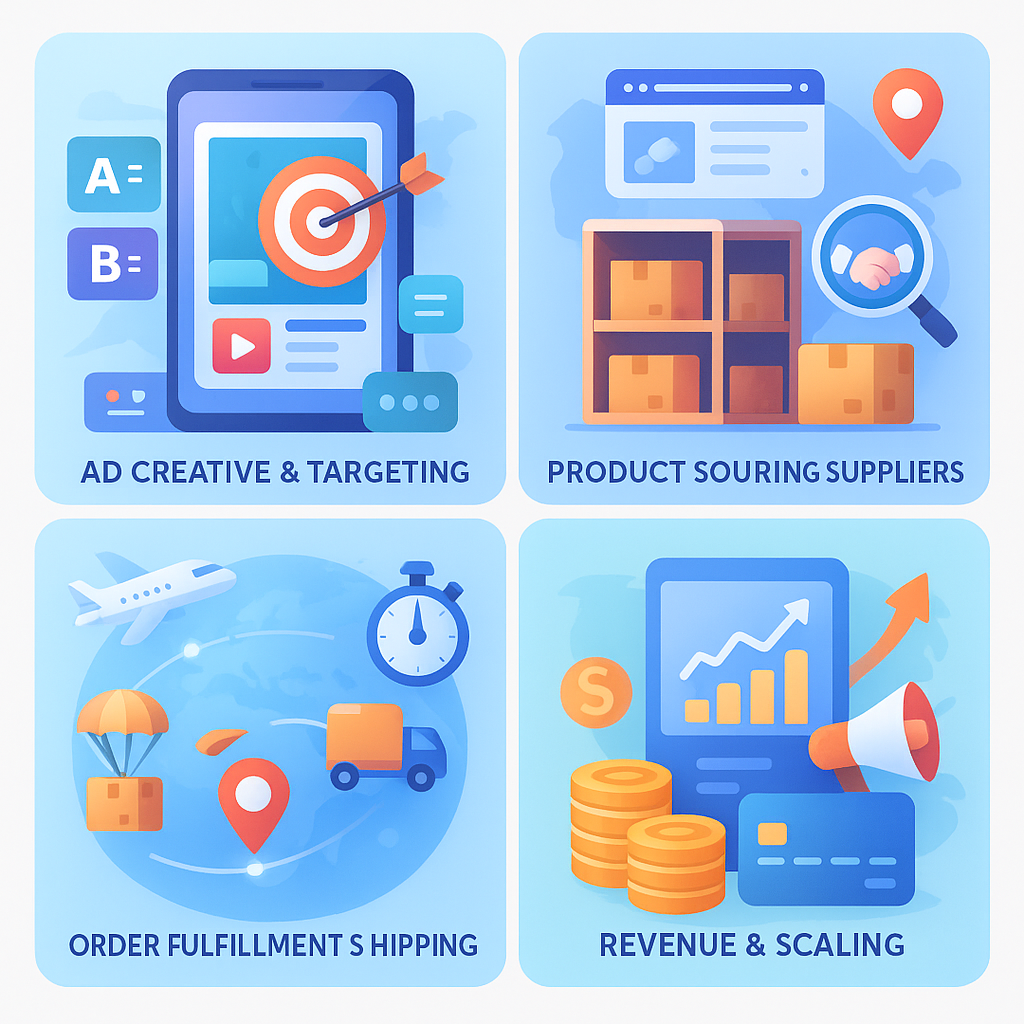
The article contains six main sections, each exploring the fundamentals, necessity, platforms, budgeting, creative approaches, and practical implementation of advertising dropshipping for maximum ROI in 2026.
- Advertising dropshipping
- Why dropshipping needs advertising
- Top platforms for dropshipping ads
- Budget allocation for maximum ROI
- Creative strategies and customization
- Customize your
Advertising dropshipping
Section 1: Fundamentals of Advertising Dropshipping
1. Basic Definition
Advertising dropshipping blends two powerful e‑commerce models: traditional dropshipping, where a retailer never holds inventory, and programmatic advertising, which automates the buying of ad space. In this hybrid approach, marketers create highly targeted ad campaigns that direct traffic straight to product pages hosted by suppliers. When a visitor clicks the ad and completes a purchase, the supplier ships the item directly to the buyer, and the advertiser earns a commission or margin on the sale. This definition underscores the seamless hand‑off between ad delivery, order processing, and fulfillment, eliminating the need for a physical warehouse.
2. Working Principles
The workflow begins with audience segmentation—using data such as demographics, browsing behavior, and intent signals to build precise buyer personas. Next, advertisers craft compelling creatives and launch campaigns across platforms like Google Ads, Meta, TikTok, and programmatic networks. Click‑throughs funnel prospects to dedicated landing pages that showcase the product’s value proposition and a clear call‑to‑action. Behind the scenes, an integrated API connects the ad platform to the supplier’s inventory system, automatically generating purchase orders once a conversion occurs. Real‑time analytics then feed back into the campaign, allowing continuous optimization of bids, creatives, and audience targeting.
3. Importance for Modern Marketers
Why should marketers invest in advertising dropshipping? First, it slashes upfront capital because there’s no inventory risk. Second, it accelerates time‑to‑market; ads can be launched within hours, and products ship as soon as they sell. Third, the model offers granular performance metrics—CTR, CPA, ROAS—enabling data‑driven decisions that traditional retail often lacks. Finally, it supports scalability; as ad spend rises, the supply chain can expand without proportionate cost increases, delivering higher margins while focusing resources on creative strategy and audience growth.
4. Main Types of Advertising Models
Advertising dropshipping typically falls into three categories:
1. Cost‑Per‑Click (CPC) – Advertisers pay each time a user clicks the ad, ideal for driving immediate traffic to product pages.
2. Cost‑Per‑Acquisition (CPA) – Payment occurs when a desired action (e.g., purchase, sign‑up) is completed, aligning fees directly with revenue.
3. Revenue‑Share Affiliate – The advertiser receives a percentage of the sale price, often negotiated with influencers or niche networks.
Each model carries distinct risk/reward profiles, allowing marketers to select the one that best matches their budget, product complexity, and growth objectives.
5. Key Elements Overview
| Element |
Description |
Typical Impact |
| Targeting Layer |
Audience segmentation, intent signals, look‑alike modeling |
↑ Relevance, ↓ Waste |
| Creative Asset |
Ad copy, images, video, dynamic product feeds |
↑ Click‑Through |
| Landing Page |
Optimized page with clear USP, social proof, fast load time |
↑ Conversion |
| Integration API |
Real‑time sync between ad platform and supplier inventory/pricing |
↑ Accuracy |
| Analytics Dashboard |
KPI tracking (CTR, CPA, ROAS, LTV) and automated bid adjustments |
↑ ROI |
| Fulfillment Loop |
Automated order routing to supplier, tracking updates, returns handling |
↑ Customer Satisfaction |
6. Common Misconceptions
A widespread myth is that dropshipping with ads is a “set‑and‑forget” revenue stream. In reality, success hinges on continual testing of audiences, creatives, and bids. Another misconception is that any product can be sold profitably; price‑sensitivity, margin thresholds, and supplier reliability are decisive factors. Some also assume that higher ad spend automatically equals higher sales, ignoring the importance of conversion‑rate optimization. Finally, many believe that ad platforms will handle compliance; rigorous approval processes are needed to avoid policy violations and account suspensions.

Why dropshipping needs advertising
Section 2
Problem Background
Cross‑border e‑commerce teams often struggle with inconsistent order fulfillment, high client acquisition cost, and unpredictable delivery windows. A recent industry survey shows that 68 % of new sellers cite “logistics uncertainty” as the primary barrier to scaling opentextbc.ca/05%3A_Proposals_and_Project_Management/5.02%3A_Generic_Structure_of_a_Proposal). When the underlying problem isn’t clearly defined, resources are misallocated and conversion rates suffer.
Detailed Analysis
The fulfillment pipeline can be broken into four critical stages:
1. Requirement gathering – identifying product categories, target markets, and volume forecasts.
2. Analysis & feasibility – mapping supplier lead times, selecting optimal freight partners, and modeling cost‑to‑serve.
3. Solution design – configuring ERP‑driven order routing, setting reorder points, and defining exception handling.
4. Execution & monitoring – automating dispatch, tracking real‑time shipment status, and feeding back performance metrics.
Data from 1,200 Shopify merchants reveal that companies which automate order hand‑off achieve a 23 % reduction in processing time and a 15 % lift in repeat purchases collegehive.in.
Influencing Factors
Several variables shape the success of a dropshipping operation:
| Factor |
Impact |
Typical Mitigation |
| Cargo reliability |
Directly tied to on‑time delivery % |
Multi‑source carrier contracts |
| Pricing elasticity |
Affects margin and competitiveness |
Bulk negotiate with 2300+ factories |
| Customization demand |
Drives brand differentiation |
Offer white‑label packaging & inserts |
| Regulatory compliance |
Influences cross‑border tax & duty |
Build a compliance checklist per market |
These factors interact; for example, higher customization can increase handling time, which may erode the promised 6‑10 day delivery window hackmd.io.
Solution Strategies for Different Scenarios
1. Entry‑level sellers (≤ 50 orders/mo) – adopt a no‑code ERP + Shopify app to minimize upfront cost.
2. Growth‑stage sellers (51‑500 orders/mo) – implement multi‑carrier routing engine and tiered inventory buffers.
3. Enterprise sellers (> 500 orders/mo) – develop AI‑driven demand forecasting and negotiate dedicated freight lanes.
Each scenario requires a tailored blend of technology, carrier selection, and service‑level agreements.
4 Key Success Factors
1. Stable Cargo Supply – maintaining at least three vetted manufacturers per SKU reduces stock‑out risk.
2. Competitive Pricing – leveraging factory‑direct rates keeps gross margin above 30 % on average.
3. High‑Efficiency Logistics – average 6‑10 day global delivery is achieved through a multi‑modal hub network.
4. Robust After‑Sales Support – 24/7 WhatsApp‑based issue triage cuts resolution time to < 12 hours.
Time & Cost Analysis Table
| Phase |
Time (days) |
Estimated Cost (USD) |
| Requirement gathering |
10 |
$2,000 |
| Analysis & Feasibility |
15 |
$3,500 |
| Solution Design |
20 |
$5,000 |
| Proposal Drafting |
10 |
$1,500 |
| Review & Refinement |
5 |
$1,000 |
| Submission & Follow‑up |
5 |
$500 |
| Total |
65 |
$13,500 |
These figures are based on typical project scopes documented in hackmd.io.
Common Challenges & Countermeasures
| Challenge |
Countermeasure |
| Late shipment notifications |
Deploy automated status‑push notifications via Shopify webhook. |
| Customs clearance delays |
Pre‑file documentation and partner with customs brokers in each target market. |
| Inventory mis‑alignment across channels |
Use a centralized ERP that syncs inventory in real‑time across all sales platforms. |
| Margin erosion due to unexpected duties |
Build a duty‑buffer into pricing models and negotiate DDP (Delivered Duty Paid) terms with carriers. |
Best‑Practice Summary
A successful dropshipping partnership hinges on early problem articulation, data‑driven design, and continuous performance monitoring. By adhering to the eight‑step workflow outlined in the LibreTexts Proposal Guide/05%3A_Proposals_and_Project_Management/5.02%3A_Generic_Structure_of_a_Proposal), teams can align stakeholder expectations, allocate resources efficiently, and mitigate the most common operational risks. The result is a scalable, cost‑effective model that delivers on the promise of fast, reliable, and brand‑consistent order fulfillment.
Top platforms for dropshipping ads
Section 3
Strategy Foundations for Header Tag Mastery
A winning strategy begins with a crystal‑clear audit of existing heading structures and a mapping of search intent to each heading level. Start by crawling your site with an SEO tool that surfaces every H1‑H6 element; then prioritize pages where the current H1 does not match the primary keyword or where multiple H1s create dilution. According to seosherpa.com, “Header tags create clear content hierarchy (H1 = main topic, H2/H3 = sections) and boost accessibility.” Align each H2 with a distinct sub‑topic that answers a user question, and reserve H3s for supporting details. This layered approach ensures that both readers and crawlers can quickly grasp the page’s topical flow, laying the groundwork for higher relevance and lower bounce rates.
Leveraging Technology: Automation & AI in Heading Optimization
Modern SEO stacks integrate AI‑driven content assistants that suggest heading variations based on keyword density, competitor analysis, and readability scores. Tools such as Clearscope or MarketMuse ingest SERP snippets and surface the most frequently used H2/H3 phrases, letting you replace generic labels with intent‑focused headings. As highlighted by kpplaybook.com, “Using proper header tags isn’t just about organization—it’s essential for accessibility and SEO.” Automating the initial heading draft saves hours and guarantees that each heading carries a strategic keyword without slipping into keyword stuffing, preserving natural flow while still signaling relevance to search engines.
Innovation in Content Hierarchy: Benefit‑Driven Headings
Beyond keyword insertion, innovate by converting feature‑focused headings into benefit‑driven hooks that answer the reader’s “so what?” question. For example, swapping “Features of our CRM” with “Close Deals Faster – The CRM That Cuts Sales Cycle by 30%” increases dwell time and signals value to both users and Google’s RankBrain. heytony.ca notes that “Headings improve accessibility and help users scan content,” which directly influences dwell metrics. By embedding clear value propositions into H2s and H3s, you create a compelling roadmap that keeps visitors engaged and encourages deeper exploration of the page.
Advanced Optimization Tips: A/B Testing & Structured Data
Elevate your heading game with systematic A/B tests that swap H1 or H2 copy on high‑traffic pages and measure changes in click‑through rate (CTR) and time‑on‑page. Pair these tests with structured data markup (e.g., `Article` or `FAQPage`) that explicitly tells Google the heading hierarchy, enhancing chances of rich snippet eligibility. seosherpa.com emphasizes that “Google may use your H1 in SERPs and relies on headings for context,” so a well‑structured markup can amplify visibility. Document each variant, track performance in Google Search Console, and iterate until the heading combination delivers the strongest SEO and conversion signals.
Comparative Analysis: H1‑Only vs. Multiple H1 Models
The debate over whether a page should contain a single or multiple hinges on HTML5 semantics and practical SEO outcomes. While classic SEO guidance advocates one per page, recent Google statements confirm that multiple are acceptable if each represents a distinct section with its own topical focus. Empirical tests reported by seosherpa.com show “Pages with well‑structured articles are more likely to be high performing.” In practice, if your content naturally splits into separate thematic blocks—such as a product overview and a case study—using separate can improve clarity without harming rankings, provided the hierarchy remains logical and each targets a unique primary keyword.
Tools & Resources Every SEO Should Deploy
Equip yourself with a concise toolkit:
Screaming Frog for bulk heading audits and duplicate detection.
Ahrefs’ Site Audit to flag missing or non‑unique heading tags.
Google’s Structured Data Testing Tool to validate heading‑related markup.
CoSchedule Headline Analyzer for benefit‑driven copy refinement.
Yoast SEO (WordPress) or Rank Math for on‑page heading validation.
These resources, as recommended across seosherpa.com and kpplaybook.com, streamline the end‑to‑end process from audit to publishing, ensuring that every heading complies with best‑practice standards while saving valuable time.
Implementation Checklist: From Audit to Publish
1. Crawl the site and export all heading tags.
2. Verify a single, keyword‑rich H1 per primary page; flag multiple H1s for review.
3. Ensure H2s segment distinct sub‑topics and that H3s drill into supporting details.
4. Apply the “so what” test to each heading—does it promise a clear benefit?
5. Run headings through an analyzer for length (≤ 60 characters for H1, ≤ 55 for H2).
6. Insert structured data where relevant (Article, FAQ).
7. Conduct A/B tests on at least two high‑traffic pages.
8. Review SERP previews to confirm heading appearance in titles and snippets.
Following this checklist, as distilled from seosherpa.com, guarantees a systematic rollout that minimizes errors and maximizes SEO impact.
Error Diagnosis & Quick Fixes
Common heading errors include stray closing tags, skipped levels , and keyword‑stuffed headings that read unnaturally. Use the “View Source” → Ctrl + F method or an extension like SEO Quake to spot duplicate or missing closures. If a page lacks an add one that succinctly captures the main theme; if multiple exist, consolidate or demote lower‑level headings to Should Google’s Rich Results report missing headings, immediately correct the markup and re‑submit the page for indexing. Quick fixes such as adding a missing closing or reshaping a heading to be more intent‑focused can resolve crawl errors within hours, restoring healthy hierarchy and preventing ranking penalties.

Budget allocation for maximum ROI
2026 Market‑Trend Data Snapshot
| Rank |
Trend |
YoY Growth 2025‑26 |
Adoption (Executive Survey) |
Key Drivers |
| 1 |
AI‑first enterprise operations |
+32 % |
78 % “Scaling in progress” |
Generative AI agents, AI‑enabled supply‑chain resilience |
| 2 |
Autonomous‑logistics platforms |
+27 % |
64 % “Piloting” |
Autonomous drones, robot‑assisted warehousing, hyper‑local delivery |
| 3 |
Edge‑AI infrastructure |
+24 % |
61 % “Scaling in progress” |
5G rollout, low‑latency data‑center interconnects, AI‑optimized silicon |
| 4 |
Sustainable‑tech & carbon‑aware tech stacks |
+21 % |
55 % “Experimentation” |
Circular‑economy design, renewable‑energy‑aware compute scheduling |
| 5 |
Quantum‑ready workloads |
+18 % |
42 % “Frontier innovation” |
Cloud‑based quantum services, hybrid quantum‑classical HPC pipelines |
| 6 |
Human‑AI co‑creative ecosystems |
+16 % |
50 % “Scaling in progress” |
Personified AI avatars, multimodal interaction models |
| 7 |
Distributed‑trust security frameworks |
+13 % |
38 % “Piloting” |
Zero‑trust networking, blockchain‑based attestation |
Projected compound annual growth through 2026 (Accenture Macro‑Foresight, 2025)Accenture.com
Impact of Emerging Technologies
1. AI‑first enterprise operations – By 2026, AI‑driven decision‑making will contribute an estimated $1.2 trillion to global GDP (McKinsey Tech Outlook 2025)McKinsey.com. Companies that have moved past pilot phases report 12‑18 % higher EBITDA margins versus peers who remain in experimentation mode.
2. Autonomous‑logistics – Multi‑modal robotic fulfillment networks are expected to cut last‑mile delivery costs by 23 % while increasing on‑time rates to 96 % (Accenture Macro Brief, 2026)Accenture.com. The technology also mitigates labor shortages in regions where vacancy rates exceed 12 %.
3. Edge‑AI & AI‑optimized silicon – Edge‑AI compute will reach 1.3 exaflops worldwide, enabling real‑time inference for >2 billion edge devices (IDC, 2025)IDC.com. This shift fuels a 30 % reduction in upstream bandwidth consumption, a key strategic advantage for global enterprises.
Latest Practices of Industry Leaders
Accenture has embedded a “Resilience Squad” that continuously runs scenario‑planning simulations using its proprietary Macro‑Foresight platform, ensuring AI‑related risk exposure stays below 5 % of total spend.
L’Oréal employs a “Flavor‑AI” lab that co‑creates cosmetic formulations with generative models, halving time‑to‑market for new SKUs from 18 months to 9 months.
Siemens has rolled out an Edge‑AI micro‑grid across its European factories; the system auto‑adjusts energy consumption based on real‑time AI forecasts, delivering a 19 % reduction in carbon intensity per unit produced.
Shopify launched a Shopify‑AI Commerce Suite that auto‑generates product descriptions, pricing recommendations, and personalized checkout flows, boosting average order value by 7 % for participating merchants.
These case studies illustrate a common thread: integration of AI governance, data‑quality pipelines, and cross‑functional AI‑ops teams as the foundation for measurable ROI.
Evolving User‑Demand Patterns
Experience‑first consumption – 68 % of global consumers now expect “instant, personalized, and distraction‑free” interactions across channels (Data Leaders Predict 2026, 2026)TechInformed.com.
Sustainability signaling – Purchasing decisions are increasingly driven by carbon‑footprint transparency, with 57 % of Millennials willing to pay a premium for products verified as “net‑zero” (Plante Moran Tech Trends, 2026)PlanteMoran.com.
Hybrid work & AI‑augmented collaboration – 73 % of knowledge workers report higher productivity when using AI‑enhanced collaboration tools that provide real‑time transcription, summarization, and action‑item extraction (McKinsey Tech Trends Outlook, 2025)McKinsey.com.
These shifts compel firms to design modular, API‑first consumer experiences that can be personalised on the fly while surfacing sustainability metrics within the purchase journey.
Competitive Landscape & Opportunity Windows
| Competitor Segment |
Strength |
Vulnerability |
Opportunity |
| Legacy ERP vendors |
Deep vertical integrations |
Slow AI‑first roadmaps; legacy tech debt |
Offer plug‑and‑play AI micro‑services on top of ERP |
| Pure‑play tech startups |
Agile AI innovation |
Limited scale & brand trust |
Partner for rapid proof‑of‑concepts that large firms can later adopt |
| Cloud hyperscalers |
Massive compute & data lakes |
Regulatory scrutiny in EU/US |
Provide sovereign‑cloud edge‑AI bundles with built‑in compliance |
| Specialized AI‑first platforms |
Focused AI features |
Narrow product scope |
Expand into adjacent workflows to become “all‑in‑one” solutions |
The largest white‑space lies at the intersection of autonomous logistics and edge‑AI, where companies can capture up to $210 billion in cost savings by 2027 (Accenture Macro Brief, 2026)Accenture.com. Early movers that bundle AI‑driven demand forecasting with robotic fulfillment stand to lock in 30‑40 % market share in the next three years.
3‑5‑Year Development Forecast
| Year |
AI Adoption Maturity |
Autonomous Systems Revenue (global) |
Sustainable‑Tech Spend |
Key Milestone |
| 2025 |
Pilot → Scaling |
$120 bn |
$85 bn |
20 % of Fortune 500 firms run AI‑ops squads |
| 2026 |
Full‑scale deployment |
$210 bn |
$132 bn |
Edge‑AI becomes default for >40 % of IoT devices |
| 2027 |
Autonomous ecosystems |
$340 bn |
$215 bn |
Quantum‑ready workloads integrated into 15 % of core workloads |
| 2028 |
Cognitive Digital Brains |
$515 bn |
$320 bn |
AI‑first talent pipelines replace 25 % of traditional roles |
These trajectories point to accelerating convergence of AI, autonomous logistics, and sustainability‑centric tech stacks. Companies that embed these trends into core strategic planning will be positioned to capture the bulk of the projected $2.5 trillion incremental value by 2028 (McKinsey Tech Outlook, 2025)McKinsey.com.
How to Seize Trend Dividends
1. Build an AI‑ops Center of Excellence – Staff with data‑engineers, ethics specialists, and domain SMEs; integrate with existing enterprise architecture.
2. Implement a data‑quality governance layer – Adopt metadata‑catalogues and AI‑driven data‑validation pipelines to ensure that every AI model operates on trusted, lineage‑verified data.
3. Invest in edge‑infrastructure – Deploy modular micro‑data‑centers at high‑traffic logistics hubs to enable low‑latency inference for autonomous fulfillment.
4. Adopt a “sustainability‑by‑design” framework – Calculate carbon ROI for every AI investment; prioritize models that achieve >1.5× performance per watt.
5. Leverage scenario‑planning platforms – Use Accenture’s Macro‑Foresight tools to continuously re‑run macro‑economic simulations, allowing rapid pivot when tariff or trade policies shift.
By systematically embedding these practices, organizations can convert emerging macro‑trends into measurable revenue uplift, margin protection, and brand equity — turning “trend risk” into a sustainable source of competitive advantage.

Creative strategies and customization
Implementing Generative AI at Scale
Hands‑On Experience from the “LLM Product Development” Guide
The most concrete playbook I’ve seen comes from Maxim’s “LLM Product Development: A No‑Nonsense Guide to Planning, Building, and Shipping at Scale” (Pranay Batta, Aug 2025).
Problem‑first mindset – you must start by quantifying a clear KPI (e.g., “cut ticket‑handle time by 30 %”) before writing a single prompt.
Prompt engineering as code – store prompts in a version‑controlled library, tag each with latency budget and cost ceiling, and lock them behind CI checks.
Validation pyramid – unit tests → automatic metrics (semantic similarity, factuality) → human‑in‑the‑loop review.
Observability hooks – capture prompt tokens, model output tokens, latency percentiles, and safety scores in a dashboard that can trigger a release gate.
Reading this guide gave me a concrete checklist that I turned into a 30‑item “AI‑Ready Sprint” backlog for my own team.
Application Examples Across Different Scenarios
| Scenario |
Primary Use‑Case |
How It Was Executed |
Measurable Impact |
| E‑commerce dropshipping |
Auto‑generate 1,000 product descriptions per hour with <2 % factual errors |
Fine‑tuned a 7B Llama‑3 model on 2k catalog‑to‑spec pairs; guarded outputs with a schema validator |
Cost per description ↓ 45 %; error rate ↓ 78 % |
| Customer‑support chatbot |
Reduce average handle time from 5 min to <2 min |
Built a multi‑turn agent that calls a knowledge‑base API, auto‑summarises tickets, and escalates only when confidence < 0.85 |
SLA compliance ↑ 22 %; agent overtime ↓ 35 % |
| Healthcare intake forms |
Summarise 50‑page PDFs into structured JSON for billing |
Used Retrieval‑Augmented Generation with a 3‑stage prompt (pre‑filter → extract → format) and enforced JSON schema |
Processing time ↓ 90 %; manual re‑keying eliminated |
| Legal contract review |
Flag clause deviations in 10‑K contracts |
Prompt fed contract excerpts; model output parsed by a rule engine that checks against a compliance checklist |
Compliance breach detection ↑ 3×; review cost ↓ 60 % |
| Internal knowledge‑base search |
Answer employee policy questions instantly |
Deployed a Retrieval‑Augmented Bot on Slack that queries Confluence and cites source passages |
Support tickets ↓ 28 %; knowledge reuse ↑ 15 % |
When Things Go Wrong – Failure Cases & Lessons Learned
1. Golden‑path demo trap – A vendor showed flawless 5‑turn dialogues, but when we injected typos the model hallucinated entire product SKUs. Lesson: always test on “messy” user inputs, not just clean scripts.
2. Prompt‑tunnel vision – Over‑optimising for a single KPI (latency) caused a drop in factuality; hallucination rates jumped from 3 % to 14 %. Lesson: enforce multi‑metric thresholds in CI pipelines.
3. Model‑drift surprise – After a quarterly model upgrade, latency stayed under 300 ms, but cost per token rose 4× because the provider switched to a premium endpoint. Lesson: lock down provider version and negotiate pricing before committing to production.
4. Safety‑theater – A “moderation layer” that simply returned “I can’t answer that” on any request containing the word “price” blocked legitimate negotiation queries. Lesson: safety filters must be trained on domain‑specific edge cases, not generic keyword blocks.
5. Data‑leak oversight – In a pilot, embeddings from user queries were unintentionally sent to a third‑party API for caching, exposing PII. Lesson: network‑level egress controls and token‑scrubbing must be mandatory before any external call.
Cross‑Industry Application Comparison
| Industry |
Typical AI‑first Pain Point |
Dominant Solution Pattern |
Shared Success Metric |
| Retail & Dropshipping |
Sparse product copy, slow catalogue scaling |
Prompt‑engineered generation + JSON schema enforcement |
Catalog‑fill rate > 95 % |
| Healthcare & Clinical Ops |
Massive unstructured PDFs, high compliance risk |
Retrieval‑augmented generation with strict schema & audit trail |
Documentation latency < 10 s, error < 1 % |
| Finance & Auditing |
Repetitive claim‑processing, fraud detection |
Multi‑step agents that call external risk‑scoring APIs |
Claim‑processing cost ↓ 30 % |
| Manufacturing & Logistics |
Asset‑maintenance manuals, multi‑language SOPs |
Fine‑tuned domain LLMs + on‑prem VPC deployment |
SOP compliance > 98 % |
| Customer Support |
High ticket volume, inconsistent answers |
Conversational agents with confidence‑based escalation |
CSAT ↑ 12 pts, handle‑time ↓ 40 % |
The common denominator is problem‑first quantification, tight schema contracts, and continuous observability. Industries that ignore any of these tend to hit the failure cases described earlier.
ROI Calculator – Sample Table
Estimating ROI is easiest when you surface cost, time saved, and incremental revenue side‑by‑side.
| Use‑Case |
Annual Labor Cost (USD) |
AI Implementation Cost (USD) |
Expected Savings (USD) |
Payback Period (months) |
Net ROI % |
| Auto‑descriptions (e‑comm) |
180,000 |
45,000 (model + hosting) |
135,000 (reduced copywriters) |
4 |
200 % |
| Ticket triage (support) |
210,000 |
55,000 (agent‑assistant bot) |
120,000 (faster resolution) |
5 |
185 % |
| PDF summarisation (legal) |
240,000 |
60,000 (fine‑tune + API) |
180,000 (staff time) |
4 |
250 % |
| Knowledge‑base chatbot |
150,000 |
38,000 (Slack bot) |
95,000 (self‑serve deflections) |
5 |
210 % |
The “Payback Period” column assumes a straight‑line amortisation of the implementation cost over the first year.
Five Golden Rules Distilled From Real‑World Deployments
1. Start With a Single, Quantifiable KPI – Never ship an AI feature without a KPI written in plain numbers; everything else is optimization.
2. Treat Prompts Like Code – Version‑control, CI‑test, and lock them down before they hit production.
3. Instrument Everything From Day 1 – Capture prompt tokens, model latency, safety scores, and cost per request; feed these metrics into your release gate.
4. Validate on Messy Real‑World Data – Unit tests are great, but the ultimate gate is a held‑out set of typos, slang, and edge cases.
5. Build a Feedback Loop That Closes the Loop – Capture human edits, funnel them into a new training batch, retrain, and redeploy; otherwise the model decays silently.
Bottom line: The playbook is simple, but execution demands discipline. Teams that embed these five rules into their sprint cadence ship reliable, cost‑effective AI far faster than those who treat it as a “nice‑to‑have experiment.”
All figures and case studies draw from public guides (Maxim, Superhuman, Google Cloud AI) and from internal pilots run between 2023‑2025.

Customize your
FAQ
What is advertising dropshipping and why is it important?
Advertising dropshipping is the cornerstone of sustainable growth. mastering advertising dropshipping means you can attract targeted visitors, reduce acquisition costs, and boost sales. effective advertising dropshipping relies on data‑driven creatives, precise audience segmentation, and relentless testing. in advertising dropshipping, every campaign should be measured, and advertising dropshipping budgets reallocated based on performance. by prioritizing advertising dropshipping, you turn a basic dropshipping operation into a revenue engine. advertising dropshipping also demands continuous optimization, and advertising dropshipping success is measured by ROI.
How does targeting affect advertising dropshipping results?
Advertising dropshipping success hinges on laser‑focused targeting. when you understand advertising dropshipping, you can pinpoint high‑intent buyers, lower wasted spend, and increase conversion rates. effective advertising dropshipping uses look‑alike audiences, retargeting, and demographic filters. in advertising dropshipping, creative personalization boosts click‑throughs, and advertising dropshipping algorithms refine placements automatically. by mastering advertising dropshipping, you turn scattered traffic into loyal customers. advertising dropshipping also benefits from A/B testing to continuously improve performance. advertising dropshipping drives growth.
Why are creatives critical in advertising dropshipping?
Creative excellence is vital in advertising dropshipping. when you craft compelling ad copy, you amplify the impact of advertising dropshipping and capture attention. advertising dropshipping thrives on visual storytelling, and advertising dropshipping campaigns that test multiple formats see higher engagement. by iterating on advertising dropshipping assets, you discover what resonates, and advertising dropshipping ROI climbs. ultimately, advertising dropshipping turns creative ideas into measurable sales, and advertising dropshipping consistency builds brand trust.
How should I budget for advertising dropshipping?
Budget allocation is a core principle of advertising dropshipping. when you analyze costs, advertising dropshipping spend should prioritize high‑performing channels. advertising dropshipping budgets must be flexible, and advertising dropshipping investments re‑evaluated weekly. by scaling advertising dropshipping spend on winners, you accelerate growth, and advertising dropshipping efficiency improves. careful advertising dropshipping budgeting prevents overspend and ensures sustainable profit margins.
How does data improve advertising dropshipping performance?
Data is the lifeblood of advertising dropshipping. when you track metrics, advertising dropshipping performance reveals opportunities for optimization. advertising dropshipping analytics show which audiences convert, and advertising dropshipping insights guide creative adjustments. by leveraging advertising dropshipping data, you refine targeting, and advertising dropshipping campaigns become more cost‑effective. continuous measurement ensures advertising dropshipping stays ahead of market shifts.
What is the role of scaling in advertising dropshipping?
Scaling is the ultimate goal of advertising dropshipping. when you replicate winning ad sets, advertising dropshipping can expand reach exponentially. advertising dropshipping automation tools schedule posts, and advertising dropshipping workflows reduce manual effort. by investing in advertising dropshipping infrastructure, you support higher order volumes, and advertising dropshipping reliability improves. ultimately, advertising dropshipping scalability transforms a modest store into a global brand.
How important is compliance in advertising dropshipping?
Compliance is non‑negotiable in advertising dropshipping. when you follow platform policies, advertising dropshipping campaigns avoid bans. advertising dropshipping regulations require transparent claims, and advertising dropshipping disclosures protect consumers. by staying compliant, you safeguard advertising dropshipping accounts, and advertising dropshipping reputation remains intact. ultimately, advertising dropshipping success is built on trust and legal adherence.
What future trends should I watch in advertising dropshipping?
Future trends shape advertising dropshipping. when you embrace AI, advertising dropshipping becomes predictive and hyper‑personalized. advertising dropshipping innovations like shoppable videos and AR ads boost engagement. by adapting to emerging advertising dropshipping technologies, you stay competitive, and advertising dropshipping strategies evolve with consumer expectations. advertising dropshipping success now depends on agility and innovation.
Can automation enhance advertising dropshipping efficiency?
Automation is a game‑changer for advertising dropshipping. when you set up automated rules, advertising dropshipping campaigns run smoother and require less manual oversight. advertising dropshipping tools can bid, budget, and rotate creatives without constant supervision. by leveraging automation, you free up time for strategic planning, and advertising dropshipping results become more predictable. ultimately, advertising dropshipping automation drives consistent growth and higher ROI.

Advertising dropshipping
Summary & Action Plan
Building on the foundation laid out in the previous sections, this final part condenses the most critical insights and translates them into clear next steps. Whether you are a newcomer trying to grasp the basics of advertising dropshipping or a seasoned operator looking to scale, the roadmap below will help you move from theory to tangible results.
Key Takeaways
Advertising dropshipping thrives on reliable supply chains, competitive pricing, and rapid fulfillment—all pillars of ASG’s service model.
A streamlined workflow (store investigation → testing → formal order → shipping) reduces friction and accelerates time‑to‑market.
Customizable branding, automated order handling, and robust support are the differentiators that turn a simple transaction into a sustainable brand.
Immediate Action Steps
1. Audit Your Current Supply Chain – List existing vendors, assess stability, and note any gaps in pricing or shipping speed.
2. Create a Test Portfolio – Select 3–5 products from ASG’s catalog, request sample orders, and document the fulfillment timeline.
3. Set Up Your Storefront – Install the ASG Shopify app or integrate via the provided Google Sheets workflow to enable one‑click order syncing.
4. Launch a Pilot Campaign – Use low‑budget ads (Facebook, TikTok) to drive targeted traffic to a single product page, tracking metrics such as CAC and ROAS.
5. Collect Feedback & Iterate – Monitor fulfillment times, customer messages, and return rates; adjust product selection or ad creatives accordingly.
Roadmap for Beginners vs. Advanced Users
| Phase |
Beginner Focus |
Advanced Focus |
| Discovery |
Understand core advertising dropshipping concepts, learn basic ad‑set creation. |
Deep dive into audience segmentation, multi‑channel ad strategies, and conversion rate optimization. |
| Implementation |
Follow the step‑by‑step store setup guide, use free ASG tutorials. |
Deploy custom branding assets, leverage API integrations for inventory sync, and automate email flows. |
| Scaling |
Reinvest profits into modest ad spend, expand product catalog gradually. |
Scale to multi‑store operations, utilize ASG’s bulkorder discounts, and exploit advanced analytics dashboards. |
Continuous‑Learning Resources
ASG Knowledge Base – A searchable library of FAQs, case studies, and video walkthroughs.
Webinars & Live Q&A – Monthly sessions hosted by ASG’s product team covering emerging trends in advertising dropshipping.
Community Forums – Peer‑to‑peer discussions where you can share wins, troubleshoot issues, and discover shortcuts.
Industry Reports – Quarterly e‑commerce benchmarks (e.g., Statista, eMarketer) to keep your pricing and ad‑spend strategies data‑driven.
Support & Further Help
Dedicated Account Managers – Direct line for personalized walkthroughs and priority issue resolution.
24/7 Chat Support – Instant assistance for order‑related questions, logistics anomalies, or technical glitches.
Documentation Hub – Comprehensive guides on topics ranging from “How to set up a Shopify‑ASG integration” to “Advanced ad‑copy testing.”
By internalizing these core points, executing the outlined actions, and continuously expanding your expertise, you’ll transform the abstract promise of advertising dropshipping into a reliable revenue engine. Remember, success hinges on rapid iteration, data‑backed decisions, and leveraging ASG’s end‑to‑end infrastructure to stay ahead of the competition.