By Janson — CEO & Founder, ASG Dropshipping | Updated: April 9, 2026 | 14 min read
Key Takeaways
- Two layers of red flags exist. Layer 1 (obvious): prices too low to be real, no physical address, non-standard payment demands. Layer 2 (hidden): these are what kills businesses at scale — fake QC documentation, no Q4 dedicated freight, verbal-only SLA, no IP protection.
- The most dangerous red flag isn’t a scam signal. It’s an agent who looks professional and communicates smoothly but has no written SLA, uses shared Q4 carrier capacity, and provides batch QC photos instead of per-unit inspection.
- Batch QC photos are the most common hidden fraud in dropshipping fulfillment. At 50 daily orders and $30 AOV, the difference between 0.3% per-unit inspection and 8% platform-average defect rate is $3,600 versus $135/month — none of it on any invoice.
- Q4 freight capacity is a structural red flag disguised as a delivery question. Shared carrier networks expand from 7-day delivery in August to 18–22 days in November — at the exact moment your revenue peaks.
- The 3-question fast filter — warehouse video tour, 90-day documented defect rate, written SLA document — surfaces every structural red flag before you commit a dollar.
Red flags when choosing a dropshipping agent fall into two categories. Obvious red flags: pricing significantly below market rate (real manufacturing, labor, and shipping costs don’t disappear — they transfer to you through defective products or hidden fees), no verifiable physical address on Google Maps, and payment requests via wire transfer or cryptocurrency.
Hidden red flags — the ones most guides miss — include batch QC photos presented as per-unit inspection (the difference between 0.3% and 8% defect rates is $3,465/month in hidden costs at 50 daily orders and $30 AOV), inability to specify Q4 freight capacity type (shared carrier networks expand from 7-day to 18–22 day delivery during November–December peak), verbal-only SLA commitments with no written document, and no formal NDA protecting your supplier relationships and sourcing data from competitors using the same agent network.
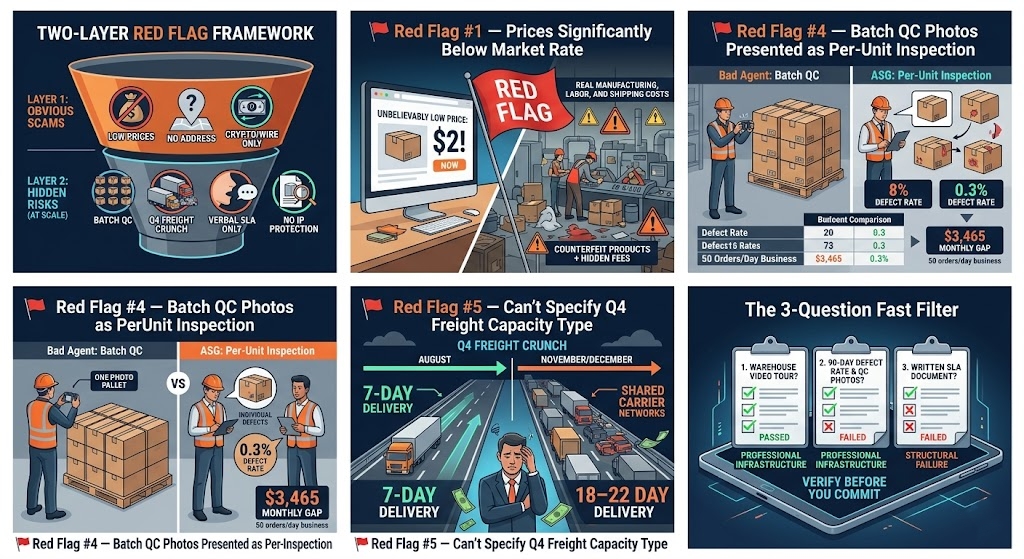
The two-layer red flag framework — Layer 1 filters obvious scams. Layer 2 filters the professional-looking agents whose structural failures only appear at scale. Most articles about dropshipping agent red flags teach you to spot scams. That’s useful — but it’s not what’s costing established sellers the most money. The agents who destroy businesses at scale aren’t the ones who disappear with your payment or ship obvious knockoffs. They’re the ones who look legitimate, communicate professionally, and perform acceptably — right up until you’re dependent on them.
I’ve processed 5M+ orders through our Dongguan and Shenzhen warehouses and documented 386 agent transitions in 2024. Here’s the complete red flag framework — both the obvious signals and the hidden ones that most sellers discover too late. Understanding what a legitimate dropshipping agent actually provides makes every red flag in this list easier to identify.
Table of Contents
- Layer 1 — The Obvious Red Flags
- Layer 2 — The Hidden Red Flags
- The 3-Question Fast Filter
- Final Thoughts
- FAQs
Layer 1 The Obvious Red Flags
The obvious red flags when choosing a dropshipping agent are: pricing significantly below market rate for equivalent products (legitimate suppliers must cover manufacturing, labor, QC, warehousing, and shipping — costs that don’t vanish and get transferred to you through defective products, counterfeit goods, or hidden charges), no verifiable physical business address on Google Maps showing a commercial or industrial facility, and non-standard payment requests including wire transfers, cryptocurrency, or offline payment methods that are untraceable and unrecoverable.
🚩 Red Flag #1 — Prices Significantly Below Market Rate
If a supplier offers unbelievably low prices, you’re likely looking at counterfeit products or unreliable sourcing — legitimate suppliers need to cover manufacturing, labor, and shipping, and real costs don’t vanish just because you’re dropshipping.
Pricing significantly below market rate tells you one of three things: the product is counterfeit or doesn’t match what your customers will see, the agent is absorbing the pricing gap to win your business and will recover it through shipping inflation or service degradation once you’re locked in, or sourcing corners are being cut in ways that appear in your defect rate rather than your invoice. If a deal seems too good to be true, it probably is — whenever products are priced significantly below market value, proceed with caution.
The benchmark: compare against CJ Dropshipping, 1688.com, and direct factory quotes. A professional private agent with factory-direct relationships should price 10–15% below equivalent platform pricing — not 40–60% below. Anything dramatically below factory-direct pricing requires explanation before you source a single unit.
🚩 Red Flag #2 — No Verifiable Physical Address
Legitimate suppliers usually provide a physical address, phone number, and professional email — the absence of verifiable contact information is often a calculated attempt to shield operations from scrutiny.
The three-minute verification process: take the address, search it on Google Maps, switch to Street View. A legitimate warehouse operation shows a commercial or industrial building with loading docks and infrastructure consistent with the claimed order volume. A residential address shows a house. A virtual office shows a shared office building — legitimate for some business registrations, but not consistent with a claim of operating 4 warehouses and processing 10,000 daily orders. Inconsistent information — where a claimed business location doesn’t match contact or shipping details — is a clear indicator of a fraudulent or misrepresented operation.
🚩 Red Flag #3 — Non-Standard Payment Requests
Suppliers requesting payment via wire transfer or cryptocurrency are likely trying to scam you — legitimate suppliers always provide secure payment options like credit cards or reputable online payment platforms. Wire transfers and cryptocurrency transactions are irreversible and untraceable. A legitimate agent company with genuine infrastructure has no reason to avoid payment channels with buyer protection. Legitimate dropshipping companies will not ask for payment upfront before you receive any products.
Acceptable payment methods: PayPal Business, credit card, Payoneer, and documented milestone-based structures for larger orders. Any agent insisting exclusively on wire transfer or cryptocurrency has structured the transaction to eliminate your ability to dispute problems after the fact.
Layer 2 The Hidden Red Flags That Kill Your Business at Scale
The hidden red flags when choosing a dropshipping agent are structural failures invisible during the sales process that compound into serious business damage once you’re dependent on the agent at scale: batch QC photos presented as per-unit inspection (the most common quality control deception — at 50 daily orders and $30 AOV, the difference between 0.3% per-unit inspection and 8% platform-average defect rate is $3,465/month in hidden costs).
Inability to specify Q4 freight capacity as pre-allocated dedicated freight (shared carrier networks expand from 7-day to 18–22 day delivery during November–December peak when your revenue is highest), verbal-only SLA commitments with no written document, and no formal NDA protecting your supplier relationships and sourcing data from competitors using the same agent network.
Red flags #1–#3 are what inexperienced sellers need to know. Red flags #4–#7 are what experienced sellers wish they’d known before committing live order volume to an agent who looked legitimate until they weren’t.
🚩 Red Flag #4 — Batch QC Photos Presented as Per-Unit Inspection
This is the most common quality control deception in dropshipping fulfillment — and the hardest to detect without knowing what to look for. Every agent says they inspect products. What most are calling “QC inspection” is a batch-level visual check — someone confirms nothing is obviously damaged and the order ships.
Per-unit inspection means each individual unit is physically handled, checked against the specific quality standard for that SKU, photographed from multiple angles with defects noted, and either approved or flagged for replacement.
The six-step protocol: receiving check, visual quality verification against product standard photos, functional testing, packaging integrity check, photo documentation per unit, final weight confirmation. That process produces 0.3% defect rate rather than 8%. For a full breakdown of what this protocol involves, see our guide on quality control in dropshipping.
The identification test: when you receive “QC photos,” check three things — are individual units photographed separately or in groups? Are unit identifiers (barcode labels, lot numbers) visible? Are any units shown with noted defects or flagged for replacement? Genuine per-unit inspection produces identifiable, traceable photos. Batch inspection produces warehouse floor shots where twenty units are visible but none identifiable.
| Volume | 8% Defect Rate | 0.3% Defect Rate | Monthly Gap |
| 30 orders/day, $30 AOV | $2,160 | $81 | $2,079 |
| 50 orders/day, $30 AOV | $3,600 | $135 | $3,465 |
| 100 orders/day, $30 AOV | $7,200 | $270 | $6,930 |
This gap appears in refund costs, chargeback fees, customer service labor ($3–$5 per contact), and review score suppression — never on any agent invoice.
The question that exposes this red flag:
“Can you send me QC photos from an order processed in the last 48 hours — specifically showing individual units with identifiers, not batch photos?”
An agent with genuine per-unit infrastructure answers immediately with exactly that.
🚩 Red Flag #5 — Can’t Specify Q4 Freight Capacity Type
This red flag is disguised as a delivery question. Ask any agent “what’s your average delivery time?” and they’ll say 5–10 days. That number is accurate for August. It tells you nothing about November.
Agents on shared carrier networks book freight on the spot market. In November, every Chinese manufacturer competes for the same carrier lanes simultaneously. Carriers prioritize premium express shipments. Shared lanes saturate. The agent delivering in 7 days in August delivers in 18–22 days in November — at the exact moment your Q4 revenue is highest. Our Q4 2024 performance: 23,000 daily orders at 97.3% on-time delivery through Black Friday — only possible because freight capacity was pre-allocated months in advance, not competing for spot capacity in November.
The question that exposes this red flag:
“Is your Q4 freight capacity pre-allocated dedicated freight, or do you use shared carrier networks? Can you name your specific freight partners and confirm they have capacity commitments for November?”
Vague answer (“we use multiple carriers depending on availability”) = shared network = Q4 collapse. No exception.
🚩 Red Flag #6 — Verbal-Only SLA With No Written Document
Every agent in the evaluation phase tells you they respond quickly and prioritize client communication. That statement costs nothing to make and commits them to nothing they’re accountable for. A written SLA specifies maximum response time by issue category, escalation protocols, holiday coverage, named backup contacts, and remediation terms if commitments are missed.
Always have service agreements documented — verbal commitments in business partnerships carry no enforceable weight when performance problems emerge. The consequence of verbal-only SLA compounds during Q4 peak and Chinese national holidays — Chinese New Year (7–10 days reduced operations) and Golden Week (October 1–7, directly before Q4 peak) — when agents without documented coverage commitments sometimes go effectively unreachable. ASG’s documented response SLA: under 20 minutes standard queries, 7×24 coverage including Chinese national holidays, named backup account manager for every client.
The question that exposes this red flag:
“Can you send me your standard SLA document?”
Professional company: document within one business day. Individual operator: verbal assurance repackaged as a paragraph that specifies nothing measurable.
🚩 Red Flag #7 — No NDA or IP Protection Documentation
This is the red flag that feels least urgent during evaluation and most damaging when you realize it matters. When you source through a shared platform or agent using a shared supplier pool, your winning product’s sourcing data flows through shared infrastructure. A competitor can source from the same factory through the same channel. There is no contractual mechanism preventing this without a written NDA.
A professional private agent with genuine IP protection documents your supplier relationships under written NDA, isolates sourcing data in client-specific systems, and has no contractual ability to share your supply chain with other clients. Spotting structural problems early requires looking for transparency — legitimate operations clearly document and verify every aspect of their service.
Three questions that verify IP protection:
1. “Do you provide a written NDA covering supplier relationships and sourcing data?”
2. “If I stop working with you, do supplier relationships transfer to me or stay with your company?”
3. “Do any current clients source from the same suppliers you’d use for my products?”
Clear answers to all three = genuine IP protection. Vague answers to #2 and avoidance of #3 = shared sourcing infrastructure.
Evaluating an agent and want to verify these four hidden criteria directly? ASG’s documented defect rate, Q4 freight capacity confirmation, written SLA, and NDA are all available before any order commitment. Start the verification here.
The 3-Question Fast Filter — Run This Before Anything Else
Three questions filter agents with structural red flags in under five minutes: “Can you send me your warehouse address and arrange a 15-minute video call tour?” (verifies physical infrastructure exists at claimed scale — a legitimate warehouse accommodates this within days), “What is your documented defect rate across all clients in the last 90 days, and can you send QC photos from this week showing individual unit identifiers?” (verifies per-unit inspection infrastructure and exposes batch QC deception), and “Can you send me your standard SLA document?” (professional company produces this within one business day — if it doesn’t exist, neither does the operational infrastructure it represents).
An agent who answers all three clearly within 24 hours has professional infrastructure. An agent who deflects, delays, or gives verbal answers to any of these three is showing you their operational reality before you commit a dollar.
Question 1 — Warehouse Address and Video Tour
“Can you send me your warehouse address and arrange a 15-minute video call tour of the facility?” This simultaneously verifies physical infrastructure at claimed scale, address consistency with manufacturing hubs (Dongguan, Shenzhen, Guangzhou, Yiwu), and operational confidence. Real discussions in Reddit communities and Facebook seller groups reveal more about suppliers than any testimonial page — legitimate suppliers are easy to research with clear, verifiable contact details.
Responses that trigger concern: “We can send photos but don’t do video calls” (removes real-time verification, since photos can be staged), “Our warehouse is currently under renovation” (a perpetually inconvenient answer experienced sellers recognize immediately), and any delay beyond two weeks to arrange a 15-minute call.
Question 2 — Documented Defect Rate With Photo Evidence
“What is your documented defect rate across all clients in the last 90 days, and can you send QC photos from orders processed this week showing individual unit identifiers?” Dishonest suppliers send high-quality samples to win your business but ship inferior products to customers — always order samples using different names and addresses to ensure you’re not receiving better-quality variations than your customers get.
A genuine per-unit inspection process catches defects — the photos should occasionally show you what a flagged unit looks like. An agent who can only show perfect product photos hasn’t shown you evidence of an inspection process. They’ve shown you product selection. Real inspection produces photos of rejections alongside approvals.
Question 3 — Written SLA Document
“Can you send me your standard SLA document?” The response time and format of the answer reveals more than its content. A professional agent company has this document ready because they’ve been making these commitments with multiple clients. It arrives within one business day with measurable commitments: maximum response time for standard and urgent queries separately, escalation protocol, holiday coverage with named backup contacts, and remediation terms.
The Pre-Payment Behavior Test
Beyond the three questions: measure how communication changes between before and after your first payment. The concerning pattern — extremely fast pre-payment responses during evaluation, gradual deceleration after the test order payment, noticeably longer windows once you’re running live volume. Pre-payment communication speed is always the best-case scenario. The trajectory after payment is the operational reality.
386 sellers who transitioned from agents with these structural red flags saw: defect rate 7.8% → 1.5% within 60 days, delivery time 18–25 days → 5–8 days, customer service contacts down 60–70% in the first billing cycle. Average ROI recovery: 11 days.
Final Thoughts
Red flags #1–#3 filter obvious scams in 10 minutes. Any one of them ends the evaluation immediately — they’re fast to check and unambiguous when present.
Red flags #4–#7 require specific questions and specific evidence. Batch QC photos disguised as per-unit inspection, inability to specify Q4 freight capacity, verbal-only SLA, and no NDA don’t present as obvious warning signs — they present as normal business communication from an agent who sounds professional. The only way to surface them is asking directly and evaluating the specificity of the answers.
The agents who cause the most damage to dropshipping businesses aren’t the obvious scams. They’re the professional-sounding operators with functional websites and smooth communication who have never built the infrastructure their marketing implies. They perform fine at 20 daily orders. They fail systematically at 100.
The 3-question filter and 2-week test protocol together cost $100–$200 and two weeks. They surface every one of the seven red flags before you’ve committed live order volume. Not running them costs months of review damage, compounding defect costs, and a Q4 delivery collapse when your revenue is highest.
All ASG operational data reflects documented Q1 2026 records. Third-party source data from SuperDS, AutoDS, TrueProfit, Chargebacks911, and Dropship.io current as of April 2026.

About the Author
Janson — Founder & CEO, ASG Dropshipping
8 years in cross-border dropshipping. 200-person team, 4 warehouses in Dongguan and Shenzhen, 2,300+ vetted factories, 5M+ orders processed. The two-layer red flag framework comes from 386 documented agent transitions in 2024.
Outside the warehouse: rock singer and guitarist.
Frequently Asked Questions
What are the red flags of a dropshipping agent?
Red flags fall into two layers. Obvious: pricing significantly below market rate (real costs transfer to you through defects or hidden fees), no verifiable physical address on Google Maps, and payment requests via wire transfer or cryptocurrency. Hidden — the ones most guides miss: batch QC photos presented as per-unit inspection (difference between 0.3% and 8% defect rates is $3,465/month at 50 daily orders and $30 AOV), inability to specify Q4 freight capacity type (shared networks expand from 7 days to 18–22 days in November), verbal-only SLA with no written document, and no formal NDA protecting supplier relationships from competitors on the same agent network. Understanding what a professional dropshipping agent provides makes every red flag easier to identify.
How do you know if a dropshipping agent is legit?
Five verification steps: verify warehouse address on Google Maps shows a commercial facility at consistent scale, request a 15-minute video call facility tour (any legitimate operation accommodates this within days), ask for 90-day documented defect rate with per-unit QC photos showing individual unit identifiers, request written SLA document (professional company produces within one business day), and run a 20–30 unit test order with QC photo documentation request within 72 hours.
Any agent who declines or delays on the warehouse tour or QC photos has an infrastructure gap regardless of what their website says. The complete evaluation framework covers all five criteria with pass/fail benchmarks.
What questions reveal a fake dropshipping agent?
Four questions expose fake or structurally deficient agents: “What is your documented defect rate across all clients in the last 90 days?” — legitimate agent provides data, fake provides claims. “Can you send QC photos from this week showing individual unit identifiers?” — per-unit inspection produces identifiable photos, batch inspection produces warehouse shots. “Is your Q4 freight capacity pre-allocated or shared carrier networks?” — agents with genuine Q4 infrastructure answer with specifics, spot-market shippers give vague answers.
“Can you send your written SLA document?” — professional companies produce within one business day. Agents who deflect or answer vaguely to any of these four are showing you their operational reality.
Can dropshipping agents steal your products?
Agents without NDA and IP protection can expose your winning product’s supplier relationships to competitors — not through deliberate theft but through shared supplier infrastructure. When you source through a shared platform or agent using a shared supplier pool, competitors can identify and access the same factory through the same channel. There’s no contractual mechanism preventing this without a written NDA. Ask directly: “If I leave your service, do supplier relationships transfer to me or stay with you?” Any professional private agent with genuine IP protection answers this clearly with supporting documentation.
What are signs of a bad dropshipping supplier vs a bad agent?
A bad supplier fails at the product level: inconsistent manufacturing quality, frequent stockouts, slow fulfillment, unreliable availability communication. A bad agent fails at the infrastructure level: inadequate QC letting defective products through, shared carrier networks collapsing in Q4, no written SLA, and no IP protection for your supplier relationships. The critical distinction: a bad supplier problem affects one product; a bad agent problem affects your entire catalog simultaneously. Dedicated per-unit quality control is the primary mechanism separating a professional agent from both a bad supplier and a batch-inspection agent at platform-average defect rates.
How do I avoid getting scammed by a dropshipping agent?
Three parallel verification steps: identity verification (warehouse address confirmed on Google Maps at commercial scale, video call facility tour completed, business registration documentation provided), performance verification (90-day defect rate with per-unit QC photos, actual delivery time measured on test units shipped to real address, communication response time measured during test period), and contractual verification (written SLA with measurable commitments, written NDA covering supplier relationships and data isolation). Financial protection: use only traceable payment methods — PayPal Business, credit card, or Payoneer — never wire transfers or cryptocurrency for any payment before verified performance.
Why do dropshipping agents fail at scale?
Four structural reasons: bandwidth ceiling (individual operators hit limits at 50–100 daily orders as manual processes can’t parallelize), Q4 freight capacity (shared carrier networks have no contracted November capacity — 7-day delivery becomes 18–22 days during peak), QC infrastructure (batch inspection producing 8% defect rates costs thousands per month at scale that 0.3% per-unit inspection doesn’t), and documentation absence (no written SLA or NDA means no accountability structure when problems emerge). These failure modes are predictable before you commit — the agent selection guide addresses each one with specific evaluation criteria.
How do I verify a dropshipping agent is real?
Four verification methods: Google Maps verification of warehouse address showing commercial or industrial facility at scale, 15-minute video call facility tour (real operations accommodate within days — repeated delays are a red flag), business registration documentation matching company name and address, and independent reputation research (Trustpilot, Reddit searches for company name plus “review” and “complaint,” Facebook seller groups). Most reliable: 20–30 unit test order with per-unit QC photo documentation request within 72 hours — an agent with genuine inspection infrastructure delivers exactly this. An agent whose documentation doesn’t survive this test has told you what you need to know before committing live volume.
Article written: April 9, 2026 | Workflow: asg-seo-writer 21-Step + geo-optimizer v1.0


 Optimized by Seraphinite Accelerator